




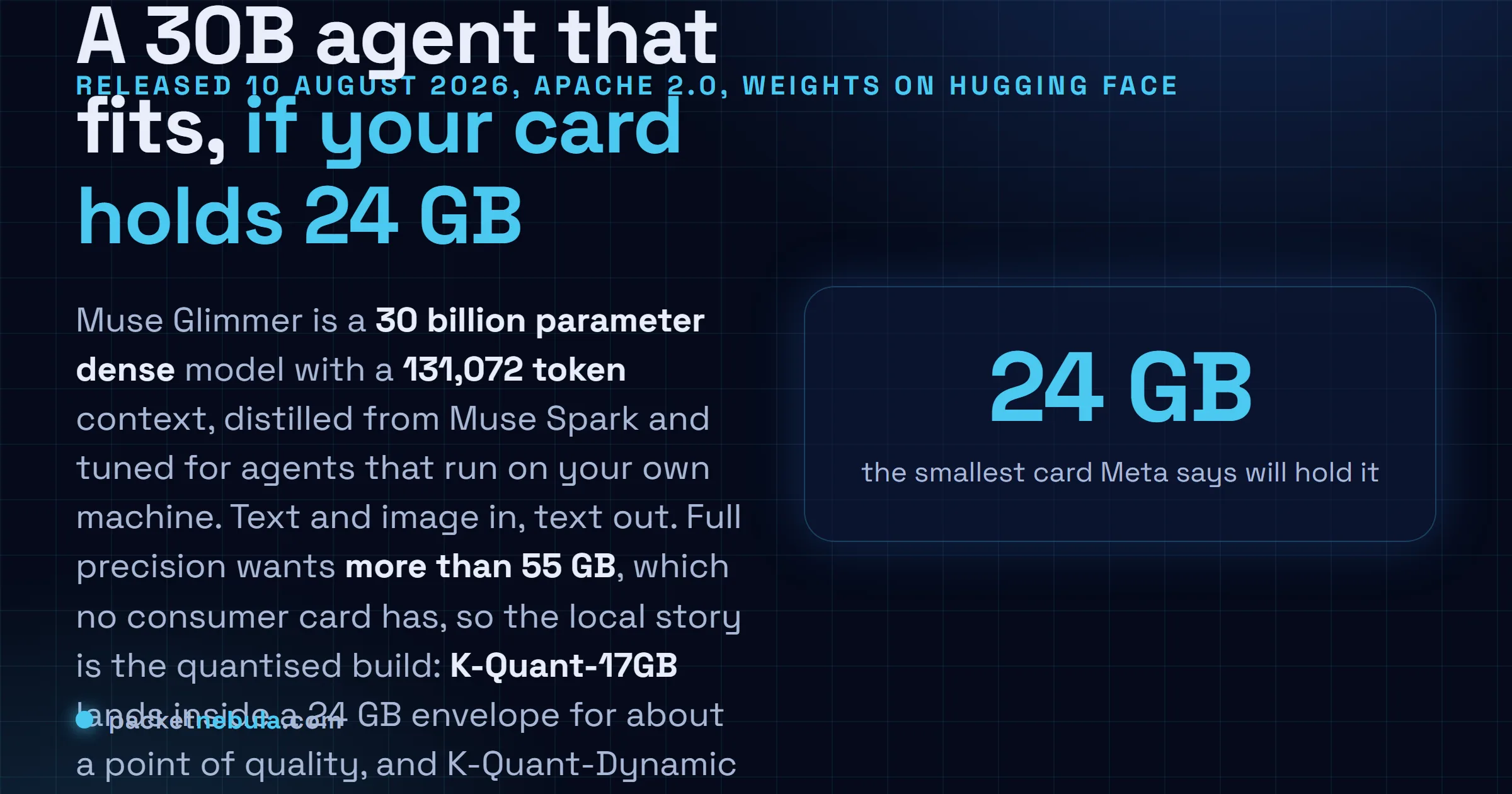
Your card holds 24 GB, or it doesn't. That one number decides whether today's Meta release is something you'll actually run or just something you'll read about. Muse Glimmer went up on 10 August: 30 billion parameters, dense, Apache 2.0, weights already on Hugging Face. It's built for agents that sit on your own machine and keep working without a round trip to anyone's API. Meta's pitch is that it fits on a single consumer GPU, and that's true at 4-bit, in a 17 GB build that costs about a point of quality. What it won't do is hit the throughput figure most of the coverage quoted. That number was measured somewhere else entirely.
The short answer
Meta Superintelligence Labs released Muse Glimmer on 10 August 2026, a 30 billion parameter dense agentic model with a 131,072 token context, distilled from Muse Spark and licensed under plain Apache 2.0. Full precision wants more than 55 GB of memory. The K-Quant-17GB build fits a 24 GB card for about a point of quality, which is what makes the local story real. It leads its size class on tool calling by a wide margin and loses to the smaller Qwen3.6-27B on straight coding.
What Meta actually shipped
A dense 30B, not a mixture of experts. That’s worth pausing on, because most releases at this size lately have gone the sparse route to keep active parameters down. Glimmer didn’t.
Under the hood it’s a causal transformer with grouped query attention, 32 query heads against 2 KV heads, and an attention pattern that runs three local layers to one global with a 2,048 token sliding window. RoPE goes on the local layers only. There’s a separate perception encoder of around 1.8B on top, a ViT-G/14, which is where the image input comes from. Context is 131,072 and the vocabulary is 202,048 tokens.
Training went in three passes: logit distillation from Muse Spark during pretraining, then longer context agent data, then supervised fine-tuning mixed with on-policy distillation and reinforcement learning. So Glimmer is the small sibling of a model Meta already sells access to, which we covered when the Muse Spark 1.2 contributor tier landed.
Image: Meta
The licence deserves its own sentence. Apache 2.0, no user threshold, no bespoke acceptable use policy stapled to the side. Meta has spent years shipping open weights under terms that made lawyers nervous, and this one just doesn’t. Compare that to the licence gymnastics we walked through on MiniMax H3’s excluded territories and it’s a real change.
The memory floor, honestly
Here’s where “runs on a single consumer GPU” needs unpacking.
Full precision is over 55 GB. Nothing you can buy at retail holds that. So every local deployment is a quantised one, and Meta ships two tiers: K-Quant-Dynamic, which wants 32 GB and costs about 0.2%, and K-Quant-17GB, which lands inside a 24 GB envelope for roughly 1.0%. Compressed weights come in near 4-bit with the language model under 20 GB.
Which means the entry ticket is a 24 GB card. A 4090, a 5090, a 32 GB workstation part, or Apple silicon with enough unified memory. If you’re on 16 GB, and plenty of people are, the 17 GB build doesn’t fit and there’s no smaller official option. That’s not a knock, it’s just the actual gate, and most coverage skipped straight past it.
About that 20,000 tokens per second
This is the part that annoyed us.
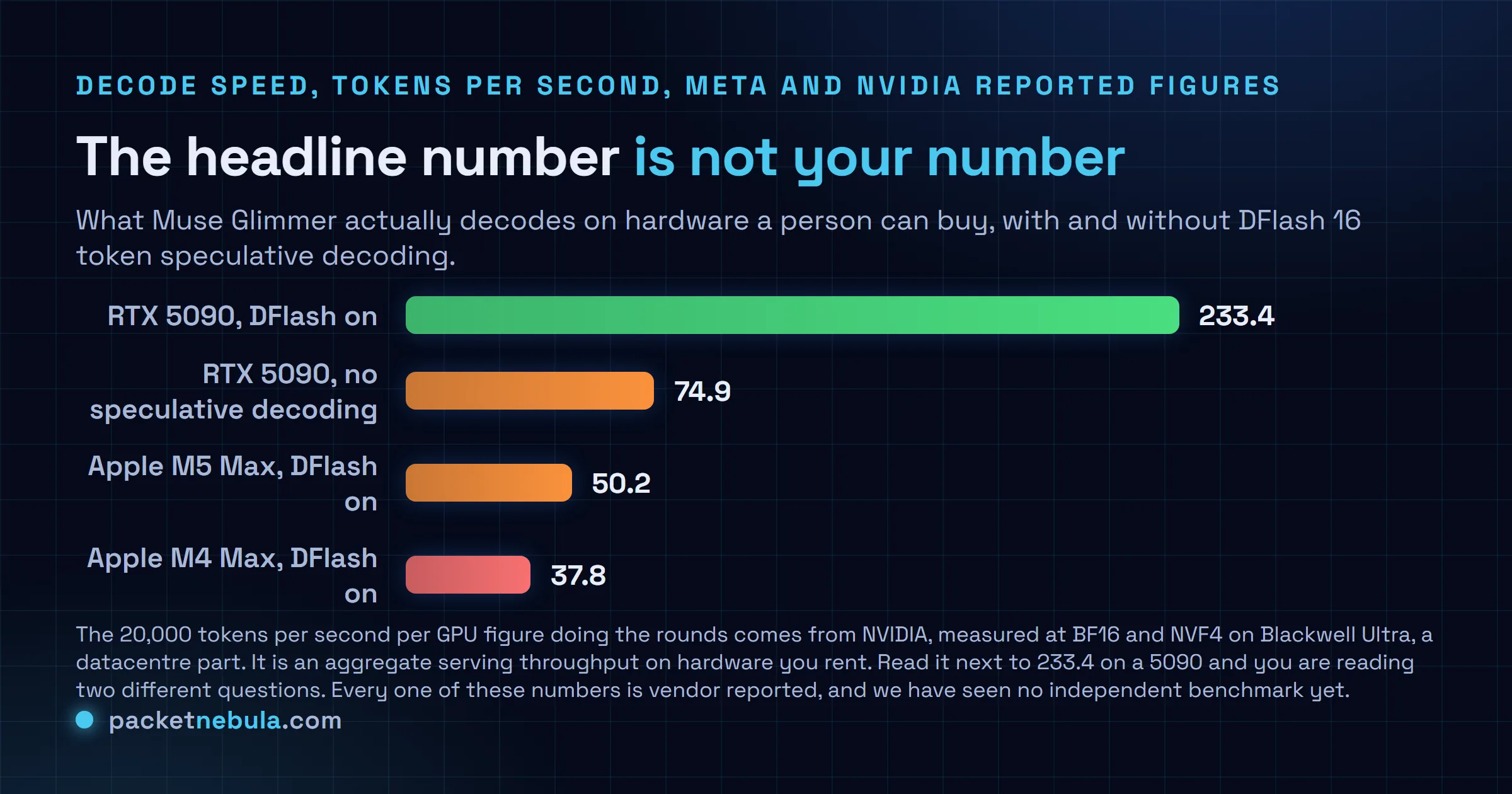
NVIDIA’s post puts Glimmer at over 20,000 tokens per second per GPU at BF16 and NVF4. On Blackwell Ultra. That’s a datacentre accelerator, and the figure is aggregate serving throughput across concurrent requests, not the speed at which one agent thinks.
What you get locally, on Meta’s own numbers, is 233.4 tokens per second on an RTX 5090 with DFlash 16 token speculative decoding enabled, and 74.9 without. The speculative decoding is doing most of the work there, a 3.1x multiplier. Apple fares less well: 50.2 on an M5 Max against 26.6 baseline, 37.8 on an M4 Max against 23.7.
Honestly, 233 tokens per second for a local agent is fine. Better than fine. The problem isn’t the speed, it’s that two numbers got printed next to each other in a lot of write-ups as though they described the same machine.
Where it wins and where it doesn’t
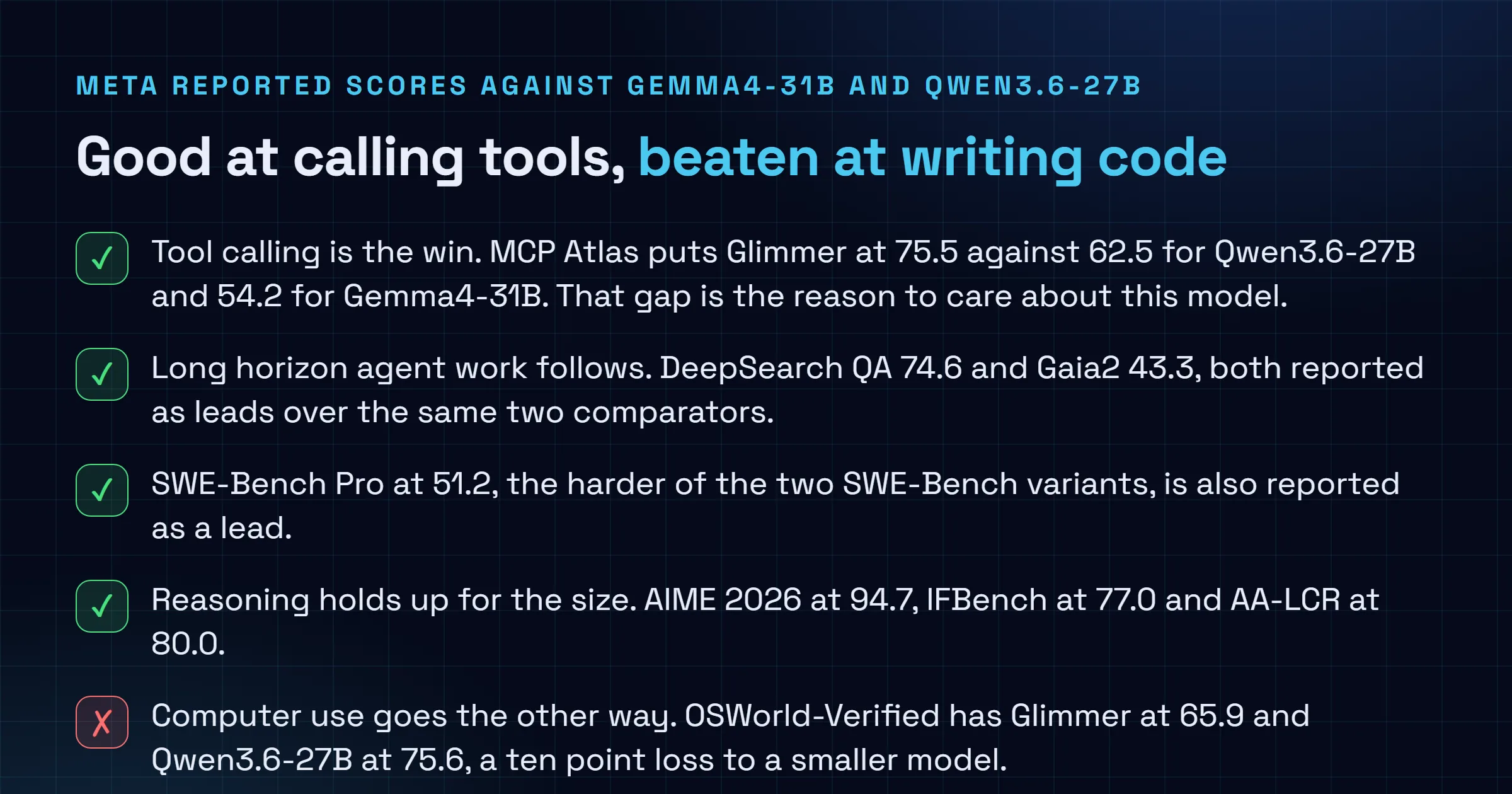
The tool calling gap is the story. MCP Atlas has Glimmer at 75.5 against 62.5 for Qwen3.6-27B and 54.2 for Gemma4-31B. Twelve points over the nearest comparator on the benchmark that most closely resembles what an agent does all day. DeepSearch QA at 74.6 and Gaia2 at 43.3 point the same way. Reasoning is strong for the class too, AIME 2026 at 94.7.
Then it loses at coding. Qwen3.6-27B, a smaller model, is ahead on SWE-Bench Verified at 77.2 and TerminalBench 2.1 at 60.7, and takes OSWorld-Verified 75.6 to 65.9. Glimmer does lead SWE-Bench Pro at 51.2, which is the harder variant, so the picture isn’t clean. We’re not sure what to make of that split yet, and I’d want independent numbers before building a workflow on it. It’s the same tension we picked apart when a 276B model beat its own 975B parent at coding while collapsing on recall.
Every one of these figures is Meta, running Meta’s harness, on release day. Nobody has replicated any of it.
So who should take it
If you’re building something that calls tools in a loop on a 24 GB card, this is now the obvious local default, and the licence removes the usual reason to hesitate. Always-on agents are exactly the shape it was trained for, and 100-plus languages plus image input widen that further.
If you mostly want a model to write code, look at Qwen3.6-27B first on these numbers.
Two caveats before you wire it into anything with reach. The knowledge cutoff is 4 January 2026, so recency has to come through tools. And Meta’s own Siren AgentDojo result is 94.2 utility with a 28.4 attack success rate under prompt injection, which for an always-on local agent holding your filesystem is the number I’d think about hardest. Scope its permissions like you would any process that reads untrusted text.
Sources
Meta’s announcement is on the Meta research blog, with the model page at developer.meta.com and weights in the Hugging Face collection. The Blackwell Ultra throughput figure comes from NVIDIA’s developer blog. Architecture and benchmark detail cross-checked against MarkTechPost and Phoronix, which notes Ollama support from 0.32.7.
Frequently asked questions
What GPU do I actually need to run Muse Glimmer?
A 24 GB card is the realistic floor, and that means the K-Quant-17GB build, which Meta puts at roughly 1.0% degradation against full precision. If you have 32 GB, take K-Quant-Dynamic instead at about 0.2%. Full precision needs more than 55 GB, so no consumer card runs it unquantised. Apple silicon works through the same quantised builds, and Meta reports figures on M4 Max and M5 Max. A 16 GB card will not hold the 17 GB build, which rules out most of the installed base.
Is Muse Glimmer really Apache 2.0?
Yes, and that is the genuinely notable part. Meta shipped it under a plain Apache 2.0 licence rather than the bespoke community licence its earlier model families carried, which means commercial use without a user count threshold and without an acceptable use policy bolted on. Weights are on Hugging Face in BF16, GGUF k-quants and ExecuTorch builds. Ollama added support in 0.32.7, and Meta says llama.cpp, MLX and ExecuTorch integrations land in the coming days.
How fast is it on a machine I own?
Meta reports 233.4 tokens per second on an RTX 5090 with DFlash 16 token speculative decoding, up from 74.9 without it. An M5 Max does 50.2 against 26.6, and an M4 Max 37.8 against 23.7. The 20,000 tokens per second per GPU number in circulation is NVIDIA's, measured on Blackwell Ultra, a datacentre part, and it describes aggregate serving throughput rather than the speed of one conversation. Both numbers are real. They answer different questions.
Should I pick Muse Glimmer or Qwen3.6-27B for a local coding agent?
On Meta's own scores, split it by what the agent spends its time doing. If the work is calling tools and chaining steps, Glimmer leads clearly, 75.5 against 62.5 on MCP Atlas. If the work is writing and fixing code directly, Qwen3.6-27B is ahead on SWE-Bench Verified at 77.2 and TerminalBench 2.1 at 60.7, and ahead by ten points on OSWorld-Verified. A smaller model beating a larger one on coding is not the usual shape, which is why we would run both before committing.
What are the real limits to know before deploying it?
Three things we would check first. The knowledge cutoff is 4 January 2026, so anything recent has to arrive through tools rather than from the weights. It takes text and images in and returns text only, with no audio or video. And on Siren AgentDojo, Meta reports a 28.4 prompt injection attack success rate alongside 94.2 utility, which is the figure that should shape how much filesystem and network reach you hand an always-on local agent.