




A fridge-sized box, four TPUs, and roughly the power budget of a hair dryer. That's Google's first Project Suncatcher satellite, called MVP, and it's due up on SpaceX's Transporter-18 rideshare, reported for 1 October 2026. It won't serve anyone. It's there to find out whether data-centre AI chips survive the ride up, and then a vacuum where fans do nothing. We've read Google's post, the November 2025 paper behind it and the launch coverage, and the interesting number isn't the TPU count. It's how long they can run before they have to stop and cool.
The short answer
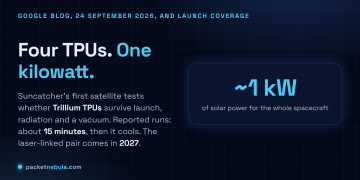
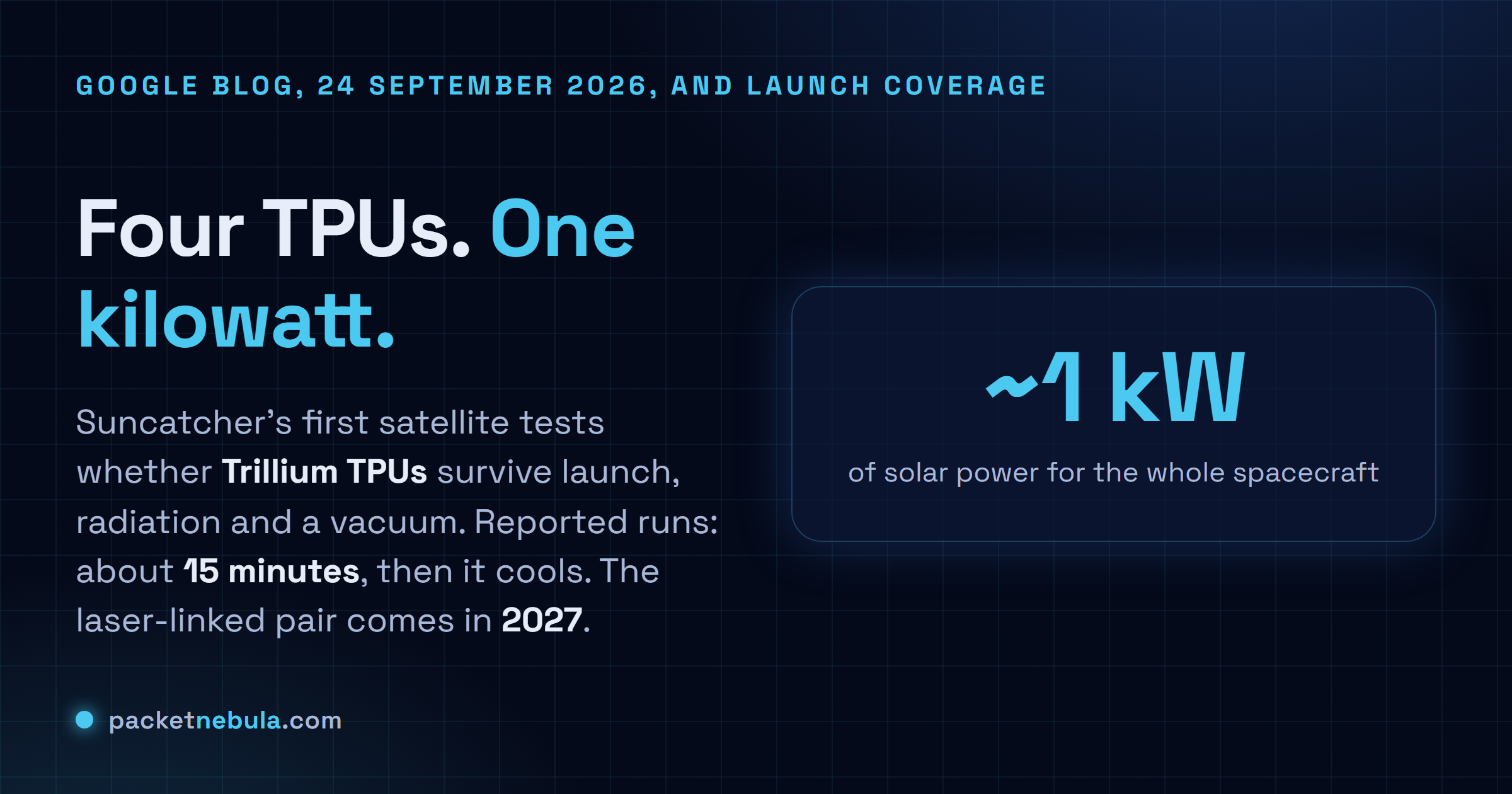
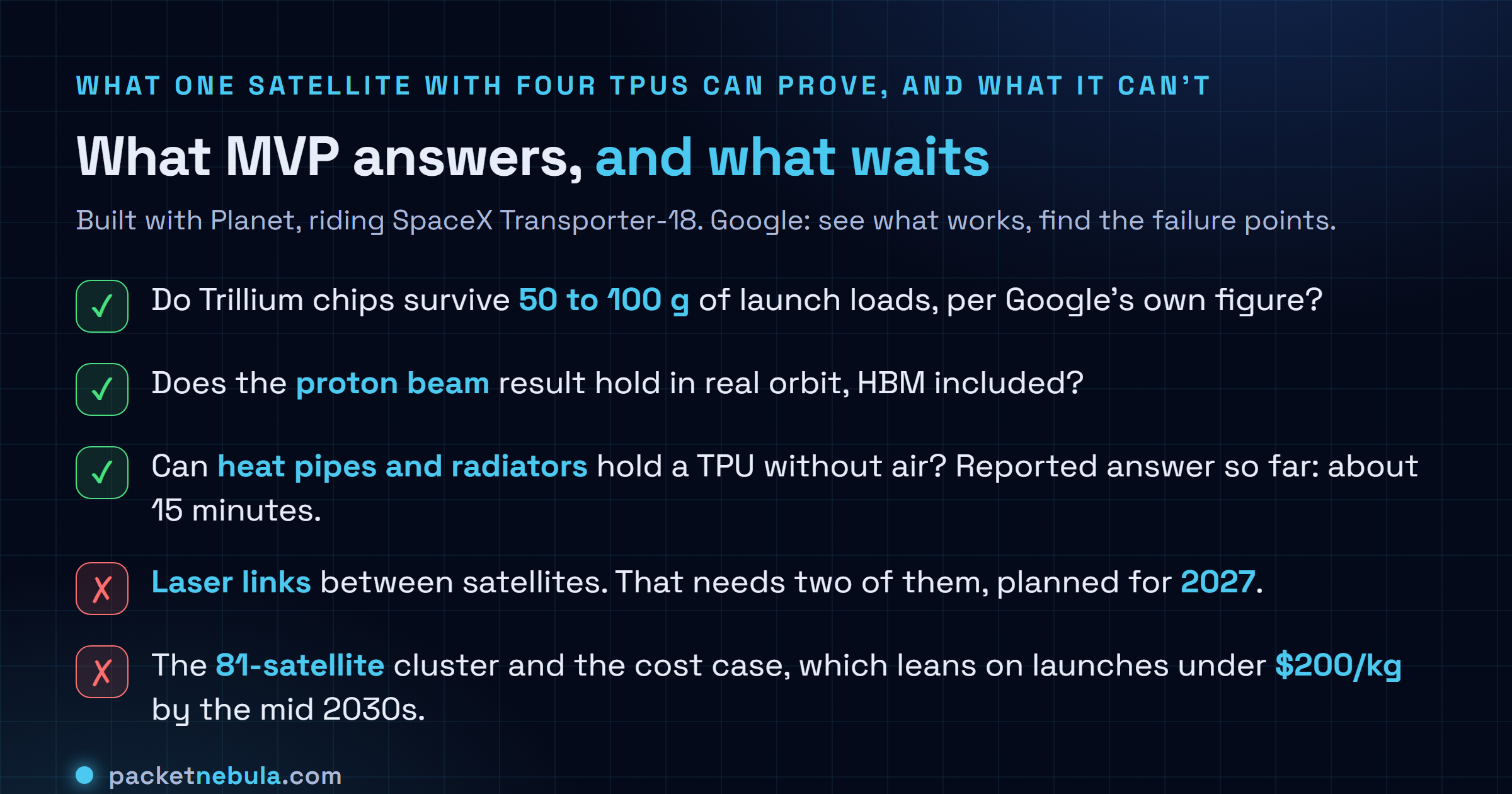
Google's Suncatcher MVP satellite, built with Planet, carries four Trillium TPUs on about 1 kW of solar power and is scheduled to fly on SpaceX Transporter-18, reported for 1 October 2026. Google's own post (24 September) says the mission gathers data on how the chips cope with launch stress and with space itself. Coverage quoting Google's Travis Beals says the chips will answer short Gemini queries and can run for about 15 minutes before shutting down to cool. Laser links between satellites wait for a two-satellite test in 2027. Nothing here is a service you can use, and the cost case still depends on launch prices Google itself dates to the mid 2030s.
What actually goes up on Transporter-18
Google's post, written by Travis Beals, doesn't give a chip count or a wattage. It says the mission rides "the upcoming Transporter-18 rideshare mission with SpaceX", that it was developed with Planet, and that it's meant to gather in-orbit data on how the TPUs handle spaceflight. The specifics come from the reporting around it. SiliconANGLE and Converge Digest both put four TPUs on board and about a kilowatt of solar generation. Beals told The New York Times, as relayed by several outlets, that the chips can run for about 15 minutes before they need to shut down and cool, and that they'll answer simple Gemini queries. The 1 October date is the press's, not Google's. Google's post just says "upcoming". Rideshare manifests slip all the time, so we wouldn't set a calendar alert.
A kilowatt. For comparison, a single current eight-GPU server can pull more than ten times that on its own, and the 460 MW Anthropic bought from Nscale is 460,000 of them. So nobody's offloading inference to orbit next year. The hard part is heat. There's no air, so nothing convects. Google says it's using heat pipes and radiators to move heat from the chips into space, and the 15-minute figure tells you where that stands: the radiators can't keep up with four TPUs at full tilt, so the thing works in bursts. Honestly, that's the most useful data point in the whole story, because it's the one the paper couldn't settle on a bench.
Launch is the other test. Google's post says individual components like the TPU chips "can experience even greater forces up to 50 to 100 g". Some coverage quotes a lower figure for the rocket as a whole, which is the overall load, not what a board-mounted chip sees. We'd trust Google's number here, it's their hardware.
The radiation result, and why the memory's the weak spot
This part's older than the launch. In November 2025 Google Research put a Trillium v6e Cloud TPU in a 67 MeV proton beam at UC Davis. The paper's numbers are specific. A five-year mission in a shielded low Earth orbit should add up to about 750 rad(Si). The chip logic took up to 15 krad(Si) on a single chip with no hard failures, which is twenty times that. The HBM didn't do as well: irregularities started at 2 krad(Si). That's still about 2.7 times the five-year dose. It's the tightest margin in the design, though, and it's the memory, not the compute.
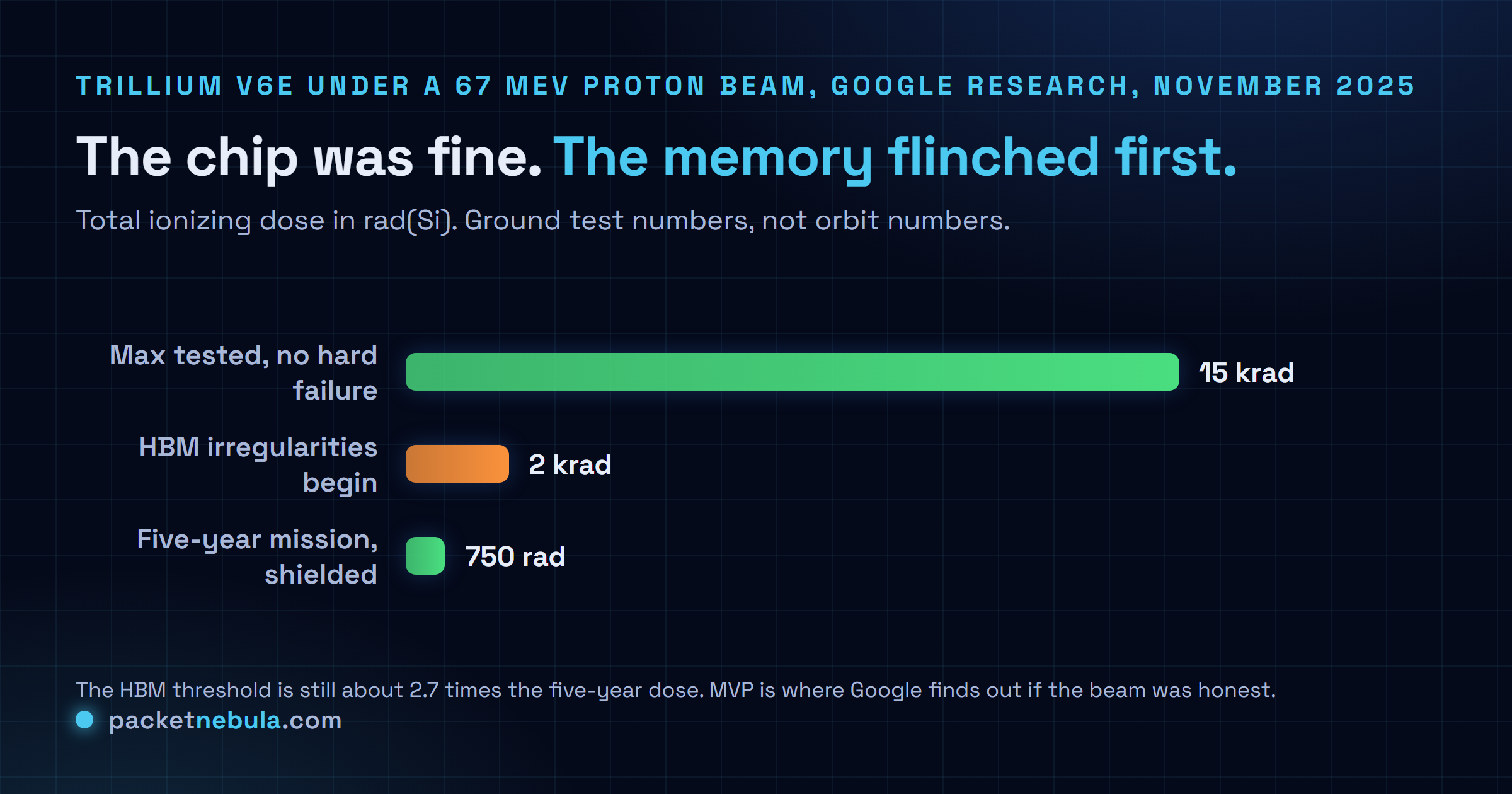
A beam isn't orbit, though. A proton accelerator gives you a clean, fast dose of one particle type at one energy. Orbit gives you a slow mix, with the occasional heavy ion, over months. Google's September post only says the Trillium chips "hold up remarkably well" and can survive a dose greater than a five-year mission's. That's the beam result restated. The orbital data is what MVP's for. If HBM errors show up early in flight, the design needs more shielding or a different memory strategy, and both cost mass, which costs launch money. I might be wrong, but we'd bet the memory telemetry is the first thing Google's engineers look at every pass.
From one satellite to 81, and the dates that moved
The long-term picture in the 2025 paper is a cluster of 81 satellites flying within a 1 km radius, 100 to 200 metres apart, at about 650 km in a sun-synchronous orbit where the panels see near-constant sun and can be up to eight times more productive than on the ground. They'd talk over free-space optical links. Google's bench demo managed 800 Gbps each way, 1.6 Tbps total, with one transceiver pair. The economics lean on launch prices falling below $200 per kilogram by the mid 2030s. That's Google's projection, not a quote from any launch provider.
What's changed is the order. Back then the plan was "two prototype satellites by early 2027", with Planet. Now there's a single survival test first, in 2026, and the two-satellite laser link experiment is still pencilled for 2027. We read that as caution, and it's sensible: why fly an expensive optical pair before you know the chips live? For anyone running infrastructure today, none of this changes a procurement plan. It's worth watching for one reason. If HBM holds and the 15 minutes stretch, the argument that power, not chips, caps AI build-outs gets a strange new answer. If they don't, this stays a research line for a good while.
Sources
Travis Beals, Google, Behind Project Suncatcher, our moonshot to put AI in space, 24 September 2026 (Transporter-18, Planet, the 50 to 100 g figure, heat pipes and radiators, the Trillium radiation line, two satellites in 2027). Google Research, Exploring a space-based, scalable AI infrastructure system design, 4 November 2025 (81 satellites, 1 km, 650 km, 1.6 Tbps, the 67 MeV test with 750 rad, 2 krad and 15 krad, the $200/kg projection, the original early 2027 prototype plan). SiliconANGLE, Google's first Project Suncatcher AI satellite set to blast off into orbit next week, 24 September 2026 (four TPUs, about 1 kW, 15-minute bursts, the 1 October date). Converge Digest, Google accelerates Project Suncatcher with first orbital TPU test, September 2026 (Falcon 9 from Vandenberg, Gemini workloads).
Frequently asked questions
When does Google's first Suncatcher satellite launch?
Coverage published on 24 September 2026 gives 1 October 2026, on SpaceX's Transporter-18 rideshare from Vandenberg. Google's own post only says "the upcoming Transporter-18 rideshare mission". Rideshare dates often move by days or weeks, so treat 1 October as the current target, not a fixed date.
How many TPUs are on the MVP satellite, and which ones?
Four, according to SiliconANGLE, Converge Digest and the New York Times reporting they cite. Google's post doesn't give the count. The radiation testing Google describes was done on Trillium, its sixth-generation TPU (v6e in the 2025 paper).
Can you run anything on it?
No. It's an experiment, not a cloud region. Reporting says the chips will answer short Gemini queries in bursts of about 15 minutes before shutting down to cool, which is enough to measure behaviour, not to serve users.
What's the next Suncatcher milestone?
Two satellites in orbit in 2027 to test laser communication between them, per Google's September 2026 post. The 81-satellite cluster described in the 2025 paper has no date, and its cost case assumes launches under $200 per kilogram by the mid 2030s.