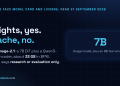





In July we wrote that Qwen-Image-3.0 was a hosted demo with no weights and no numbers, and that the whole reason anyone cared about this model line was that you could run it yourself. On 20 September 2026 the Qwen team put files back on Hugging Face. Qwen-Image-2.1 is a 7B diffusion transformer with a Qwen3-VL 8B text encoder and an RGBA autoencoder, about 33 GB in BF16, and it does text-to-image and editing in one checkpoint. So the download's back. The Apache 2.0 licence that came with Qwen-Image 1.0 isn't, and that's the part we'd read before pulling 33 GB.
The short answer
Qwen-Image-2.1 shipped on 20 September 2026 with open weights on Hugging Face and ModelScope: a 7B single-stream DiT (32 layers), a Qwen3-VL 8B encoder and a 64-channel RGBA VAE with 16x compression, native 2K output, up to 10 reference images and real transparent PNGs. Diffusers, ComfyUI, vLLM-Omni, SGLang and LightX2V supported it on day zero. The licence is the Qwen Research License Agreement: "research or evaluation purposes only", with commercial use by a separate licence you request by email. Every earlier Qwen-Image release with weights was Apache 2.0. There's no benchmark table in the model card or README, and no independent test yet.
What's actually in the 33 GB
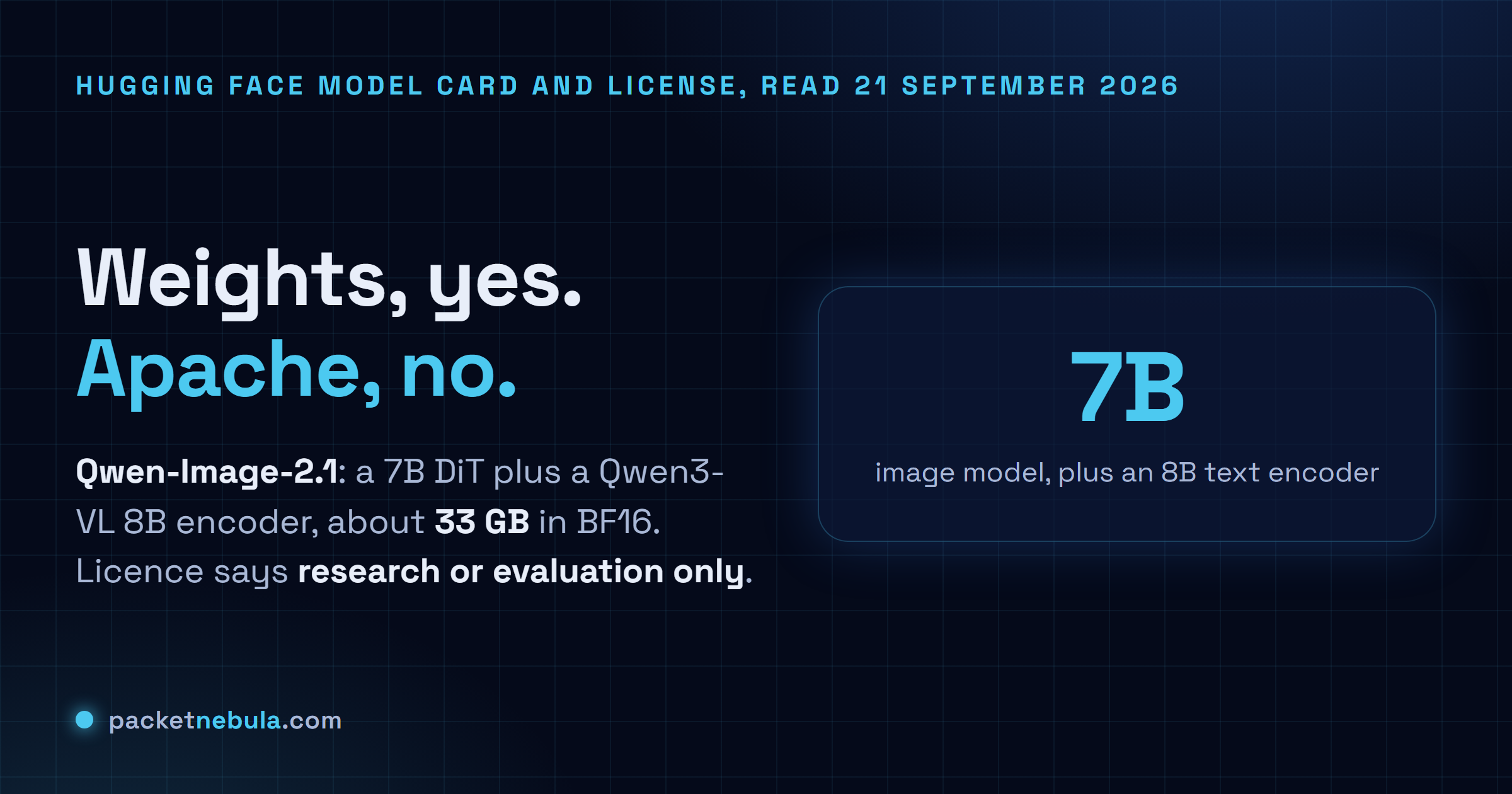
Three parts, and the biggest one isn't the image model. The transformer is 7B parameters in 32 single-stream DiT layers, 14.2 GB in BF16 across two safetensors shards. The text encoder is a full Qwen3-VL 8B, 36 layers with a vision tower, and it's 17.5 GB on its own. It does double duty: it reads your prompt and it encodes the reference images you pass in, so there's no separate image encoder. Then a 1.35 GB VAE with a 64-channel latent, 16x spatial compression and four input channels, which is how the alpha channel gets in and out without a matting step. Add it up and you're at roughly 33 GB before you've generated anything.
For scale, the transformer in Qwen-Image 1.0 was 20B and 40.9 GB by itself. This one's a third of that. The Comfy-Org repack goes further: an INT8 transformer at 7.3 GB, an INT8 encoder at 9.4 GB or a W4A8 encoder at 6.3 GB, and a 0.7 GB VAE. Pick the small ones and the whole thing sits around 14 GB on disk. Disk isn't VRAM, though. The vLLM-Omni recipe measured 34 GB peak in BF16 at 1024x1024 and 40 steps on a single data-centre GPU, and 3.3 to 4.5 seconds an image at that size. Qwen's blog says a 3090 will run it (that's a 24 GB card, so with offload), and Diffusers ships enable_model_cpu_offload() for exactly that. One early reviewer reported about 13.9 GB peak on a 16 GB card at 1024 square with offload. We haven't reproduced that, so treat it as one data point.
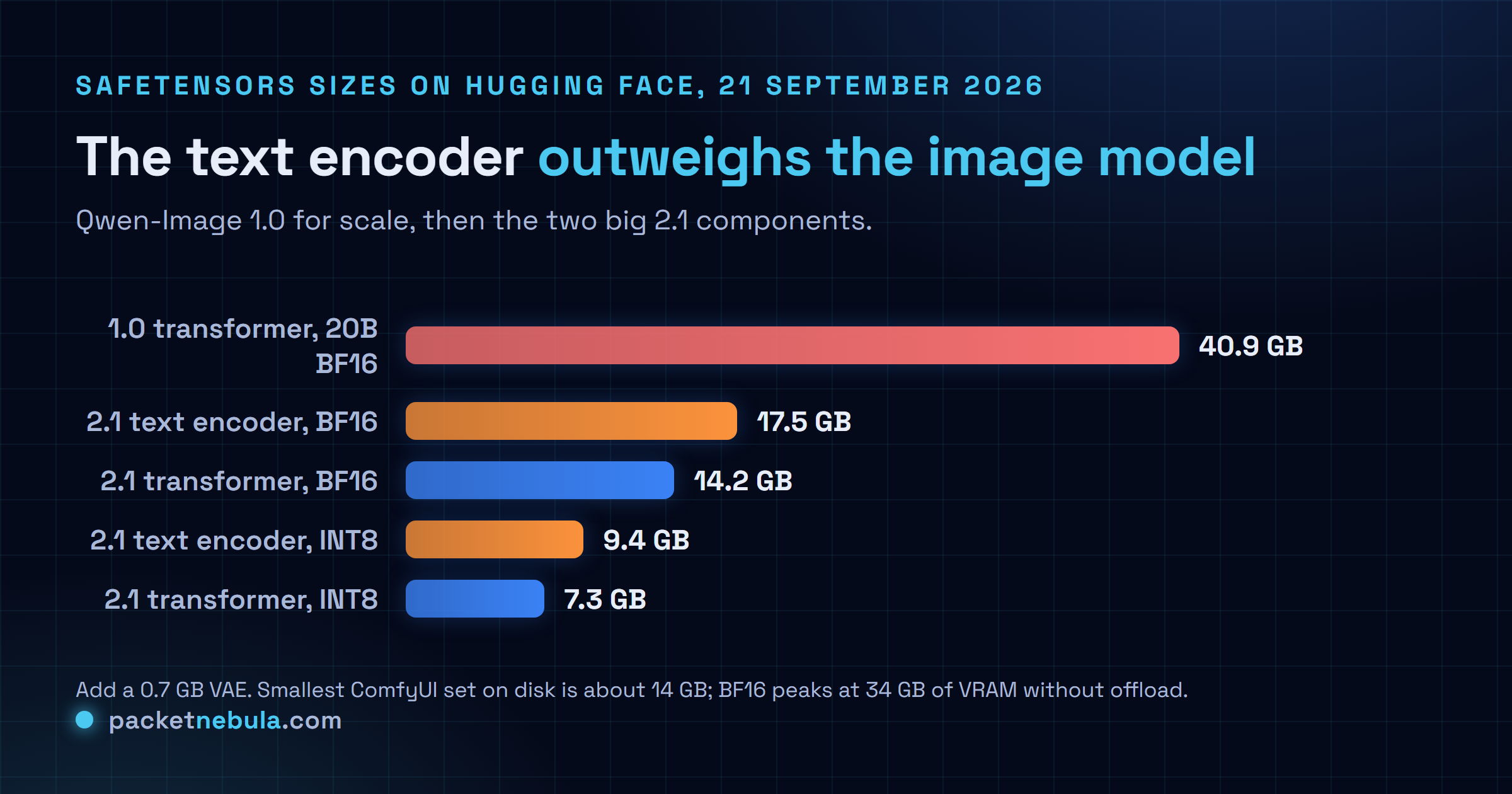
The features are the ones the card leads with. Native 2K, meaning 2048x2048 by default and seven fixed aspect ratios up to 2752x1536. Up to 10 reference images in one call, with local edits guided by a drawn circle or a separate mask. Transparent output from a prompt, using a slightly odd recommended phrasing ("This is an RGBA image with transparency. ... The image has alpha channel and the background is transparent."). And prefix KV cache reuse: because the attention is block-causal, the text and the reference images get encoded once at the first denoising step and reused for the other 39. The vLLM recipe puts a repeated prompt at about a third of the first submission's cost, and says four reference images leave roughly a fifth of the sequence to recompute. That's the real engineering in this release, honestly, more than the parameter count.
The licence is the story
Every Qwen-Image checkpoint we've pulled before this one was Apache 2.0. Qwen-Image (August 2025), Qwen-Image-Edit-2511 and Qwen-Image-2512 (December 2025), all of them. Qwen-Image-2.0 in February and 3.0 in July never got weights at all. So 2.1 is the first open release in the line under something else, and that something is the Qwen Research License Agreement, dated 20 September 2026 in the file itself.
The wording matters. Section 1 defines "Non-Commercial" as "for research or evaluation purposes only". Section 2 grants you the weights "FOR NON-COMMERCIAL PURPOSES ONLY" and says that if you want to use them commercially you request a separate licence at a qwencloud.com address. There's no revenue threshold, no monthly-user cutoff like the licences some other labs use. It's binary: research and evaluation, or a deal with Hangzhou Tongyi Laboratory. Section 4 adds the usual "Built with Qwen" notice if you fine-tune and redistribute, and section 8 puts disputes under Chinese law in the courts of Hangzhou. The Comfy-Org repack and the two prompt-rewriter models carry the same licence.
For a lab or a hobby box, none of that bites. For anyone who wanted to swap this into a product, it does. I might be wrong about the intent here, but the pattern reads like a lab that's decided the small open model is a funnel and the API is the product, and that's a different relationship from the one Qwen3.8-27B under Apache 2.0 offers on the language side of the same company. If you're evaluating it for commercial use, the evaluation itself is covered. Shipping it isn't, until someone writes back.
Running it, and what nobody's measured yet
Day-zero support is unusually broad. Diffusers merged a QwenImage21Pipeline (PR 14804), ComfyUI has native nodes and two template workflows, vLLM-Omni serves it behind an OpenAI-style /v1/images/generations endpoint with FP8 and prefix caching, SGLang has a cookbook, and LightX2V has a script folder. The pinned requirements are PyTorch 2.4 or newer and Transformers 5.17 or newer, with Diffusers installed from git for now.
pip install "torch>=2.4.0" "transformers>=5.17" accelerate pillow && pip install git+https://github.com/huggingface/diffusers
vllm serve Qwen/Qwen-Image-2.1 --omni --port 8091
The default is 40 steps at 2048x2048, which is where the 2K claim comes from. Drop to 1024 for testing, it's four times fewer latent tokens. The RGBA path saves a real four-channel PNG when the model decides the image has transparency, so check the mode of what comes back rather than assuming.
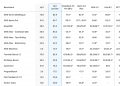
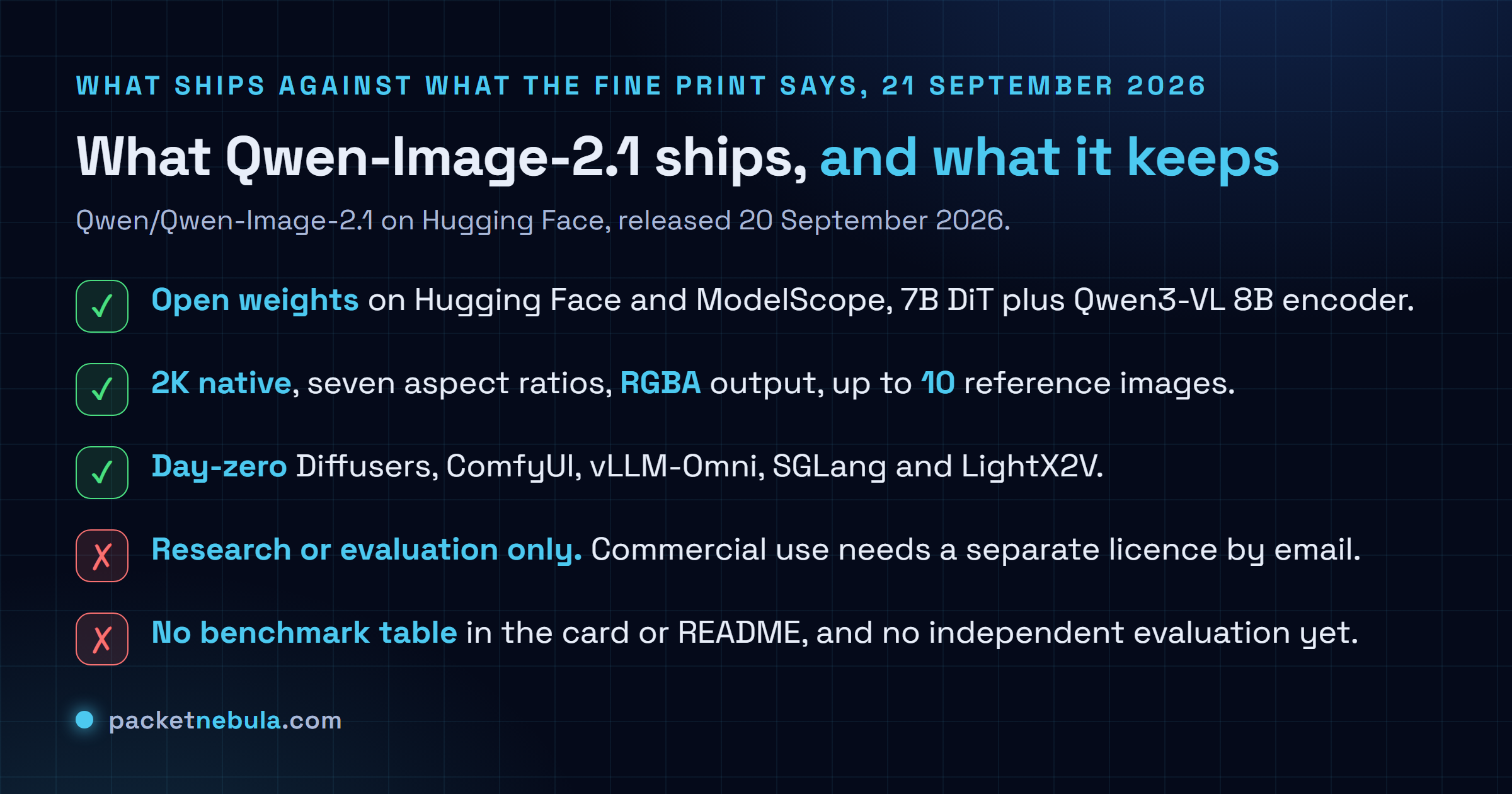
What's missing is any number you can check. The model card has no benchmark table. The GitHub README has none either. The claim that it "beats most closed models" lives in the blog post and is scored on Qwen's own benchmark, which is the same self-graded setup we flagged when 3.0 ranked itself. One day in, nobody independent has published an evaluation. Early hands-on reports mention a yellow cast and detail drift on edits, and I'd expect that to be prompt-rewriter dependent, since Qwen ships two fine-tuned 9B rewriters and clearly expects you to use them. We'll run it against the 2512 Apache build ourselves before we say anything about quality. The weights being back is good news. The licence is the thing to read first.
Sources
Hugging Face, Qwen/Qwen-Image-2.1 model card and LICENSE, read 21 September 2026 (the 7B and 32-layer figures, the aspect ratio table, the RGBA prompt format, the shard sizes, the config files for the Qwen3-VL encoder and the 64-channel VAE, the full licence text). GitHub, QwenLM/Qwen-Image-2.1 README, 20 September 2026 (the release date, the architecture section, the day-zero integrations and PR numbers, the prompt rewriters, the vLLM and SGLang commands). Hugging Face, Comfy-Org/Qwen-Image-2.1, read 21 September 2026 (the INT8 and W4A8 file sizes). vLLM, Qwen-Image-2.1 recipe, September 2026 (the 34 GB peak, the per-image timings, the prefix cache figures). The Decoder, Alibaba's open-weight Qwen-Image-2.1 claims to beat closed models, 20 September 2026 (the blog's benchmark claim and the 3090 line). Hugging Face, Qwen/Qwen-Image, Qwen-Image-2512 and Qwen-Image-Edit-2511, read 21 September 2026 (the Apache 2.0 licences and the 1.0 transformer size).
Frequently asked questions
Can we use Qwen-Image-2.1 commercially?
Not under the licence as shipped. The Qwen Research License Agreement defines non-commercial as "research or evaluation purposes only" and requires a separate commercial licence, requested by email, for anything else. There's no user or revenue threshold below which commercial use is allowed. The Comfy-Org repack and the prompt-rewriter models carry the same terms.
How much VRAM does Qwen-Image-2.1 need?
In BF16 without offload, the vLLM-Omni recipe measured 34 GB peak at 1024x1024 and 40 steps. Qwen says a 3090 (24 GB) runs it, which implies CPU offload, and Diffusers exposes enable_model_cpu_offload(). The INT8 and W4A8 repacks for ComfyUI bring the files to about 14 GB on disk. One early report puts a 16 GB card at roughly 13.9 GB peak with offload at 1024 square; we haven't confirmed that.
Is Qwen-Image-2.1 better than Qwen-Image-3.0?
Nobody outside Qwen can say yet. 3.0 is hosted-only with no weights and no published scores. 2.1 has weights but no benchmark table in its card or README; the comparison claim sits in the blog and uses Qwen's own benchmark. What's clear is that 2.1 is the one you can run, at 7B plus an 8B encoder, and 3.0 isn't.
Does it really output transparent PNGs?
Yes. The VAE has four input and output channels and a 64-channel latent, so the alpha channel is generated, not cut out afterwards. The card recommends a specific prompt wrapper ("This is an RGBA image with transparency ... the background is transparent") and the Diffusers pipeline saves RGBA when the model produces it. Semi-transparent edges are where we'd look first for artefacts.