
• Latest
  • Trending
  • All
Answer card on Gemini 4 Argon pricing and gated access, announced by Google on 30 September 2026.

Gemini 4 Argon costs $2 and $10 now, $4 and $20 later

2 October 2026
Answer card: Reflection AI announced Beam, a 501B parameter open-weight mixture of experts model, with weights promised later in October 2026.

Reflection Beam is a 501B open model with no weights yet

6 October 2026
Answer card: Aleph Alpha released Kolibri-1 on 3 October 2026 as an Apache 2.0 mixture of experts model with 78.1 billion total and 3.46 billion active parameters, served at 1 million tokens of context but trained on sequences of up to 256 thousand tokens.

Kolibri-1 serves 1M tokens but was trained to 256K

4 October 2026
Answer card for GPT-6.1 Sol showing 2 dollars in and 10 dollars out per million tokens, unchanged from GPT-6 Sol, with cached input at 10 cents.

GPT-6.1 Sol costs what GPT-6 Sol did, and only the cache got cheaper

30 September 2026
Answer card for Claude Sonnet 5.5 showing 2 dollars in and 10 dollars out per million tokens, unchanged from Sonnet 5, and between_tools replacing disabled thinking.

Claude Sonnet 5.5 keeps $2 and $10 and retires thinking disabled

29 September 2026
Answer card: Xiaomi retrained MiMo-V2.6 to stop repeating tool calls, API swapped on 25 September 2026, MIT weights on 27 September, same model names.

MiMo-V2.6-Pro was quietly retrained to stop looping on tool calls

28 September 2026
Answer card: Anthropic committed $11.6 billion over seven years to Akamai Cloud for CPU workloads only, with revenue from the second half of 2027.

Anthropic’s $11.6B Akamai deal buys CPUs, not GPUs

27 September 2026
Answer card: Google Suncatcher MVP satellite, four Trillium TPUs on about one kilowatt, launching on SpaceX Transporter-18, reported for 1 October 2026.

Google’s first Suncatcher satellite flies four TPUs on 1 kW

25 September 2026
Answer card for Claude Opus 5.5: 4 dollars in and 20 dollars out per million tokens, down from 5 and 25, with cache reads at 20 cents.

Claude Opus 5.5 drops to $4 and $20, and breaks four Opus 5 habits

23 September 2026
The official xAI announcement card for Grok 4.7, white type on a dark grey and navy gradient.

Grok 4.7 keeps $2 and $6, and its gains over 4.6 are xhigh versus high

22 September 2026
Answer card stating that Qwen-Image-2.1, released on 20 September 2026, ships open weights with a 7 billion parameter diffusion transformer, a Qwen3-VL 8B text encoder and an RGBA VAE totalling about 33 gigabytes in BF16, under the Qwen Research License that limits use to research or evaluation and requires a separate commercial licence, unlike the Apache 2.0 licence of Qwen-Image 1.0.

Qwen-Image-2.1 brings the weights back, but not the Apache licence

21 September 2026
Answer card stating that Ternary Bonsai 2 27B, released by PrismML on 17 September 2026 under Apache 2.0, packs Qwen3.8 27B into 5.95 gigabytes at 1.72 bits per weight, keeps 98.2 percent of the 14-benchmark average, about 75 percent on SWE-bench Verified and Terminal-Bench 2.1, and needs PrismML's llama.cpp fork to run.

Does Bonsai 2 27B really keep 98% of Qwen3.8 in 5.95 GB?

20 September 2026
Answer card stating that Jev 1.13 from TypeSafe AI is a decision model in early access since 15 September 2026 that returns typed probabilities instead of text, priced at 42 dollars per billion input tokens with output tokens free, answering in 70 to 500 milliseconds, with a 64K token request budget, text input only, and a documented list of things it does badly, including counting and dates.

Jev 1.13 bills $42 a billion tokens, and it can’t count

19 September 2026
  • About
  • Contact
  • Privacy
  • Legal
Wednesday, October 7, 2026
  • Login
Packet Nebula
  • Home
  • Articles
    • Security
    • Network
    • Dev
    • Sysadmin
    • SEO
    • Email & DNS
  • Tools
    • Network tools: free, fast, no signup
    • Security tools: free, fast, no signup
    • Developer tools: free, fast, no signup
    • Sysadmin tools: free, fast, no signup
    • SEO tools: free, fast, no signup
    • Email & DNS tools: free, fast, no signup
  • Download
  • About
No Result
View All Result
Packet Nebula
No Result
View All Result
Home Dev

Gemini 4 Argon costs $2 and $10 now, $4 and $20 later

by stephane
2 October 2026
in Dev
0
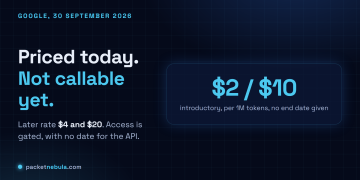
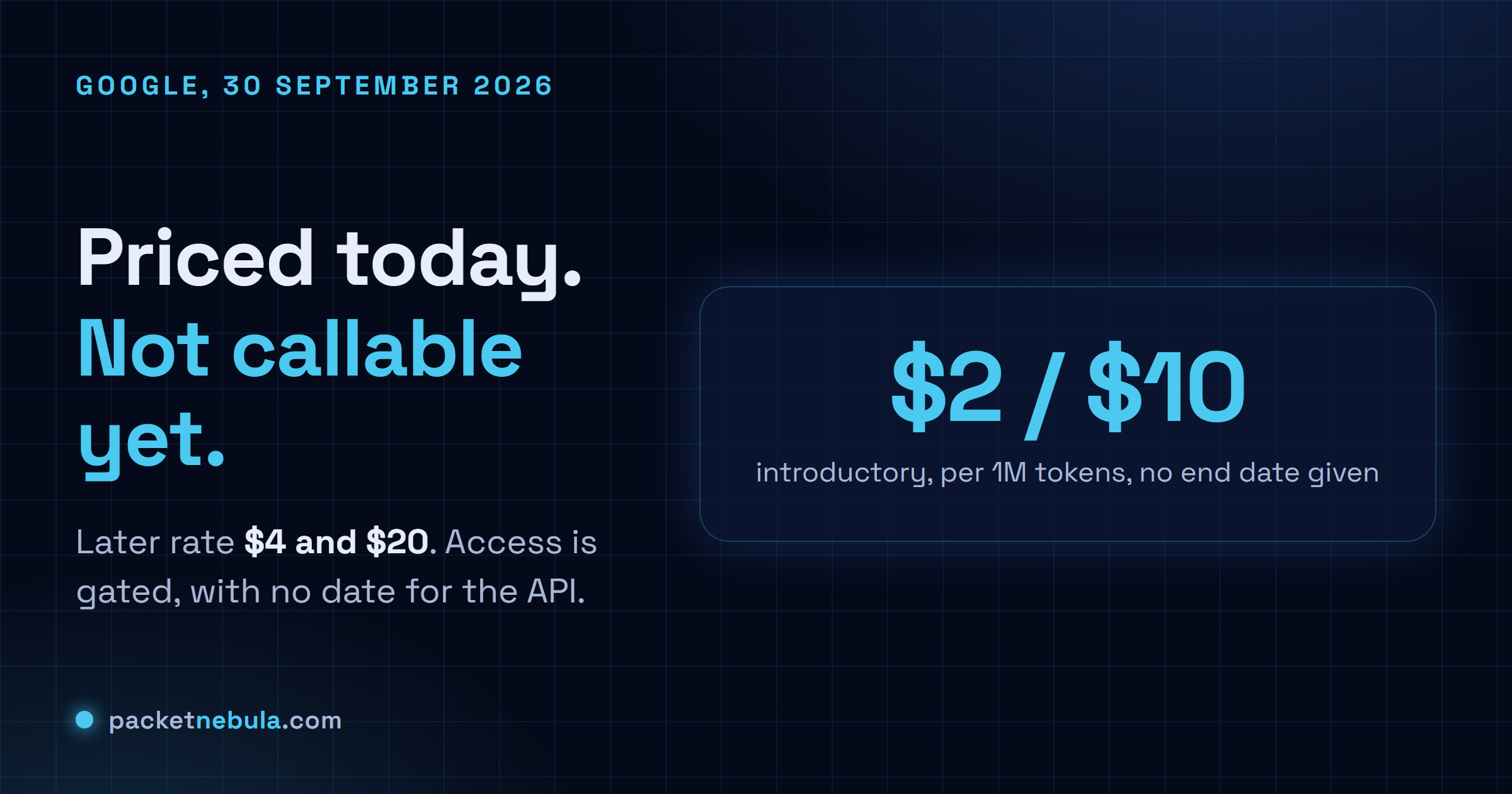
Answer card on Gemini 4 Argon pricing and gated access, announced by Google on 30 September 2026.
494
SHARES
1.4k
VIEWS
Share on FacebookShare on Twitter

Google put a price on Gemini 4 Argon this week, and then told almost everyone they can't have it. We checked the announcement twice because the two halves don't sit well together. On 30 September 2026 Google DeepMind listed Argon at $2 per million input tokens and $10 per million output, with a later rate of $4 and $20. Today it's limited to a small group of trusted testers.

The short answer

Argon's introductory price is $2 input and $10 output per million tokens, cached input is 95% cheaper, and Google says the rate will rise to $4 and $20 without saying when. Output can run to 1 million tokens in one trajectory, up from 64,000. You can't call it yet: paid API customers and Google AI Ultra subscribers come next, with no date given. The benchmark numbers are Google's own.
$2 / $10per 1M tokens, introductory
$4 / $20the announced later rate
1Moutput tokens in a single trajectory
Answer card stating that Google announced Gemini 4 Argon on 30 September 2026 at two dollars per million input tokens and ten dollars per million output tokens, rising later to four dollars and twenty dollars, with access gated and no date given for the application programming interface.
The rate card is public. The model mostly isn't.

What Google actually announced

Koray Kavukcuoglu, Google's chief AI architect, announced it in a blog post. Argon is the first flagship Gemini since February, according to Yahoo's report on the launch, and the headline spec isn't the price. It's the output ceiling. Google says Argon can generate up to 1 million tokens in a single trajectory, where earlier Gemini models stopped at 64,000. The post's own argument is that a model with room to think for hundreds of thousands of tokens reaches a different depth on hard problems.

Honestly, we like that framing more than the benchmarks. Google reports 77.9% on DeepSWE v1.1, 51.3% on AutomationBench (first place on its list) and 91.7% on LVBench, a long video test. Yahoo's write-up puts the DeepSWE figure next to 74.2% for Claude Opus 5.5 and 74.1% for GPT-6 Astra. A three point lead on a coding benchmark is the kind of number we'd wait on. Every one of these figures comes from Google, and nobody outside has re-run them yet.

Availability is the awkward part. Argon is rolling out through Google's Fairwind Program to a few hundred vetted organisations first. Google says it wants developers, enterprises and consumers to get it as soon as possible, starting with paid API customers and Google AI Ultra subscribers. Its own wording is that a phased approach is required. There's no calendar attached to any of that.

The price, and the promotion hiding in it

Look at the rate card again. $2 and $10 are introductory. The standard rate is $4 and $20, so the price you can plan around is the one that doubles. Google hasn't said how long the introductory rate lasts. We can't tell you whether that's weeks or a quarter, and we'd be inventing it if we tried.

It matters most on the output side, because that's where a 1M token trajectory lands. Run one full-length trajectory and you've generated 1 million output tokens: $10 at the introductory rate, $20 at the later one. For comparison, GPT-6 Astra lists at $10 input and $50 output, and its output is capped at 128,000 tokens, so a maxed out answer costs about $6.40. Different shape, different bill. Argon is cheaper per token and can still cost more per answer if you let it think at length.
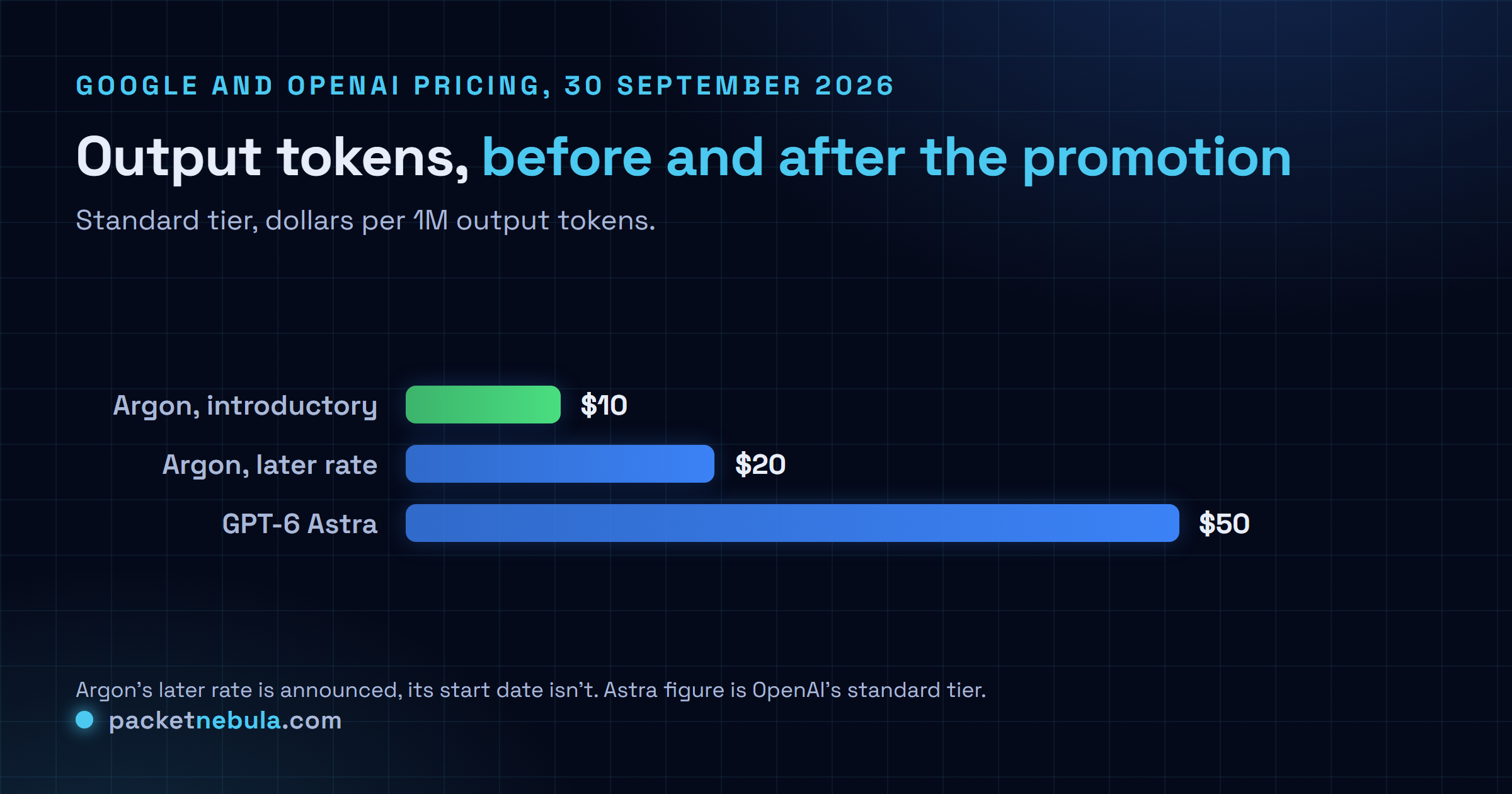
Horizontal bar chart of output prices per million tokens: Gemini 4 Argon introductory ten dollars, Gemini 4 Argon later rate twenty dollars, GPT-6 Astra fifty dollars.
Per token, Argon is cheaper even after the doubling. Per answer depends on how long it thinks.

Cached input is 95% off, according to the announcement. If that applies to the listed input rate, and we're doing the arithmetic ourselves here, cached input comes to about $0.10 per million now and $0.20 later. That's the line we'd watch for agent work, where the same long prefix gets sent over and over. Anthropic's pricing has its own sharp edges, as we found when Opus 5.5 landed with four breaking changes, so compare whole workloads, not sticker prices.

What we'd do this week

Nothing, mostly. If you aren't in the gated programme you can't test it, and a price you can't call isn't a reason to rewrite a budget. I might be wrong about the timing, since Google could open the API within days, but the announcement gives no hint of it.

Two things are worth doing now. Write down your current cost per finished task on whatever model you run today, because that's the number Argon will have to beat once it's available. And decide in advance whether you'd accept the $4 and $20 rate, since that's the one you'll end up paying. If the answer is no, the introductory price is a trial, not a plan.

Image: packetnebula.com, built from Google's published figures.

Sources

Google, Gemini 4 Argon: our next era of frontier intelligence, 30 September 2026 (pricing, the 1M output limit, benchmark figures, the phased rollout wording). 9to5Google, Google announces Gemini 4 Argon as its new frontier model, 30 September 2026 (independent confirmation of the rates and the rollout order). Yahoo Finance, Google's Gemini 4 Argon closes the pricing triangle (comparison figures for Opus 5.5 and GPT-6 Astra, and the note that they're vendor-reported).

Frequently asked questions

How much does Gemini 4 Argon cost?

$2 per million input tokens and $10 per million output tokens at the introductory rate, with cached input 95% cheaper. Google says the rate will later be $4 and $20 and hasn't said when.

Can I use Gemini 4 Argon today?

Not unless you're in Google's gated Fairwind Program. Paid API customers and Google AI Ultra subscribers are next, and Google hasn't given a date.

What's new compared with earlier Gemini models?

The output ceiling. Argon can generate up to 1 million tokens in one trajectory, where the previous limit was 64,000. Google also reports 77.9% on DeepSWE v1.1.

Is Argon better than GPT-6 Astra and Claude Opus 5.5?

Google's figures say so on several benchmarks, including 77.9% on DeepSWE against roughly 74% for both rivals. They're vendor-reported and unverified, so wait for independent runs before switching anything.

Tags: API pricinggeminigooglellmnews
Share198Tweet124
stephane

stephane

  • Trending
  • Comments
  • Latest
Answer card: Proton Lumo 2.0 is private by policy, not by locality. Saved history is locked so even Proton cannot read it, but the prompt is decrypted on a Proton EU server to answer it, then forgotten.

Proton Lumo 2.0 review: how private is it, really?

3 September 2026
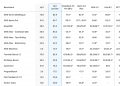
The Agentic Coding section of the official Hy4 preview benchmark appendix published by Tencent, a table comparing Hy3 and Hy4 preview against DeepSeek V4 Pro 0813, Qwen 3.8 Max, GLM 5.3, Kimi K3, GPT 5.6 Sol and Claude Opus 5 across SWE-bench Multilingual, SWE-bench Pro, DeepSWE, three SWE Atlas tasks, SWE-Marathon, Terminal-Bench 2.1, NL2Repo-Bench, CyberGym, ProgramBench, PostTrainBench and Harbor-Index.

Tencent’s 770B Hy4 tops one benchmark row in 46

3 September 2026
Answer card: Qwen 3.7 Max is API-only and cannot run locally yet; the open Qwen models (Qwen 3.6 27B, qwen3:8b to 32b) run offline via Ollama.

Qwen 3.7 local: what you can actually run offline

22 June 2026
Answer card: JWTs are not encrypted, anyone can read them; the signature proves who issued the token, not who may read it.

Are JWTs encrypted? No, and the difference will bite you

0
Answer card: a random 8 character password falls in under 2 hours offline, while 16 random characters hold for 1.4 trillion years at the same speed.

How long does it take to crack a password in 2026?

0
Answer card: three DNS records decide if your mail lands or bounces; SPF lists allowed senders, DKIM signs messages, DMARC sets the failure policy.

SPF, DKIM and DMARC explained: the records your email needs

0
Answer card: Reflection AI announced Beam, a 501B parameter open-weight mixture of experts model, with weights promised later in October 2026.

Reflection Beam is a 501B open model with no weights yet

6 October 2026
Answer card: Aleph Alpha released Kolibri-1 on 3 October 2026 as an Apache 2.0 mixture of experts model with 78.1 billion total and 3.46 billion active parameters, served at 1 million tokens of context but trained on sequences of up to 256 thousand tokens.

Kolibri-1 serves 1M tokens but was trained to 256K

4 October 2026
Answer card on Gemini 4 Argon pricing and gated access, announced by Google on 30 September 2026.

Gemini 4 Argon costs $2 and $10 now, $4 and $20 later

2 October 2026
  • About
  • Contact
  • Privacy
  • Legal

Copyright © 2026 Stephane Cardon.

Welcome Back!

Login to your account below

Forgotten Password?

Retrieve your password

Please enter your username or email address to reset your password.

Log In
No Result
View All Result
  • Home
  • Articles
    • Security
    • Network
    • Dev
    • Sysadmin
    • SEO
    • Email & DNS
  • Tools
    • Network tools: free, fast, no signup
    • Security tools: free, fast, no signup
    • Developer tools: free, fast, no signup
    • Sysadmin tools: free, fast, no signup
    • SEO tools: free, fast, no signup
    • Email & DNS tools: free, fast, no signup
  • Download
  • About

Copyright © 2026 Stephane Cardon.