




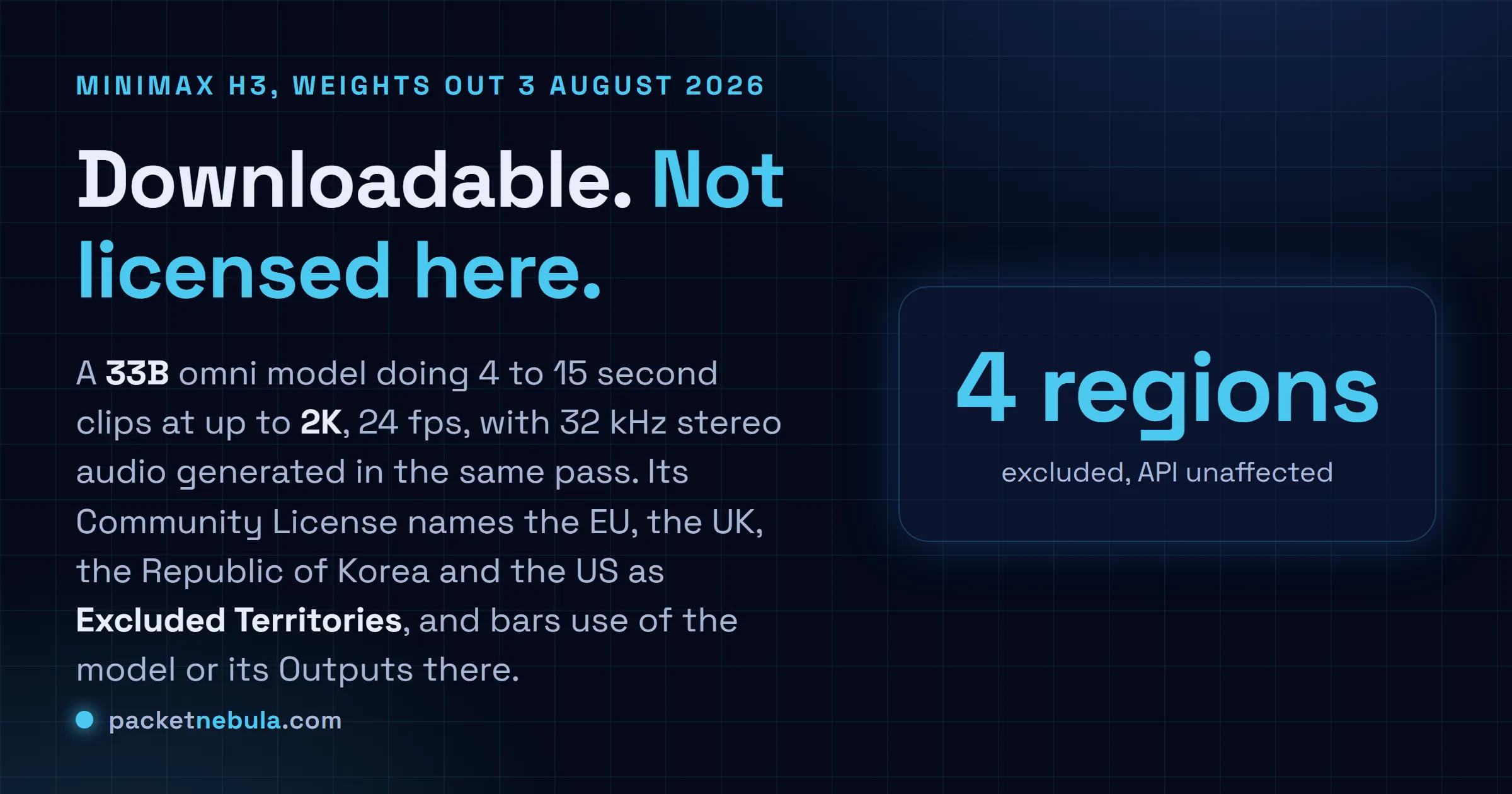
You go to pull the weights, and the license stops you at the door. That's the shape of this one. On August 3 MiniMax published H3 on Hugging Face, a 33B omni model that generates 2K video at 24 fps with stereo audio baked into the same pass, and its Community License defines the European Union, the United Kingdom, the Republic of Korea and the United States as Excluded Territories. This isn't a nag screen. The text says you may not use, reproduce, modify, distribute or display the works or any of their Outputs there. So if you're reading this from Lyon or Portland, the most interesting open video release of the week is one you can download and still not lawfully run. We read the license, the model card and the hardware numbers to work out what's actually left.
The short answer
MiniMax shipped the H3 video weights on August 3, days after the API. It reads text, images, video and audio in one context and generates up to 15 seconds at 2K, with sound produced alongside the picture rather than bolted on. Then the license names the EU, the UK, South Korea and the US as Excluded Territories, and bars use of the model or its outputs there. Here’s what that leaves you.
 Image: MiniMax, banner from the MiniMax-H3 model repository.
Read the subtitle on their own banner. Open-Weights, capital O, capital W. Then read section V.4.
What actually shipped
A 33B dense single-stream transformer, in one piece. H3 takes text, images, video and audio in the same context and generates from any mix of them. About 13B of those parameters sit in AdaLN modulation branches that don’t need to be loaded at all for inference-only deployment, so the thing you actually run is smaller than the headline suggests.
Output is 768 pixels on the short edge natively, pushed to 2K by a second stage MiniMax calls H3-Regenerate-2K. Clips run 4 to 15 seconds, integer values only, at 24 fps, in aspect ratios from 21:9 down to 9:16. The audio is 32 kHz stereo generated jointly with the picture, not dubbed over it afterwards. That joint generation is the part worth testing yourself, because it’s where these models usually come apart.
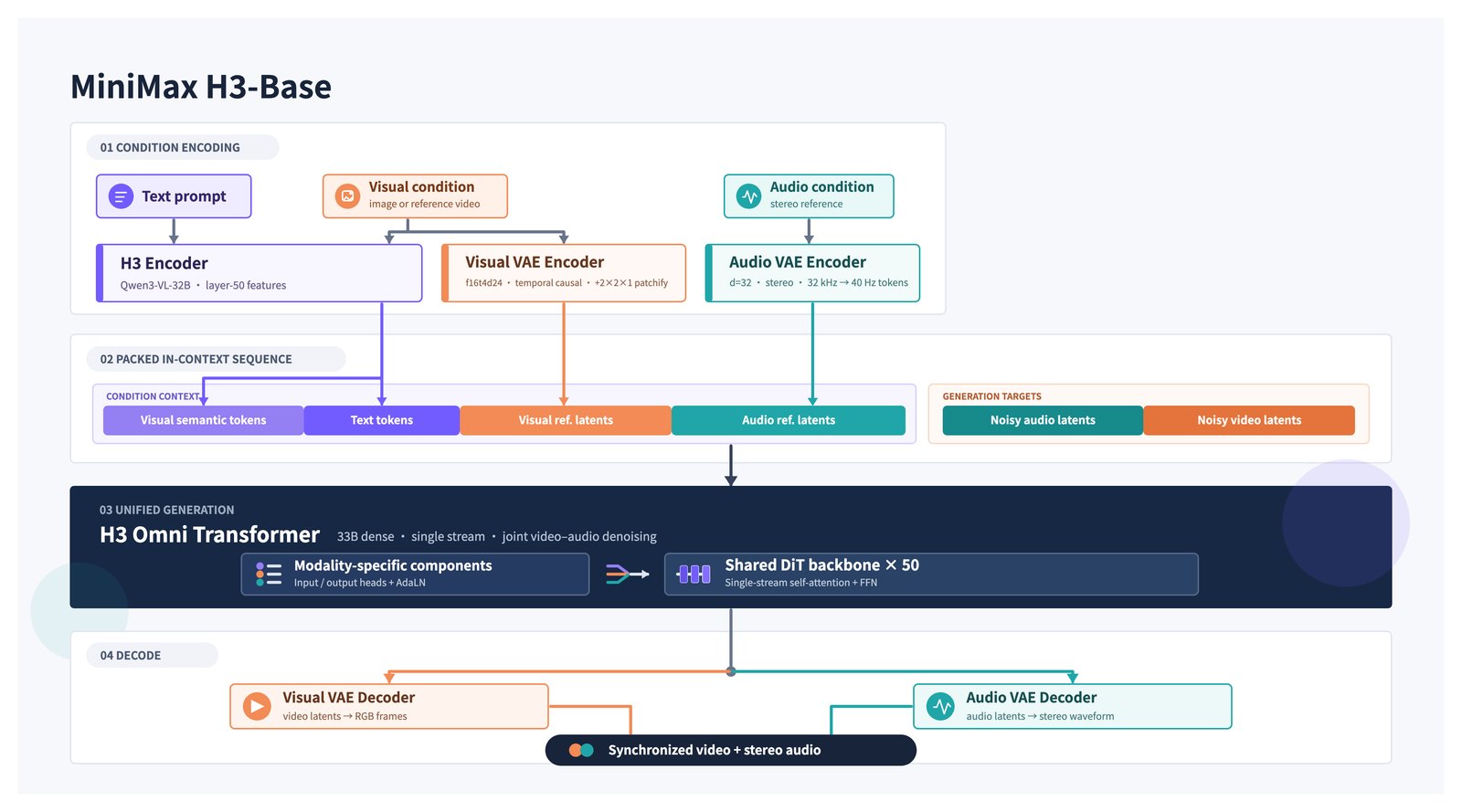 Image: MiniMax, full architecture diagram from the MiniMax-H3 model card.
The rollout came in two beats. API at the end of July, under the model ID MiniMax-H3, at roughly 0.13 dollars per second of 2K output. (Coverage disagrees on the exact day and on whether it’s 0.13 or 0.14, so price it against the console before you budget anything.) Weights second, on August 3, on Hugging Face, with ComfyUI support the same day. That gap matters more than it looks.
On the scoreboard: Artificial Analysis has H3 first in video editing. It trails Gemini Omni Flash on text to video, and it’s behind both Seedance 2.0 and Gemini Omni Flash on image to video. First at one job, mid table at the two people actually use most.
The license is the story
Here’s the clause. “Excluded Territories” means the European Union, the United Kingdom, the Republic of Korea and the United States of America. “Applicable Territory” means worldwide, excluding those. And then section V.4: “You may not use, reproduce, modify, distribute, or display the MiniMax H3 Works or any of their Outputs or results outside the Applicable Territory.”
Read that second sentence twice, because the word Outputs is doing a lot of work. It isn’t only the weights that are geofenced. A clip you generated somewhere permitted, then displayed to a client in London, falls under the same sentence. I’ve read a lot of these community licenses and this is the broadest territorial carve-out I can remember on a model people are calling open.
MiniMax explains itself in a Q and A shipped in the repo, and the explanation is more candid than the usual boilerplate: video generation faces “a more complex and rapidly evolving regulatory environment” than text or image models, with likeness generation and copyright named as the worries. Worth remembering that Disney, Universal and Warner Bros. Discovery sued MiniMax in September 2025 over its Hailuo platform, and that Judge Stanley Blumenfeld denied the company’s motion to dismiss on 26 May 2026, sending the case into discovery. The US exclusion isn’t hard to read in that light.
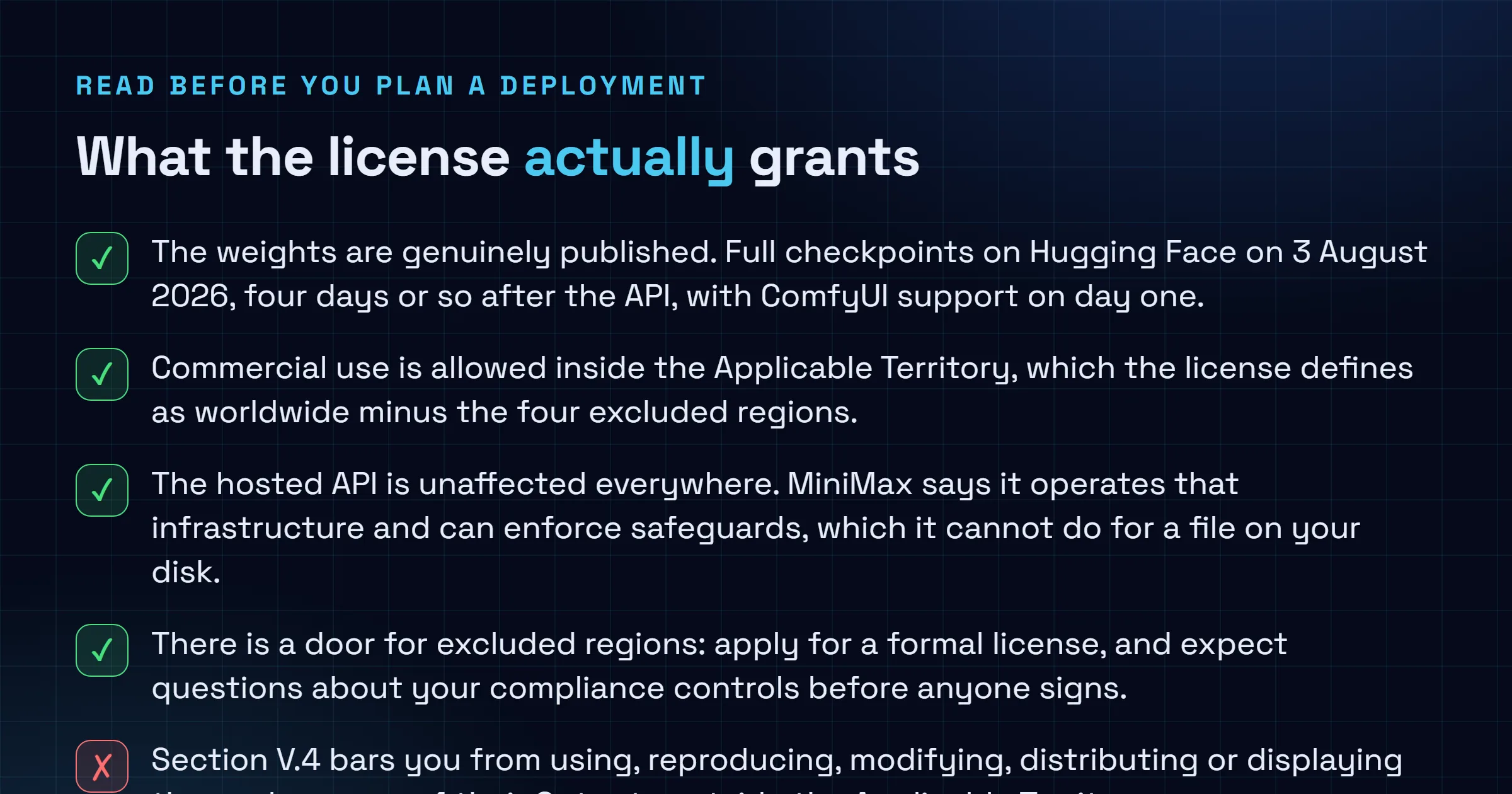
There’s more in there than the territories. Section IV.1 puts commercial products above 20 million dollars a year in revenue behind separate written authorisation. Section IV.2 requires you to prominently display “MiniMax H3” in the interface of any commercial product that uses it. Section V.3 is the standard distillation lock: you may not use the works or their outputs to improve any other AI model.
The API carve-out is the tell. MiniMax says the hosted endpoint is unaffected because it “operates the serving infrastructure and can enforce appropriate safeguards,” which it can’t do once a checkpoint is on your disk. So the company will happily sell you H3 in Berlin by the second. It just won’t license you the file. Honest reasoning, and a reminder that open weights is now a spectrum rather than a yes or no. We made much the same point this morning about Qwen 3.8 Max, where the weights aren’t out yet and no license has been named at all.
If you’re in an excluded region and you want the weights anyway, there’s a door: apply for a formal license, and expect to be asked what your compliance controls look like before anyone signs. Companies get that conversation. Someone with a 3060 and a weekend does not.
What it takes to run
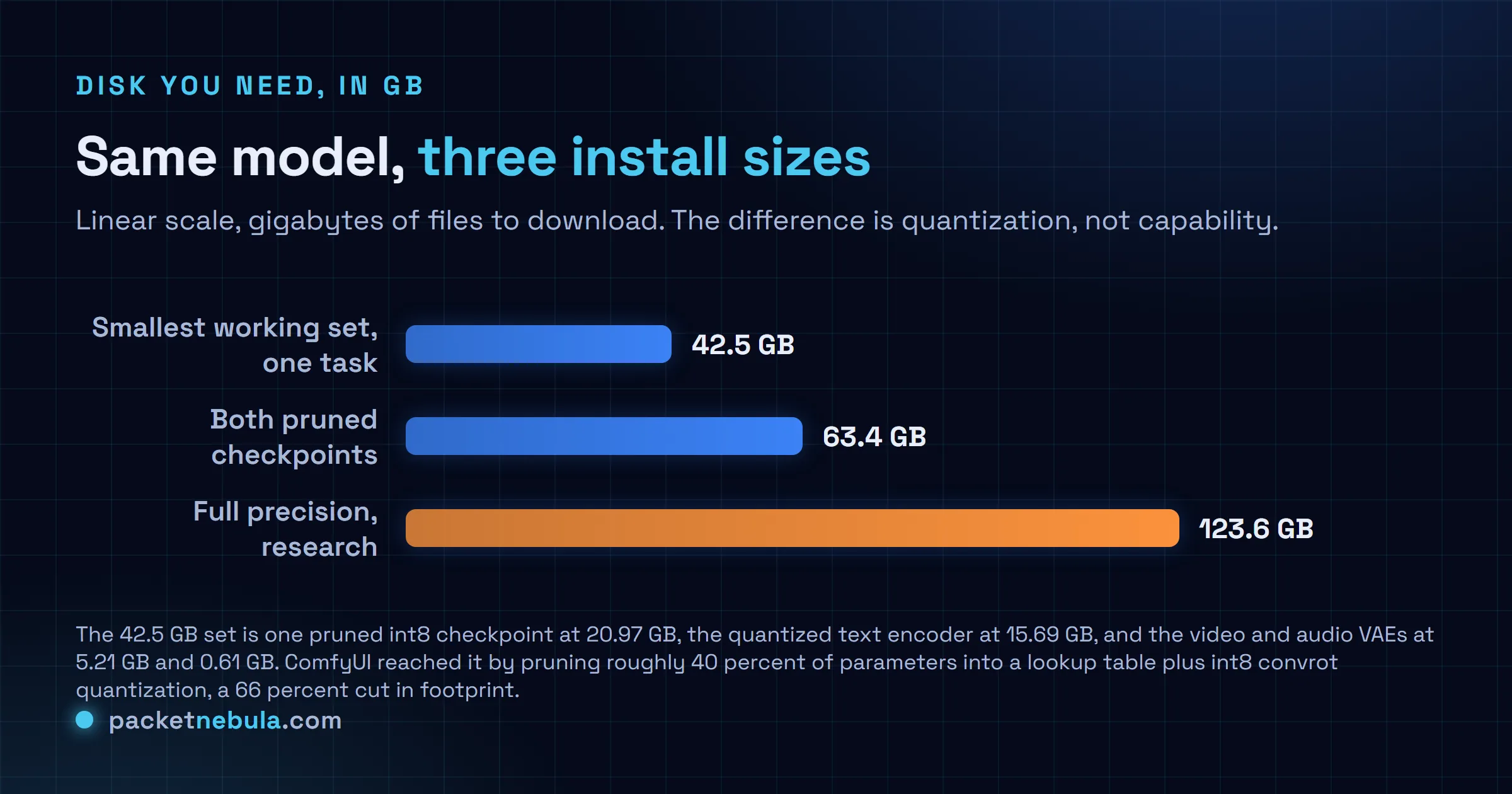
The full precision research setup is 123.6 GB. Nobody needs that to make a clip.
The smallest set that does one task is 42.5 GB: a pruned int8 checkpoint at 20.97 GB, the quantized text encoder at 15.69 GB, and the video and audio VAEs at 5.21 GB and 0.61 GB. Add the second pruned checkpoint, another 20.97 GB, and you’re at 63.4 GB with both task paths covered. ComfyUI got there by pruning roughly 40 percent of the total parameters into a lookup table plus an int8 convrot quantization with custom kernels, for a 66 percent cut in footprint.
Which brings us to the RTX 3060 claim. ComfyUI’s words are that the model runs on “a GPU like the RTX 3060,” and that’s true in the sense that it completes. A 12 GB card is trading VRAM for system RAM, and nobody has published a seconds-per-clip figure on that hardware, so treat it as “it fits” rather than “it’s usable.” Honestly I’d want a timing before planning anything around it.
The honest read
Strip the license out and this is a good release. Joint audio and video from one model, at 2K, with weights you can inspect, is what the field kept promising. Black Forest Labs put FLUX 3 into early access in July with the open weights deferred to later this year, and MiniMax shipped its files within days of its API. That’s a real difference in behaviour.
But you can’t strip the license out. For a reader in Paris, Manchester, Seoul or Austin, H3 is an API product with a public source tree attached, and the useful move is to price the endpoint rather than plan a local deployment. For everyone else it’s genuinely one of the most capable models you can now hold on disk. Both of those are true, and which one applies to you depends on nothing more technical than where you’re sitting.
One prediction, and I might be wrong: we’ll see more region-scoped model licenses before the year is out. Regulation diverged, litigation followed, and the license is the cheapest place for a lab to draw the map. Worth noting that EU AI Act Article 50 became applicable on August 2, one day before these weights landed.
Sources: MiniMaxAI/MiniMax-H3 on Hugging Face, the model repository itself, for the 33B parameter count, the roughly 13B of AdaLN parameters skipped at inference, the 768 pixel native and 2K regenerated resolutions, the 4 to 15 second durations at 24 fps, the 32 kHz stereo audio and the aspect ratio list, and for both official images reproduced above. The MiniMax H3 Community License Agreement is the source for every quoted clause, including the Excluded Territories definition, the Applicable Territory wording, the section IV.1 revenue threshold, the section IV.2 branding requirement and the section V.3 ban on improving other models, and the repository’s licensing Q and A for MiniMax’s own explanation and the unaffected API. The ComfyUI blog supplied the quantization work, the 66 percent memory reduction from 123.6 GB to 42.5 GB and the RTX 3060 statement; Atlas Cloud the per-file download sizes and the 63.4 GB two-checkpoint figure; and MarkTechPost the API launch, the pricing and the Artificial Analysis placements. The Disney, Universal and Warner Bros. Discovery suit and the 26 May 2026 denial of the motion to dismiss are covered by Loeb and Loeb. Benchmark placements are Artificial Analysis rankings as reported, not results we reproduced.
Frequently asked questions
Are the MiniMax H3 weights actually open?
They are downloadable, which is not the same thing. MiniMax published the checkpoints on Hugging Face on 3 August 2026 under the MiniMax H3 Community License Agreement. That license grants rights only inside an Applicable Territory it defines as worldwide minus the European Union, the United Kingdom, the Republic of Korea and the United States, so it is not an open source license by the usual definition.
Can I use MiniMax H3 in the EU or the United States?
Not under the default license. Section V.4 says you may not use, reproduce, modify, distribute, or display the works or any of their Outputs outside the Applicable Territory, and the four excluded regions are named explicitly. MiniMax says people in those regions can apply for a formal license, and that it may authorise use after reviewing the deployment scenario and confirming that compliance controls and safeguards are in place.
Does the territory restriction apply to the API too?
No. MiniMax draws the line at who runs the serving infrastructure. Its licensing Q and A says the hosted API is unaffected because MiniMax operates that infrastructure and can enforce appropriate safeguards, which it cannot do once a checkpoint is on someone else's disk. So the endpoint stays available worldwide, at roughly 0.13 dollars per second of 2K video.
What hardware do I need to run MiniMax H3 locally?
The smallest working set is 42.5 GB of files: one pruned int8 checkpoint at 20.97 GB, a 15.69 GB quantized text encoder, and the two VAEs at 5.21 GB and 0.61 GB. Both checkpoints together run 63.4 GB, and the full precision research setup is 123.6 GB. ComfyUI says its offloading brings the model within reach of a card like an RTX 3060, at the cost of pushing weights into system RAM.
Is MiniMax H3 the best video model right now?
It leads video editing on the Artificial Analysis rankings, which is a real result. It trails Gemini Omni Flash on text to video, and sits behind both Seedance 2.0 and Gemini Omni Flash on image to video. So it is first at one job and mid table at the two most common ones, and what makes it notable is the open weights rather than a clean sweep.