

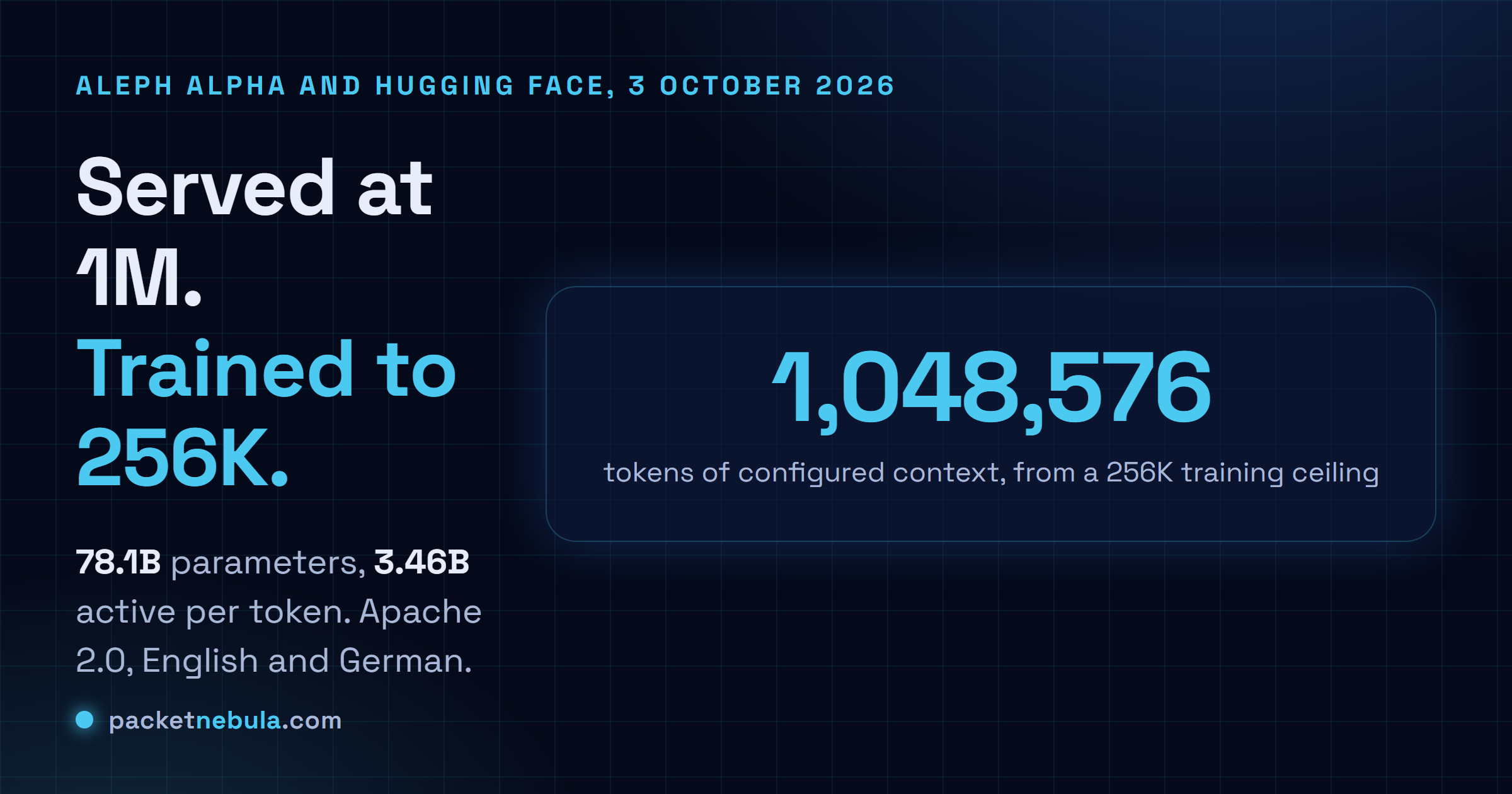
Every long-context launch has a number on the poster, and this one's 1,048,576. We read the Kolibri-1 model card before the press coverage, and the first thing that jumped out was a smaller number further down: 256K. Aleph Alpha, the German lab, released the weights on 3 October 2026 under Apache 2.0. It's a 78.1B mixture of experts model, and it can be served at 1M tokens. It wasn't trained there.
The short answer
Kolibri-1 is an English and German reasoning model with 78.1B total parameters and 3.46B active per token, free to use commercially under Apache 2.0. Its 1M token window is a configuration override: training stopped at 256K sequences. The benchmark scores are Aleph Alpha's own, and nobody outside has reproduced them yet. If you need long context, test at your real length before you believe the poster.
What Aleph Alpha actually shipped
The weights are on Hugging Face as Aleph-Alpha/Kolibri-1, with a BF16 variant alongside. The architecture is a sparse mixture of experts with 50 layers and 384 experts per layer, plus one shared expert that every token passes through. The router picks 6 of the 384 for each token. That's why only 3.46B of the 78.1B parameters do any work on a given step, roughly 4.4% of the model.
It speaks English and German. About 21.3% of the pre-training data was German, which is unusually deliberate for a model at this size, and the knowledge cutoff is 18 June 2026 for both languages. There are four reasoning settings (none, low, medium, high) and tool calling. Aleph Alpha says it trained on 768 NVIDIA B200 GPUs in Germany and Finland over about 21 days.
The pitch is sovereignty. Aleph Alpha is aiming at public administration, aerospace and industry, where the data can't leave the building. That's a more believable pitch than "best model in the world", and it fits how the model is built: grounding is a design goal, and the lab says it trained on abstention examples so the model declines rather than guesses. One reported figure has it avoiding a wrong answer on 44% of AA-Omniscience items against 14.8% for its predecessor. We'd call that promising and unverified.
The 1M window and the 256K training
Here's the part we keep coming back to. According to the model card and the coverage built on it, Kolibri was trained in three stages: 20 trillion tokens at 16K sequence length, 3.44 trillion at 64K, and 200 billion at 256K. That's nearly 24 trillion in total. Serving at 1,048,576 tokens takes a longer maximum model length in the config, which is four times the longest sequence the model saw in training.
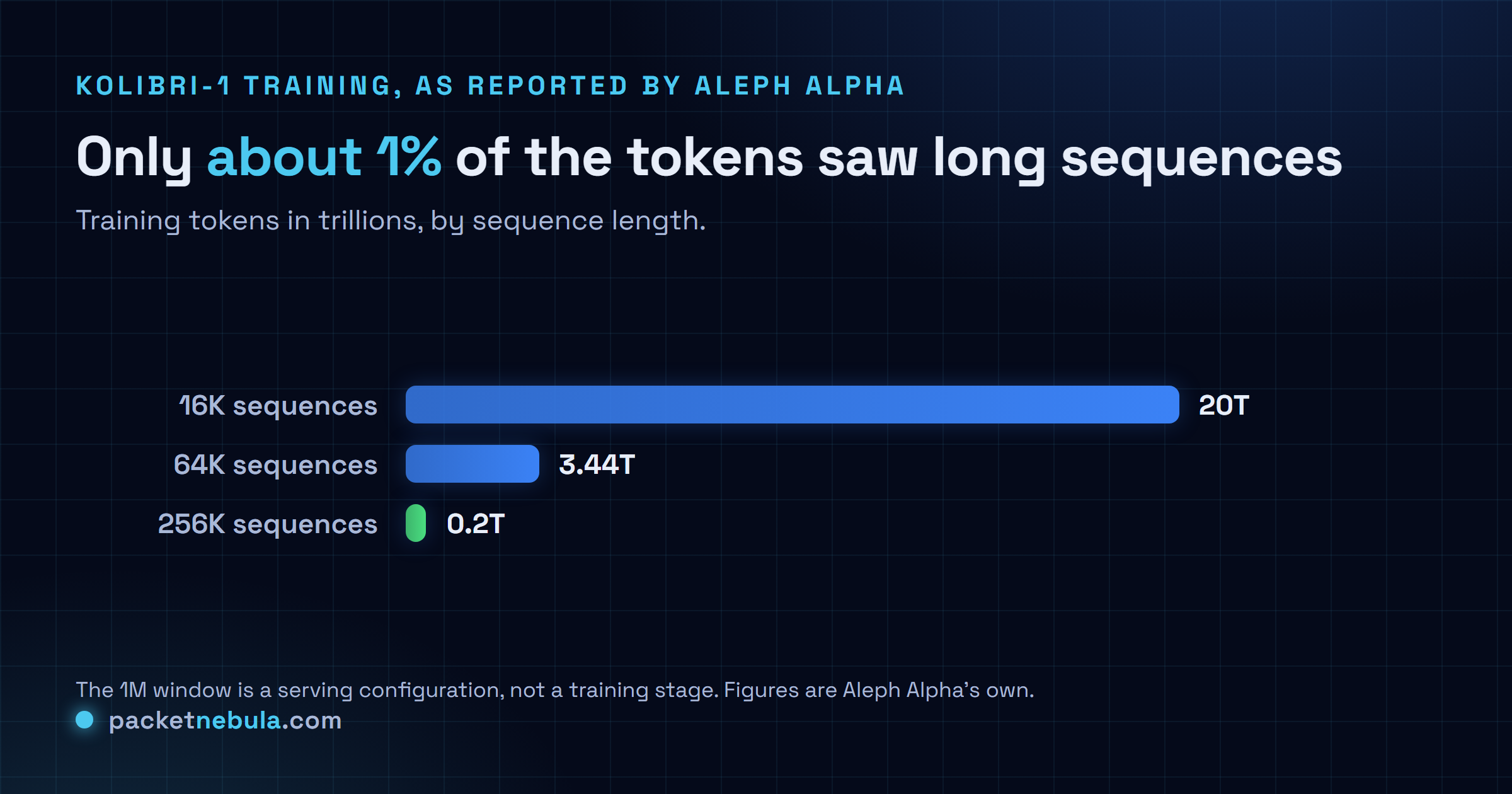
The 256K stage is 0.2 trillion of roughly 23.6 trillion tokens, so about 0.85%. Nothing is wrong with that. Long-context adaptation is normally a short final stage, and extending past the trained length is a known trick. It just isn't the same claim as "trained for a million tokens", and the model card is honest about it: 262,144 is the recommended length for efficiency. Aleph Alpha's own blog talks about 256K queries when it quotes throughput, not 1M. We'd read that as the lab telling you where it's comfortable.
I might be wrong about how well it holds up beyond 256K. Sometimes models degrade gently past their trained length, sometimes they fall off a cliff, and a vendor chart won't tell you which. Our advice is boring: run your own documents through it at the length you need.
Benchmarks, and what it takes to run
The scores Aleph Alpha reports are 96.9 on AIME 2025, 85.9 on LiveCodeBench v6, and overall averages of 75.5 in English and 70.8 in German. One independent write-up counts it ahead on 10 of 17 benchmark rows against the comparison models. It trails on tool use: BFCL v4 comes in at 61.4 against 67.2 for the best rival listed. Every figure is the lab's own, run on its own harnesses, and we haven't seen a third party reproduce any of them.
Hardware is the more useful number. The model card says the minimum is two A100 80GB cards, or an H100, H200 or B200 equivalent, and that the FP8 model takes about 78GB. Two 80GB cards give you 160GB, so by our arithmetic that leaves roughly 80GB for the KV cache. Aleph Alpha's blog says two H100s handle 18 concurrent requests with 256K-token queries. That's a small cluster, not a data centre, and it's the reason the sparse design matters.
If you already run something in this class, compare it directly. We covered Nemotron 3.5 Lightning, a 30B model with 3B active, and the trade-offs are similar. For the other end of the open-weight scale, Inkling at 975B shows how far a single node can't go. Our take: Kolibri is a serious European option for German-language work. For a 1M token job, test before you commit.
Image: packetnebula.com, built from Aleph Alpha's published figures.
Sources
Aleph Alpha, Kolibri Has Landed: A Sovereign Open-Weight Model, 3 October 2026 (release, licence, architecture, throughput claims). Hugging Face, Aleph-Alpha/Kolibri-1 model card (hardware, recommended context, scores, limitations). FourWeekMBA, Aleph Alpha's Kolibri: 1M Context, Trained to 256K (training stages, the note that scores are unverified). TestingCatalog, Aleph Alpha releases open-weight Kolibri with 1M context (independent confirmation of the specs and scores).
Update, 7 October 2026. The model card lists a minimum of two A100 80 GB, two H100 SXM5, one H200, one B200 or one B300. Native context is 262,144 tokens, and the lab says it validated quality and serving up to 1,048,576.
Frequently asked questions
Is Kolibri-1 really a 1M token model?
It can be served at 1,048,576 tokens, but it was trained on sequences up to 256K. The recommended length on the model card is 262,144.
What licence does Kolibri-1 use?
Apache 2.0, so commercial use is allowed. The weights are on Hugging Face under Aleph-Alpha/Kolibri-1.
What hardware do I need?
The model card lists two A100 80GB cards as the minimum, or an equivalent H100, H200 or B200 setup. The FP8 weights take about 78GB.
Which languages does it support?
English and German. About 21.3% of its pre-training data was German.
Can I trust the benchmark scores?
They're Aleph Alpha's own, run on its own harnesses. We haven't seen independent reproductions, so treat them as claims for now.


