
Most labs publish the launch chart and bury the table. Tencent did the opposite on 28 August, and the table is the interesting half. Hy4 preview is out under a plain Apache 2.0 licence, 770B parameters with 49B firing per token, 1M context, and behind the pretty bars sits a 46 row appendix that pits it against seven other models. We read every row and counted the winners. Hy4 preview holds the highest number in exactly one of them. Claude Opus 5 holds 28. That sounds like a demolition and it isn't quite, because the two models doing most of the winning are closed ones you cannot download. Against the four rivals you can actually weigh it against, the picture is a lot more respectable.
The short answer
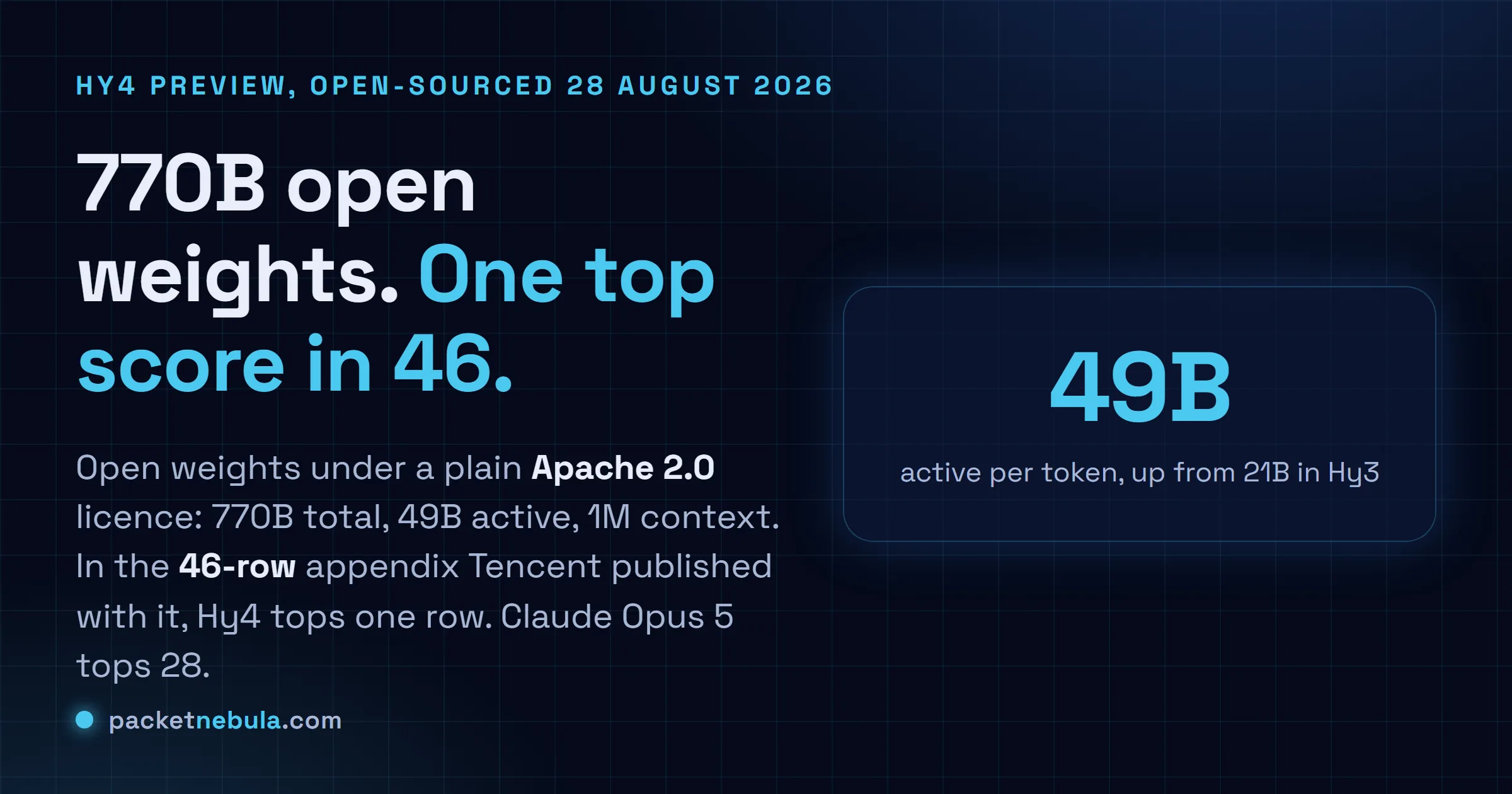
Tencent open-sourced Hy4 preview on 28 August: 770B parameters, 49B active, 1M context, permissive licence. The generational jump over Hy3 is enormous and real. The frontier claim is thinner: in Tencent’s own 46 row appendix, Opus 5 takes 28 rows and Hy4 takes one. Against the open field it does much better.
We counted the appendix
Tencent’s README says Hy4 preview lands “at the open-source frontier” off the back of the largest generation gain it has measured. The first half of that is a positioning claim. The second half is a number, and both are checkable, because Tencent shipped the whole comparison table rather than a curated four.
So we counted. Forty-six benchmark rows, eight columns: Hy3, Hy4 preview, DeepSeek V4 Pro 0813, Qwen 3.8 Max, GLM 5.3, Kimi K3, GPT 5.6 Sol, Claude Opus 5. Where a cell holds two numbers we took the starred one, which Tencent’s own footnote defines as its own testing rather than a vendor report. Then we asked a boring question of every row: who has the highest number here.
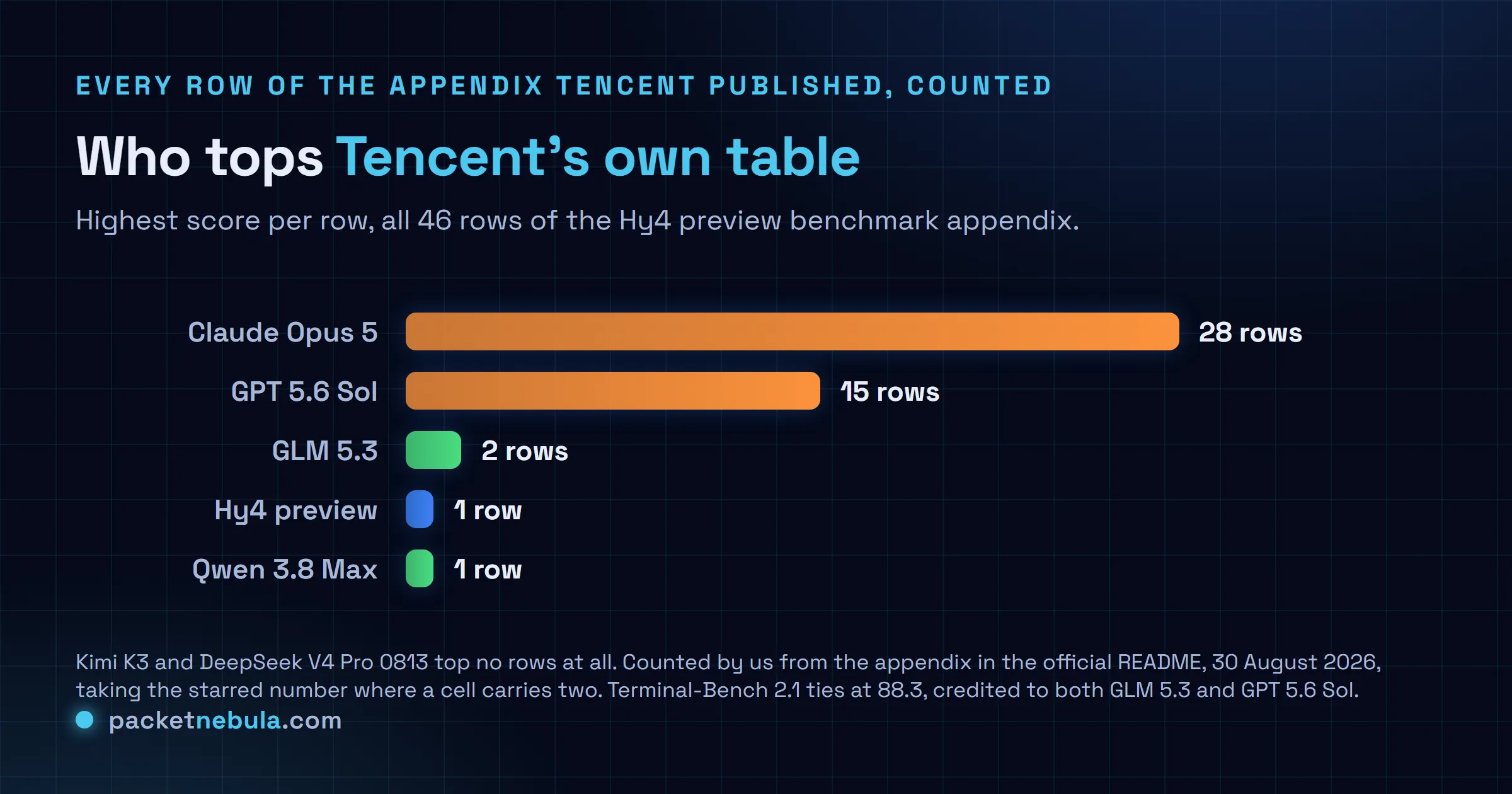
One row. SWE Atlas Codebase Q&A, where Hy4 preview posts 64.0 against 58.1 for GPT 5.6 Sol, and that is a proper win, not a rounding one. Everywhere else somebody else is ahead.
The internal benchmarks are the part that made us look twice. Tencent built Hy-SWE Max Verified and Hy-CompanyBench V2 in house, on its own tasks, presumably reflecting the work it cares about most. Hy4 preview comes last on both. Last. On Hy-SWE Max Verified it posts 64.2 while every one of the six rivals sits between 65.2 and 70.1. Publishing that took some nerve, and I’d rather have a lab that prints it than one that quietly drops the column.
The frontier claim, read properly
Now the fair part, because that count on its own is misleading.
Opus 5 and GPT 5.6 Sol are closed. You cannot download either, you cannot fine-tune either, and the price of losing to them is a monthly bill rather than a design decision. Strip those two columns out, compare Hy4 preview against the four models it is genuinely shipped alongside, and it leads on 17 of the 46 rows with two ties. Not the frontier. A solid top-of-the-open-pack position, which is roughly what Tencent’s phrasing technically claims.
Where it leads is coherent too, and that usually means the training worked rather than the harness leaked. It takes the whole SWE Atlas family, both agentic search rows we would care about, JobBench, both E-Bench variants. Codebase comprehension and long messy workflows, in other words. Where it falls over is single-shot hard reasoning: CritPt 16.9 against 32.3 for GPT 5.6 Sol, MathArena Apex 74.2 against 91.4 for Opus 5, ProgramBench 17.5 against 39.5.
The generational jump is the real headline

Image: Tencent Hy Team, from the Hy4 preview README
Look at how that chart is built. The blue bar is two tone on purpose: the pale section is Hy3, the bright section is what Hy4 preview added on top. The grey bars are everyone else, sorted low to high. It is a chart about a jump, not about a lead, and once you see that, the framing is honest.
The jump is genuinely big. DeepSWE goes 28.0 to 64.3. SWE-Marathon 5.0 to 31.9. MathArena Apex 2025 38.7 to 74.2. E-Bench 48.5 to 77.1. Seven weeks after Hy3 shipped at 295B, the successor is 2.6 times the size and roughly twice as capable on agentic coding. Tencent also ran a blind side by side, 163 internal staff on 203 engineering tasks, and reported 2.99 against 2.92 for GLM 5.3 with a 46.8% win rate, 12.8% ties and 40.4% losses. Their own employees, their own tasks, a 0.07 margin on a four point scale. Read that as parity, not a victory.
Architecture, and the bill
The attention module is the detail worth your time. Tencent says it is “inspired by DeepSeek and GLM” and ships Gated DeepSeek Sparse Attention with IndexCache for cross layer sparse index reuse, plus identity Hyper-Connections on the residual path. A flagship Chinese lab putting a rival lab’s published attention mechanism, by name, in its top model. That is how a 1M context gets affordable, and it says something healthier about this ecosystem than any benchmark row does.
The rest is conventional at a large scale: 78 layers, the first dense and the other 77 mixture of experts, 256 routed experts plus one shared, top-8 firing per token, hidden size 6144, 120,832 vocabulary. A separate 10B MTP layer handles speculative decoding.
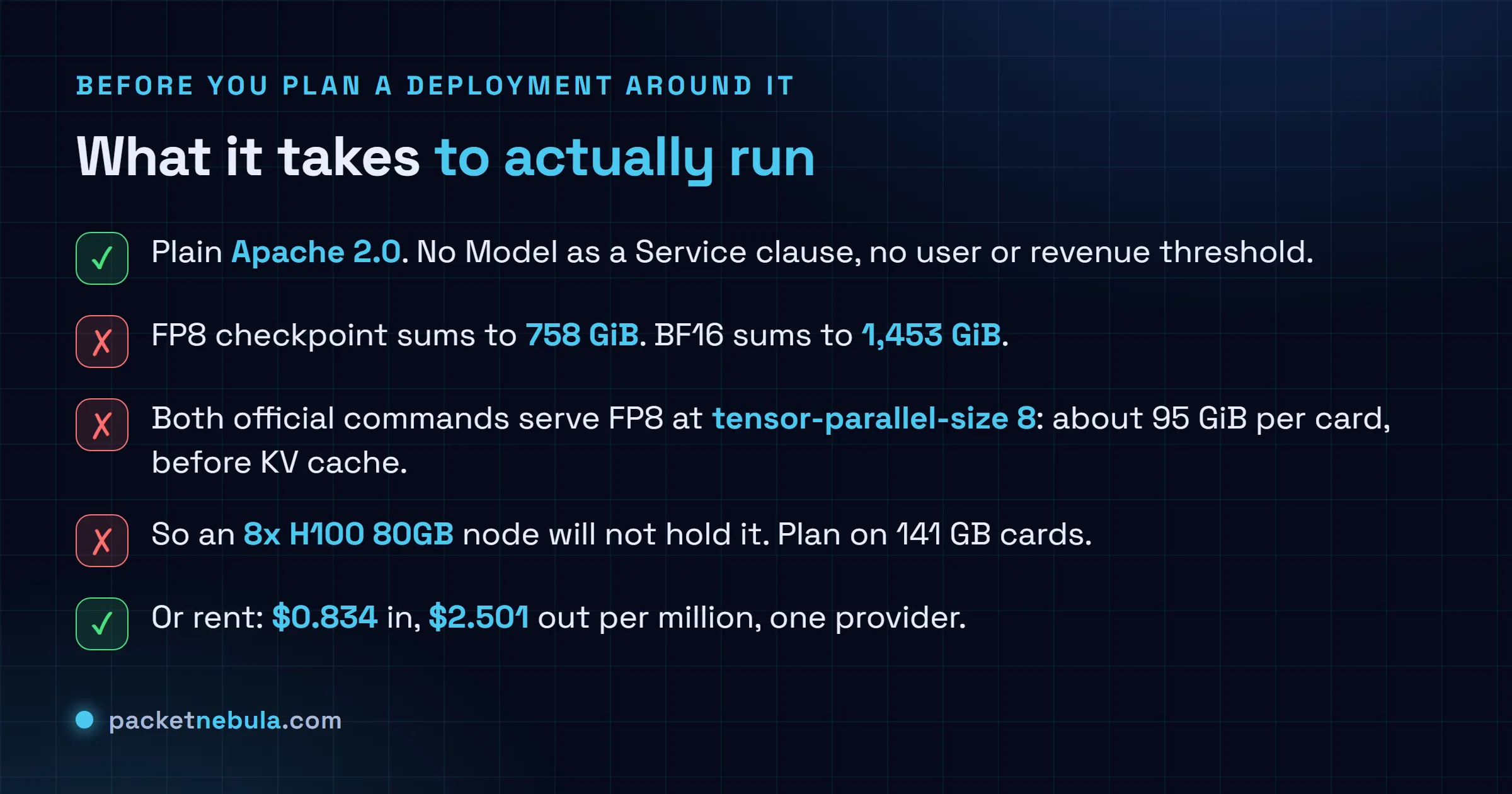
Now the metal. We summed the Hugging Face repository files on 30 August: 758 GiB for the FP8 checkpoint, 1,453 GiB for BF16. Both of Tencent’s own Docker commands serve the FP8 build at --tensor-parallel-size 8, which is about 95 GiB of weights per accelerator before you allocate a single token of KV cache. An eight card H100 80GB box does not fit that, so the recommended config quietly assumes 141 GB cards or better. Kimi K3 landed in the same territory, and the pattern is now the norm: the licence is free, the node is not.
If you would rather rent, OpenRouter lists $0.834 per million in and $2.501 per million out, single provider, completions capped at 64,000 tokens.
Would we use it
For long agentic work over a big codebase, yes, it earns an evaluation, and the SWE Atlas and search rows are why. For hard one-shot reasoning, no. The appendix says so plainly, and you would be paying for a lot of parameters to lose to something cheaper.
If you are picking an open model to self-host this quarter, the honest comparison was never Hy4 against Opus 5. It is Hy4 against DeepSeek V4 Pro, GLM 5.3 and Kimi K3, on your tasks, with your harness. Tencent’s own appendix says that race is close. Close enough that a vendor table should not be the thing that decides it.
Sources
Model weights, architecture table and licence: tencent/Hy4-preview on Hugging Face. Benchmark appendix, blind evaluation figures and serving commands: the Tencent-Hunyuan/Hy4-preview repository README. Announcement: Tencent Releases and Open-Sources Tencent Hy4 preview, with coverage at TechNode. API pricing: tencent/hy4-preview on OpenRouter. The 46 row count and the checkpoint sizes are ours, taken from the appendix image and the Hugging Face API on 30 August 2026.
Frequently asked questions
What is Tencent Hy4 preview?
Hy4 preview is Tencent's new flagship mixture-of-experts language model, open-sourced on 28 August 2026 under the Apache 2.0 licence. It has 770B total parameters with 49B activated per token, 78 layers, 256 routed experts plus one shared expert per MoE layer, a 1M token context window and a built-in MTP layer for speculative decoding. Weights are on Hugging Face, ModelScope, GitCode and CNB.
How does Hy4 preview compare to Hy3?
It is 2.6 times the total size (770B against 295B), 2.3 times the active parameters (49B against 21B) and four times the context (1M against 256K). The benchmark gains are large: DeepSWE goes from 28.0 to 64.3, SWE-Marathon from 5.0 to 31.9, MathArena Apex 2025 from 38.7 to 74.2. Tencent calls it the largest generation-over-generation gain it has measured, and on its own numbers that looks fair.
Does Hy4 preview beat GPT 5.6 Sol and Claude Opus 5?
Not on Tencent's own appendix. We counted the top score in each of the 46 benchmark rows: Claude Opus 5 leads 28, GPT 5.6 Sol leads 15, and Hy4 preview leads one, SWE Atlas Codebase Q&A, at 64.0 against 58.1 for the next best. Both of those rivals are closed models, so the "open-source frontier" wording is narrower than the launch chart suggests.
Can I run Hy4 preview myself?
Only on serious hardware. We summed the Hugging Face repository files on 30 August 2026: the FP8 checkpoint is about 758 GiB and the BF16 one about 1,453 GiB. Tencent's own vLLM and SGLang commands both serve the FP8 build at tensor-parallel-size 8, which works out to roughly 95 GiB per accelerator before any KV cache. An eight card H100 80GB node will not hold it.
How much does Hy4 preview cost through an API?
OpenRouter lists $0.834 per million input tokens and $2.501 per million output on 30 August 2026, with $0.042 per million for cache reads. One provider serves it, Tencent Cloud. The context is 1,048,576 tokens but completions are capped at 64,000 on that endpoint. The weights themselves are free under Apache 2.0.


