




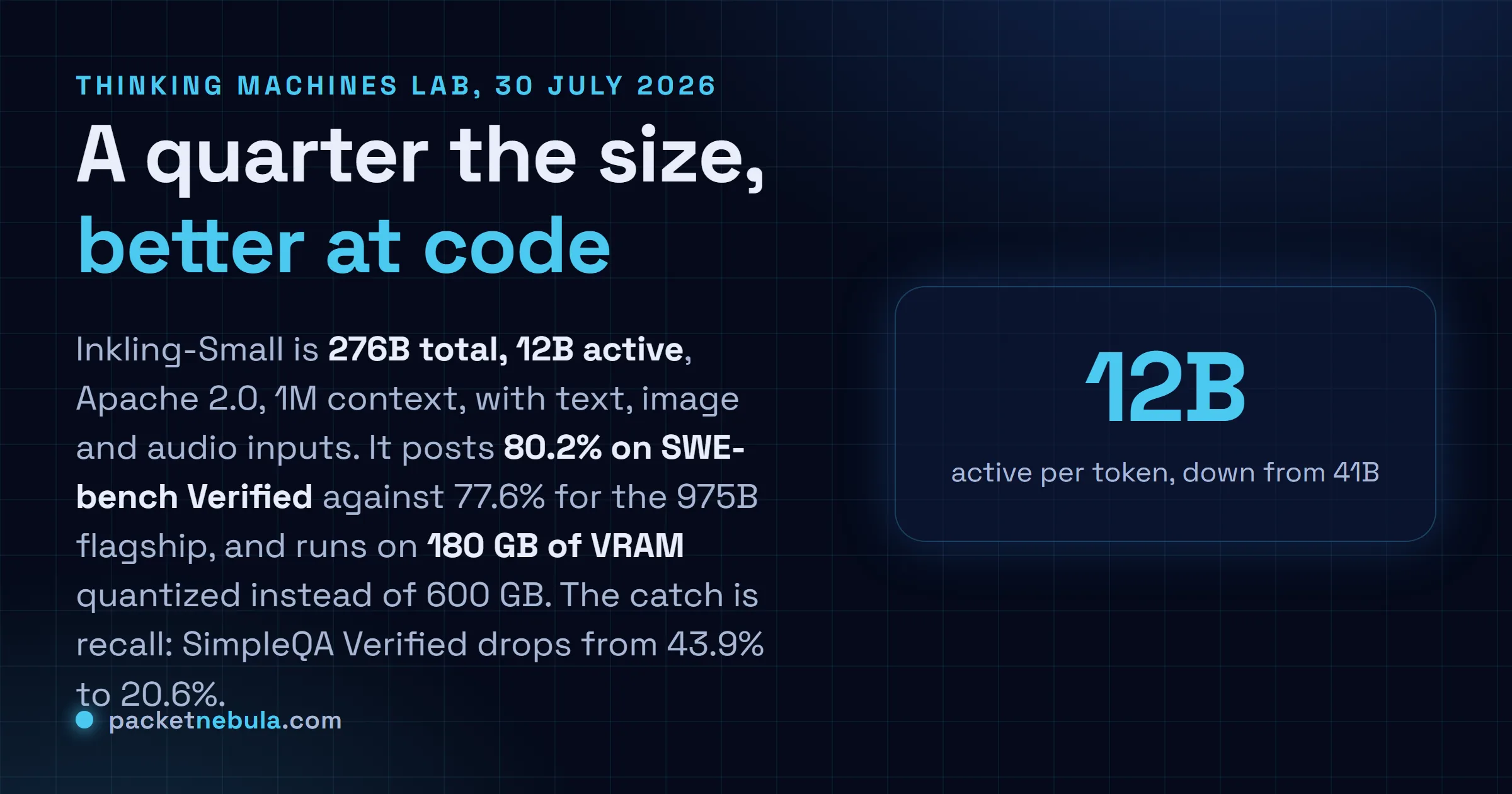
Two weeks ago we said the honest problem with Inkling was that you probably couldn't run it. Two terabytes of VRAM will do that. Thinking Machines seems to have agreed, because on 30 July it shipped Inkling-Small: 276B total parameters, 12B active, Apache 2.0, a million tokens of context. Then the part we didn't expect. It beats its own 975B parent on SWE-bench Verified and on Terminal-Bench 2.1, while asking for roughly a third of the memory. Free lunch? No. The same shrink that gained it two and a half points on SWE-bench cost it more than half its factual recall, and a third of its score on multi-turn banking tool use. Parameters store facts. Take 700B of them away and the facts leave too.
The short answer
Inkling-Small is a quarter the size of the Inkling flagship and better at agentic coding than it. The trade is recall: factual questions and long tool-use conversations both fall hard. If your workload retrieves what it needs, this is the better model and a third of the metal. If it expects the weights to know things, it isn’t.
What actually shipped
Thinking Machines published Inkling-Small on 30 July, weights on Hugging Face, Apache 2.0, with a Model Acceptable Use Policy sitting alongside the licence. The architecture is a 42-layer decoder-only transformer with a sparse mixture-of-experts feed-forward stack. Each token goes to 6 of 256 experts, plus 2 shared experts that always fire. Attention alternates local and global layers.
276B total, 12B active. The 975B flagship from July ran 41B active across 66 layers, so this isn’t a distillation of the big one so much as a smaller sibling built on the same recipe.
Everything else carried over. A context window up to 1M tokens. Text, images and audio in, text out, with the same encoder-free multimodal handling. The thinking-effort dial that we liked in July is still there, still exposed as named levels, and it matters more here: at 12B active per token, the reasoning tokens you spend cost about a third of what they did.

Image: Thinking Machines Lab
It gained code and lost facts
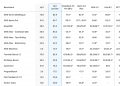
Here’s where it gets interesting. The lab’s own headline claim is that Inkling-Small reaches comparable performance at a quarter the size, and that it edges the flagship on Humanity’s Last Exam, 31.6% against 29.7%.
That undersells one half of the story and hides the other.
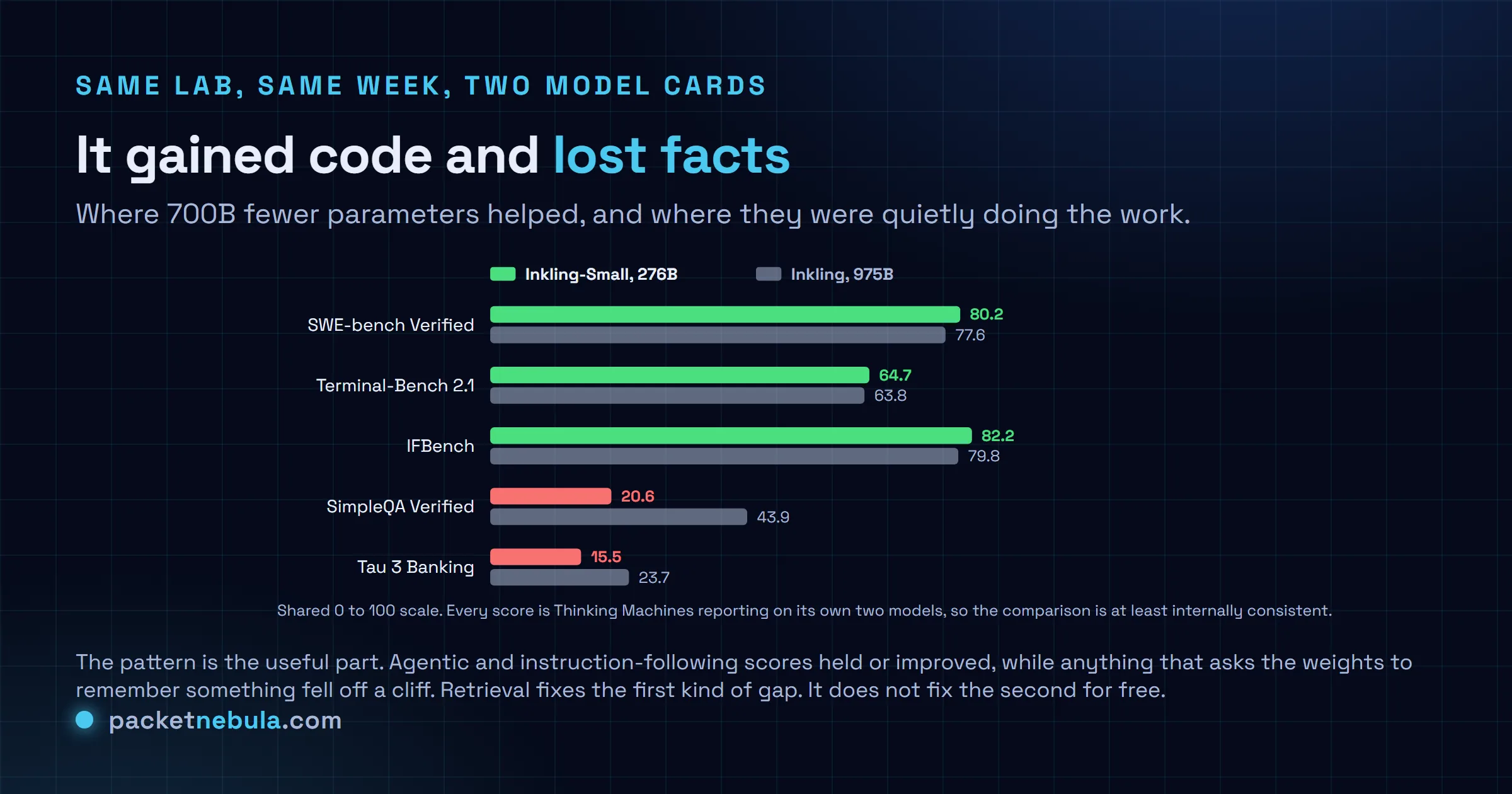
The wins are all in the same family. Agentic coding, terminal work, instruction following. SWE-bench Verified goes 77.6 to 80.2, Terminal-Bench 2.1 goes 63.8 to 64.7, IFBench 79.8 to 82.2. None of those are huge, but they all point the same way, and a smaller model beating a bigger one from the same lab on any of them is worth a raised eyebrow.
Then SimpleQA Verified: 43.9 down to 20.6. That’s less than half. Tau 3 Banking, which measures multi-turn tool use inside a policy, goes 23.7 to 15.5.
We think the read is fairly plain. Skills that live in the reasoning loop survived the cut. Anything that needs the weights themselves to hold a fact did not, because that’s exactly what the missing 700B parameters were storing. Nice to see it this cleanly isolated, honestly, since both numbers came from the same lab in the same fortnight.
Which one you care about depends entirely on what sits in front of the model. Give it a codebase, a shell and a search tool, and 20.6 on SimpleQA barely registers. Ask it to answer from memory in a support flow and you’ve just halved your accuracy to save some GPUs.
Tau 3 is the number we’d actually worry about. Multi-turn tool use is what everyone is building right now, and 15.5% is low in absolute terms, not just relative to the flagship. Neither model looks good there.
Small is doing a lot of work in that name
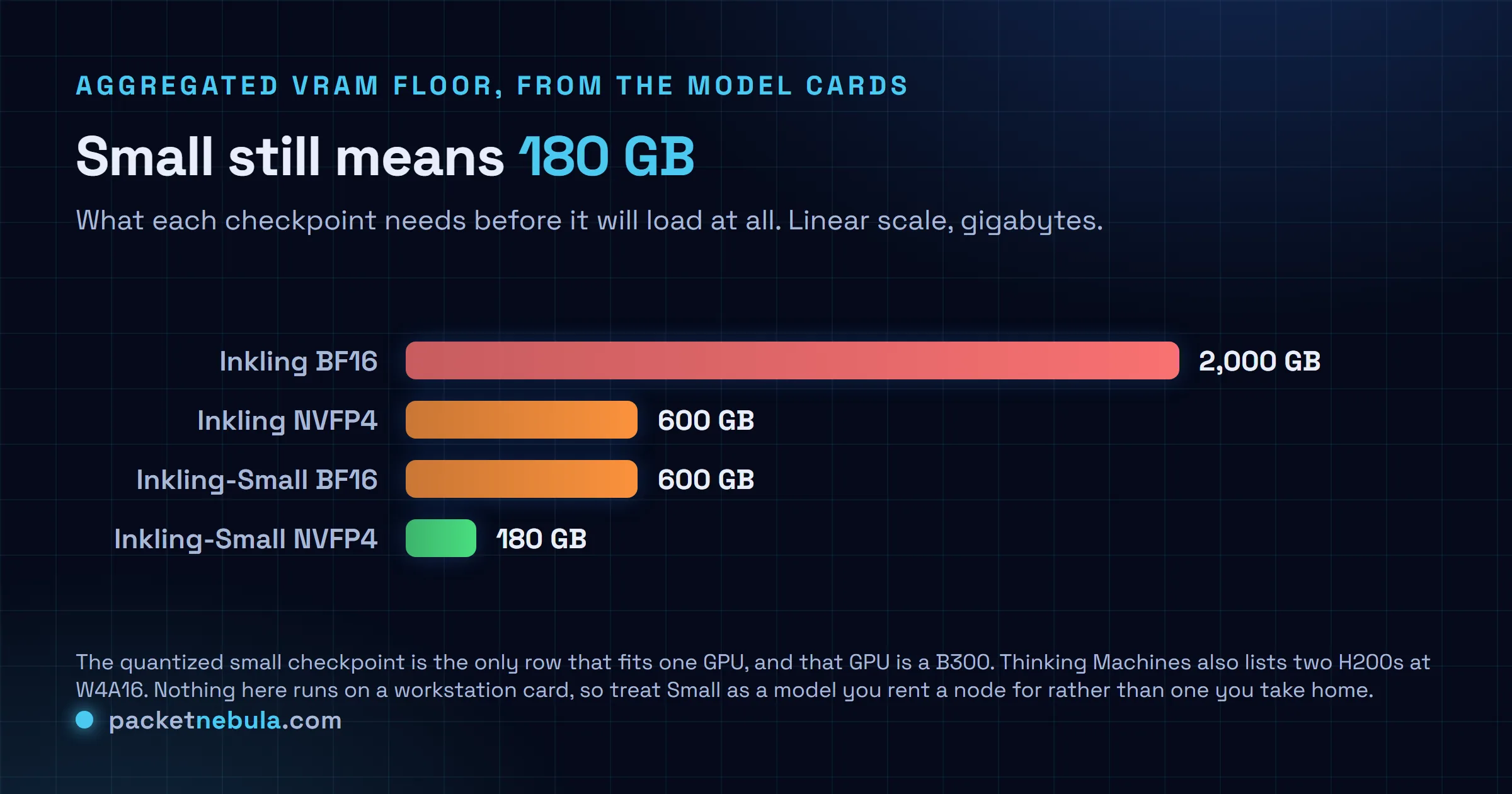
Straight from the model card: BF16 wants at least 600 GB of aggregated VRAM, so 4 B300s or 8 H200s. The NVFP4 checkpoint wants at least 180 GB, which is W4A4 on one B300, or W4A16 on a pair of H200s.
One GPU. That’s a real milestone for a model this capable, and it’s the first time a Thinking Machines checkpoint fits on a single card at all.
It’s also a card that costs more than a house deposit. Nobody is running this next to their editor. If you want weights on hardware you actually own, the honest answer is still a much smaller model, and our notes on running Qwen 3.7 offline haven’t changed. What Inkling-Small changes is the rental bill: a single-node deployment instead of a four or eight-GPU cluster, and 12B active parameters burning per token instead of 41B. For anyone serving this at volume, that second number is the one that shows up on the invoice.
When we’d reach for it
If you’re already serving open weights for agentic coding and you have retrieval in the loop, Inkling-Small looks like a straight upgrade on cost. Same or better scores on the tasks you’re running, a quarter of the parameters, single-node inference.
If your product answers questions from the model’s own knowledge, keep the flagship, or keep whatever closed model you’re paying for. The SimpleQA gap isn’t a rounding error and no amount of prompting closes it.
And if you’re comparing this against the rest of the open field rather than against its own parent, the picture is less flattering than the launch post suggests. GLM-5.2 still leads on the long-horizon coding benchmarks, and DeepSeek-V4-Flash-0731 posts a much higher Terminal-Bench figure on its own harness. Every one of these numbers is self-reported by the lab that shipped the model, on its own harness, which is the caveat we end up writing every single time.
One thing we can’t check yet: nobody outside the lab has published independent evals of Inkling-Small. Artificial Analysis put it within a point of the flagship on its Intelligence Index, and that’s the only third-party read we found. Give it a fortnight.
Sources
Thinking Machines Lab, Introducing Inkling-Small, 30 July 2026, and the Inkling-Small model card for architecture, hardware and benchmark tables. The flagship figures come from the Inkling model card. Cross-checked against TestingCatalog and XenoSpectrum. Announcement artwork is Thinking Machines Lab’s own, reproduced as a credited citation.
Frequently asked questions
What is Inkling-Small?
Inkling-Small is the second open-weights model from Thinking Machines Lab, released 30 July 2026 under Apache 2.0. It is a 42-layer sparse mixture-of-experts transformer with 276B total parameters and 12B active per token, routing each token to 6 of 256 experts plus 2 shared experts. It takes text, images and audio, returns text only, and supports a context window of up to 1M tokens.
Is Inkling-Small better than the 975B Inkling?
On agentic coding, yes. Thinking Machines' own model cards put Inkling-Small at 80.2% on SWE-bench Verified against 77.6% for Inkling, 64.7% against 63.8% on Terminal-Bench 2.1, and 82.2% against 79.8% on IFBench. It is clearly worse at recall and at long tool-use conversations: SimpleQA Verified falls from 43.9% to 20.6%, and Tau 3 Banking from 23.7% to 15.5%.
What hardware do I need to run Inkling-Small?
The BF16 checkpoint needs at least 600 GB of aggregated VRAM, which the model card lists as 4 Nvidia B300s or 8 H200s. The NVFP4 quantized checkpoint drops that to at least 180 GB, running W4A4 on a single B300 or W4A16 on two H200s. No consumer or workstation GPU gets close, so this is a rented node rather than a desktop model.
Does Inkling-Small still have the thinking effort dial?
Yes. The same controllable thinking effort carries over, exposed as named levels from minimal up to xhigh, so you trade reasoning tokens against latency and cost without swapping models. With 12B active parameters instead of 41B, each of those reasoning tokens is also cheaper to generate.
Where can I get the weights?
Full weights are on Hugging Face under Apache 2.0, with a separate Model Acceptable Use Policy layered on top. Fine-tuning runs on Thinking Machines' Tinker platform, which also hosts a playground chat that accepts text, images and audio.