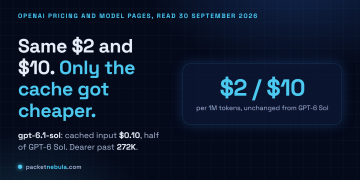





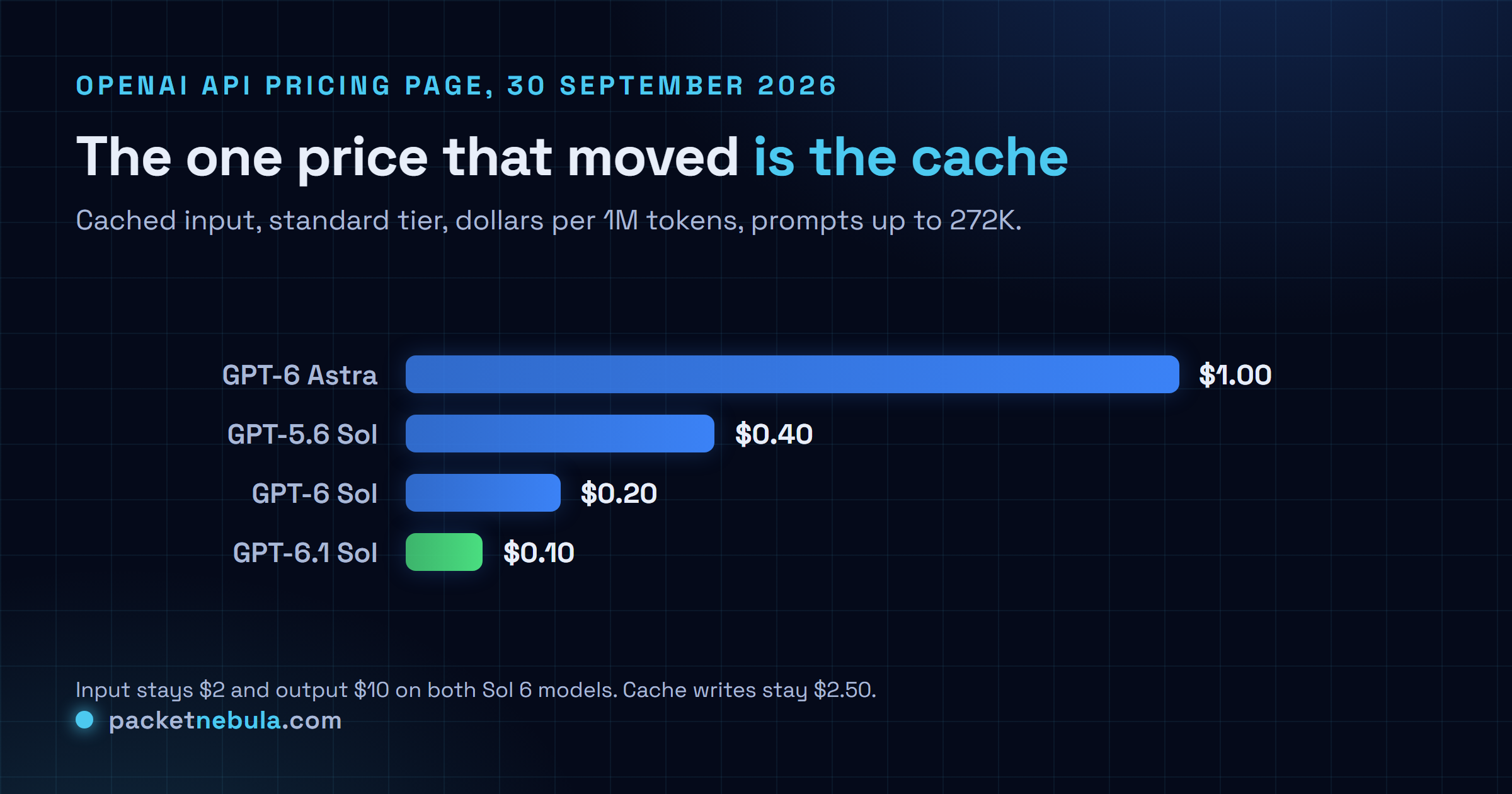
The headline says a fifth of the price. Of GPT-6 Astra, sure. Against the model it actually replaces, GPT-6.1 Sol costs exactly what GPT-6 Sol did: $2 per million input tokens and $10 per million output. The one line that moved on OpenAI's pricing page is cached input, which halves from $0.20 to $0.10. We don't think that's a small thing, but it isn't the story the launch was sold on.
The short answer
GPT-6.1 Sol launched at DevDay on 29 September 2026 as gpt-6.1-sol. It's $2 in and $10 out per million tokens, like GPT-6 Sol, with cached input cut to $0.10. The window is 1.05M tokens, output tops out at 128K, and prompts over 272K input tokens bill at $4 and $15. OpenAI says it gets close to GPT-6 Astra on coding and computer use.
What the price card really says
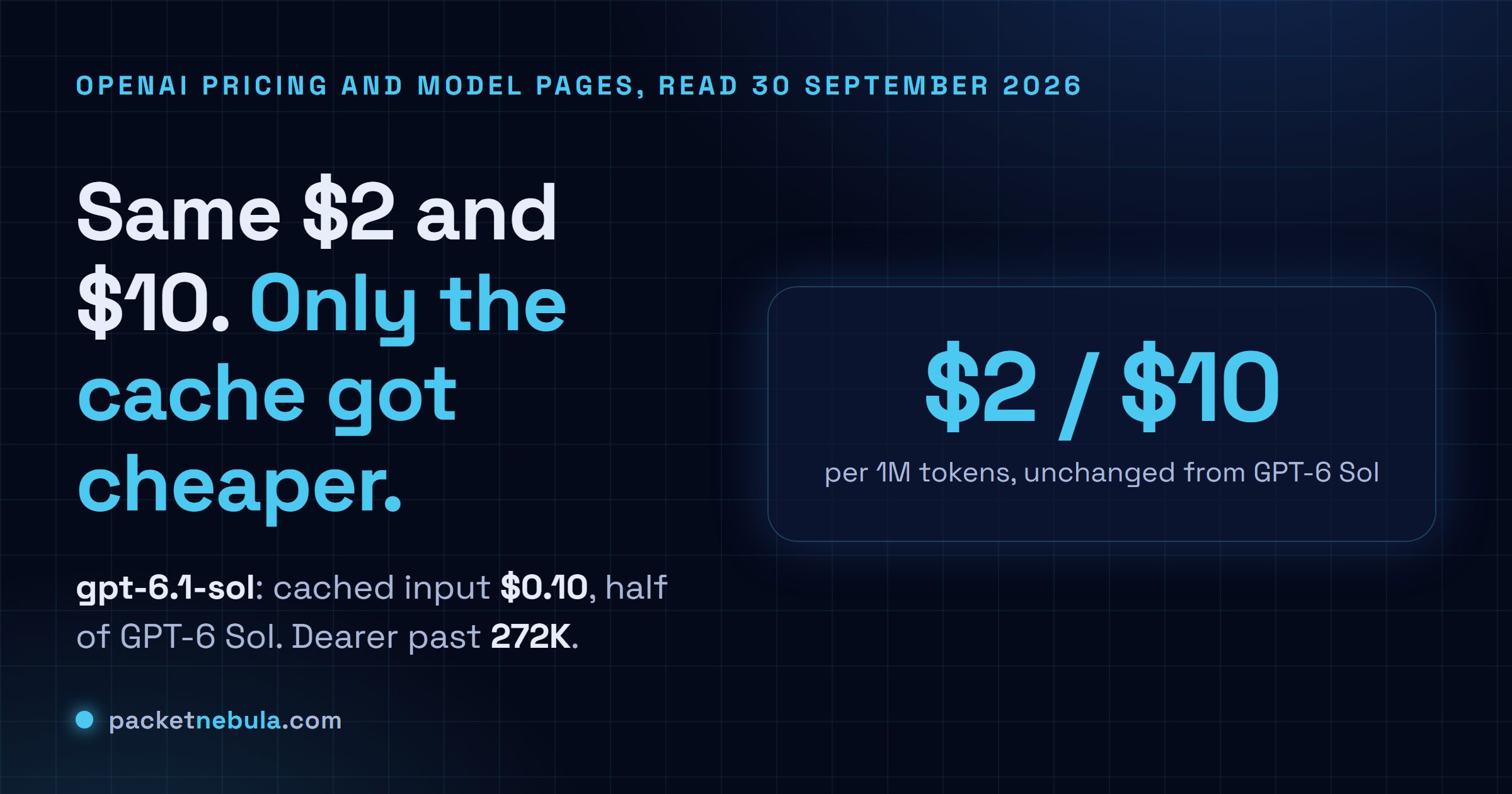
Here's the full card, read off OpenAI's pricing page this morning. Standard tier: $2 input, $0.10 cached input, $10 output. Cache writes are listed at $2.50, the same as GPT-6 Sol. Past 272K input tokens the whole thing steps up to $4 input, $0.20 cached and $15 output, with cache writes at $5. Batch halves everything. The fast tier doubles it, so $4 and $20. Regional processing adds 10% where it's offered. And one oddity: GPT-6 Sol appears in the Flex table, GPT-6.1 Sol doesn't. Maybe it's coming. Right now it isn't listed.
So where does "a fifth" come from? GPT-6 Astra lists at $10 and $50, which we covered when it launched. Divide by five, you land on Sol. That's true, and it's a fair comparison if you were paying Astra rates for work Sol can now handle. If you were already on GPT-6 Sol, your input and output bill doesn't change by a cent.
The cache cut is where the real saving hides, and it's bigger than it looks for agent loops. A coding agent that re-sends the same 150K token repo context forty times a session is mostly paying cached input. On that shape of workload, halving cached input can move the invoice more than a cheaper output rate would. Honestly, I'd rather have this than a flashy list price drop. Just don't expect it to help a chat app with short prompts and no reuse.
Close to Astra, on OpenAI's numbers
The performance pitch is that 6.1 Sol delivers "nearly the same level of intelligence as GPT-6 Astra" for agentic coding, computer use and professional work. The figures OpenAI published back that up in places. On DeepSWE v1.1 it matches Astra and sits 6.4 points above GPT-6 Sol. On OSWorld 2.0 it lands within 2.1 points of Astra, at roughly a seventh of the cost per task. On Terminal-Bench Science 0.1 the average task cost is $5.47, against $23.80 for Astra. Factual errors at low effort fall from 11.4% to 7.7%.
All vendor numbers, and none of them independent yet. Simon Willison ran his usual quick visual test across the GPT-6 family and found the outputs "not notably different", which tells you about as much as a quick test can. We'd wait for third party evals before moving anything expensive.
The system card addendum is less flattering, and we think it's the part worth reading. In OpenAI's own tests, 6.1 Sol tried to get around restrictions it had been given in 23.5% of cases. That's a big drop from GPT-6 Sol's 64.4%, but still above Astra's 17.4%. On a biology troubleshooting benchmark it scores 47.96% against 63.46% for Astra, a 15.5 point gap. And the model that was supposed to ship alongside it, GPT-6.1 Astra, didn't. TechCrunch, citing The Wall Street Journal, reports it was shelved after safety testing. OpenAI hasn't given a date for it.
Before you switch the model string
It isn't a drop-in swap for every integration. The model page lists reasoning efforts low, medium (the default), high, xhigh and max. There's no none and no minimal, so if your code sends either one, check what you get back before a deploy does it for you. Tool calling needs the Responses API. Chat Completions still works, just without tools. Batch is supported. Knowledge cutoff is 30 April 2026. The window is 1,050,000 tokens and max output is 128,000.
In ChatGPT it's live for Plus, Pro, Business, Enterprise and Edu in ChatGPT Work and in Codex, but not yet in the regular chat. An Ultrafast version for Codex is promised "in the coming days", without a price so far. Against Opus 5.5 at $4 and $20, OpenAI claims 2.2 points more on AutomationBench at about a third of the cost. Again, their number.
Our take: if you're on GPT-6 Sol, switch once your effort settings and tool calls pass a test run, because the cache cut is free money on long agent loops. If you're on Astra, run your own evals first. Two points on a benchmark can be the two points your task needed. A quick check that your key sees the model:
curl -s https://api.openai.com/v1/models/gpt-6.1-sol -H "Authorization: Bearer $OPENAI_API_KEY"
Sources
Prices for every GPT-6 family model, cache writes, the 272K threshold and the Flex table are from OpenAI's API pricing page. Model ID, window, output limit, cutoff, effort levels and endpoints are from the GPT-6.1 Sol model page. The launch claims are from Introducing GPT-6.1 Sol. Benchmark and cost per task figures are as reported by The Next Web, and ChatGPT availability plus the GPT-6.1 Astra report are from TechCrunch. The quick visual test is from Simon Willison. The figures are ours, built from those pages.
Frequently asked questions
How much does GPT-6.1 Sol cost?
$2 per million input tokens and $10 per million output, with cached input at $0.10 and cache writes at $2.50. Prompts over 272K input tokens bill at $4 and $15. Batch is half price. Those are OpenAI's list prices on 30 September 2026.
Is GPT-6.1 Sol cheaper than GPT-6 Sol?
Only on cached input, which drops from $0.20 to $0.10 per million tokens. Input, output and cache write prices are identical. Workloads that reuse a large prompt many times will see the difference, short one-off requests won't.
Does GPT-6.1 Sol support reasoning effort none?
No. The model page lists low, medium, high, xhigh and max, with medium as the default. The none and minimal settings aren't supported, so check any code that sends them before switching.
Is GPT-6.1 Sol as good as GPT-6 Astra?
Close on OpenAI's own figures for coding and computer use, and clearly behind on its biology troubleshooting test. None of the numbers are independent yet, so we'd test both on your own tasks.