
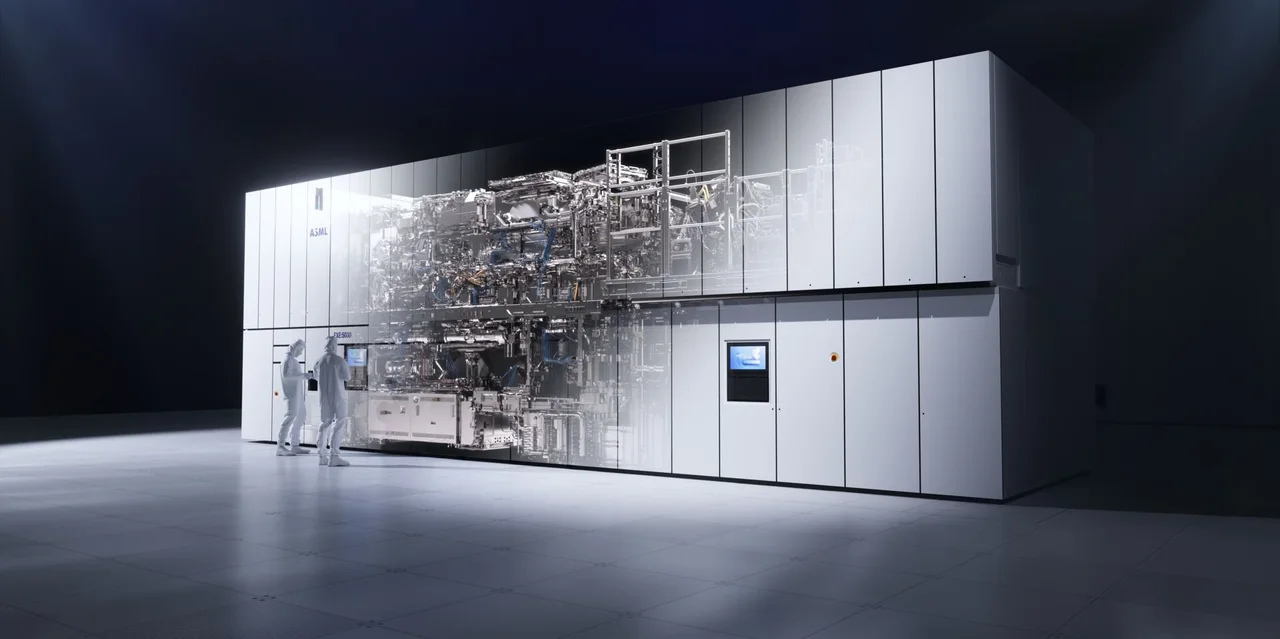
A hedge fund that lost roughly two thirds of its value in July just wrote a $400 million cheque for a company nobody has seen a product from. Bloomberg named the recipient on 8 August: Source Foundry, a stealth startup founded last year by two Stanford researchers, now valued at $5 billion, building tools for lithography. The pitch is the biggest one in hardware, which is that ASML should not be the only company on Earth capable of printing a leading edge chip. We think the bet is defensible and most of the coverage is not. Because $500 million, the total Situational Awareness has now put in, is roughly what a single High-NA EUV scanner costs to install. So this is a research programme with a valuation stapled to it. Worth watching anyway, and not for the reason the headlines suggest.
The short answer
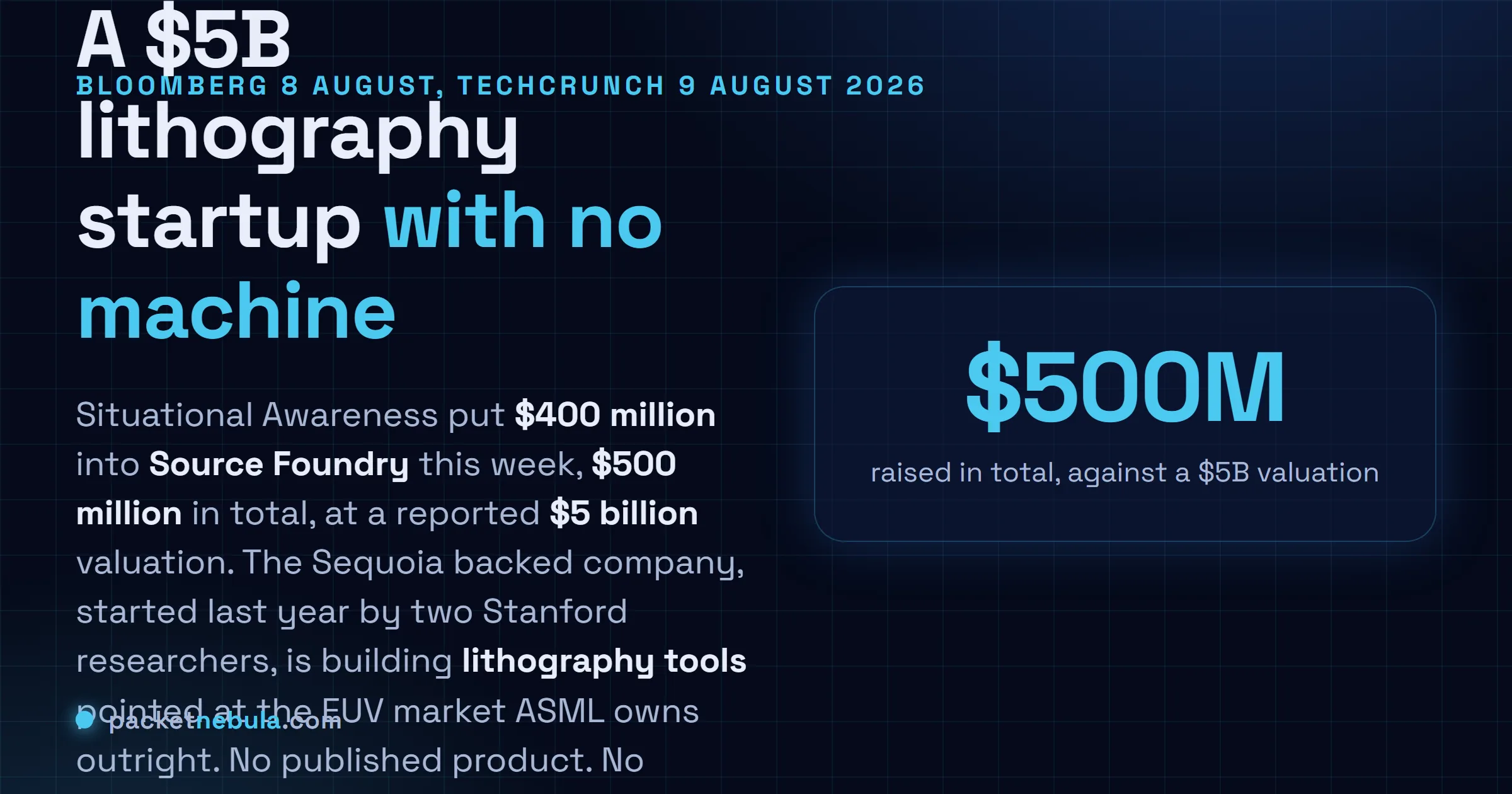
Situational Awareness put $400 million into Source Foundry, taking its total to $500 million at a reported $5 billion valuation. The company was founded last year by Stanford researchers Abdulmalik Obaid and Joe Burg, it is backed by Sequoia, and it is building lithography tools aimed at the EUV market ASML owns. No product, wavelength or timeline has been published. The money is roughly the price of one machine from the incumbent, so read it as a research budget rather than a competitive threat.
What actually got reported
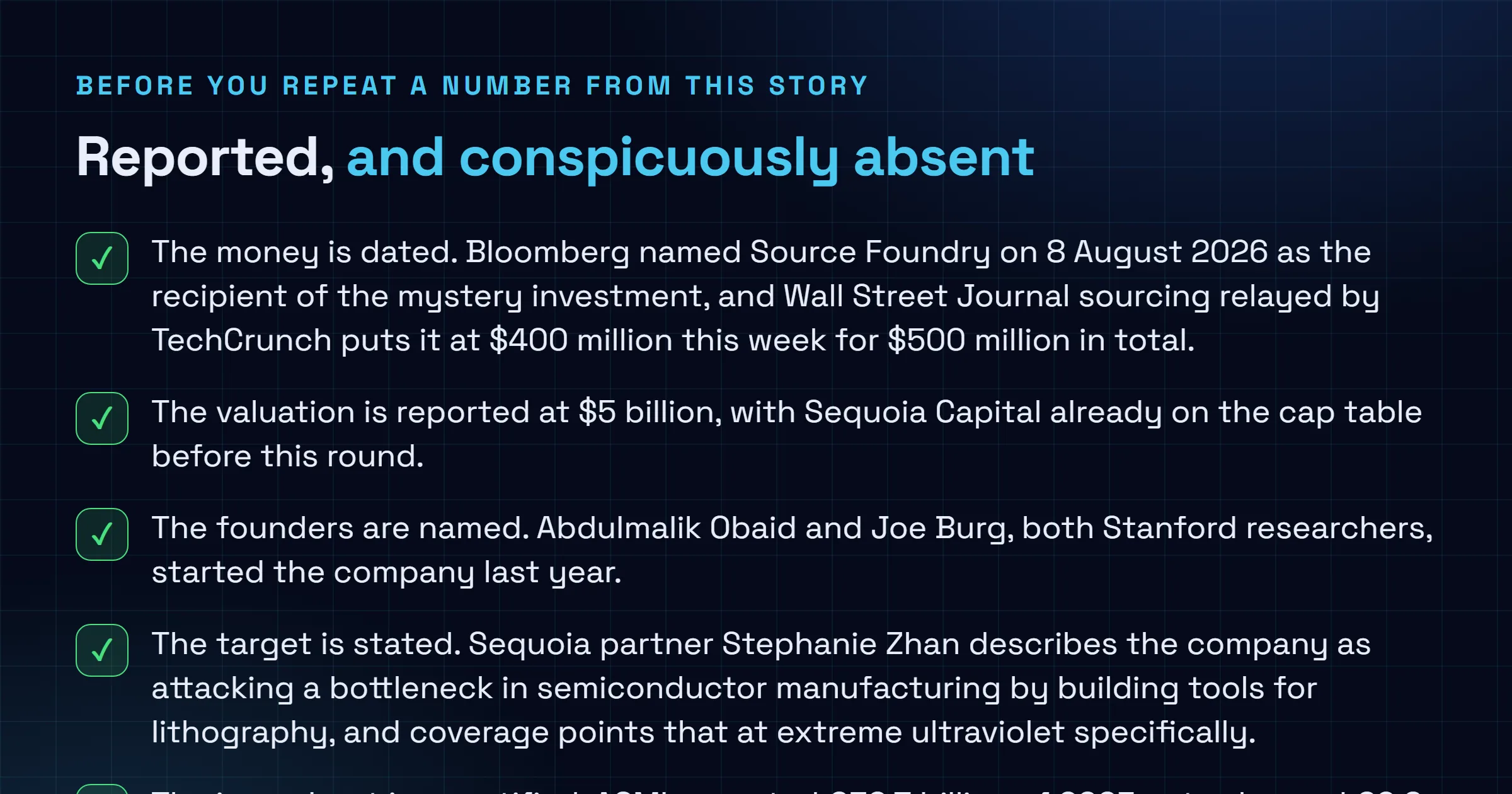
Bloomberg broke the identification on 8 August. Situational Awareness had made a large private investment that it had not named, and the recipient turned out to be Source Foundry. TechCrunch followed on 9 August with Wall Street Journal sourcing putting the new money at $400 million, and the fund’s cumulative position at $500 million.
Source Foundry started last year. The founders are Abdulmalik Obaid and Joe Burg, both out of Stanford, and Sequoia was already on the cap table. The latest round values the company at $5 billion. Sequoia’s Stephanie Zhan frames the work as attacking a bottleneck in semiconductor manufacturing by developing tools for lithography, and every write-up then points that at extreme ultraviolet, because that is the bottleneck everybody means.
That’s the whole confirmed story. No wavelength. No light source approach. Nothing about whether they are chasing a full scanner or one subsystem inside somebody else’s.
Five hundred million dollars is one machine
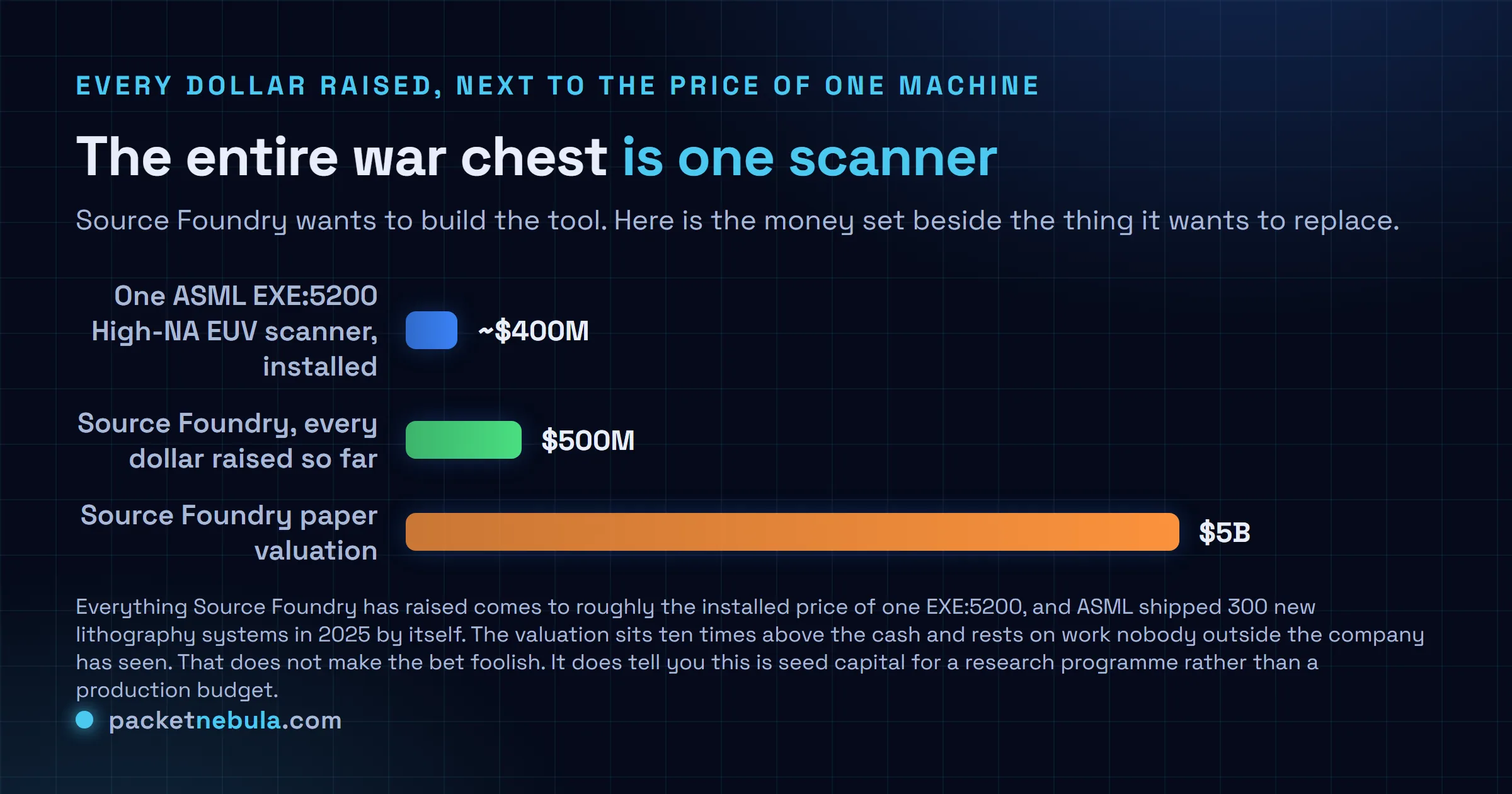
Here’s the comparison that reframes the story. A single ASML EXE:5200 High-NA scanner runs somewhere around $400 million installed, and fewer than a dozen exist anywhere. Source Foundry’s entire funding to date, across every investor, is $500 million.
So the war chest buys one of the things it intends to replace, with change left for a lease.
Run it against the incumbent’s operating rhythm and it gets starker. ASML reported €32.7 billion in net sales for 2025 and €9.6 billion of net income. It shipped 300 new lithography systems that year plus 27 used ones. Its own guidance puts R&D at roughly €1.2 billion for the first quarter of 2026, so Source Foundry’s total raise is about five weeks of ASML research spending. That is not a knock on the founders. It’s just what the gap looks like when you write it down.
The hard part was never the money
EUV is not one clever machine. It’s a stack of separately absurd engineering problems, and ASML’s advantage is that it either owns or has spent decades welding together the suppliers who solved them.
The light comes from firing a high power laser at droplets of molten tin tens of thousands of times a second, turning them into plasma that radiates at 13.5 nanometres. Nothing focuses that wavelength by refraction, because everything absorbs it, so the optics are multilayer mirrors polished to a flatness that has become the standard cliché of the industry. Then the whole thing has to hold that precision, in vacuum, on a stage moving wafers at production speed, for years.
Any one of those is a company. Buying your way through all of them at once, on $500 million, is not a plan anyone credible would pitch. Which is why I suspect the actual bet is narrower than the ASML challenger framing implies. Maybe a metrology tool, maybe a source, maybe something upstream that makes existing scanners cheaper to run. A component win would be a good outcome, and it would still not read as a headline.
Worth remembering that the last serious attempt to build an alternative EUV path folded into ASML rather than beating it.
Who is writing the cheque, and why that matters
Situational Awareness is not a normal semiconductor investor. Leopold Aschenbrenner started it in 2024 after leaving OpenAI, ran a concentrated long book on AI infrastructure, and had a very bad July. Reporting describes a drawdown near 67% and a forced sale of most of the public portfolio to Citadel. Mike Novogratz called it the most catastrophic hedge fund blowup of his career.
The numbers wobble depending on where you read. TechCrunch puts the fund at $20 billion before and about $10 billion after. CNBC’s coverage of the fire sale worked from a $45 billion peak. Either way the fund kept its private holdings, including a large Anthropic stake, and it is evidently still deploying into private AI infrastructure at scale.
So the $400 million is conviction from someone with an unusually specific thesis about compute scarcity. It is not diligence you can borrow. A fund that just took that kind of loss on AI hardware writing a nine figure private cheque is, if anything, a reason to look harder at the technical claims rather than less.
Does this change anything for you
No. Not this year, probably not this decade.
Wafer capacity does not move because a stealth company raised money, and scanner lead times are set by ASML’s build rate rather than by anybody’s cap table. If you buy accelerators, your prices are still governed by packaging capacity and memory, which is the same squeeze that has been pushing consumer hardware prices up all year.
The interesting read is directional. Every serious AI operator has spent this year trying to own more of its own supply, whether that means standing up a fab of your own or quietly staffing a custom silicon team. Funding the machines that make the chips is the logical end of that anxiety. It’s also the hardest version of it.
What we’d watch for is boring and specific: a named evaluation partner. Lithography tools become real when a fab or a research institute agrees to put one on the floor and says so publicly. Until that happens, Source Foundry is a $5 billion valuation attached to a research programme, and the most honest thing anybody can say about the technology is that we don’t know what it is.
Sources
- TechCrunch, “Embattled hedge fund Situational Awareness invests $400M in chip startup Source Foundry”, 9 August 2026, for the $400 million this week, the $500 million cumulative figure from the Wall Street Journal, the Stanford founders, the Citadel sale and the retained Anthropic stake.
- Bloomberg, “Situational Awareness’s Mystery Investment Was to Source Foundry”, 8 August 2026, for the original identification of the recipient.
- Yahoo Finance, 9 August 2026, for the $5 billion valuation, the founder names Abdulmalik Obaid and Joe Burg, the Sequoia backing, the Stephanie Zhan description of the lithography target and the Novogratz quote.
- ASML, “ASML reports €32.7 billion total net sales and €9.6 billion net income in 2025”, 28 January 2026, for the 2025 results, the 300 new and 27 used lithography systems shipped, and the Q1 2026 R&D guidance of around €1.2 billion.
- Tom’s Hardware and TrendForce, 19 March 2026, for the High-NA EXE:5200 price of roughly $380 million to $400 million installed and the small number of units deployed worldwide.
- CNBC, 31 July 2026, for the July drawdown, the peak assets figure and the sale of the public portfolio to Citadel.
Frequently asked questions
What is Source Foundry actually building?
Tools for lithography, which is the step where circuit patterns get printed onto a silicon wafer. Sequoia partner Stephanie Zhan describes the company as going after a bottleneck in semiconductor manufacturing, and coverage points that at extreme ultraviolet, the wavelength ASML alone can sell into production today. Beyond that the company is in stealth. There is no published wavelength, no light source approach, no resolution target and no prototype. Anyone telling you how Source Foundry's machine works is guessing.
How much did Situational Awareness invest and when?
Wall Street Journal sourcing relayed by TechCrunch on 9 August 2026 puts it at $400 million this week, taking the fund's total in Source Foundry to $500 million. Bloomberg had identified the recipient of the fund's previously unnamed investment a day earlier, on 8 August. The round values Source Foundry at a reported $5 billion, and Sequoia Capital was already an investor before this money arrived.
Can a startup really compete with ASML?
Not soon, and the numbers say why. ASML booked €32.7 billion of net sales in 2025 with €9.6 billion of net income, shipped 300 new lithography systems that year, and guides around €1.2 billion of R&D for the first quarter of 2026 by itself. So Source Foundry's entire $500 million is about five weeks of the incumbent's research spending. EUV is also not one machine, it is a supply chain covering the tin plasma light source, the mirror optics and the high power lasers that drive it. The more realistic outcome is a component or a niche tool rather than a full scanner.
Why is a hedge fund leading a chip equipment round?
Because that fund is unusual. Situational Awareness was started in 2024 by Leopold Aschenbrenner, a former OpenAI researcher who is now 24, and it ran a concentrated long book on AI infrastructure. July 2026 went badly, with reporting describing a roughly 67% drawdown and a forced sale of the public portfolio to Ken Griffin's Citadel. The fund kept its private positions, notably its Anthropic stake, and is clearly still deploying into private AI infrastructure. Take the size of the cheque as conviction, not as validation of the technology.
Does this change chip supply or GPU prices?
No, and not for years. Nothing about a stealth company raising money alters wafer capacity, scanner lead times or what an accelerator costs you this quarter. The only near term effect is on ASML's narrative, since a credible funded challenger changes how people talk about a monopoly long before it changes what anybody can buy. If you want a real signal, watch for a named evaluation partner at a fab or a research institute.


