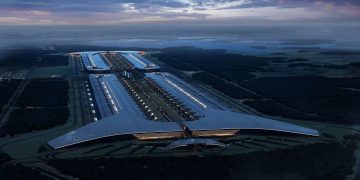





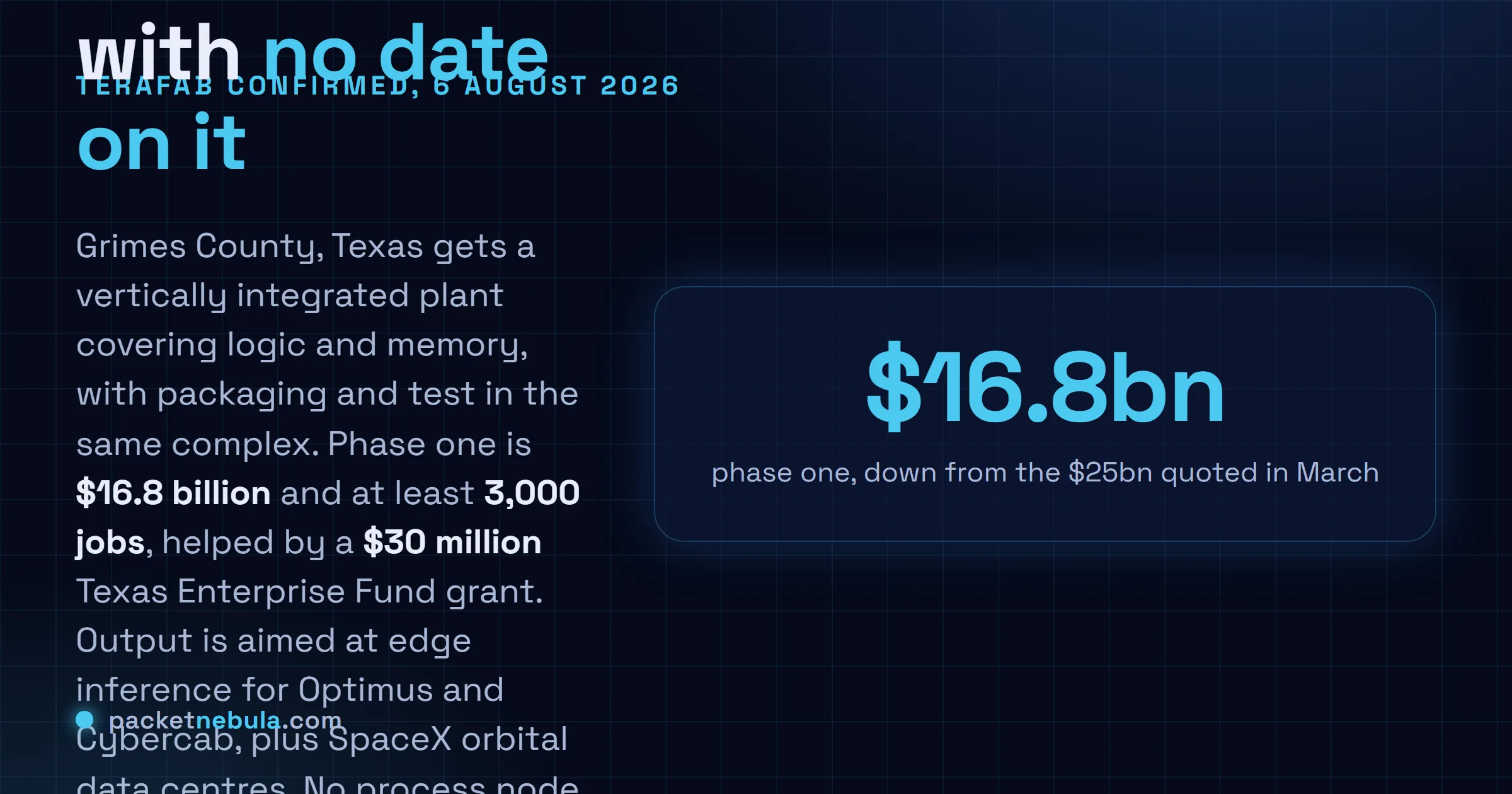
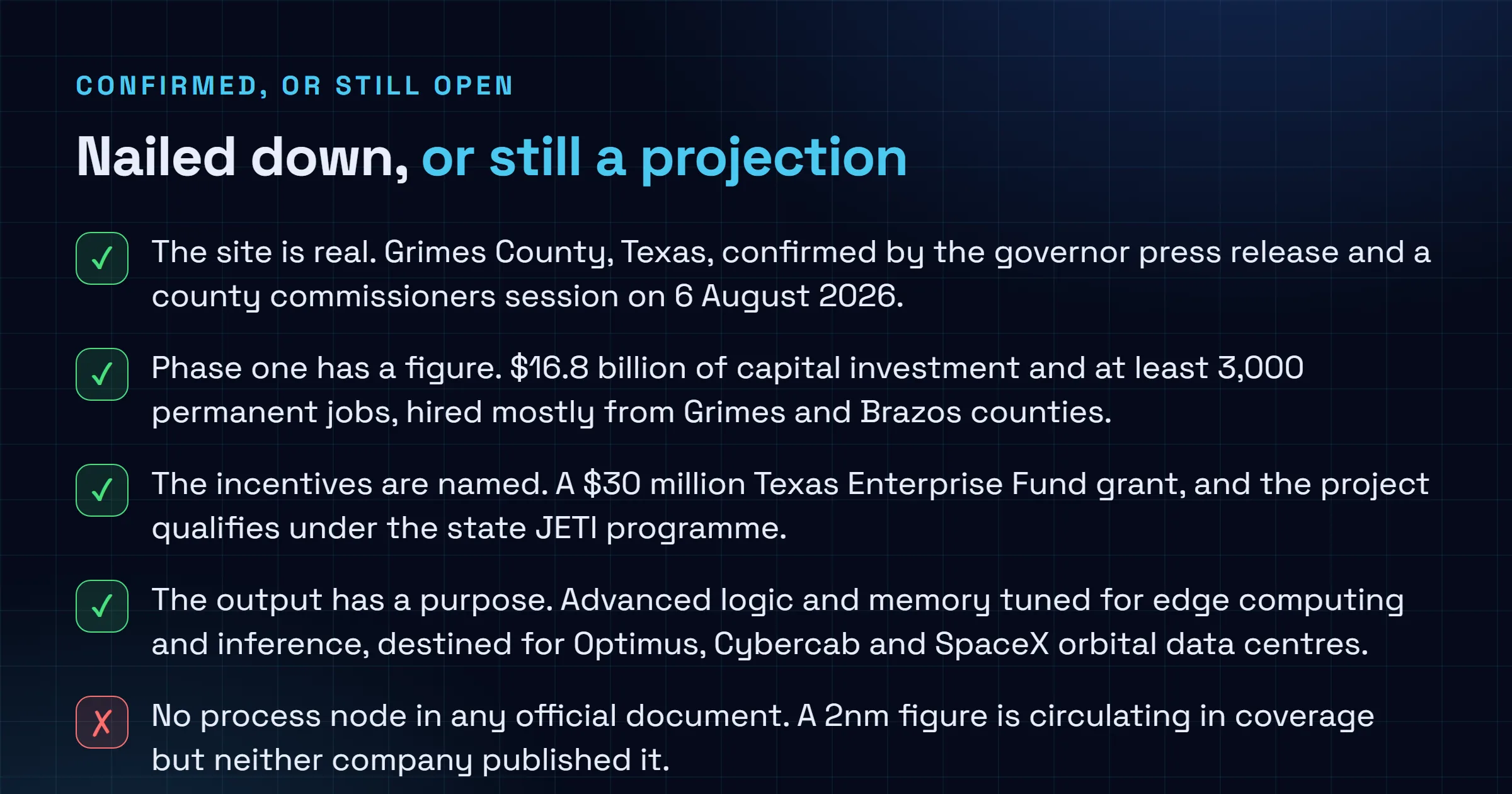
Grimes County sits an hour northwest of Houston and it's mostly ranch land. It now has a $30 million state grant and a plan for the largest building on the planet. Tesla and SpaceX confirmed on 6 August that Terafab goes there: one vertically integrated fab covering logic and memory, with packaging and test in the same complex. Phase one is $16.8 billion and at least 3,000 jobs. Governor Abbott's office issued the press release the same day. What nobody published is a process node, or a date when the first wafer comes out. The chips are meant for edge inference in Optimus robots and Cybercabs, plus SpaceX's orbital data centres. Musk called it the most valuable building on Earth. The March version of phase one was $25 billion, so the figure that got confirmed is the smaller one.
The short answer
Tesla and SpaceX confirmed Terafab lands in Grimes County, Texas, with a $16.8 billion first phase, at least 3,000 jobs and a $30 million state grant. The plant is meant to cover logic and memory in one complex, aimed at edge inference for Optimus and Cybercab plus SpaceX orbital data centres. Every headline number past phase one is a projection: the $119 billion ceiling, the 100 million square feet, the terawatt of compute. No process node, no timeline.
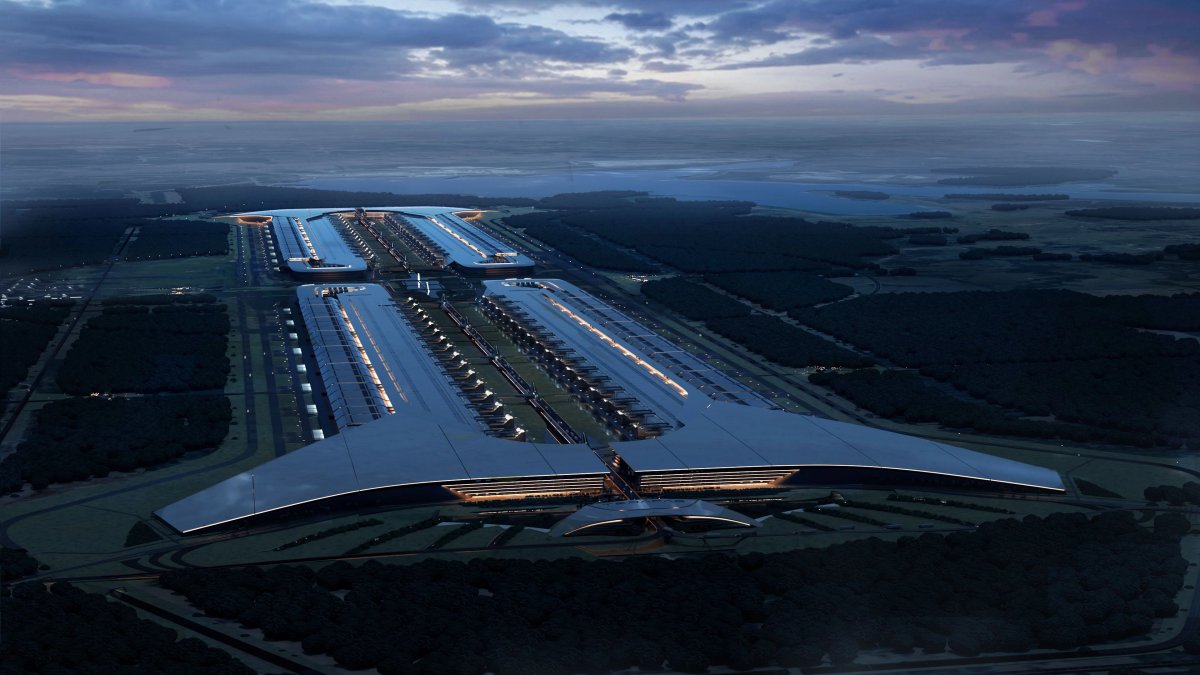 Image: SpaceX. Watch the full render on X.
What Texas actually signed
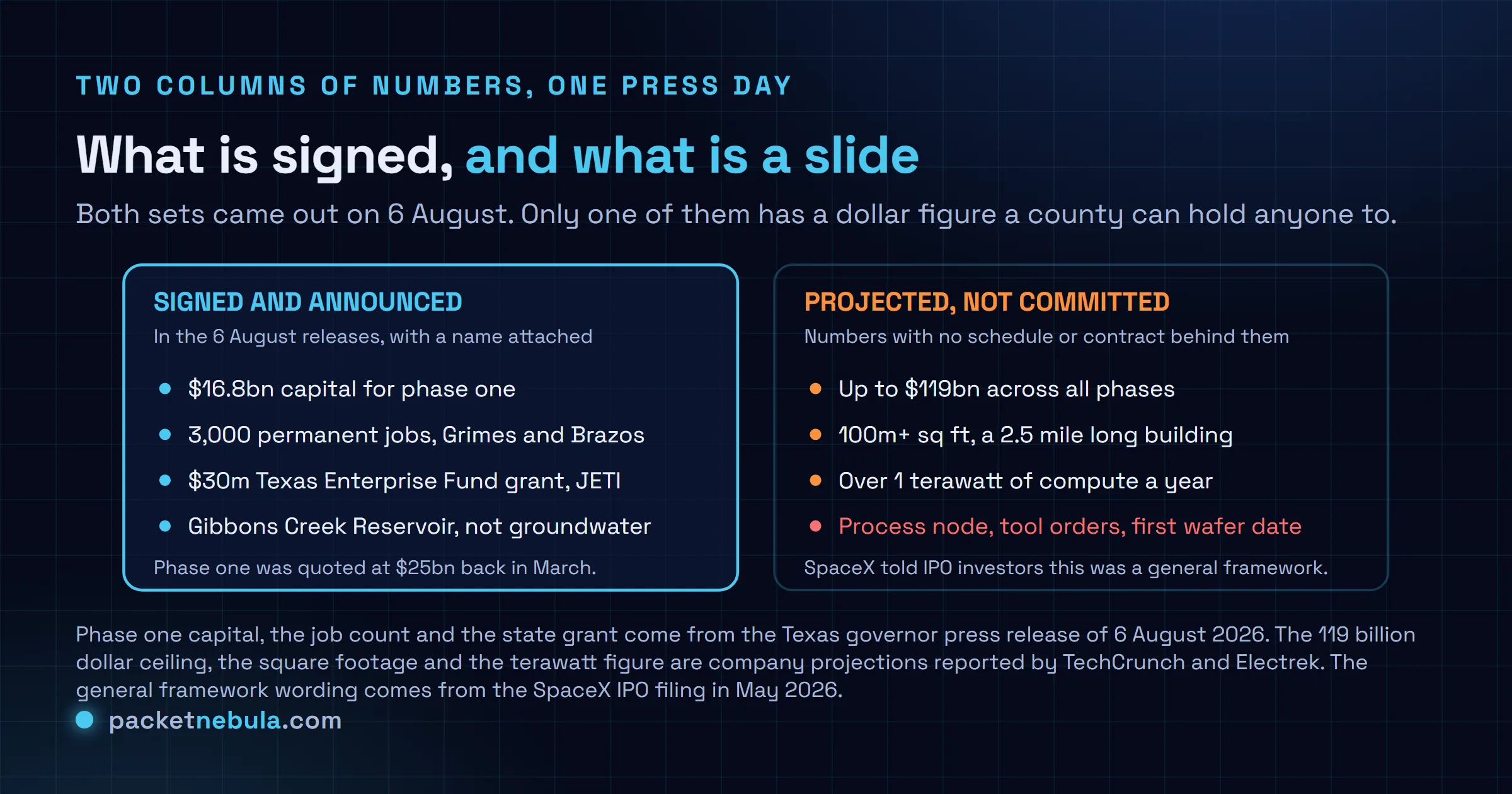
The paperwork is unusually specific for a Musk project, and that’s worth crediting. SpaceX fronted a Q&A at Grimes County Commissioners Court and confirmed the project on the record. Abbott’s office followed with a release naming a $30 million Texas Enterprise Fund grant, qualification under the state’s JETI programme, 3,000 jobs and a $16.8 billion first phase. Abbott’s line was that Texas is where big ideas grow even bigger. Musk’s contribution to the release was about cutting-edge manufacturing coming to America.
Water got answered too, which matters more than it sounds. Fabs drink. The site will pull industrial water from Gibbons Creek Reservoir, formerly attached to a coal plant that shut in 2018, rather than tapping local groundwater. Residents at the county meeting still pushed back on how little had been said before the deal was done.
SpaceX’s stated reason for building at all is the honest part of the announcement:
While we are deeply appreciative of our current chip suppliers and encourage them to expand production whenever possible, this looming gulf between supply and demand is at the core of Terafab’s necessity.
That’s a company saying it doesn’t believe the foundry industry will build fast enough for it. Given that Tesla already signed a $16.5 billion deal with Samsung for AI6 chips back in 2025, and is still short, I find that plausible.
The money got smaller, not bigger
Here’s the detail that got buried under the Pentagon comparisons. When Terafab surfaced in March, phase one carried a roughly $25 billion price tag. The version confirmed on 6 August is $16.8 billion. Projects that are accelerating don’t usually revise phase one down by a third.
There are innocent readings. Scope moved between phases, or the March figure was never costed properly, or Intel taking on production (reported in April, never confirmed by either company) shifted capital off the balance sheet. There’s also a less innocent reading, which is that the ambition met a bill of materials. I genuinely don’t know which it is, and neither does anyone quoting the $119 billion ceiling as though it were a budget.
That ceiling deserves its own asterisk. SpaceX’s own IPO filing in May described Terafab as a general framework, with no binding commitments between the parties. You can’t put a general framework in a capex model.
One terawatt of compute is not a compute number
This one bugs me. Both companies have framed the project around exceeding one terawatt of compute, and Electrek reported the fab targeting over 1 TW of compute per year.
A terawatt is power. It’s what the silicon would draw, not what it would calculate. Nobody sizes a fleet in watts of compute, because the same watt buys wildly different throughput depending on node and architecture. Wafer starts per month is the number a fab is normally judged by, and it’s absent here.
So read the terawatt line as a statement about intended scale. It’s saying “data-centre volumes, not automotive volumes”, and that’s a real signal about what these two companies think they’ll need. Just don’t mistake it for a spec.
The same caution applies to the size claim.
Terafab Texas will be the largest and most valuable building on Earth by far. And it will be stunningly beautiful.
Elon Musk (@elonmusk), 6 August 2026, on X
He followed that with a claim that Terafab will be fifty times the size of the Pentagon when complete. The published footprint is over 100 million square feet, and the Pentagon has about 6.6 million square feet of floor space, which puts the ratio nearer fifteen. The fifty presumably compares against something else, maybe ground footprint. Neither company has reconciled the two figures, and the render of a 2.5 mile long building is doing a lot of the persuading.
Does this change anything for you
Not for years, and possibly never in a way you’d notice directly.
Terafab isn’t a foundry pitching for your business. It exists to feed internal demand: inference parts for Optimus, whose V3 was announced without the robot being shown, silicon for Cybercab, and high-power devices for orbital data centres that don’t exist yet either. There’s no external customer in the announcement because there isn’t meant to be one.
The indirect effect is the interesting one. If it runs, two enormous buyers stop bidding for capacity at TSMC and Samsung, which loosens things slightly for everyone else. That’s a long way off. The near-term reading is simpler: every serious AI operator is now trying to own its silicon supply, whether by building fabs or by buying the designers. AMD just bought Taalas to etch models into mask layers, and NVIDIA is standing up a 2 GW AI factory in Korea with SK. Different bets, same anxiety.
What I’d watch isn’t the render. It’s the first equipment order. Fabs become real when somebody places a multi-billion dollar order with ASML or Applied Materials, and that order gets reported whether or not anyone announces it. Until then Terafab is a very large site with a very large grant attached.
Sources
- Office of the Texas Governor, “Governor Abbott Announces SpaceX Expansion In Grimes County”, 6 August 2026, for the $16.8 billion first phase, the 3,000 jobs, the 100 million square foot figure, the $30 million Texas Enterprise Fund grant, the JETI qualification and the Abbott and Musk quotes.
- TechCrunch, 6 August 2026, for the up to $119 billion multi-phase figure, the Gibbons Creek Reservoir commitment, the tax breaks and the community pushback at the county meeting.
- Electrek, 6 August 2026, for the March $25 billion phase-one figure, the over 1 terawatt of compute per year framing, the April 2026 research fab groundbreaking at Giga Texas, the reported Intel manufacturing role and the SpaceX IPO filing describing Terafab as a general framework.
- Fox Business, 6 August 2026, for the SpaceX statement on the supply and demand gulf, the Pentagon floor area of 6.6 million square feet and the $55 billion proposed figure.
- KBTX, 6 August 2026, for the 2.5 mile long building in the SpaceX render and the confirmation at Grimes County Commissioners Court, alongside the SpaceX render video on X and Musk’s post of 6 August 2026.
Frequently asked questions
What exactly did Tesla and SpaceX confirm on 6 August 2026?
That Terafab, a vertically integrated semiconductor fabrication plant, will be built in Grimes County, Texas, with a first phase of more than $16.8 billion in capital investment and at least 3,000 permanent jobs. SpaceX confirmed it at a Grimes County Commissioners Court session, and Governor Greg Abbott's office issued a press release the following day naming a $30 million Texas Enterprise Fund grant and qualification under the state JETI programme.
What chips will Terafab make?
Advanced logic and memory devices optimised for edge computing and inference, with packaging and test handled in the same complex rather than shipped elsewhere. The named customers are internal: Tesla Optimus humanoids, self-driving Cybercabs, and the high-power parts SpaceX wants for space-based data centres. No process node appears in any official document. A 2nm figure is circulating in coverage, and neither company has published it.
Is $119 billion the real cost of Terafab?
No, it is a ceiling across an unscheduled multi-phase build. The only figure with a document behind it is the $16.8 billion first phase. SpaceX has suggested spending up to $119 billion over all phases, and one earlier framing put the near-term proposal at $55 billion. For comparison, phase one was quoted at around $25 billion in March 2026, so the confirmed number came in below the earlier estimate.
What does one terawatt of compute actually mean?
Nothing precise, which is the problem. A terawatt is a unit of power, not of computation, so the claim is really about the electrical draw of the silicon this fab would produce annually. It signals ambition at data-centre scale rather than a measurable output target. Until somebody attaches wafer starts per month or a device count to it, treat it as marketing rather than a specification you can plan against.
Does Terafab change anything for anyone buying hardware this year?
No. There is no construction start, no first-wafer date and no external customer, because the stated purpose is to feed Tesla and SpaceX demand rather than to sell capacity. If it ever runs, the effect on the merchant market is indirect: two very large buyers stop competing for someone else's foundry slots. That is years out, and SpaceX told IPO investors in May that Terafab was a general framework with no binding commitments between the parties.