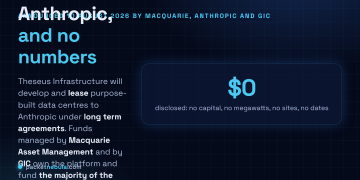





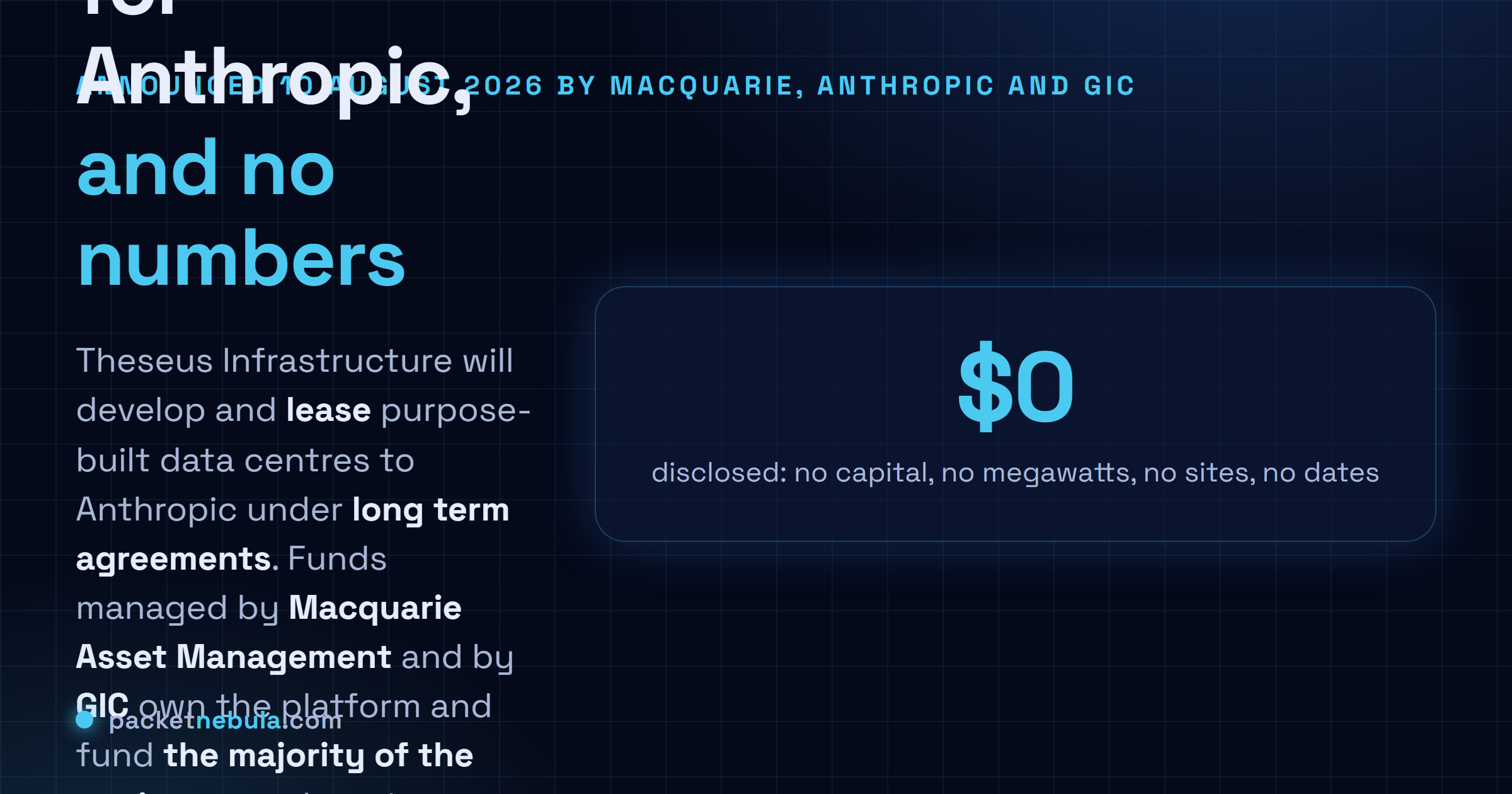
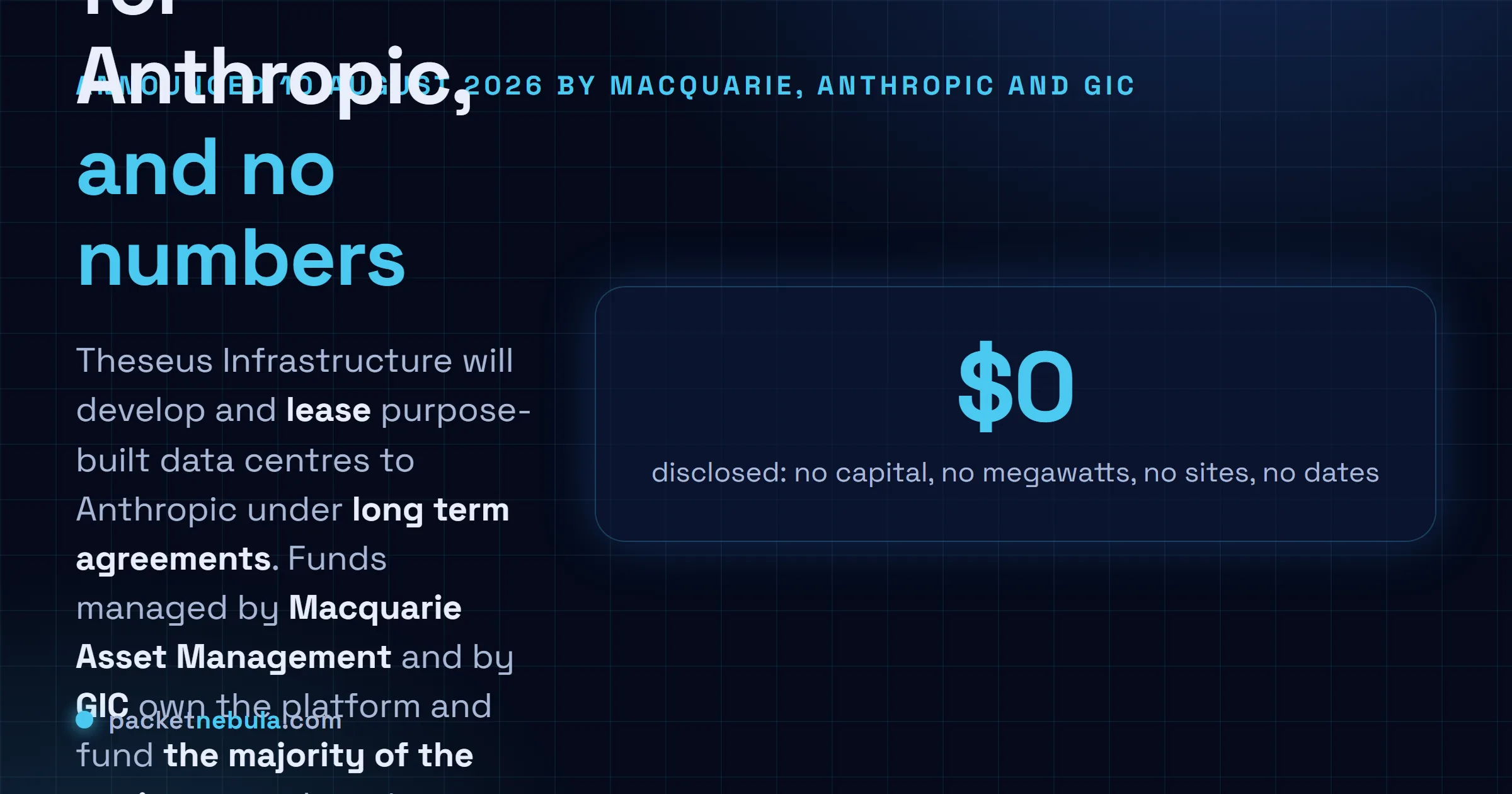
Macquarie's newsroom in Australia published it, not an AI lab, and it runs about four paragraphs. On 10 August, Anthropic, Macquarie Asset Management and GIC announced Theseus Infrastructure, a platform that will develop data centers and lease them to Anthropic under long term agreements. Funds managed by Macquarie and by GIC own the platform and put up most of the equity on each project. Anthropic signs as anchor tenant. That's it. No capital figure, no megawatt number, no site list, no timeline, and nobody quoted by name. We read a lot of these releases, and honestly the empty ones are often the more interesting ones, because when the numbers are missing the structure is the story.
The short answer
Anthropic, Macquarie Asset Management and GIC announced Theseus Infrastructure on 10 August 2026. The platform will develop and lease purpose-built data centers to Anthropic on long term agreements, with Macquarie managed funds and GIC owning it and funding most of the equity per project. Initial focus is the United States. The release quantifies nothing: no capital commitment, no capacity, no sites, no dates, and no named executive quotes. What it does confirm is the direction of travel, which is Anthropic renting its buildings from infrastructure investors rather than owning them.
What Theseus actually is
Four facts, and then the release runs out.
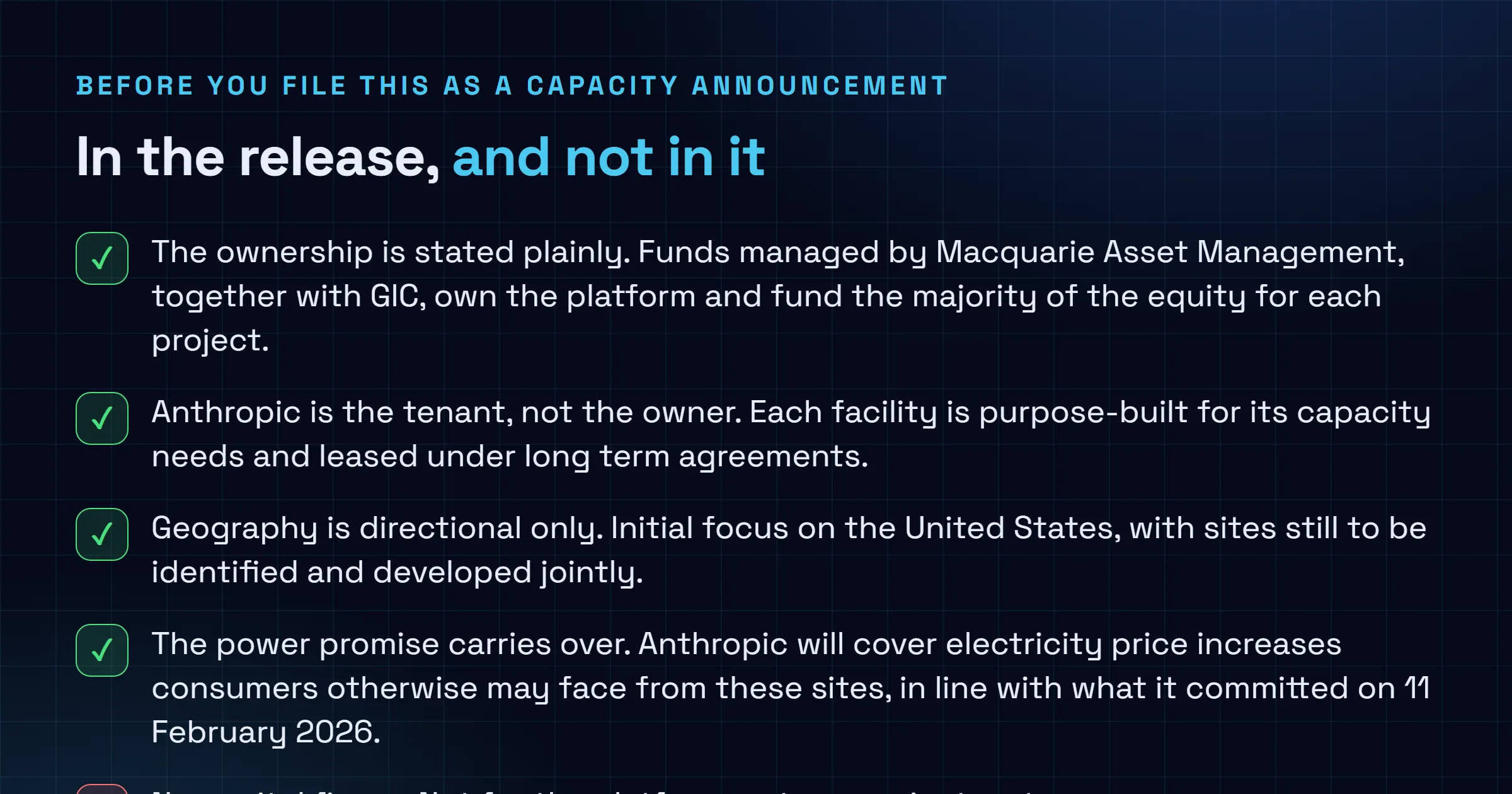
Funds managed by Macquarie Asset Management, together with GIC, own the platform and fund the majority of the equity for each project. Anthropic is the anchor tenant on long term agreements. Each facility is purpose-built for its capacity needs. Initial focus is the United States, with the sites themselves still to be identified.
The developments will create thousands of construction jobs and permanent operational roles, the parties say, which is a sentence that has appeared in essentially every data center announcement since about 2019. Anthropic also repeats its promise to cover electricity price increases consumers would otherwise face from these sites.
Nothing else is quantified. Not the platform size, not a per-project range, not megawatts, not a state, not a date. No executive from any of the three parties is quoted by name either, which in a three-way press release is unusual enough that we noticed it before we noticed the missing dollars.
Anthropic is renting, and that is the point
Here is the read we would defend.
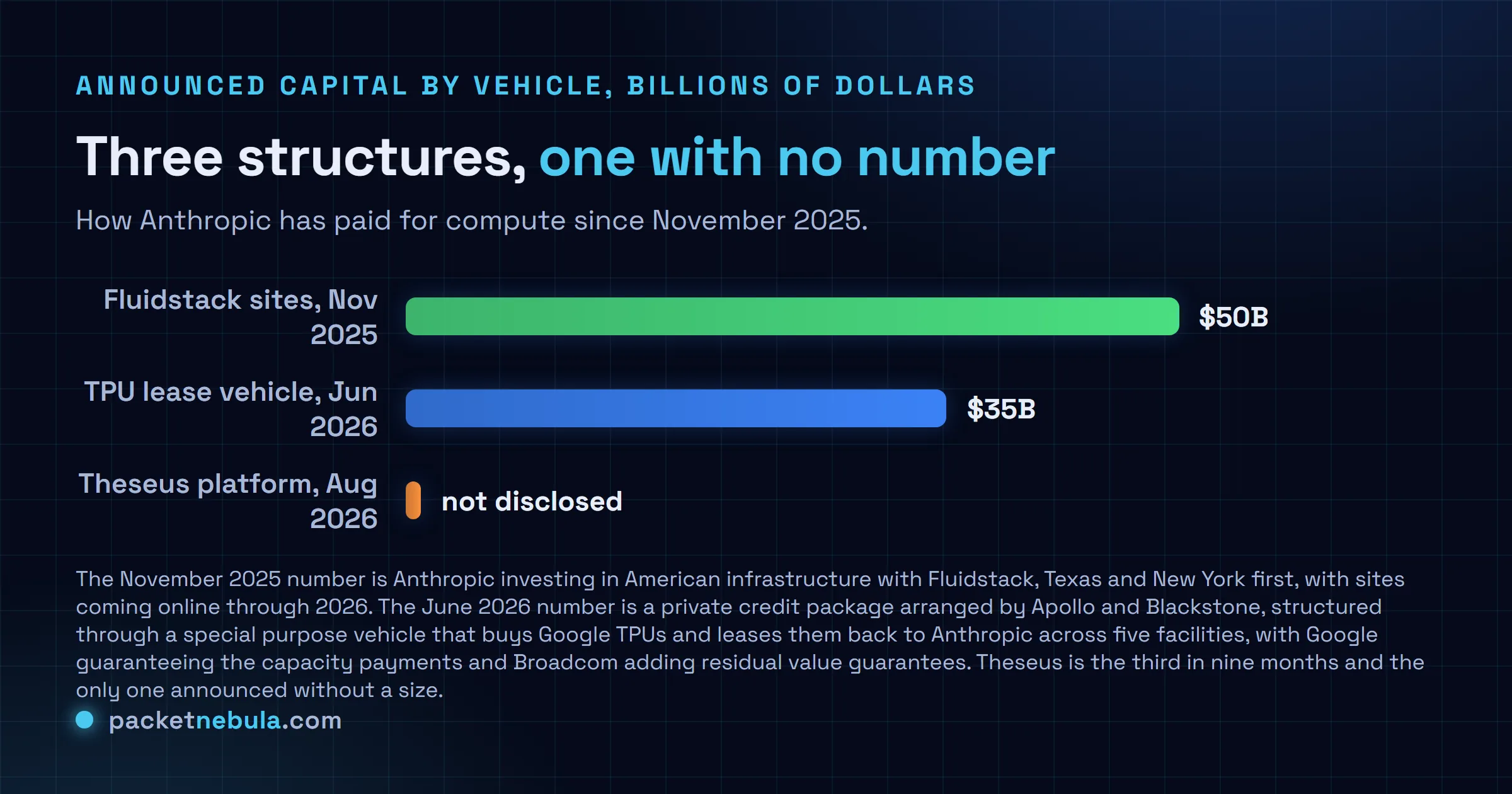
Anthropic has announced three different ways of paying for compute in nine months, and each one pushes the asset further off its own books.
November 2025 was $50 billion into American infrastructure with Fluidstack, Texas and New York first, roughly 800 permanent jobs and 2,400 construction jobs, sites coming online through 2026. That is Anthropic buying.
June 2026 was a $35 billion private credit package from Apollo and Blackstone, structured through a special purpose vehicle that buys Google TPUs and leases them back to Anthropic. Google guarantees the payments on capacity at all five facilities involved, and Broadcom adds residual value guarantees on top. So the chips are rented, and the lenders are underwriting Google’s credit at least as much as Anthropic’s.
August 2026 is Theseus. Macquarie and GIC put up the equity and own the buildings. Anthropic signs leases.
Look at that as a sequence and the shape is hard to miss. A frontier lab needs gigawatts, gigawatts cost more than any private company funds from revenue, so the capital arrives from infrastructure funds and private credit while the lab keeps the operating commitment. Macquarie and GIC are not technology companies. They are asset managers with very long horizons and a taste for toll roads and airports, and a purpose-built building with one creditworthy tenant on a long lease is exactly that shape of asset.
Whether it is a good trade for Anthropic depends entirely on lease terms nobody has published. Long dated leases on single-purpose buildings are not cheap optionality, and you cannot walk away from a data center the way you can decline to renew a cloud contract. I might be wrong here, but I would guess the absence of a number reflects terms still being negotiated site by site rather than anyone hiding a disappointment.
The electricity clause is the load-bearing part
The one line in the release with real teeth is about power.
On 11 February 2026 Anthropic committed to pay for 100% of the grid upgrades needed to interconnect its data centers. It also said it would bring net new generation online to match what those sites draw, and cover the demand-driven price effects in the gap before that generation is running. The same framing put the US AI sector’s need at a minimum of 50 gigawatts over the next several years. Theseus carries that promise forward to buildings that do not exist yet.
Good. It is also the hardest thing in the announcement to verify. Somebody has to work out what share of a substation upgrade or a transmission line belongs to one tenant, and that argument happens slowly, in public, inside utility rate cases, in front of regulators who are already handling local moratoriums on new data center load. A pledge in a press release is not a tariff filing.
We would watch the dockets rather than the newsroom.
Does any of this change your week
No. Not even slightly.
Nothing here adds capacity anyone can rent or moves a price on any API. Theseus owns no buildings. It has an intention to find sites and a balance sheet willing to fund them, and the first concrete evidence will be a filing with a name attached: an interconnection queue position, or a county planning application in some specific county.
What it does tell you is where the pressure in the compute market is going. Everyone serious is locking in land and power years ahead, whether that looks like a two gigawatt build in Korea or a landlord platform in the United States. The scarce input stopped being GPUs a while ago. It is interconnection. If you are planning anything that depends on renting a lot of accelerators in 2028, the signal worth tracking is who has grid capacity reserved, and that shows up in utility filings long before it reaches a press release.
Sources
- Macquarie Group, “Anthropic, Macquarie Asset Management, and GIC announce strategic partnership to develop dedicated data center infrastructure at scale”, 10 August 2026, the primary release, for the Theseus Infrastructure name, the ownership and majority equity funding structure, Anthropic as anchor tenant on long term agreements, the initial United States focus, the jobs language and the electricity price commitment.
- HPCwire, “Anthropic, Macquarie and GIC Launch Theseus Infrastructure for AI Data Centers” and Bloomberg, 10 August 2026, for independent confirmation of the announcement and its date.
- Anthropic, “Anthropic invests $50 billion in American AI infrastructure”, 12 November 2025, for the $50 billion figure, Fluidstack as partner, the Texas and New York sites, the roughly 800 permanent and 2,400 construction jobs, and sites coming online through 2026.
- Anthropic, “Covering electricity price increases”, 11 February 2026, for the commitment to pay 100% of grid interconnection upgrades, to bring net new generation online, to cover demand-driven price effects in the interim, and for the 50 gigawatt sector figure.
- Bloomberg, “Anthropic Secures $35 Billion Chip Financing With Google’s Support”, 9 June 2026, for the private credit package, Apollo and Blackstone, the special purpose vehicle buying Google TPUs and leasing them back, Google’s payment guarantees across five facilities and Broadcom’s residual value guarantees.
Frequently asked questions
What is Theseus Infrastructure?
A new platform announced on 10 August 2026 that will develop, operate and lease data center infrastructure to Anthropic under long term agreements. Funds managed by Macquarie Asset Management, together with GIC, own the platform and fund the majority of the equity for each project. Anthropic is the anchor tenant and each facility is purpose-built for its capacity needs. The initial focus is the United States, and the parties say they will identify and develop new sites together.
How much is Anthropic investing in Theseus?
The announcement does not say. There is no platform size, no per-project figure and no range, which makes Theseus the only one of Anthropic's three publicly announced compute financing structures since November 2025 without a headline number attached. For comparison, the Fluidstack investment announced on 12 November 2025 was $50 billion, and the private credit package reported in June 2026 was $35 billion. Anyone quoting a dollar figure for Theseus today is guessing.
Does Anthropic own these data centers?
No, and that is the substance of the deal. Macquarie managed funds and GIC own the platform and fund most of the equity per project. Anthropic signs long term leases as anchor tenant. It gets purpose-built capacity without providing the majority of the upfront construction capital, and the infrastructure investors take the ownership position and the long term return.
What is the electricity commitment about?
On 11 February 2026 Anthropic said it would pay for 100% of the grid upgrades needed to interconnect its data centers, bring net new generation online to match what those sites draw, and cover demand-driven price effects in the gap before that generation runs. The Theseus release carries the same promise forward to these future sites, stating that Anthropic will cover electricity price increases consumers otherwise may face from them. It is a commitment, not yet a tariff filing, and utility rate cases are where it gets tested.
Does this change anything I can buy or rent today?
Not this year. Theseus owns no buildings yet, the sites are still to be identified, and no capacity or service date has been published. It has no effect on model pricing, API availability or accelerator rental supply. The first concrete thing to look for is a filing with a name on it, such as an interconnection queue position or a county planning application.