




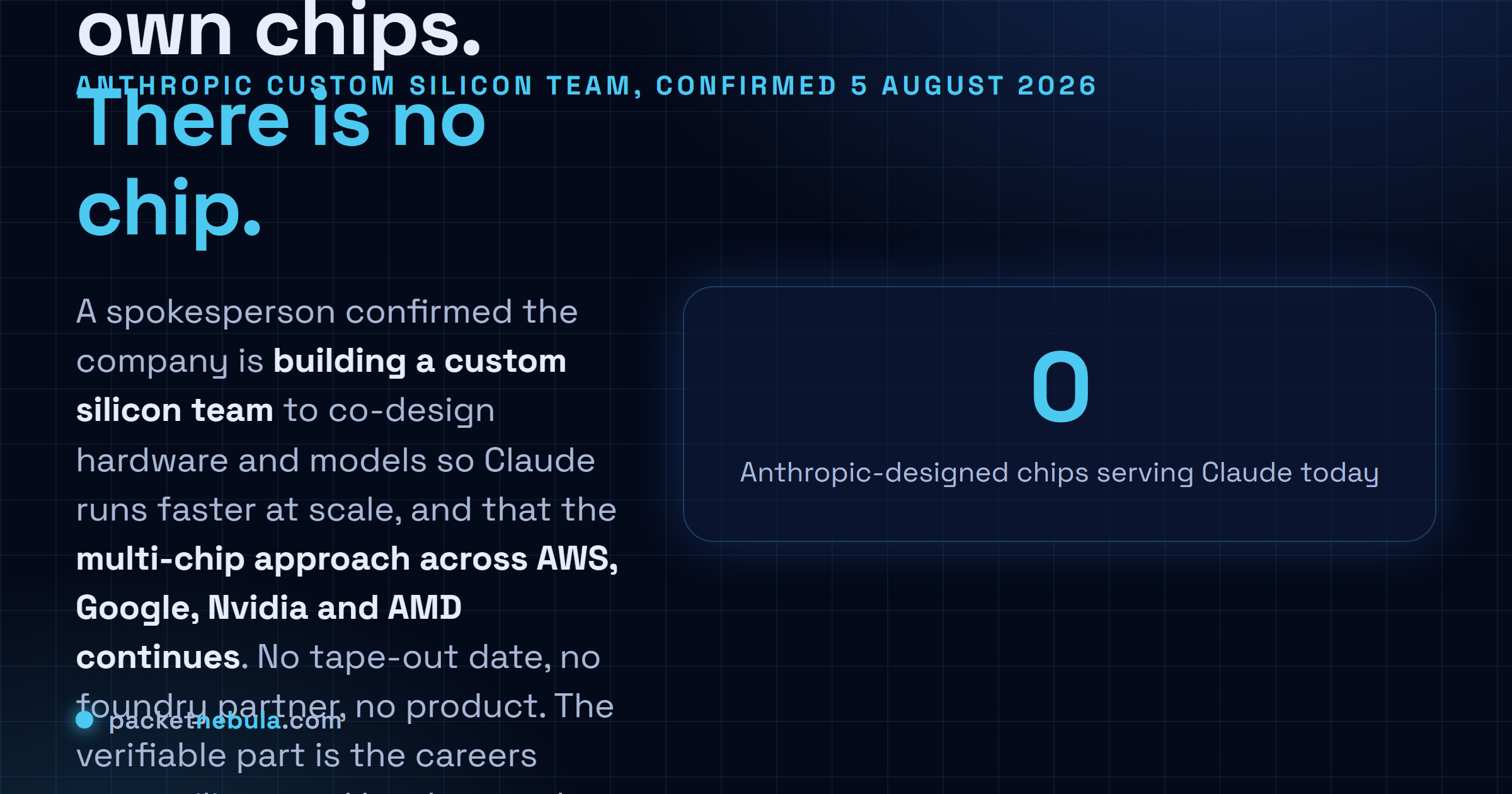
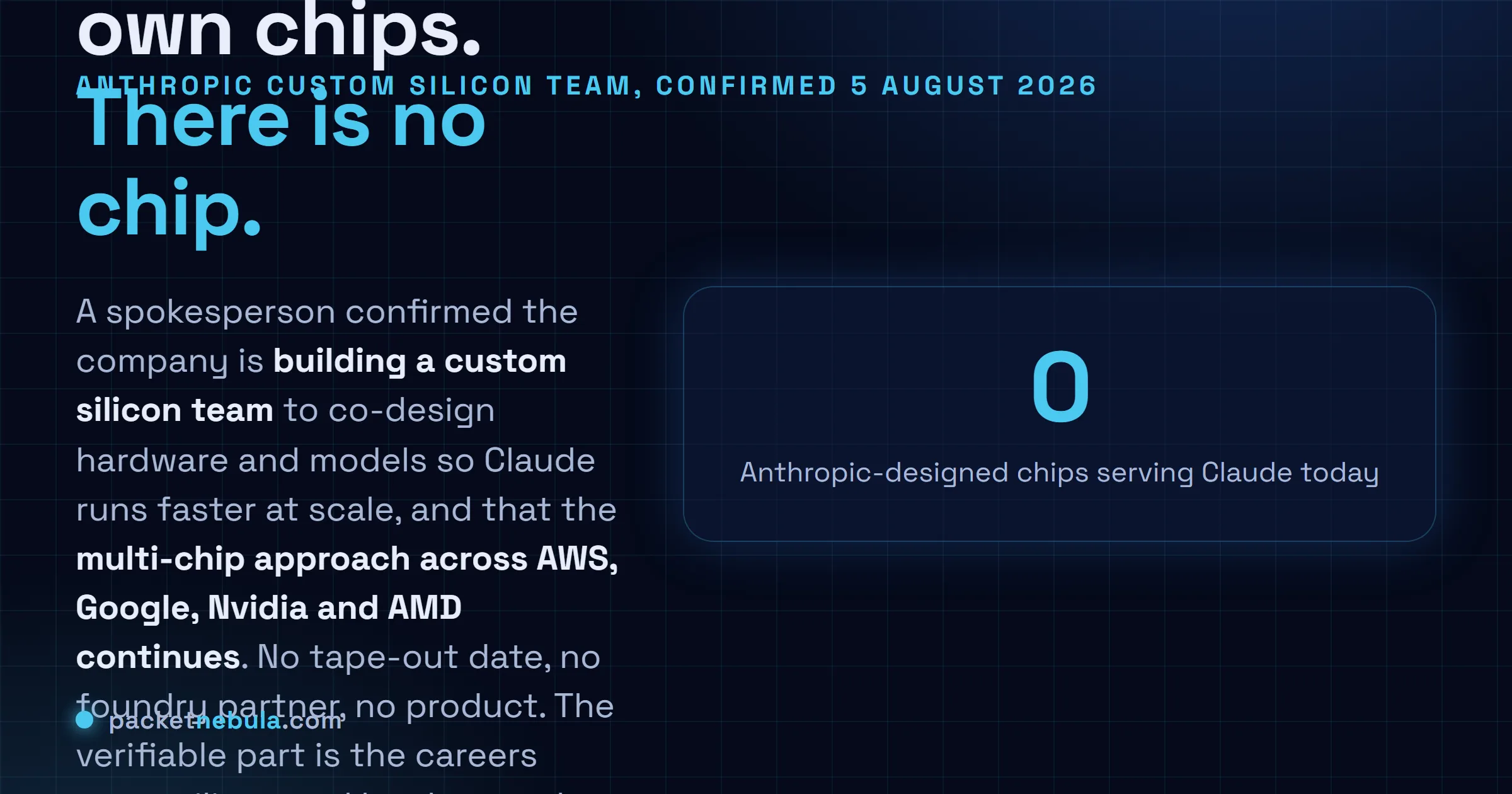
Six job listings. That's most of the announcement, and honestly it's more informative than the headlines stacked on top of it. On 5 August Anthropic confirmed it's building a custom silicon team to co-design chips and Claude models, then kept every existing supplier in place: AWS, Google, Nvidia and AMD all stay. No tape-out date. No foundry named. What we can actually verify is the careers page, which lists a Silicon Engineer, a Hardware Systems Architect, a Technical Program Manager for Silicon and a few more, at $320,000 to $485,000. One listing asks the hire to support first silicon bring-up and debug when it arrives. When it arrives. That's a team being assembled, not a chip being shipped, and the difference matters if you're sizing Claude spend for next year.
The short answer
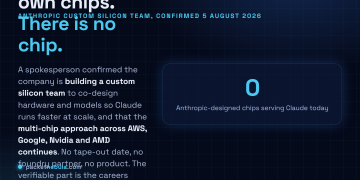
On 5 August Anthropic confirmed it’s building a custom silicon team to co-design chips with Claude models. Everything else stays: AWS, Google, Nvidia and AMD remain in the plan, and no tape-out date, foundry or product was named. The strongest evidence is the careers page, where the listings ask for engineers who have shipped silicon and mention first silicon bring-up as a future event. The 50 percent inference saving doing the rounds is outlet framing, not an Anthropic number.
What was confirmed, and what was inferred
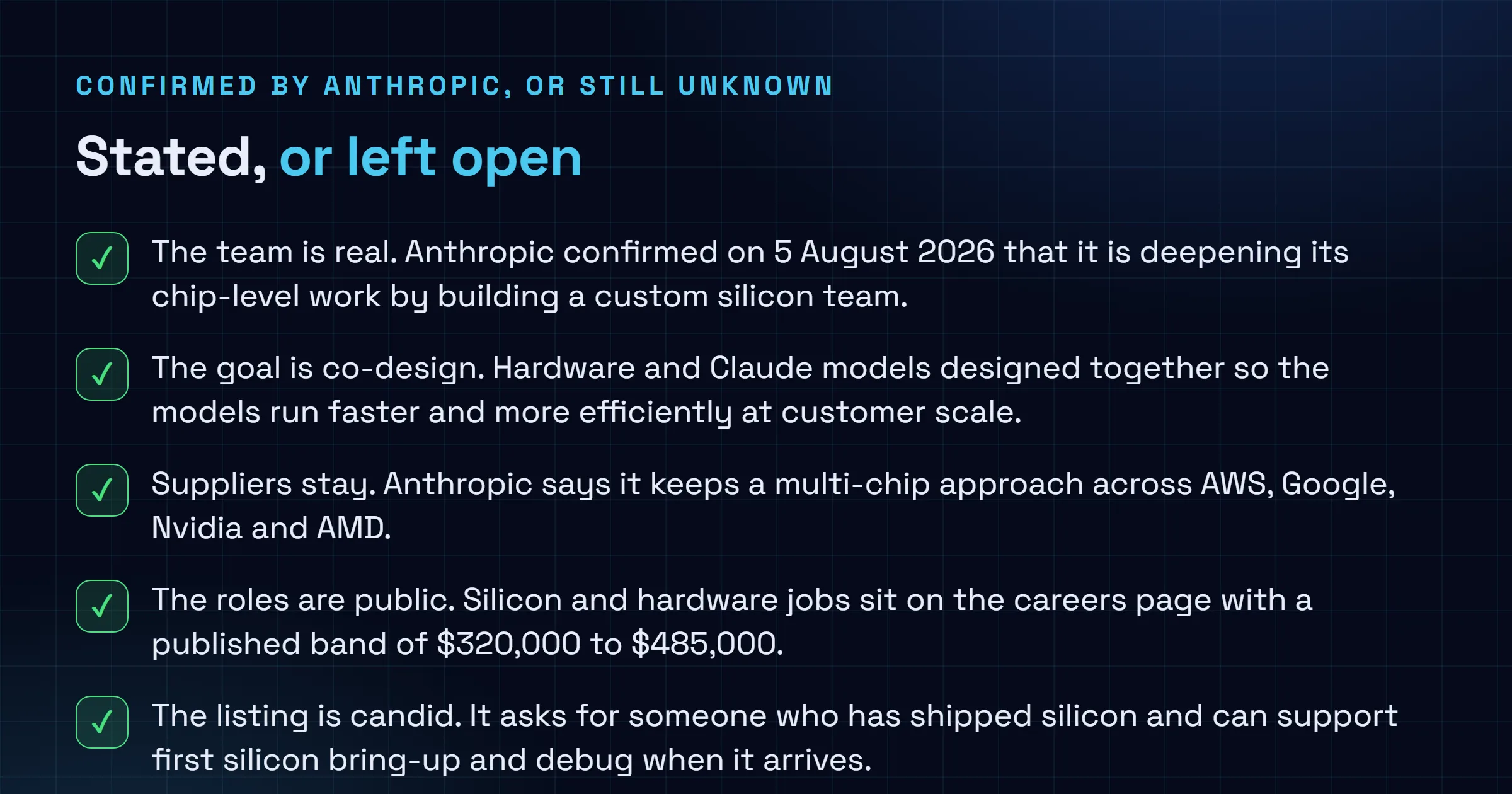
The confirmation came through Business Insider and was quickly matched by everyone else. The quote is short: Anthropic works from the chip level up with its silicon partners, and is now deepening that investment by building a custom silicon team. The stated goal is co-design, meaning hardware and Claude models shaped around each other so the models run faster and more efficiently at the scale customers need.
Then the important half. Anthropic said it keeps a multi-chip approach across AWS, Google, Nvidia and AMD. Read that carefully and it’s a hedge with four names in it. Nothing is being replaced.
What nobody got was a date. No tape-out, no sampling window, no node, no foundry. Reuters reported back in April that Anthropic was exploring chip design, and The Information reported talks with Samsung in July, but talks aren’t a manufacturing deal and Anthropic hasn’t confirmed one. So when a headline says Anthropic is building chips, the accurate version is that Anthropic is building the team that would build chips.
The job board is the most honest document
This is the part I’d point at if I only had thirty seconds. Anthropic’s careers page currently carries a Silicon Engineer role, a Hardware Systems Architect, a Technical Program Manager for Silicon, a Hardware Lab Manager, a TPU Kernel Engineer and a Research Engineer working on chip design with reinforcement learning. The published band runs from $320,000 to $485,000.
The wording gives away the stage better than any press coverage. One listing asks for someone who has shipped silicon and is comfortable making consequential calls without a large organization behind them. Another says the hire will support first silicon bring-up and debug when it arrives. Bring-up is what happens weeks after a wafer comes back from a fab. Writing it as a future conditional means there’s no wafer, and there’s no fab commitment either.
The breadth of disciplines is the other tell. Front-end design, pre-silicon verification, physical design, design-for-test, analog and mixed-signal, packaging with signal and power integrity. That’s not one team. That’s the org chart of a chip company, being recruited from scratch, by a company whose entire staff would fit inside one floor of a traditional silicon vendor. I might be wrong about the pace, but hiring across that many disciplines simultaneously usually means year one, not year three.
Does it change your Claude bill
No. Not this year, and I’d be surprised at next year too.
Custom accelerators are a fixed-cost bet before they’re a variable-cost win. You pay for design tools, mask sets, verification and bring-up long before a single token gets cheaper, and the payoff only lands if the volume is enormous and the model architecture stays stable enough for the silicon to still fit it two years later. That second condition is the interesting one for a lab shipping new frontier models every few months.
The 50 percent per-token saving that showed up in a few write-ups is worth flagging. We couldn’t find it in anything Anthropic said. It reads like an analyst estimate that got repeated until it acquired quotation marks, which is exactly the kind of number that ends up in someone’s budget spreadsheet as a fact. If your capacity planning already runs close to the edge, the pattern to watch is the one we saw when a $1.8 million Claude bill came in 860 percent over forecast: the cost lever that actually works today is caching and routing, not future hardware.
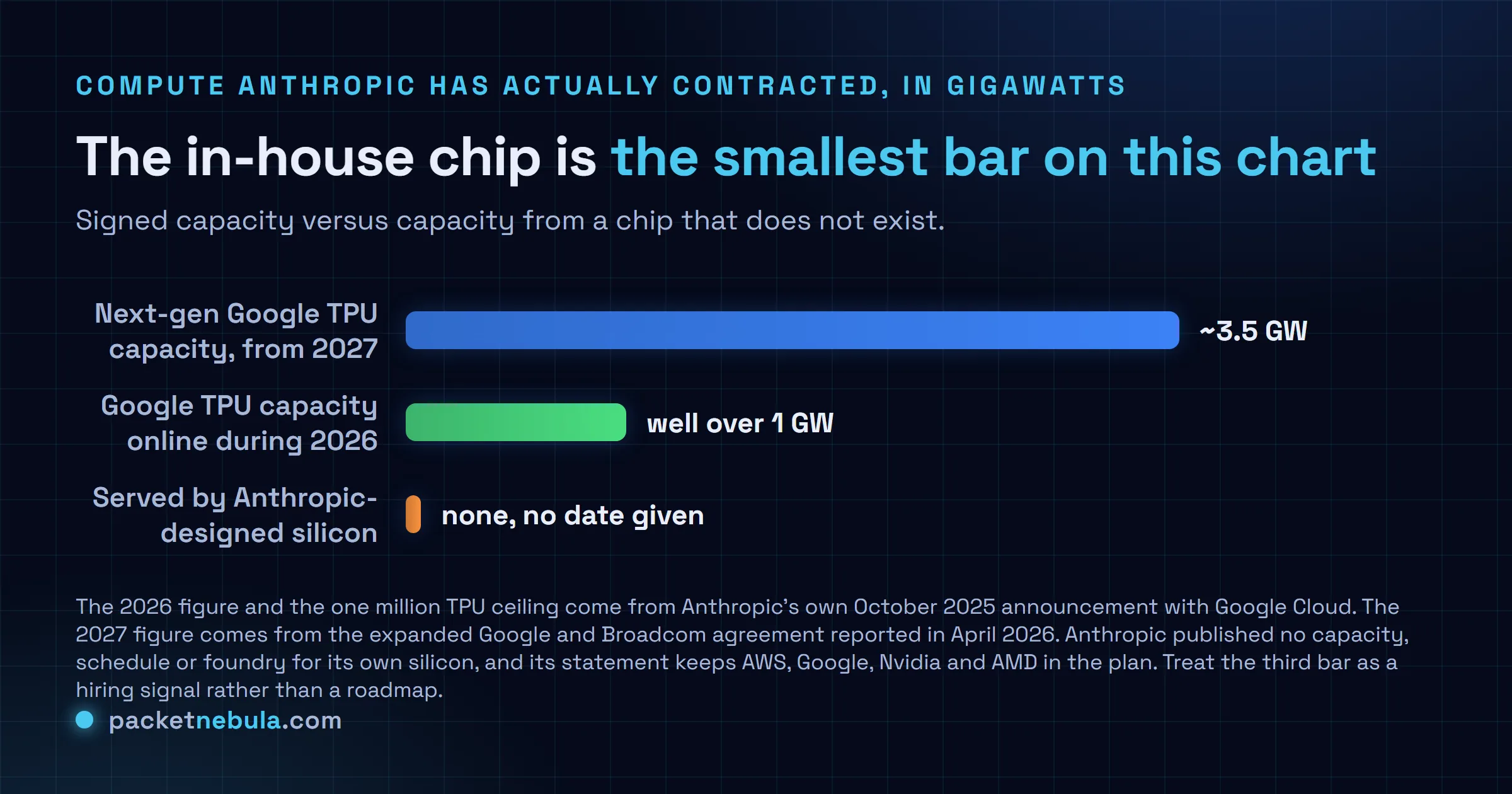
Put it next to the contracted capacity and the proportions get clear. Anthropic’s October 2025 agreement with Google Cloud gives it access to up to a million TPUs and was expected to bring well over a gigawatt online during 2026, for tens of billions of dollars. The expanded deal reported in April 2026, with Broadcom involved, adds roughly 3.5 gigawatts of next-generation TPU capacity from 2027. Against that, an in-house part is a rounding error for years.
Everyone is doing this now, which is the actual story
OpenAI put its name on the Broadcom-built Jalapeno inference chip in June. Meta has been pushing its own accelerator into production. Google has shipped TPUs for a decade. Amazon has Trainium. Anthropic joining is less a surprise than a confirmation that no frontier lab thinks it can buy its way out of compute constraints on the merchant market alone.
What separates them is where they are on the curve. OpenAI has a named partner and a named part. Anthropic has a hiring page. Both facts are worth knowing, and conflating them is how a reasonable strategic move turns into a headline about Nvidia losing another customer. Nvidia is still in Anthropic’s own list of four.
For anyone building on the API, the practical takeaway is short: change nothing. Watch for a foundry announcement or a stated tape-out. Those are the events that would move a date onto a calendar. A job listing isn’t one.
Sources
- Anthropic careers page, for the live silicon and hardware roles, checked 7 August 2026.
- TechCrunch, “Anthropic is hiring an AI chip design team”, 5 August 2026, for the confirmation and the list of existing chip suppliers.
- Unite.AI, for the spokesperson wording, the quoted job listing phrases, the salary band and the disciplines being recruited.
- Techzine, for the Reuters and The Information reporting timeline including the Samsung talks.
- Anthropic, “Expanding our use of Google Cloud TPUs and services”, 23 October 2025, for the one million TPU ceiling and the gigawatt of capacity expected in 2026.
- Forbes, 6 August 2026, for the 3.5 gigawatts of next-generation TPU capacity from 2027.
Frequently asked questions
What did Anthropic actually announce on 5 August 2026?
That it is building an in-house custom silicon team. A spokesperson said the company works from the chip level up with its silicon partners and is now deepening that investment by building a custom silicon team, with the aim of co-designing hardware and models so Claude runs faster and more efficiently at the scale customers need. Anthropic also said it keeps a multi-chip approach across AWS, Google, Nvidia and AMD. It announced no chip, no tape-out date and no manufacturing partner.
Will this make Claude cheaper?
Not on any timeline Anthropic has given. Several outlets framed the move as targeting roughly half the per-token inference cost, but that figure is coverage framing rather than a number Anthropic published, so treat it as unconfirmed. Custom accelerators are also a fixed-cost play: you pay for design, masks and bring-up years before the unit economics improve. Nothing about your current bill changes because a job listing went up.
Is Anthropic dropping Nvidia?
No. The confirmation explicitly keeps the multi-chip approach across AWS, Google, Nvidia and AMD, and the in-house effort sits alongside those suppliers rather than replacing them. Anthropic already has enormous contracted capacity on Google TPUs, so its own silicon would join a mix rather than take it over.
How does this compare with OpenAI and Meta?
It is a later start on the same path. OpenAI unveiled its Broadcom-built Jalapeno inference chip in June 2026, Meta has been producing its own accelerator silicon, and Google has shipped TPUs for years. Anthropic is at the stage of hiring people who have shipped silicon before, which is roughly where those programs were several product generations ago.
What would count as real progress here?
A named foundry and process node, a stated tape-out or sampling window, and a clear answer on whether the part targets inference or training. Until at least one of those is public, the honest read is that Anthropic has a team, a budget line and a hiring page.