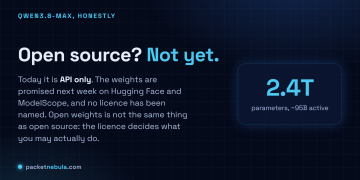





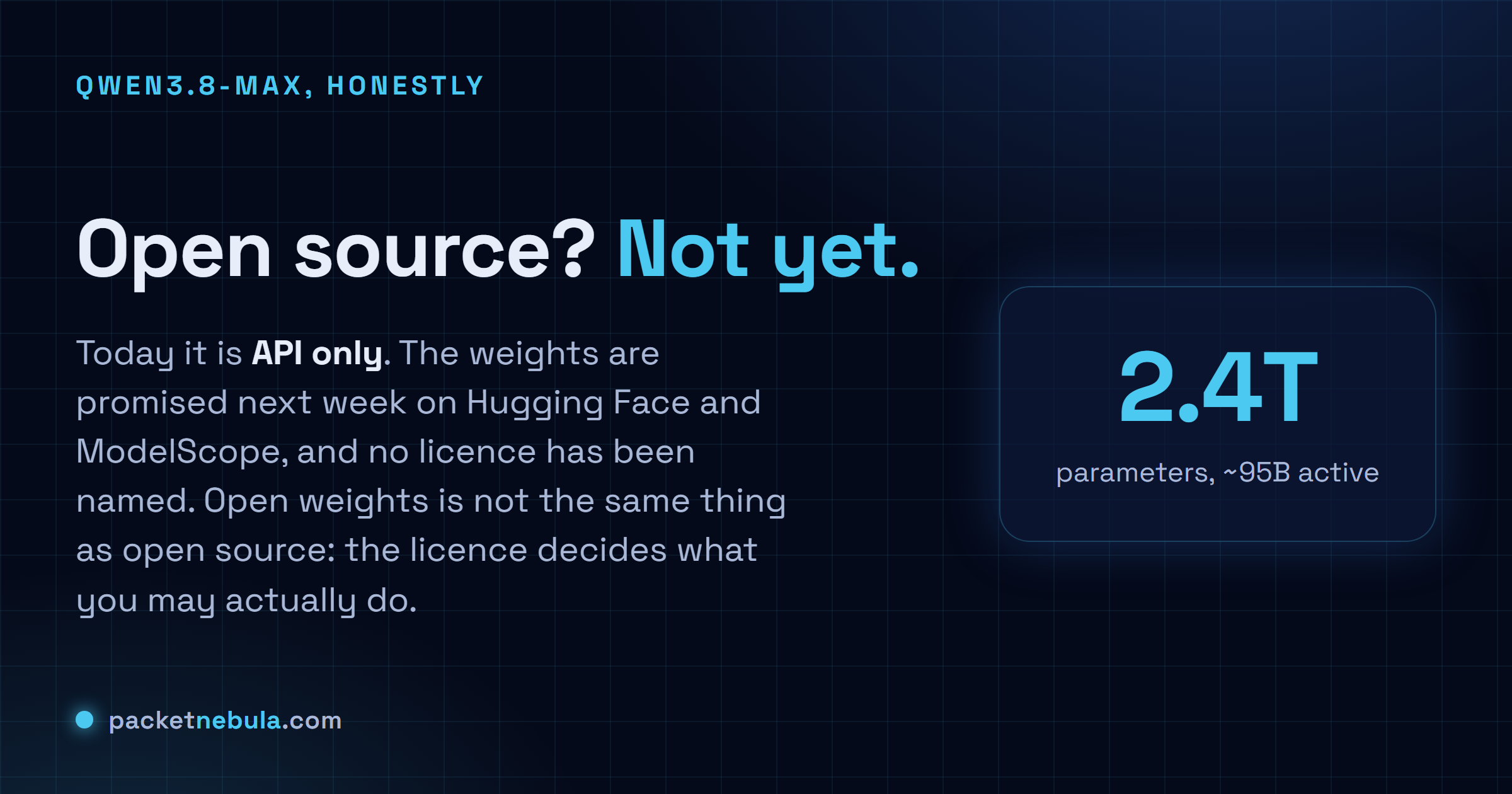
Half the headlines this week call Qwen3.8-Max an open source model. Right now it isn't one, and the gap matters if you were planning around it. Alibaba announced the model on August 3, made it available through its hosted API, and promised the weights on Hugging Face and ModelScope next week. Promised. Nothing to download today. And when they do land, open weights still isn't the same thing as open source, because the licence decides what you may actually do, and Alibaba hasn't named one. So here is the honest state of play: what shipped, what didn't, what the licence question really means for you, and whether a 2.4 trillion parameter model is something you could realistically run even after the download button appears.
The short answer
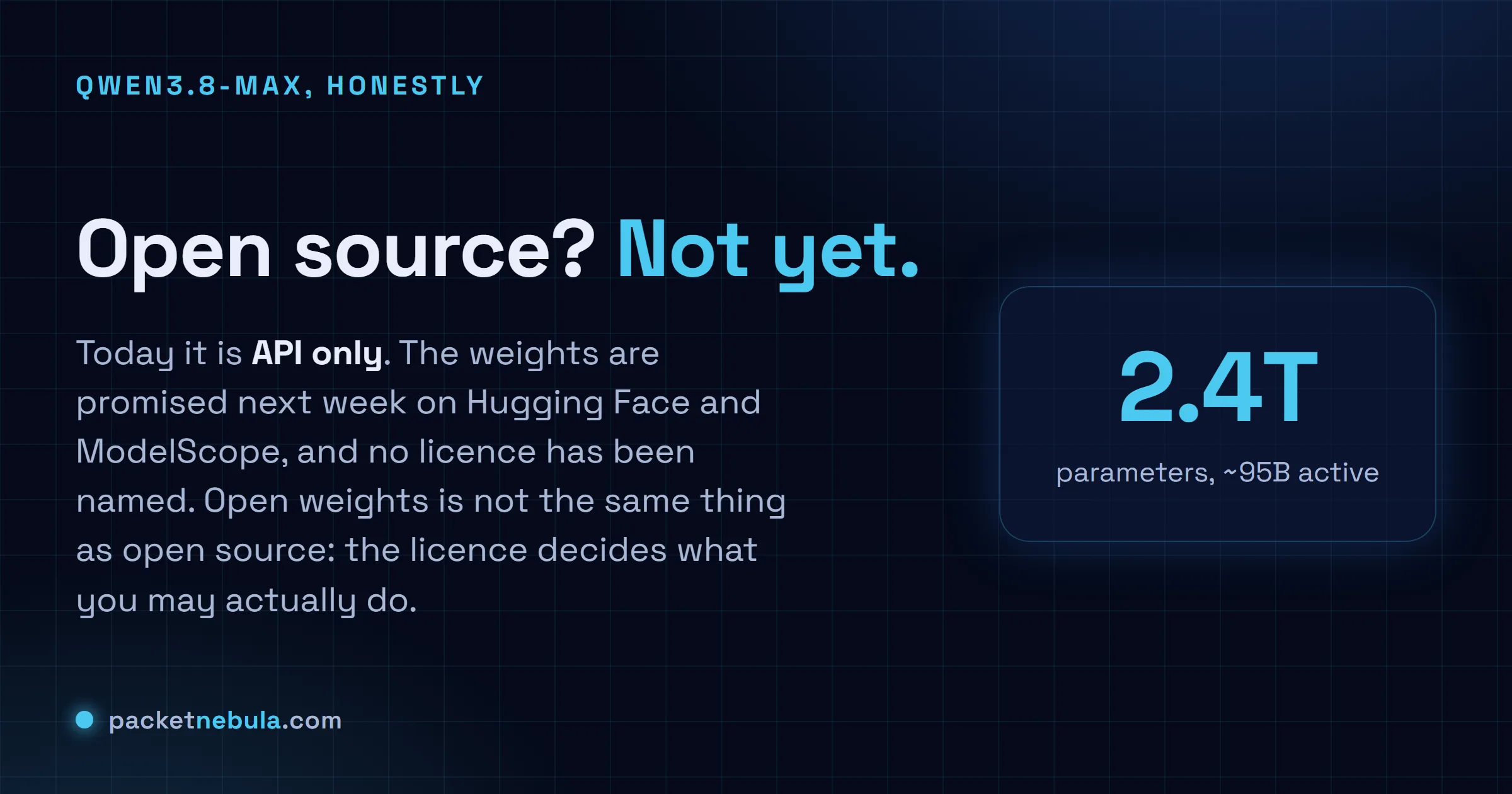
Qwen3.8-Max isn’t open source right now. It’s a hosted model you reach through an API, with weights promised for next week on Hugging Face and ModelScope. Even after they land, the licence decides whether you can really use them, and Alibaba hasn’t published one. Worth watching. Not worth planning on yet.
What Alibaba actually announced
On August 3 Alibaba put out Qwen3.8-Max, and the specs explain the noise. It’s a mixture of experts model with 2.4 trillion total parameters, reported at around 95 billion active per token, a 1 million token context window (991K of usable input, a little less with thinking on) and up to 131K tokens of output. Reasoning chains can run to 262K tokens, which tells you what it’s built for: long agentic jobs, autonomous coding, research that doesn’t finish in one pass.
You can use it today through QwenCloud, and the API is OpenAI and DashScope compatible, so wiring it into existing code is a config change rather than a project. Pricing is $2 in and $6 out per million tokens, with cached input reads down at $0.25. Same headline rate as Grok 4.5, a fraction of what the Western flagships charge.
What you cannot do today is download it. Alibaba said the weights ship next week on Hugging Face and ModelScope, and framed it as a return to the open strategy after keeping several recent flagships closed. It would be the first Max-class Qwen ever opened. That’s genuinely a big deal. It’s also, right now, a sentence in an announcement.
Open weights is not open source
This is the part the headlines flatten, and it’s worth being precise about, because the two phrases give you very different rights.
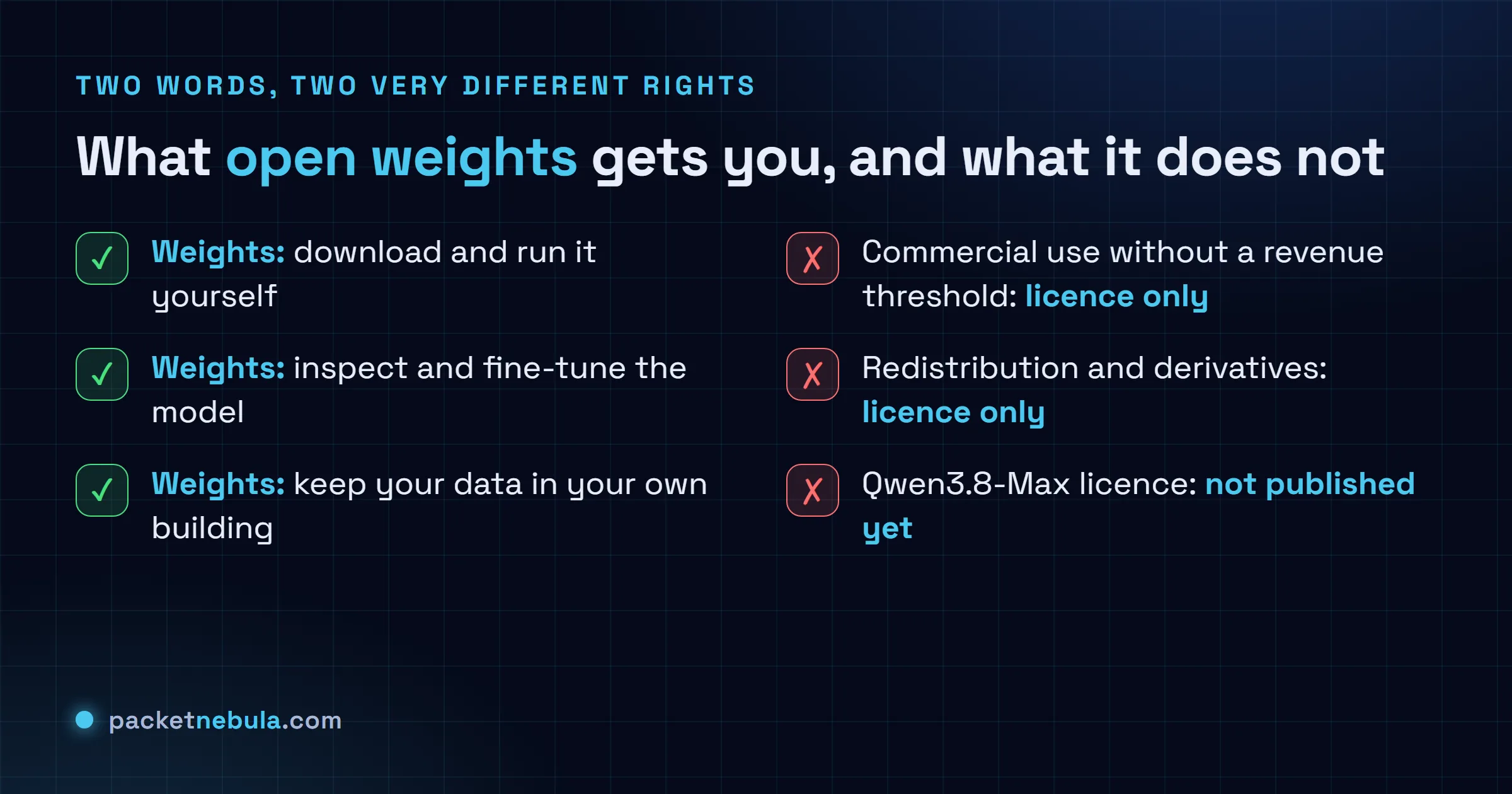
Open weights means you can download the model file and run it. That’s it. Open source, in the sense the term normally carries, implies a licence that lets you use, modify and redistribute freely, including commercially. Model weights routinely ship under custom licences that look open at a glance and carry real conditions underneath: revenue thresholds above which you need a separate deal, use restrictions, limits on redistribution, clauses about training other models on the outputs.
We’ve seen both ends of that spectrum recently. GLM-5.2 shipped under MIT, about as permissive as it gets, and that licence is a large part of why we recommended it as the open option against API-only rivals. Other releases have arrived with paperwork that quietly rules out the exact use case you had in mind.
Alibaba hasn’t named a licence for Qwen3.8-Max. Until it does, the correct posture is interest, not planning. If you’re building something commercial that depends on self-hosting these weights, that decision can’t be made yet, however loudly a headline says open source.
Even with the weights, could you run it?
Say the download lands next week under a licence you like. There’s a second question people skip, and for most readers it’s the one that decides everything.
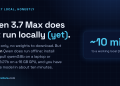
A 2.4 trillion parameter model isn’t a laptop project. Even with a mixture of experts design that only activates a fraction of the network per token, and even heavily quantized, you’re looking at server-class memory measured in hundreds of gigabytes. This is self-hostable in the sense that a company with real GPUs can serve it privately. It’s not self-hostable in the sense that you can pull a model with Ollama and run it offline, which is what most people mean when they get excited about open weights.
So the open drop matters, a lot, but for a specific audience: providers who’ll serve it cheaply, labs who’ll fine-tune it, companies with data that can’t leave the building. If you wanted a Qwen on your own machine, the smaller open models in the family remain the answer, and always were.
The benchmarks, and how much to trust them
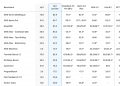
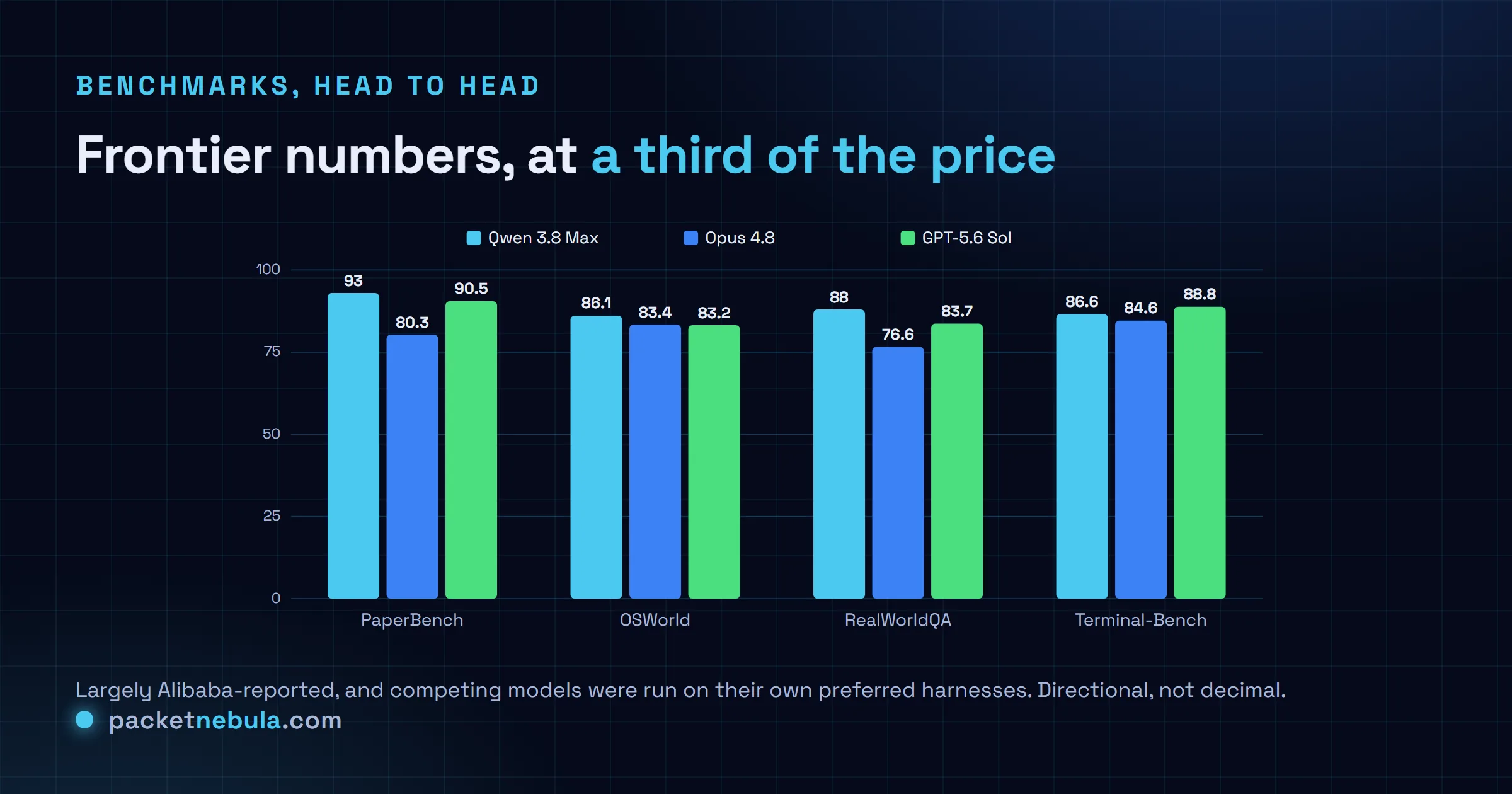
The scores are real and they’re good. On PaperBench it posts 93.0 against Claude Opus 4.8’s 80.3 and GPT-5.6 Sol’s 90.5. On OSWorld-Verified, the computer-use test, 86.1 against 83.4 and 83.2. On RealWorldQA it’s 88.0 against Opus at 76.6. Terminal-Bench 2.1 puts it at 86.6, ahead of Opus 4.8’s 84.6 and behind GPT-5.6 Sol at 88.8. Its own predecessor got left behind entirely on FrontierSWE, 40.7 up to 73.5.
Now the honest caveat, which the write-ups include and the headlines drop: most of the competing models were evaluated on their own preferred harnesses, and some of the Qwen in-house benchmarks are new. Cross-lab comparisons like these are directional. The direction says a Chinese lab is shipping frontier-class multimodal and agentic performance at a third of the Western price. That conclusion survives a generous error bar. The individual decimals don’t need to.
What to watch next week
Three things, in order of how much they’d change your plans.
The licence first. MIT or Apache and this is a genuinely significant open release, the first Max-class model anyone can self-host. A custom licence with commercial thresholds and it’s a research artifact with good PR. Second, the model card: real activated-parameter numbers, training details, and eval methodology you can check rather than take on faith. Third, whether the drop actually happens next week, because promised weights have slipped before, at every lab.
Until then, Qwen3.8-Max is an interesting, cheap, capable hosted model with an open future that hasn’t arrived. Use the API if the price and the vision scores fit your work. Just don’t build the self-hosting plan yet, and be a little suspicious of any headline that already put the words open source in the past tense.
Sources: Alibaba’s Qwen3.8-Max announcement of August 3 2026, with specs, pricing and benchmark tables collated by MarkTechPost and Developers Digest. Benchmark figures are largely Alibaba-reported and were not run on a common harness; the open-weights date, licence and model card were unpublished at the time of writing.
What changed since
19 July 2026. Qwen3.8-Max-Preview went up with a 2.4T parameter claim and open weights promised soon. Nothing runnable, and the promise was a post rather than a licence.
4 August 2026. The state described above: API only, weights promised, no licence named.
15 August 2026. The picture split in two, and this is the part that dates the answer above. The small model, Qwen3.8-27B, shipped under Apache 2.0 with a vision encoder. The 2.4T flagship weights came out text only, under a custom licence rather than a permissive one. So "is Qwen 3.8 open source" now depends entirely on which model you mean, and we pulled that apart in Qwen3.8-27B ships Apache 2.0 with vision, the 2.4T doesn’t.
Frequently asked questions
Is Qwen 3.8 Max open source?
Not today. As of August 4, 2026 the model runs through Alibaba's hosted API only. The weights are promised for next week on Hugging Face and ModelScope, which would make it open weight, and open weight is not automatically open source: that depends on a licence Alibaba has not published yet.
When are the Qwen 3.8 Max weights released?
Alibaba said next week, counting from the August 3 announcement, on Hugging Face and ModelScope. No exact date has been given, and no model card has appeared. It would be the first Max-class Qwen model the company has ever opened, so the drop is worth watching rather than assuming.
What licence will Qwen 3.8 Max use?
Unannounced, and it is the detail that decides everything. GLM-5.2 shipped under MIT, which lets you use it commercially with almost no strings. Plenty of other model weights ship under custom licences with revenue caps, use restrictions or no redistribution. Until Alibaba names one, treat any commercial plan built on these weights as provisional.
Can I run Qwen 3.8 Max locally?
Realistically, no, not on your own machine. It is a 2.4 trillion parameter mixture of experts, reported at about 95 billion active parameters per token, so even quantized you are looking at server-class memory rather than a desktop GPU. Open weights here means self-hostable on serious infrastructure, not something you pull with Ollama on a laptop.
How much does Qwen 3.8 Max cost?
Through the API it is $2 per million input tokens and $6 per million output, with cached input reads as low as $0.25 per million. That is the same headline rate as Grok 4.5 and a fraction of the Western flagships, which is a large part of why the model is getting attention.