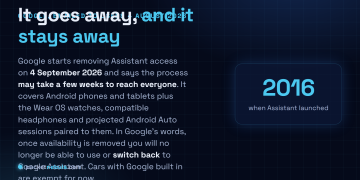





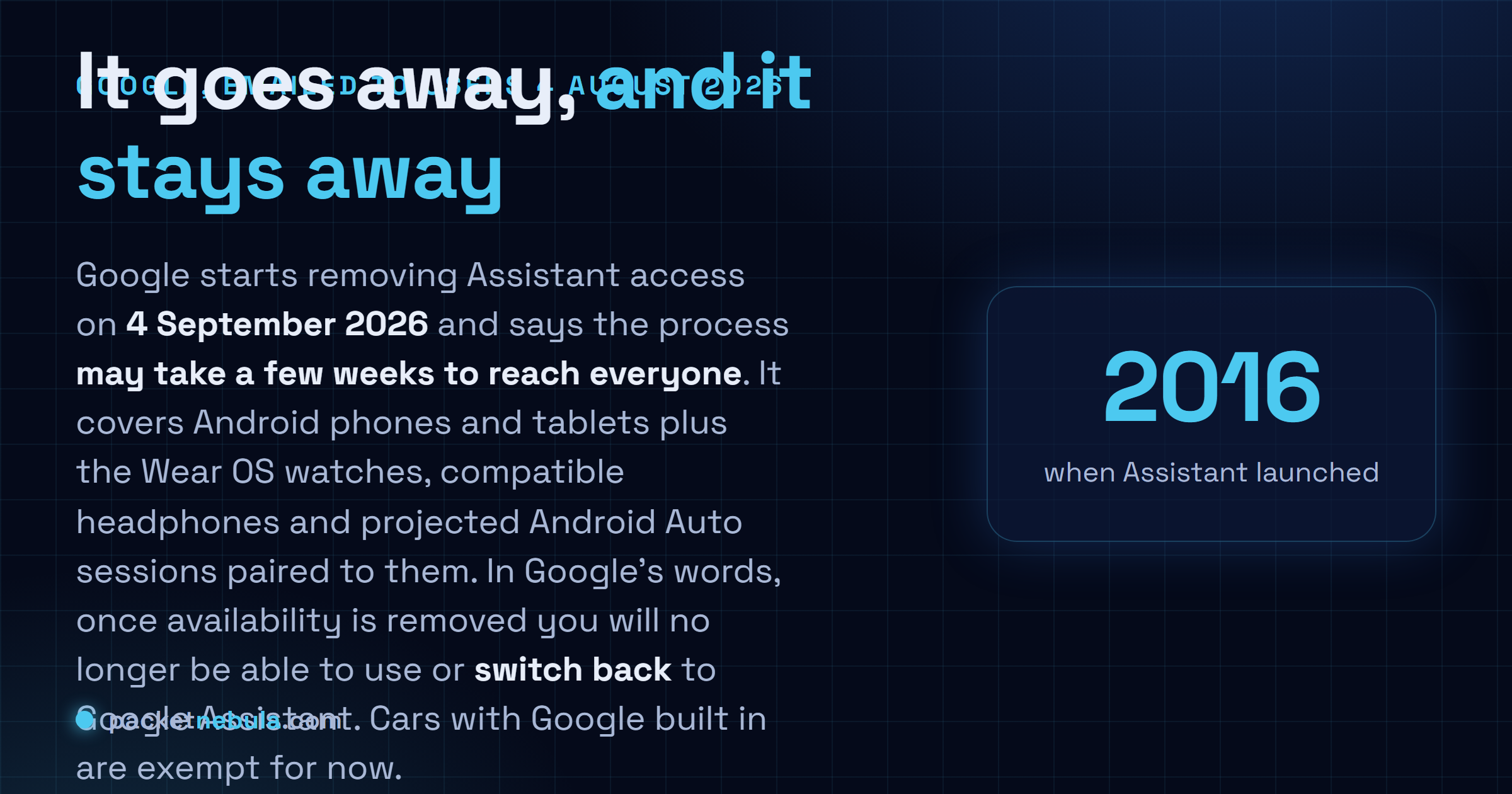
Check your inbox. If there is an Android phone in your pocket, Google sent you a notice this week saying the assistant on it is being discontinued. Removal starts 4 September 2026, it reaches phones, tablets, Wear OS watches and any headphones paired to that phone, and once it lands on a device you cannot go back. That last clause is the one to read twice. Google''s own wording is that you will no longer be able to use or switch back to Google Assistant on your phone, tablet, or paired devices. Cars with Google built in keep Assistant past that date. Android Auto projected from your phone does not.
The short answer
Google is retiring Google Assistant on mobile. Removal starts 4 September 2026 and rolls out over a few weeks, covering Android phones and tablets plus the Wear OS watches, compatible headphones and projected Android Auto sessions attached to them. Cars with Google built in are exempt for now, and TVs and speakers are a separate announcement. The migration is one way. Gemini still has holes where Assistant had features.
The email, and the sentence inside it
Google did not blog this. It mailed it, which is why the date turned up in user inboxes on 4 August before it turned up anywhere official looking.
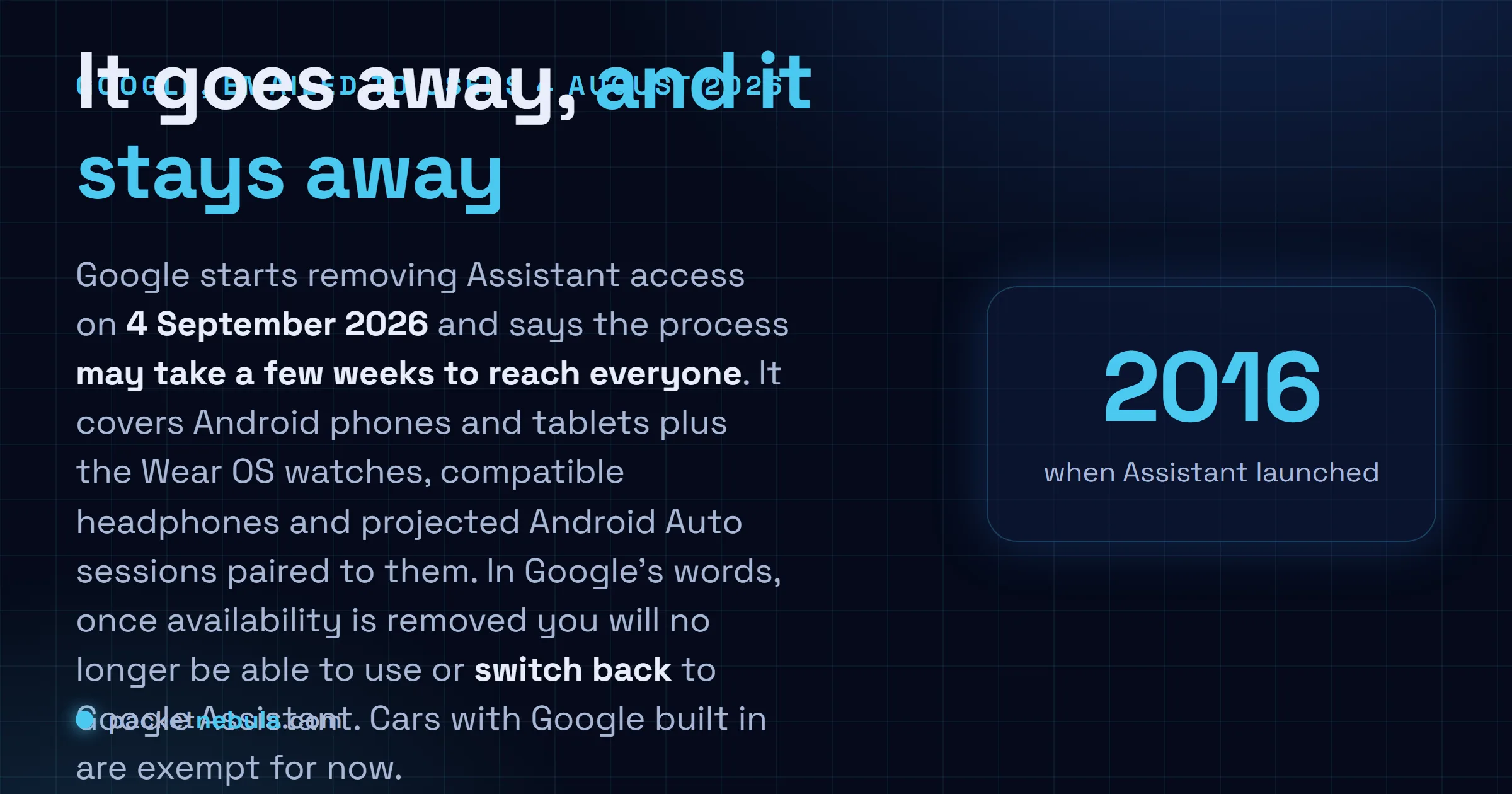
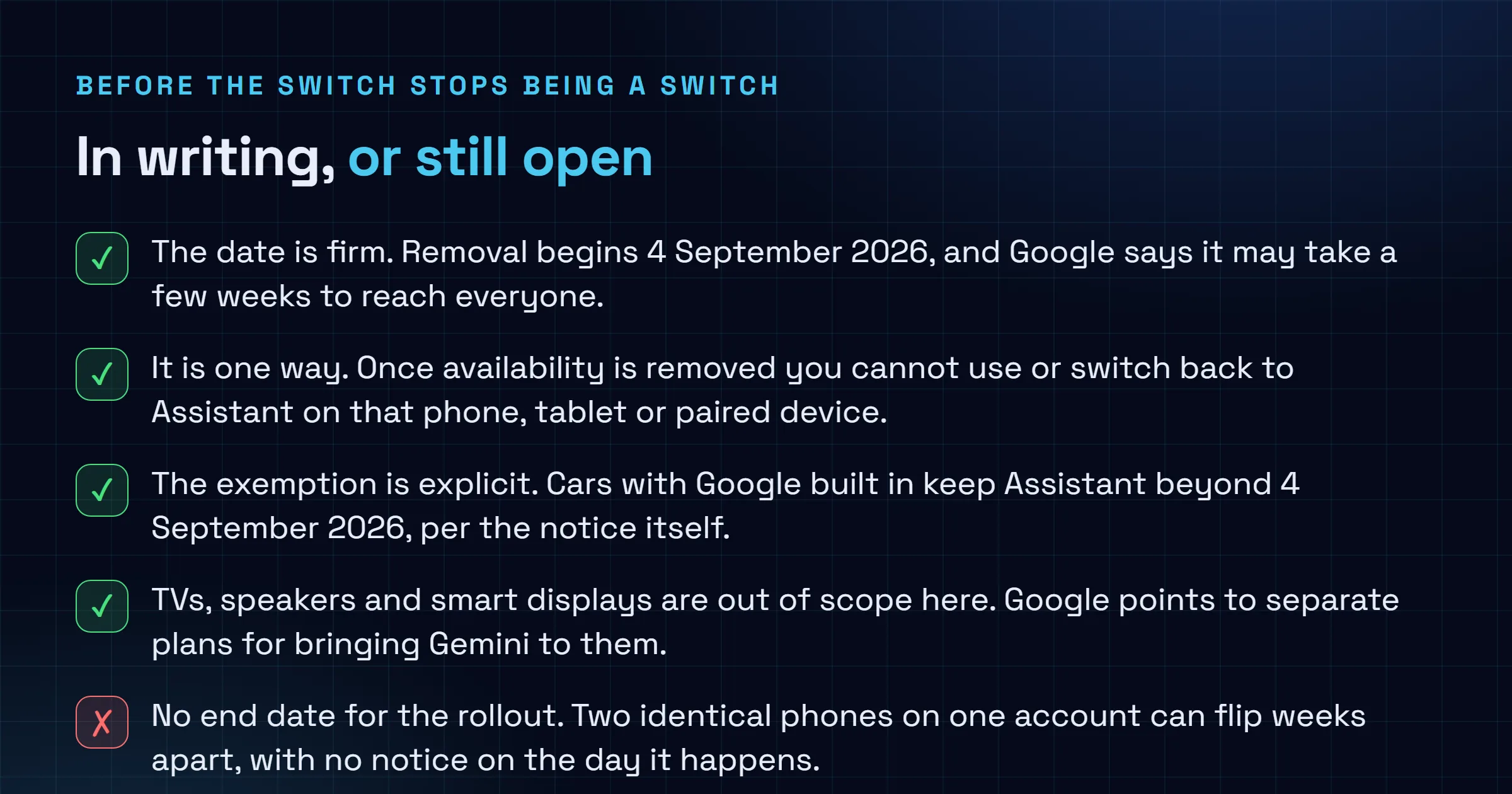
The notice opens by saying the Google Assistant on your mobile device is being discontinued and that Gemini is now the assistant experience on Android. Fine. Everyone saw that coming since Gemini started answering the power button long press. The operative paragraph is the next one: “We will begin removing access to Google Assistant starting on September 4, and expect that this process may take a few weeks to reach everyone. Once availability is removed, you will no longer be able to use or switch back to Google Assistant on your phone, tablet, or paired devices.”
Read the second sentence again. Right now, on most Android phones, the assistant choice is a setting. You can put Gemini on, decide you hate what it did to your alarms, and put Assistant back. That reversibility is what has made the last eighteen months of this migration tolerable.
It ends on 4 September. Not the ability to use Gemini, the ability to refuse it.
Honestly, we think the staggered rollout is the more annoying half of this. “A few weeks to reach everyone” means you cannot plan a cutover. Your phone might flip on the 4th and your spouse’s identical phone on the 22nd, same account, same model, no notification when it happens.
What loses it, what keeps it
The email is unusually precise about surfaces, so it is worth being precise back.
Going: Android phones and tablets that meet Gemini’s minimum requirements, in regions where Gemini ships. Then everything downstream of that phone. Watches running Wear OS. Headphones and earbuds compatible with Gemini. Vehicles running Android Auto projected from the phone.
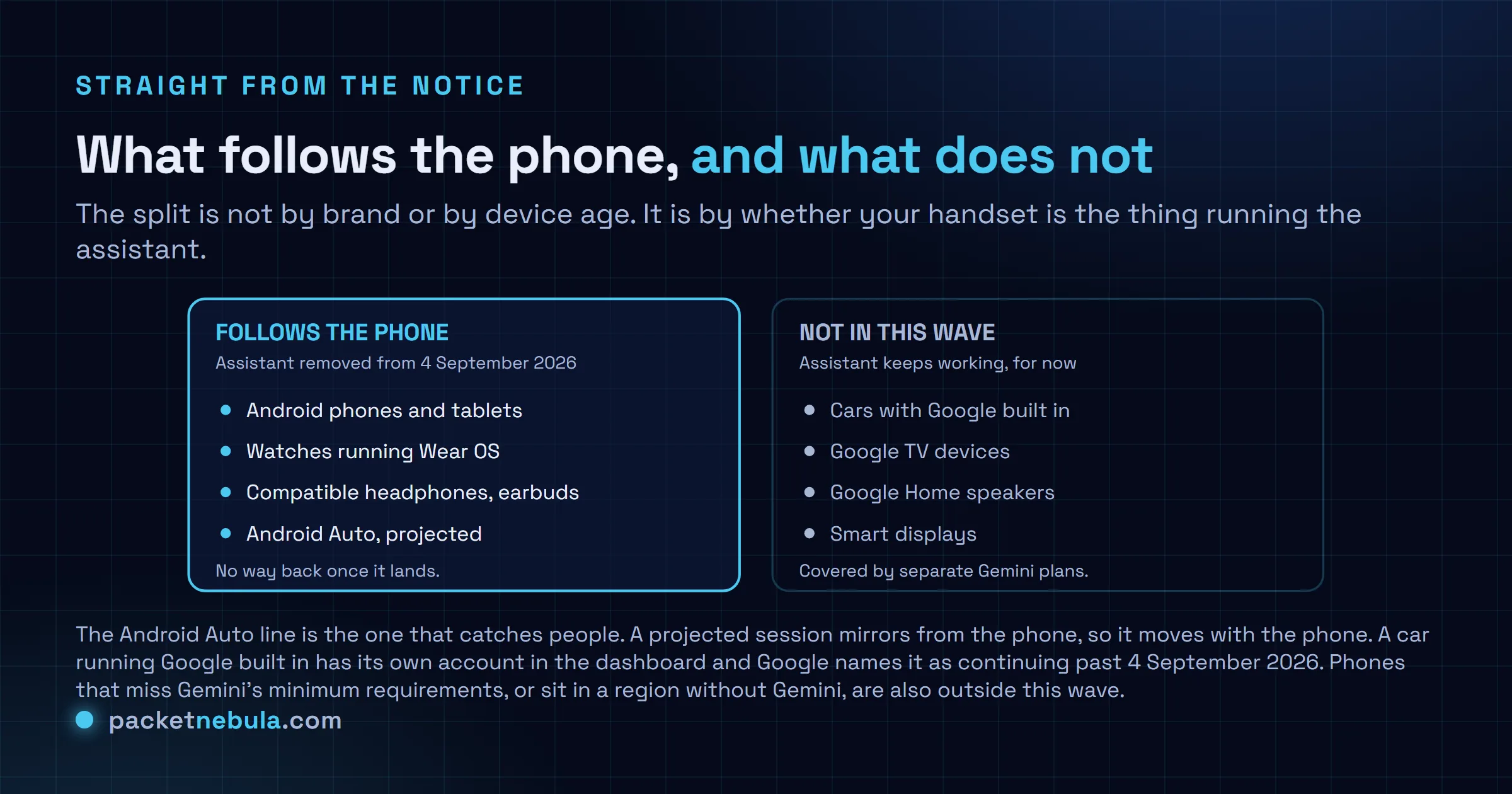
Staying, at least for now: cars with Google built in, which Google names outright as continuing to function beyond 4 September 2026. Google TV, Google Home speakers and smart displays are not in this announcement at all, and Google points to separate plans for bringing Gemini to them.
That Android Auto line catches people. Two cars can show the same interface and land on opposite sides of this, because one is projecting from a handset and the other is running its own Google account in the dashboard. If you cannot remember which yours is, the giveaway is whether the car still does assistant things with the phone unplugged and out of the vehicle.
The gap list nobody put in the email
Here is where the announcement gets quiet. It promises a smooth transition and a more capable assistant. It does not enumerate what Gemini currently cannot do.
Reporting on the migration has been tracking those gaps for months, and the list is not short. Podcasts, news and radio stations and third party music providers do not have the same hooks. Routines are the ugly one: Gemini does not support every starter or action, scheduled time triggers and some media actions among the holes, and routines fired from Clock app alarms have been reported as simply not running. Reminders and task creation have been flagged as missing. So has interpreter mode. Google Home device control works by voice but not by typing.
Most of these read like unfinished plumbing rather than deliberate removals, and some will probably be quietly fixed before September. I might be wrong about that. The point is that Google has published no dated commitment on any single one of them, and the deadline is dated. Those two facts are not symmetrical, and you are the one absorbing the difference.
If your household automation leans on Assistant routines, that is the thing to test now, while you can still fall back.
What to do in the next four weeks
Nothing dramatic. Just stop treating the switch as reversible, because in a month it is not.
Flip to Gemini deliberately, on your own schedule, and run your actual daily commands through it. The alarm you set by voice every night. The lights. Whatever the watch does on your wrist without you looking at it. You will find the broken ones faster by using it for a week than by reading any feature comparison, including this one.
Then decide what needs a non-assistant backup. A routine that matters becomes a Clock alarm plus a Home automation. A voice reminder becomes an app you actually open. Boring, but it survives the next assistant too, and going by the last decade there will be a next assistant.
For the fleet managers reading this: there is no enterprise control here. No policy, no deferral, no staged ring. The rollout reaches devices when it reaches them. If you have kiosk tablets or shared handsets with voice workflows on them, that workflow changes underneath you sometime after 4 September and you will not be told which day.
We covered what changed in Gemini 3.6 Flash when the model side of this moved, and the new Siri in the iOS 27 public beta if you want to see the other big assistant rewrite happening on the same calendar.
Ten years is a decent run for a product. Assistant shipped in 2016 and it is being switched off by email in 2026, which is roughly how these things go now.
Sources
Google’s notice reached users by email rather than a blog post. The full text is reproduced by Droid Life, and the date and affected surfaces were reported independently by 9to5Google, Android Authority and Engadget. The running list of features Gemini has not yet matched comes from Android Police. Where the reporting disagreed, we went with the wording in Google’s own email.
Frequently asked questions
What is the exact date Google Assistant shuts down?
Google begins removing access on 4 September 2026. That is a start date, not a finish line. The email says the process may take a few weeks to reach everyone, so two phones on the same account can flip on different days. There is no published end date for the rollout and no way to request it early or late.
Can I switch back to Google Assistant afterwards?
No. This is the part people keep missing. Google wrote that once availability is removed, you will no longer be able to use or switch back to Google Assistant on your phone, tablet, or paired devices. Today the Assistant settings screen still offers a toggle between the two. After the change reaches your device that toggle is gone, and it is gone for the watch and the earbuds attached to it as well.
Which devices keep Google Assistant?
Cars with Google built in are named explicitly in Google's email as continuing to work beyond 4 September 2026. Google TV devices, Google Home speakers and smart displays are outside this announcement entirely, and Google says it will bring Gemini to them under separate plans. Android phones that do not meet Gemini's minimum requirements, or that sit in a region where Gemini is not offered, are also not part of this wave.
What can Gemini not do that Assistant could?
Enough to matter if you built habits on it. Podcasts, news and radio stations and third party music providers are not wired up the same way. Routines are partial, with some starters and actions unsupported, and routines attached to Clock app alarms have been reported as broken. Setting reminders and creating tasks, interpreter mode, and typed rather than spoken control of Google Home devices have all been flagged as missing. Google has published no dated commitment to restore any specific one.
Does this affect Android Auto?
It affects the projected kind. If Android Auto runs off your phone and mirrors to the head unit, that stack follows the phone and moves to Gemini. If the car itself runs Google built in, with its own account and its own Assistant, Google says it keeps working past 4 September 2026. Same badge on the dashboard for a lot of drivers, two different outcomes.