
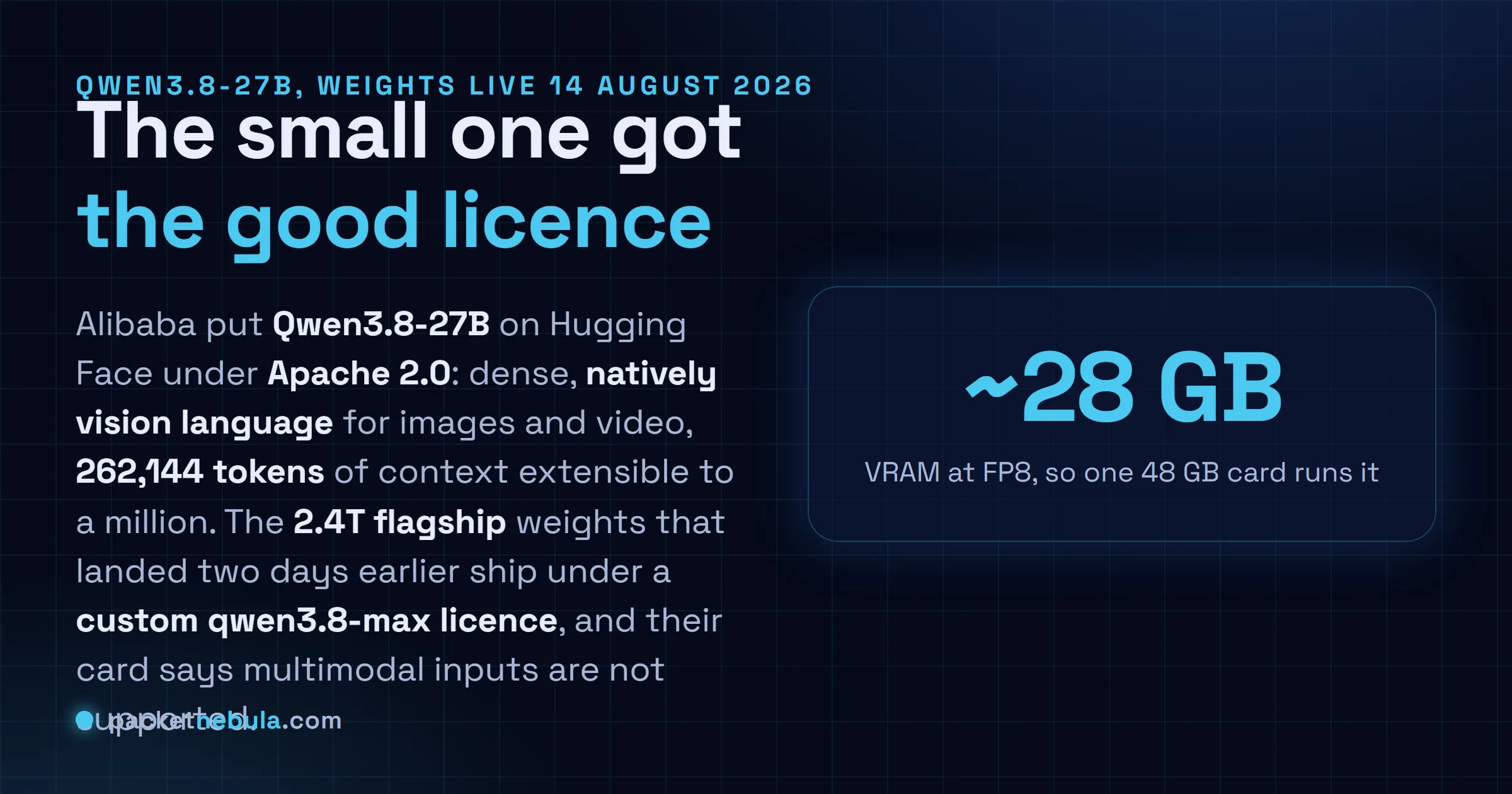
Open the two model cards side by side and the surprise is which one you would rather self host. Qwen3.8-27B went up on Hugging Face on 14 August under Apache 2.0: dense, with a vision encoder nobody had been promised, 262,144 tokens of native context, and a reasoning effort dial you can actually turn down. The 2.4 trillion parameter flagship whose weights landed two days earlier carries a bespoke licence called qwen3.8-max, and its own card says multimodal inputs are not supported and thinking cannot be disabled. So the small one is the permissive one. It is also the multimodal one. We went looking for the catch, and the catch is mostly VRAM.
The short answer
Alibaba shipped two sets of Qwen3.8 weights inside three days. The 2.4T flagship came first, text only, under a bespoke licence. Then the 27B landed under Apache 2.0 with a native vision encoder. If you self host, the second one is the interesting release, and it is the one that fits on hardware you might already own.
What actually landed
Back on 4 August we wrote that Qwen3.8-Max was not open source, that it was API only, and that the weights were promised for the following week with no licence named. Both halves of that promise have now been kept, sort of.
The flagship weights went up around 12 August as Qwen/Qwen3.8-2.4T-A95B. Then on 14 August the 27B appeared, and it is the one that got the attention.
Here is the shape of it. Qwen3.8-27B is dense, not sparse. Sixty four layers, built as sixteen repeats of a block that mixes Gated DeltaNet with Gated Attention. Native context of 262,144 tokens, extensible to a million. And a vision encoder, which is the part nobody had been trailing: the card calls it a native vision language model that understands images and videos.
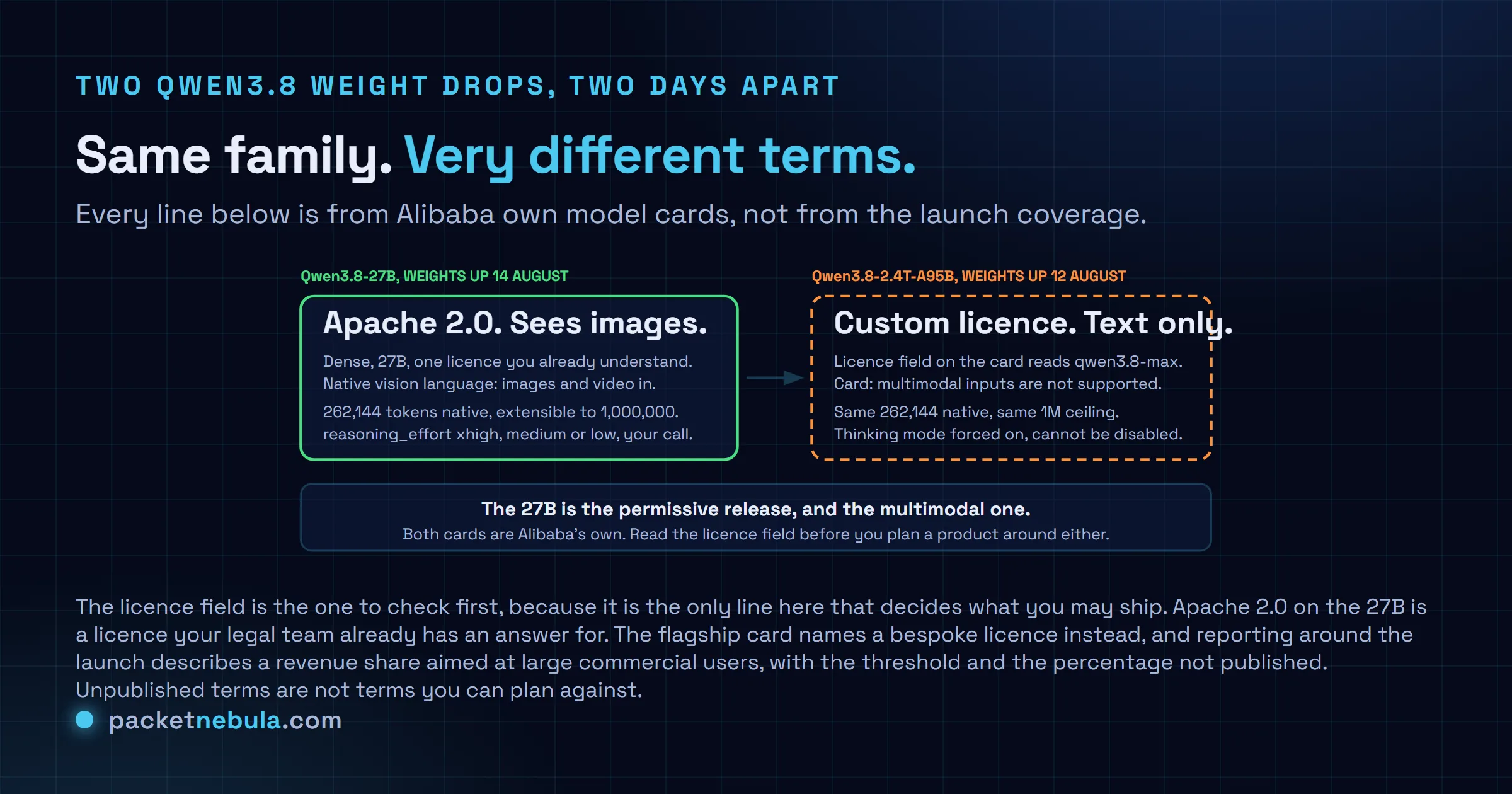
The licence is the line I would read first. Apache 2.0 on the 27B, which is boring in the best way: your legal team already has a position on it. The flagship card names qwen3.8-max instead, a bespoke licence, and reporting around that launch describes a revenue share aimed at large commercial users with neither the threshold nor the percentage published. Unpublished terms are not terms you can plan around, so I would treat the flagship weights as unusable for anything commercial until the actual text is out.
The bit that reads backwards
Normally the flagship gets the features and the small model gets the leftovers. Not here.
The 2.4T card is explicit: multimodal inputs are not supported, and thinking cannot be disabled. Both of those are real constraints. Forced thinking means every call pays the reasoning tokens whether the task needs them or not, which is exactly the problem we flagged on GLM-5.3 last week when Z.ai removed non-thinking mode. The 27B keeps the dial, with reasoning_effort at xhigh, medium or low.
So the downloadable flagship is a text only model that always thinks, and the downloadable 27B sees images and lets you turn the thinking down. For most self hosted work that is the wrong way round from what the parameter counts suggest, and it is a good outcome.
The numbers Alibaba published
First real benchmark table for the Qwen3.8 family, incidentally. The July preview shipped with a tweet and no card at all.
On the 27B: SWE-bench Pro 61.7, Terminal Bench 2.1 73.0, LiveCodeBench v6 90.3, IFBench 79.5. On the vision side, OSWorld-Verified 84.3 and WebArena-Verified 64.8, with MathVision at 94.6.
The flagship posts higher where you would expect: SWE-bench Pro 67.7, Terminal Bench 2.1 86.6, GPQA Diamond 92.6, PaperBench 93.0. Six points of SWE-bench Pro between a 27B dense model and a 2.4 trillion parameter mixture of experts is a narrower gap than the parameter counts imply, and the usual caveat applies with full force. These are vendor numbers on vendor runs. Nobody outside Alibaba has reproduced any of them yet.
What I would take from the table is the shape rather than the digits. A 27B that lands in the low sixties on SWE-bench Pro and above eighty on OSWorld is a genuinely capable local agent model, and OSWorld is the computer-use benchmark, which is where the vision encoder earns its place.
Whether you can run it
This is the part that decides it for most people.
Alibaba publishes an FP8 build itself, Qwen3.8-27B-FP8, using fine grained quantisation at block size 128, and says the metrics come out nearly identical to the original. That build is compatible with Transformers, vLLM and SGLang. Community quantisations for llama.cpp, Ollama, LM Studio and Jan appeared within a day, as they always do.
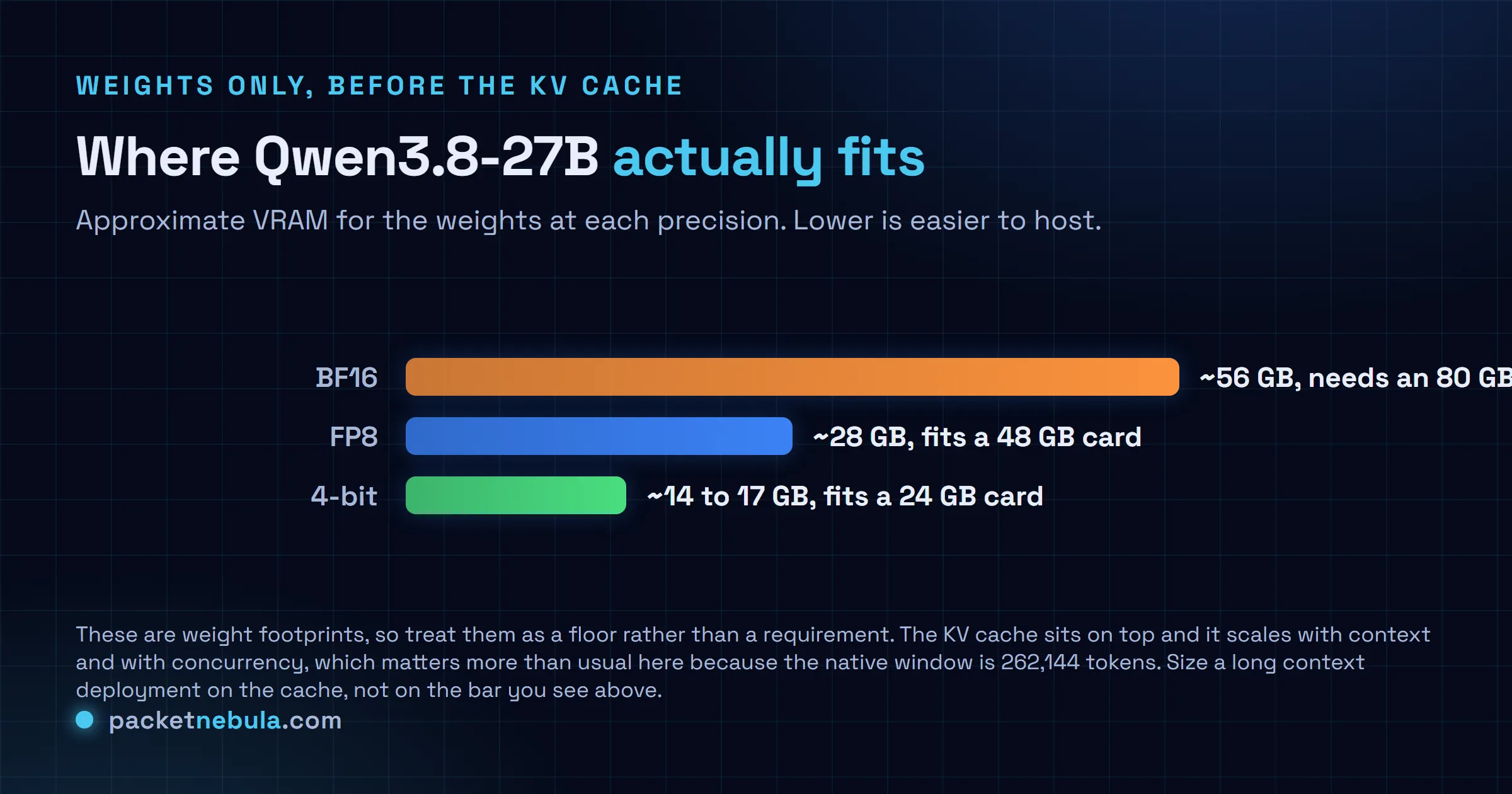
Rough weight footprints: about 56 GB at BF16, about 28 GB at FP8, somewhere in the 14 to 17 GB range at 4-bit. Those are community estimates, not vendor figures, and they cover the weights only.
Then the cache. A 262k native window sounds like a gift until you price the KV cache that fills it, and at long context with a few concurrent requests the cache can outweigh the weights. If you are sizing a box on the 4-bit number because it fits a 24 GB card, budget for a short context or a single stream. That is the constraint people keep discovering after the hardware arrives, and it is the reason we keep saying the same thing about local models: the parameter count tells you almost nothing about what you need.
Would we run it
If you have a 48 GB card, yes, the FP8 build is the obvious thing to try this week. Apache 2.0, vision included, and a coding score that is respectable for the size.
If you were waiting on the 2.4T weights so you could self host the frontier model, the honest answer is that what shipped is not what the hosted product is. Text only, thinking forced, licence unpublished in its details. It exists, you can download it, and I am not sure who it is for yet.
And if you are picking a local model for agent work specifically, the OSWorld number plus the vision encoder is the argument for this one over a text only competitor of similar size. Worth a weekend. We will run it against Qwen3.7 on local hardware once there is something to compare beyond Alibaba’s own table.
Sources
Alibaba, Qwen3.8-27B-FP8 model card on Hugging Face, for the architecture, the Apache 2.0 licence, the 262,144 token native context, the native vision language description, the reasoning effort levels, the FP8 block size 128 quantisation and the benchmark table. Alibaba, Qwen3.8-2.4T-A95B model card, for the qwen3.8-max licence field, the 95B active parameters out of 512 experts, the statement that multimodal inputs are not supported and that thinking cannot be disabled, and its own benchmark figures. Yotta Labs, Qwen 3.8 27B specs and hardware requirements, for the VRAM estimates by precision. ExplainX, Qwen3.8-Max open weights are live, for the 12 August flagship weights date and the reporting on the revenue share clause, whose threshold and percentage are not published.
Update, 7 October 2026. The Qwen3.8-Max (2.4T) licence file was added on 12 August. It requires a separate licence for model-as-a-service or AI work assistant businesses whose group revenue passes $50 million in 12 months, and the text contains no revenue share or percentage. Source: the licence file.
Frequently asked questions
What licence is Qwen3.8-27B under?
Apache 2.0. The licence field on the Qwen/Qwen3.8-27B-FP8 model card reads apache-2.0, which allows commercial use, modification and redistribution with attribution and no revenue share. That is a different licence from the flagship weights: the Qwen/Qwen3.8-2.4T-A95B card names a custom licence called qwen3.8-max instead.
Can Qwen3.8-27B read images?
Yes. Alibaba describes it on the card as a native vision language model that understands images and videos, and publishes vision results alongside the text ones, including 84.3 on OSWorld-Verified and 64.8 on WebArena-Verified. The 2.4T flagship weights cannot: that card states plainly that multimodal inputs are not supported.
How much VRAM does Qwen3.8-27B need?
Roughly 56 GB at BF16, about 28 GB at FP8 and somewhere around 14 to 17 GB at 4-bit, for the weights alone. The KV cache is extra and it grows with context length and concurrency, which matters here because the native window is 262,144 tokens. Alibaba does not publish VRAM figures itself, so treat these as the community estimates they are.
Is Qwen3.8-27B dense or mixture of experts?
Dense. The card describes 64 layers built as 16 repeats of a block mixing Gated DeltaNet and Gated Attention with feed forward layers. The 2.4T flagship is the sparse one, a fine grained mixture of experts with 95B parameters active per token out of 512 experts.
What context length does it support?
The card says 262,144 tokens natively, extensible up to 1,000,000. Both Qwen3.8 open weight releases quote the same pair of numbers, so context is not what separates them. The licence and the vision support are.


.jpg)
