
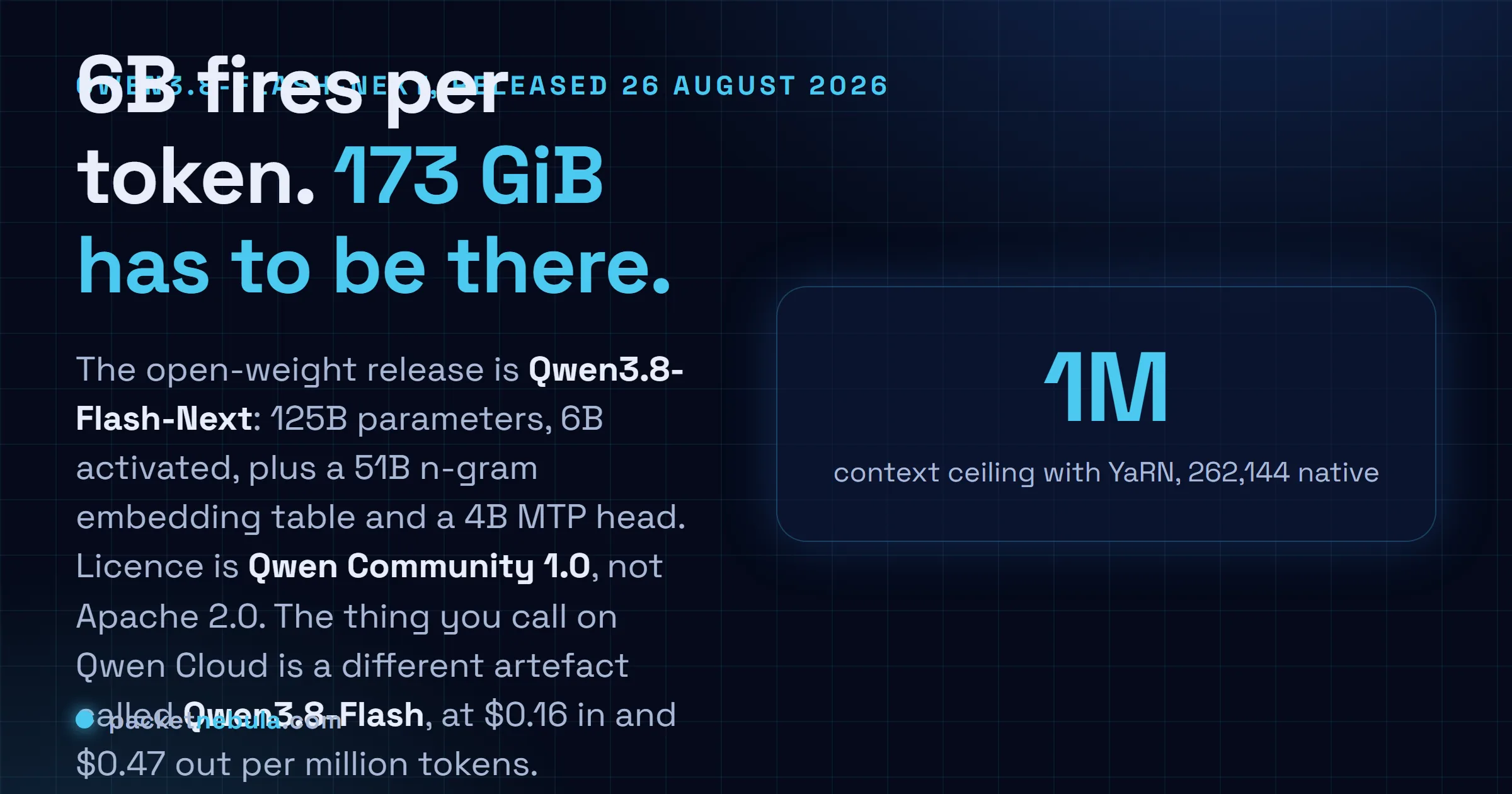
Somebody on the team read "6B activated" and asked which of our boxes could run it. Fair question, wrong number: the FP8 checkpoint for Qwen3.8-Flash-Next is about 173 GiB of safetensors, and the BF16 one is 335 GiB. Six billion is what fires per token, not what you have to keep somewhere. Alibaba put the model out on 26 August 2026 as an open-weight preview of the architecture behind Qwen4, and the engineering in it is the most interesting thing we have read all month. Two details keep getting flattened in the coverage, though. The licence is not Apache 2.0, whatever a few launch write-ups said. And the model you call on the API is named Qwen3.8-Flash, which is not the same artefact as the one on Hugging Face.
The short answer
Qwen3.8-Flash-Next is a preview of the Qwen4 architecture, open-weight since 26 August. Genuinely clever design, real benchmark wins over a model three times its size. Just don’t confuse it with the Qwen3.8-Flash you call on the API, and read the licence before you build a product on it.
Two names, one release
This trips people up within about thirty seconds of the announcement, so let’s clear it first.
The weights on Hugging Face are Qwen/Qwen3.8-Flash-Next, with an FP8 variant beside them. The thing you hit on Qwen Cloud is Qwen3.8-Flash. Qwen’s own model card puts it plainly:
Qwen3.8-Flash is the official version based on Qwen3.8-Flash-Next with more production features, e.g., 1M context length by default, official built-in tools.
So the API model is a superset, not a mirror. If you benchmark the open weights locally and then ship against the hosted endpoint, you are not testing the same system. That matters more than usual here, because the context handling is one of the things that differs: the open release is 262,144 tokens natively and stretches to a million with YaRN, while the hosted one starts at a million.
Pricing on Qwen Cloud is $0.16 per million input tokens and $0.47 per million output. OpenRouter’s listing reads $0.15 in, same $0.47 out. Nobody has explained the cent.
The architecture is the actual story
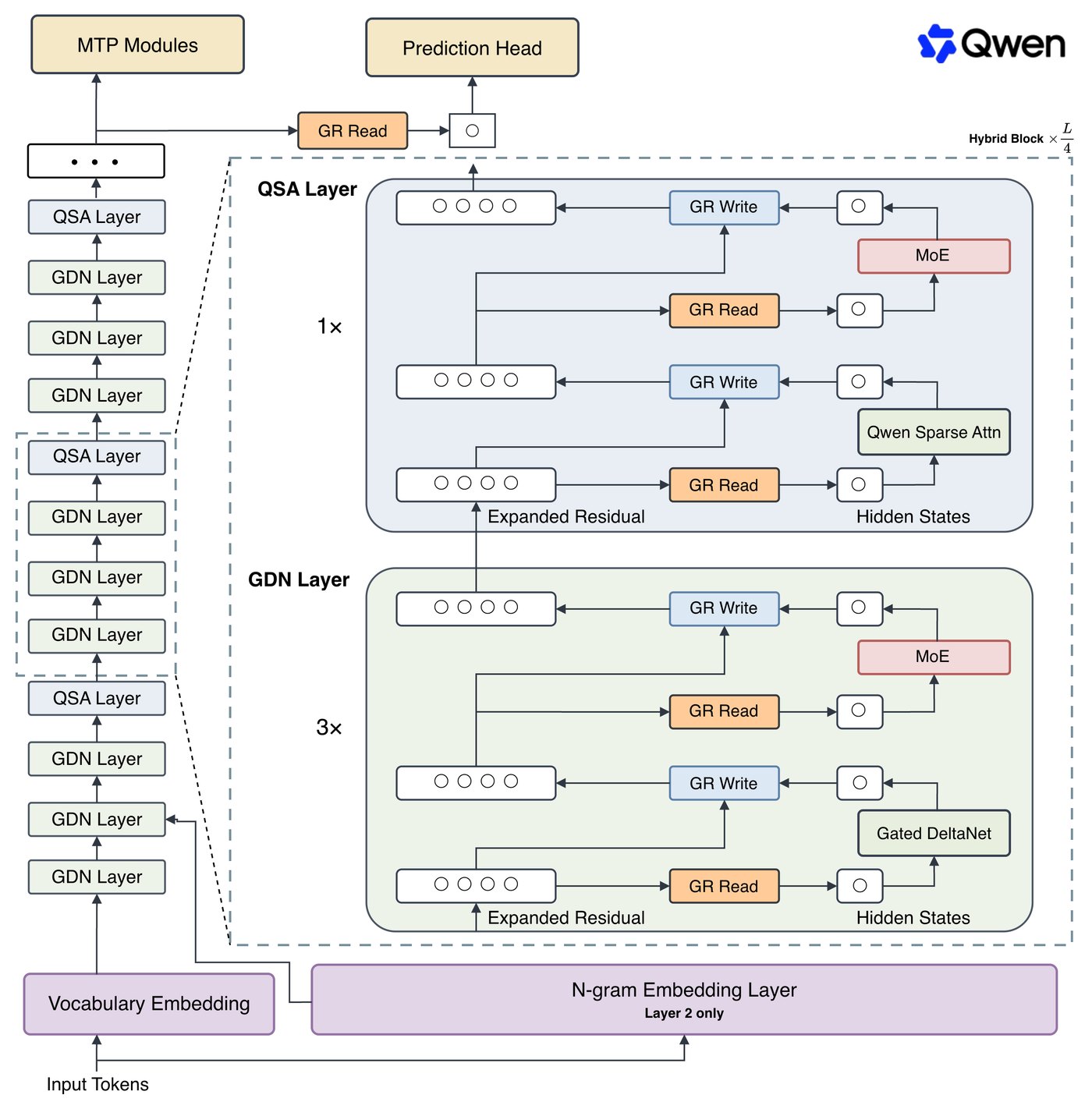
Image: Qwen (Alibaba Group), from the Qwen3.8-Flash-Next model card
Forty-eight layers, arranged as twelve repetitions of three Gated DeltaNet blocks followed by one Qwen Sparse Attention block. Every one of those blocks feeds a mixture of experts with 512 experts, of which ten routed plus one shared fire per token. Expert intermediate dimension is a slim 640. Hidden dimension across the model is 2560, which is small for something with 125B parameters in it, and that’s the point: the width lives in the expert count, not the tensor shapes.
Then there’s the n-gram table. Twenty million bigram and trigram entries, 51B parameters, consulted at layer 2 only. Qwen’s framing is that embeddings scale parameters without scaling compute and are easier to offload than MoE weights are. Which reads as a polite way of saying they found somewhere cheaper than HBM to keep half the model.
I might be wrong about how well that holds up under a real serving load. The idea is sound, the memory hierarchy is not always as forgiving as an architecture diagram makes it look.
The 6B figure, read properly
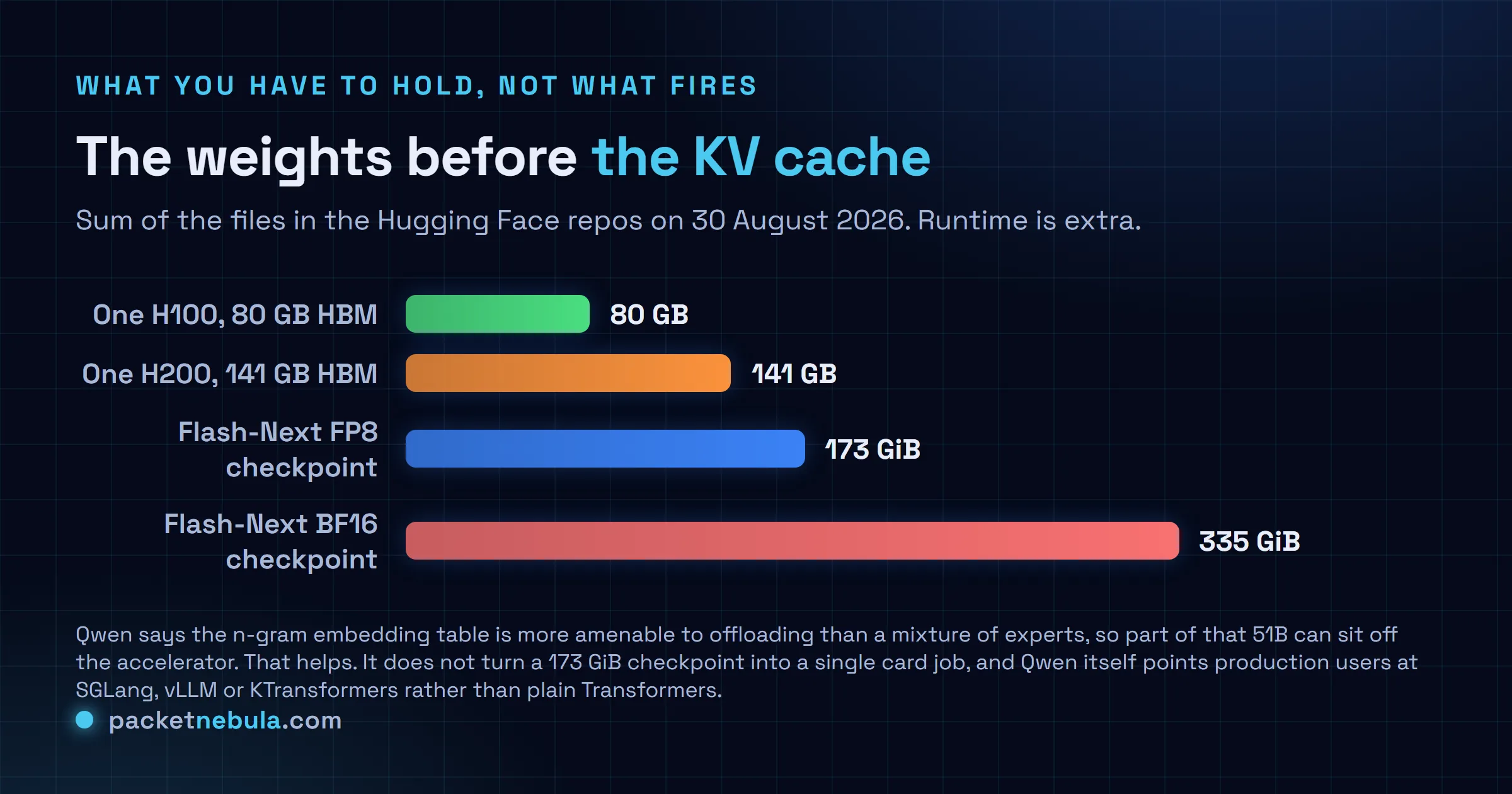
Six billion parameters activate per token. That’s a compute claim, and it’s a good one. It is not a memory claim, and the gap between the two is where the disappointment usually lands.
We pulled the file sizes off the Hugging Face API on 30 August: 144 files summing to 172.8 GiB for the FP8 repo, 335.3 GiB for BF16. Add the KV cache for whatever context you actually intend to use, add framework overhead, and this is a small cluster or a very well equipped single node. Not a workstation.
Compare that to GLM-5.3-Flash, which Z.ai shipped the same day at 320B total and 18B active. Different tradeoff, same conclusion for anyone hoping to self-host on a desk.
What the benchmarks say, losses included
Credit where it’s due: Qwen published a table that includes the places it comes second.
It beats Qwen3.7-Plus, a 397B model with 17B active, almost everywhere. SWE-bench Pro 62.5 against 55.8. CoWorkBench 73.9 against 65.1. JobBench 55.7 against 27.6, which is a gap wide enough to make us suspicious of the harness rather than impressed by the model. Same instinct on DeepSWE 1.1, where Flash-Next posts 58.7 and Qwen3.7-Plus posts 16.5. Numbers that far apart usually mean the older model was failing to complete the task format, not that it’s fifteen times worse at software engineering.
The losses are more informative. On repo-level generation, NL2Repo-Bench, DeepSeek-V4-Flash-0731 takes it 54.2 to 48.1. On HLE, Claude Opus 4.6 Max wins 40.0 to 35.9. And on Agents’ Last Exam the Pass@1 goes to DeepSeek, 25.2 to 24.3.
One thing the table doesn’t do is compare against anything newer than Opus 4.6. Opus 4.8 and Opus 5 both shipped before 26 August. Their absence is a choice.
The licence is the part to actually read
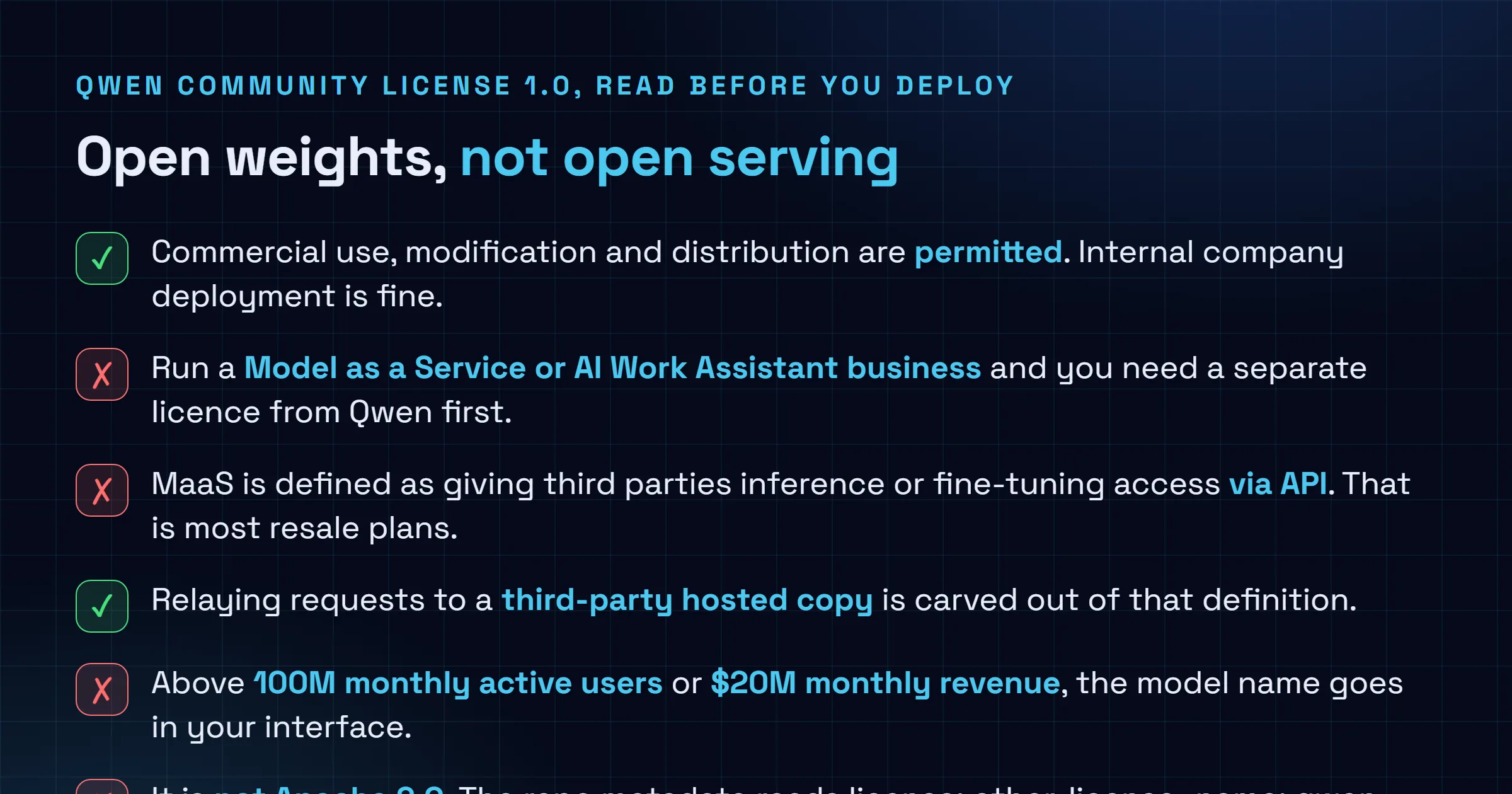
The repo metadata says license: other, license_name: qwen-community-1.0. Not Apache 2.0. Several outlets reported Apache 2.0 on launch day and it isn’t a small distinction.
You can use it commercially, modify it, redistribute it, run it inside your own company. What you cannot do without asking Qwen first is run a Model as a Service or an AI Work Assistant business on it. The licence defines MaaS as giving third parties access to inference or fine-tuning via API, and explicitly carves out relaying requests to a third-party hosted copy. So reselling an endpoint you host yourself needs a separate licence. Pointing your users at somebody else’s hosted Qwen doesn’t.
Above 100,000,000 monthly active users or US$20,000,000 monthly revenue, you also have to display the model name prominently in the product.
So when would we reach for it
If you’re paying for a hosted frontier model to do long agentic runs, $0.16 per million in is worth an afternoon of evaluation, particularly on the office-work and tool-use side where CoWorkBench and Toolathlon flatter it. If you want to self-host, budget for a node and not a card, and take the FP8 checkpoint.
And if you’re building a product that sells inference to other people, read the licence before you read the benchmarks. That order saves time.
What changed since
5 October 2026. The "not on one card" answer in the FAQ below needs a footnote now. On 4 October a project called Strata sat at the top of Hacker News, 740-odd points and 330 comments, with a claim we'd have laughed at in August: Qwen3.8-Flash-Next writing text on a 12 GB gaming GPU. We read the repository and the thread rather than the headline, and the claim mostly holds, with the word "quantised" doing most of the lifting. Strata is an MIT-licensed engine built on llama.cpp and ggml. It keeps the busiest experts on the graphics card, pins all 24,576 of them in system RAM, and reads the n-gram table from the SSD, which is exactly the offload Qwen hinted at in the model card and we were sceptical about further up. The weights it loads are 2-bit and 3-bit GGUF packs from ISTA-DASLab, UkisAI and Unsloth. The README asks for 12 GB of VRAM, 32 GB of RAM (64 to run every size) and about 80 GB of disk. Its own table has an RTX 5070 at 94 tokens a second on the Q2_0 pack and 53 on IQ3_S, with prompt processing between 1,620 and 2,650 tokens a second, and the author expects a 24 GB RTX 3090 to land around 100 to 140.
The 100 tokens a second in the Hacker News title isn't in the README. It comes from the submitter's own box, an RTX 4090 with 128 GB of DDR5 and a 7950X3D, where they report 124. Further down the thread someone gets 30 tokens a second on a 10 GB RTX 3080 with 48 GB of RAM on the Coder pack, and someone else about 7 on a Ryzen 8845HS with 96 GB and no discrete GPU at all. So the speed is real, and it scales with how much of the model you can keep off the SSD.
What it costs you is precision, and the thread has the one measurement we trust more than any table. A commenter ran a coordinate-finding vision test and got a median error of 154.8 pixels through Strata against 46.5 pixels through plain llama.cpp on the same model, which they compared to dropping from a 35B model to a 9B one. The Coder pack, which strips out half the experts, is the only variant with a published quality figure: 91% of the full model's SWE-bench Verified score, measured by its own authors, and the README admits it's weaker on CJK text. Everything else is anecdote so far, and we'd want a week with the IQ3 packs before trusting them on work that matters. The disk arithmetic hasn't moved either. Unsloth's 2-bit GGUF is 78.9 GB and its 4-bit one 93.7 GB, so the 173 GiB we summed above is still the honest size of this model. You're just not loading all of it at full precision. Two more things before you install it: the repository was eleven days old with 325 open issues when we checked, and the Qwen Community licence applies to whatever you serve through it.
Sources for this update: the Strata repository (requirements, the RTX 5070 and RX 9070 XT tables, the expert placement and the Coder figure), the Hacker News thread of 4 October 2026 (the submitter's RTX 4090 figure, the other users' numbers and the vision test), and Unsloth's GGUF repository (file sizes).
Sources
Model card and licence: Qwen/Qwen3.8-Flash-Next on Hugging Face and the Qwen Community License 1.0. Official announcement: Qwen3.8-Flash-Next, A New Architecture, Towards Ultimate Cost-Efficiency and the QwenLM repository. API listing: qwen/qwen3.8-flash on OpenRouter. Coverage: TechNode and MarkTechPost. Checkpoint sizes are our own sum of the repository files via the Hugging Face API on 30 August 2026.
Update, 7 October 2026. Alibaba's Model Studio international price for the input side is $0.15 per million tokens, not the $0.16 quoted for Qwen Cloud.
Frequently asked questions
What is the difference between Qwen3.8-Flash-Next and Qwen3.8-Flash?
Flash-Next is the open-weight release on Hugging Face and ModelScope, published on 26 August 2026 under the Qwen Community License 1.0. Qwen3.8-Flash is the managed version on Qwen Cloud, described by Qwen as based on Flash-Next but with production features on top, including a 1M context length by default and official built-in tools. Same family, different artefacts, and the API one is the one with a price attached.
How much does Qwen3.8-Flash cost?
Qwen lists $0.16 per million input tokens and $0.47 per million output tokens on Qwen Cloud. The OpenRouter listing for qwen/qwen3.8-flash reads $0.15 in and $0.47 out on 30 August 2026, with a 1,000,000 token context and a 131,072 token completion ceiling. The one cent gap between the two input rates is not something either side has explained.
Is Qwen3.8-Flash-Next Apache 2.0?
No. Several launch write-ups said Apache 2.0 and they were wrong. The Hugging Face repo metadata reads license: other with license_name: qwen-community-1.0, and the licence file is the Qwen Community License 1.0. It permits commercial use and redistribution, but it requires a separate licence from Qwen if you run a Model as a Service or an AI Work Assistant business.
Can I self-host it on one GPU?
Not on one card. The FP8 repo on Hugging Face sums to roughly 173 GiB and the BF16 repo to about 335 GiB, before any KV cache. The 6B activated figure describes compute per token, not residency. Qwen does note that the n-gram embedding table offloads more gracefully than mixture of experts weights do, so some of the 51B can live off the accelerator, and it points production users at SGLang or vLLM rather than plain Transformers.
Is it better than DeepSeek V4-Flash or Claude Opus?
Depends what you measure, and Qwen published its own losses. On the vendor table Flash-Next takes SWE-bench Pro at 62.5 against 56.0 for DeepSeek-V4-Flash-0731 and 53.4 for Claude Opus 4.6 Max. It loses NL2Repo-Bench, 48.1 against 54.2 for DeepSeek, and it loses HLE, 35.9 against 40.0 for Opus 4.6 Max. Worth noting the comparison set stops at Opus 4.6, so 4.8 and Opus 5 are absent.


