




Your DeepSeek bill didn't change last Friday. The model did. On 31 July DeepSeek shipped DeepSeek-V4-Flash-0731 onto the same deepseek-v4-flash endpoint you were already calling, at the same price, with the same 284B parameters and 13B firing per token, and the weights underneath turned into something that scores 82.7 on Terminal Bench 2.1 where the April preview managed 61.8. Those are DeepSeek's own numbers, and we'll get to how much weight they carry. The practical bit first: nothing in your code has to change, which is the whole problem. If you keep an eval suite from the spring, it now describes a model you aren't talking to any more.
The short answer
DeepSeek-V4-Flash-0731 supersedes the April preview on the same model name, the same endpoint and the same price, with no architecture change at all. The benchmark jumps are large and they’re all post-training. They also come from a harness DeepSeek hasn’t released, at the most expensive effort setting, so read them as a direction rather than a measurement.
What actually shipped
DeepSeek published DeepSeek-V4-Flash-0731 on Hugging Face on 31 July, under the MIT licence, ungated. The model card calls it the official release of DeepSeek-V4-Flash, superseding the preview, with what it describes as substantially enhanced agentic capabilities.
The company was unusually blunt about the scope on X:
DeepSeek-V4-Flash-0731 keeps the exact same model architecture and size as the preview version. Today’s upgrade applies ONLY to the DeepSeek-V4-Flash API. The DeepSeek-V4-Pro API and App/Web models remain unchanged for now. The official release of DeepSeek-V4-Pro is coming ASAP!
That’s @deepseek_ai on X, 31 July 2026, emoji stripped.
So: a mixture of experts with 284B parameters and 13B firing per token, 256 routed experts per layer with six active, a 1M token window. The Hugging Face card lists 304B total, which is the same base model plus the DSpark speculative decoding module riding along in the checkpoint. Both numbers are floating around the coverage and both are right about different things.
Two API changes came with it. deepseek-v4-flash now speaks the Responses API format natively and has been adapted for Codex. And reasoning_effort takes three levels, low, high and max.
The caveat DeepSeek printed itself
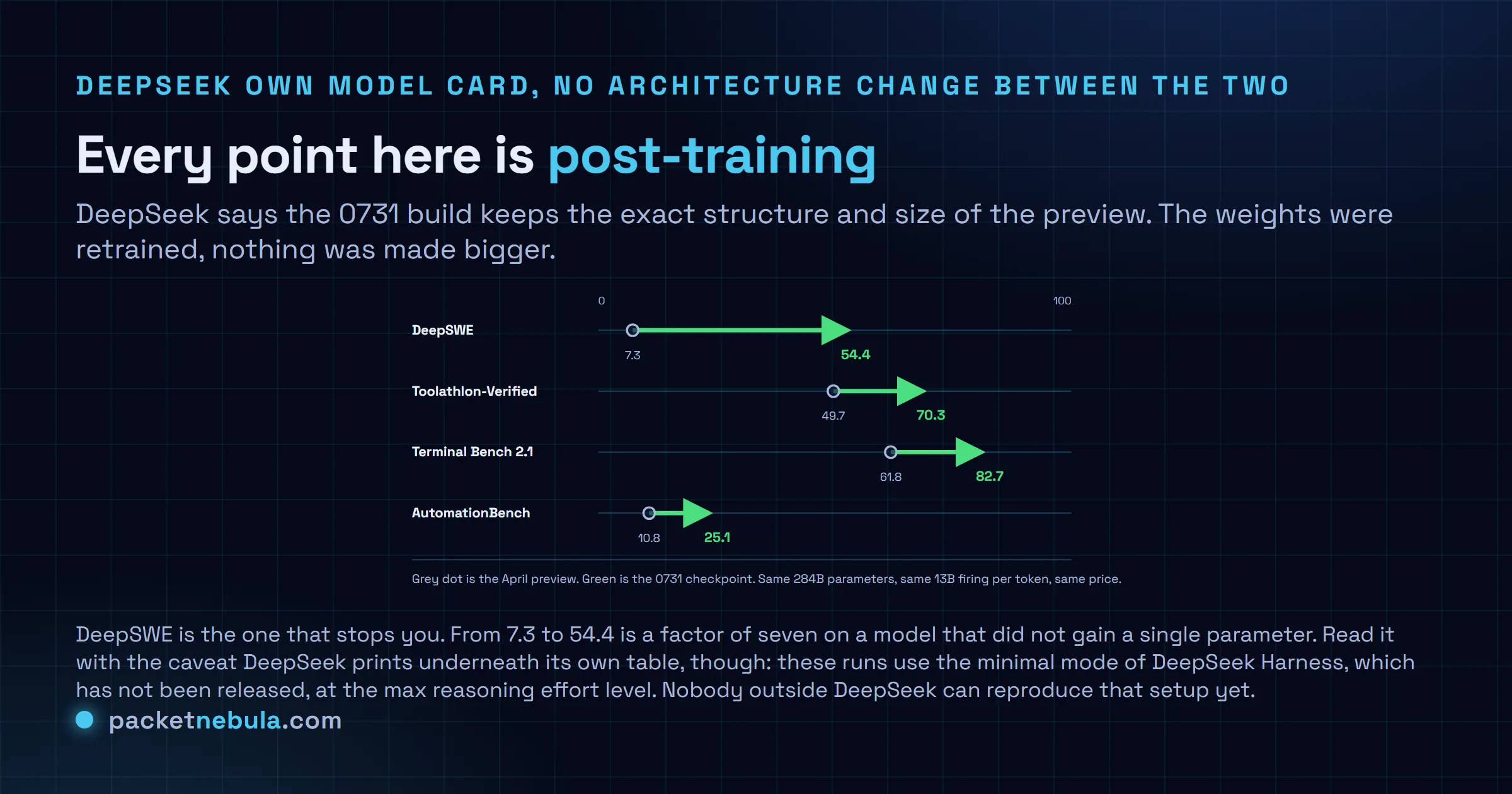
DeepSWE going from 7.3 to 54.4 is the number everyone quoted, and honestly it’s the one that made us go and read the footnotes.
They’re right there under the table. For the code agent tasks, the model was evaluated with the minimal mode of DeepSeek Harness, which the card marks as still to be released, at the max reasoning effort level with temperature 1.0 and top_p 0.95. Two of the nine benchmarks, DSBench-FullStack and DSBench-Hard, are DeepSeek’s own internal test sets.
None of that is dishonest. It’s disclosed, in the same paragraph, which is more than a lot of launch posts manage. But it does mean nobody outside DeepSeek can reproduce a single row today, and it means the headline scores were produced at the setting that burns the most tokens. A 7x jump on a preview that scored 7.3 also tells you the preview was badly broken at agent work, which is a slightly less exciting way to frame the same fact.
The one independent read we found comes from Artificial Analysis, which puts it at 50 on its Intelligence Index and ranks it third of 101 open weights models. Different methodology, same rough conclusion.
Where it lands against everything else
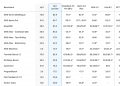
We pulled the Terminal Bench 2.1 figures we’ve collected across launches into one place. Every score below is self-reported by whoever shipped the model, on its own harness, so read the ordering loosely.
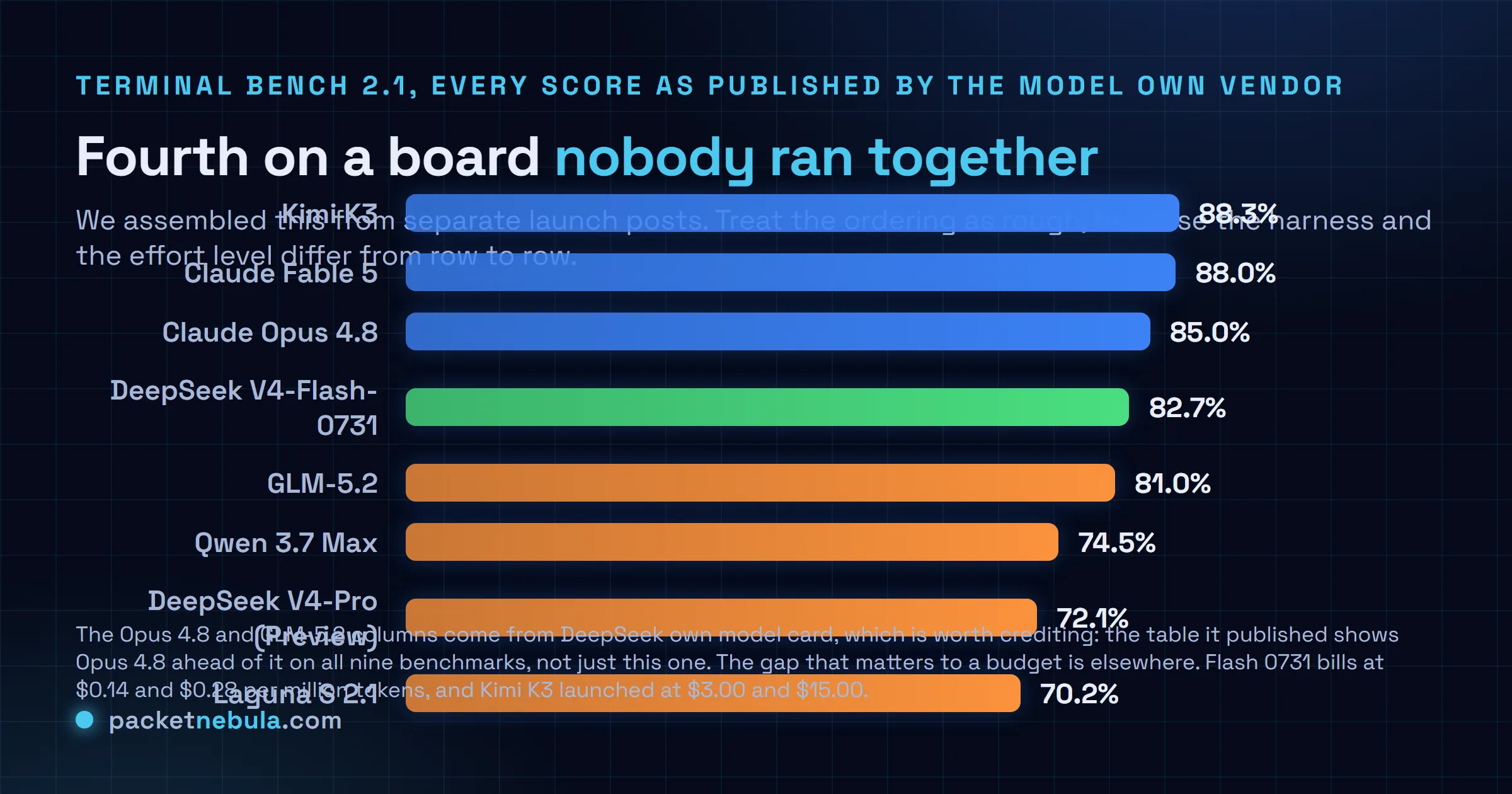
Credit where it’s due: the Opus 4.8 and GLM-5.2 columns come from DeepSeek’s own card, and Opus 4.8 beats it on all nine rows. Publishing a table you lose is not the norm.
The interesting comparison isn’t the score anyway. Kimi K3 sits five points ahead at $3.00 and $15.00 per million tokens. Flash 0731 is at $0.14 and $0.28. You can argue about whether five points of benchmark is worth anything, but you can’t really argue with twenty times the input price.
The price, and the cache
Unchanged from the preview. $0.0028 per million tokens on a cache hit, $0.14 on a miss, $0.28 for output.
Divide those first two and you get exactly 50. A cache hit costs a fiftieth of a cache miss, and a hundredth of an output token.
Put it on a workload. Say an agent loop pushing 10 million input tokens and 2 million output tokens a day. Cold, that’s $1.40 plus $0.56, so $1.96. Now assume a stable system prompt and tool schema, which is what an agent loop actually looks like, and let 90 percent of that input hit cache: $0.14 for the misses, about $0.03 for the hits, $0.56 for output. Roughly $0.73.
That’s our arithmetic on published rates, not a DeepSeek claim. It’s also a 63 percent cut for setting a cache breakpoint properly, which is a better return than most model swaps.
One thing DeepSeek doesn’t publish: the token cost of each effort level. The scores above were run at max. Whatever max costs you in thinking tokens, that bill lands on the output line at $0.28. Effort control is a genuine lever here, and it’s one Laguna S 2.1 shipped without.
Running it yourself
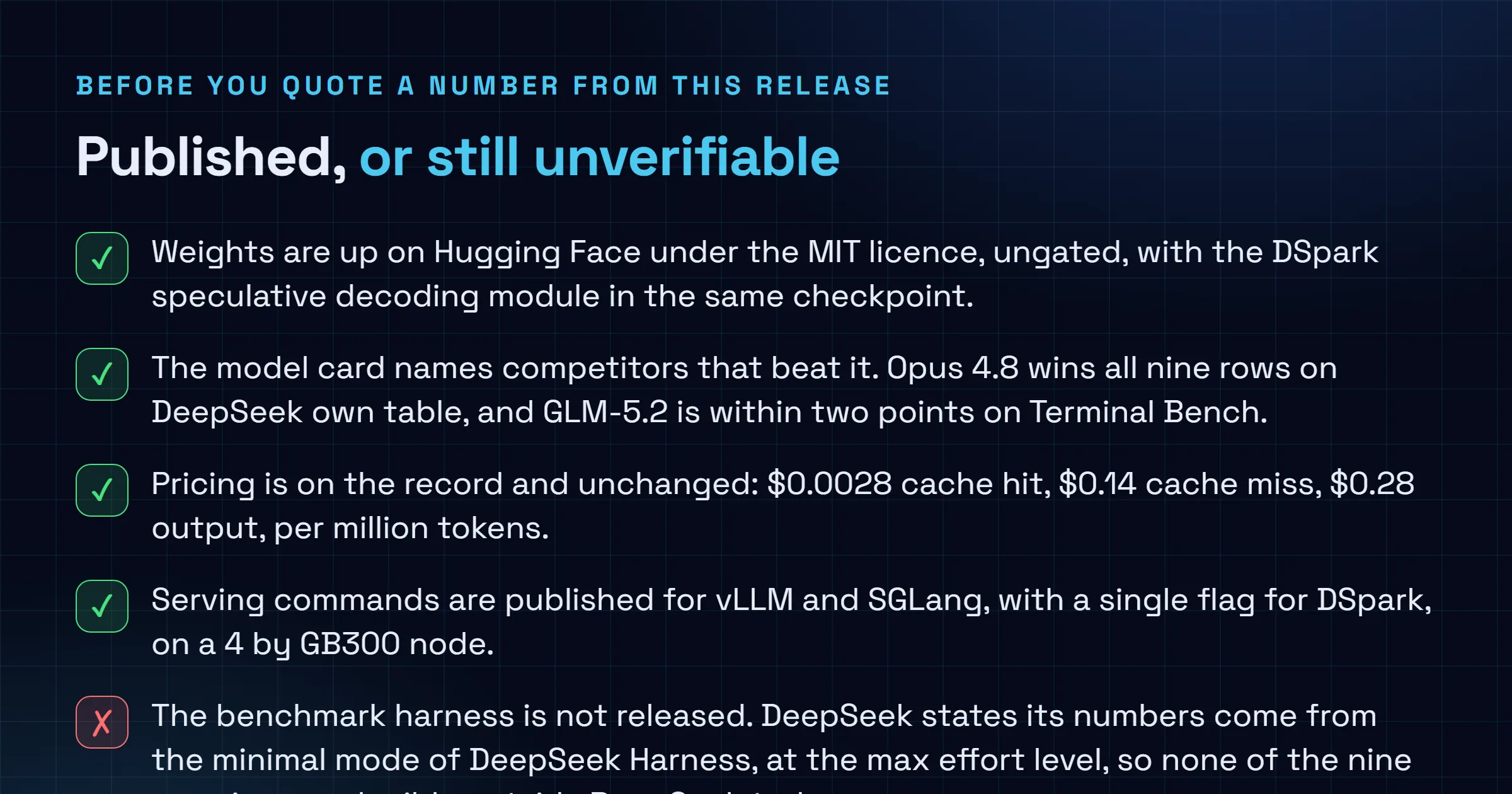
MIT, ungated, weights on Hugging Face. DeepSeek gives you a vLLM invocation that serves the model on a single node of four GB300s, and an SGLang recipe alongside it.
DSpark is the nice detail. The speculative decoding draft module lives in the same checkpoint as the target weights, so you turn it on with one flag instead of standing up a second model. In vLLM that’s --speculative-config '{"method":"dspark","num_speculative_tokens":7}', and in SGLang it’s --speculative-algorithm DSPARK with no separate draft path.
Worth saying out loud: four GB300s is not a homelab. This is open weights in the licensing sense, not the run-it-on-your-desk sense.
What we’d do this week
Re-run your evals. That’s it, mostly.
If you’re on deepseek-v4-flash in production, you got a different model on Friday whether you wanted one or not, and any regression tests you passed in April are now stale. Probably in your favour. Probably.
Then look at your cache hit rate before you look at anything else. The model got better for free. The 50x gap between a hit and a miss is the part still sitting on the table.
And if you’re still calling the old aliases, that’s a separate deadline you’ve already missed. We wrote up the deepseek-chat cutover when it landed.
What changed since
12 September 2026. This model is retired. On 10 September DeepSeek shipped DeepSeek-V4.1-Flash on a new encoder-decoder architecture and moved the API to a new name, deepseek-flash. The deepseek-v4-flash name still resolves, but DeepSeek describes the routing as temporary, so anything still calling it has been talking to the new model since 10 September without an opt-in. The prices above are history too. The flat $0.14 and $0.28 gave way to peak and off-peak billing on 16 August ($0.22 in and $0.66 out off-peak, double at peak), and V4.1-Flash now lists at $0.15 and $0.60 off-peak. The 0731 weights stay on Hugging Face under MIT if you need the exact build you benchmarked. We’ve written up what V4.1-Flash changes for your bill and your model names separately.
Sources
The benchmark table, the architecture description, the licence and both serving commands come from the DeepSeek-V4-Flash-0731 model card on Hugging Face, published 31 July 2026, including the footnote about DeepSeek Harness and the two internal DSBench sets. The scope of the upgrade and the note about V4-Pro are from DeepSeek on X. Pricing and the Responses API and Codex changes via MarkTechPost and Simon Willison. The independent index score and open weights ranking are from Artificial Analysis. The daily cost figures and the fifty times cache ratio are our own arithmetic on the published rates.
Frequently asked questions
What changed in DeepSeek-V4-Flash-0731?
The weights, and only the weights. DeepSeek states that the 0731 build keeps the exact same architecture and size as the April preview, so the gains come entirely from a reworked post-training pipeline aimed at coding, agents and tool use. On DeepSeek's published table, Terminal Bench 2.1 goes from 61.8 to 82.7, DeepSWE from 7.3 to 54.4 and Toolathlon-Verified from 49.7 to 70.3. The API also gained native support for the Responses API format and an adaptation for Codex.
Do I need to change my code?
No, and that is the part worth pausing on. The model name deepseek-v4-flash, the endpoint, the latency profile and the price are all unchanged, so anything already pointed at it picked up the new build automatically on 31 July 2026. There is no opt-in and no version pin in the API name. If you benchmarked the preview and wrote down the results, re-run that suite, because the thing answering your calls is not the thing you measured.
How much does DeepSeek-V4-Flash-0731 cost?
Per million tokens: $0.0028 on a cache hit, $0.14 on a cache miss, and $0.28 for output. That cache hit rate is exactly one fiftieth of a cache miss, which matters more than it sounds for an agent loop that resends the same system prompt and tool schema on every turn. A workload sending 10 million input and 2 million output tokens a day costs about $1.96 with no caching, and roughly $0.73 if 90 percent of the input hits cache. That last figure is our arithmetic on the published rates, not a DeepSeek quote.
Is DeepSeek-V4-Flash-0731 better than V4-Pro?
On the nine benchmarks DeepSeek published, yes, and by a clear margin despite a far smaller activated parameter count. Flash 0731 beats V4-Pro (Preview) on every row, 82.7 against 72.1 on Terminal Bench 2.1 and 54.4 against 12.8 on DeepSWE. The catch is that the comparison is against the Pro preview, not a released Pro. DeepSeek said on 31 July that the V4-Pro API and the app and web models are unchanged for now, with the official Pro release coming later.
Can I run DeepSeek-V4-Flash-0731 locally?
The weights are on Hugging Face under the MIT licence and ungated, so yes if you have the hardware. DeepSeek publishes a vLLM command that serves it on a single node of four GB300s, plus an SGLang recipe. The DSpark speculative decoding module ships inside the same checkpoint, so you enable it with one flag rather than loading a separate draft model. For the high and max reasoning effort levels DeepSeek recommends allowing up to 384K tokens of output.