
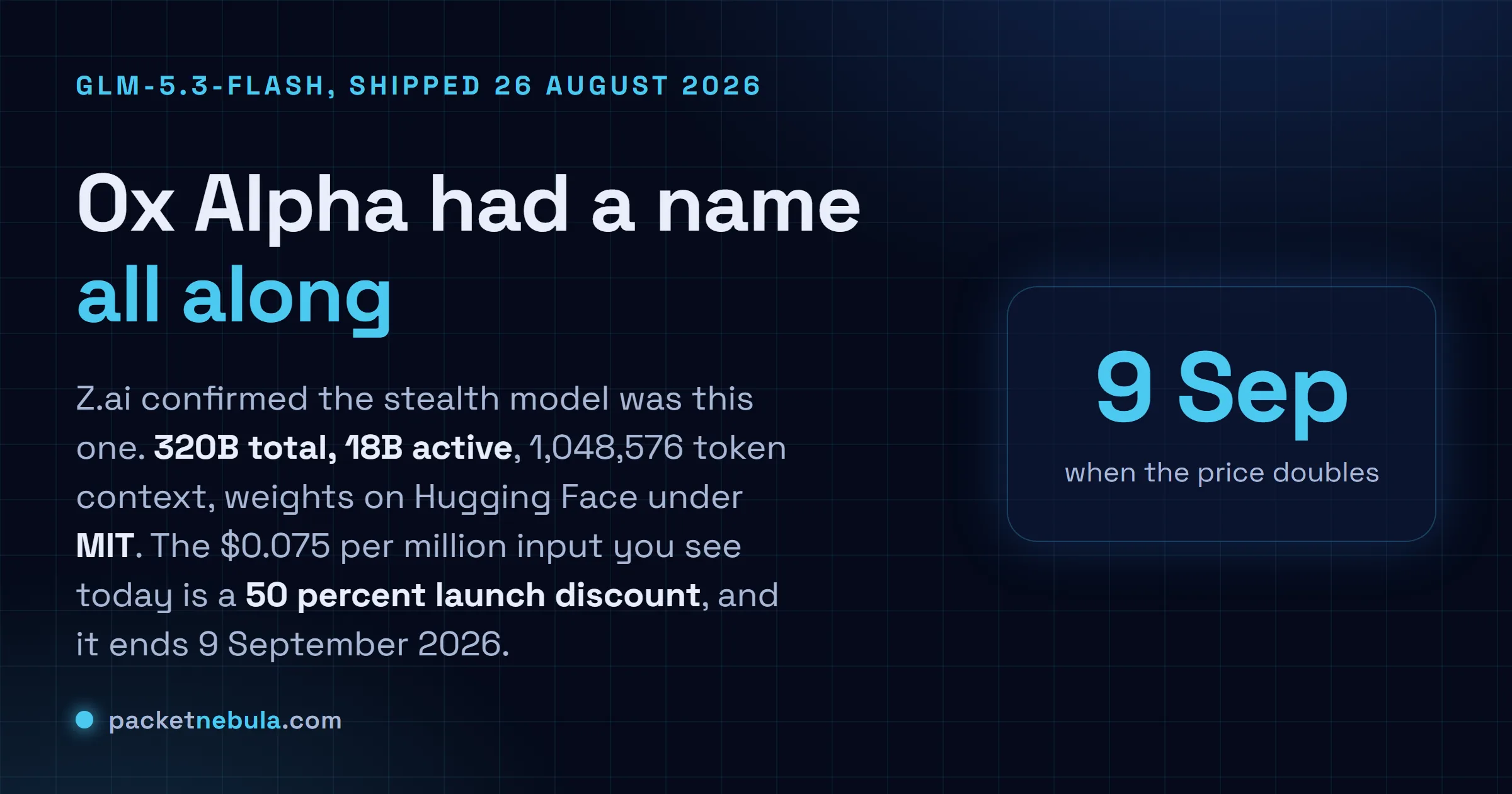
We spent last week telling people not to send work code to Ox Alpha, because nobody would say who was running it. That question closed on 26 August: it was Z.ai, and the model is GLM-5.3-Flash. Two things flipped at once. The weights went up on Hugging Face under MIT, so you can now run the thing yourself instead of trusting anyone with your prompts. And the anonymous listing that retained everything you sent it was replaced by a named provider whose OpenRouter data policy says it retains nothing. The bit nobody is putting in the headline is the price. That $0.075 per million input tokens is a launch discount with an expiry date on it.
The short answer
The stealth model is GLM-5.3-Flash, shipped by Z.ai on 26 August with open weights and a named data policy. Good model for the money. Just note that the money on the listing today is half what it will be in two weeks.
What was actually announced
Z.ai calls GLM-5.3-Flash the first natively multimodal model in the GLM-5 line. Text, images and video go in, text comes out. It runs 320 billion total parameters with 18 billion active per token, on a hybrid attention design that mixes linear attention for local structure with sparse attention for the long range lookups, plus something they call Manifold-Constrained Hyper-Connections. Pre-training corpus is 30 trillion tokens. Context window is 1,048,576, with a 131,072 token ceiling on the completion, which is exactly what the anonymous listing carried in August.
The weights are on Hugging Face under MIT. Not a bespoke community licence with an acceptable use annex, actual MIT. Serving recipes are published for SGLang, vLLM, TokenSpeed and KTransformers.
And the headline claim from Z.ai, in their words: it beats GLM-5.2 across benchmarks and real workloads at one tenth the price, while approaching Claude Opus 4.8 on coding and agentic work.
Half of that holds up well. The other half deserves a slower look.
The scoreboard, read carefully
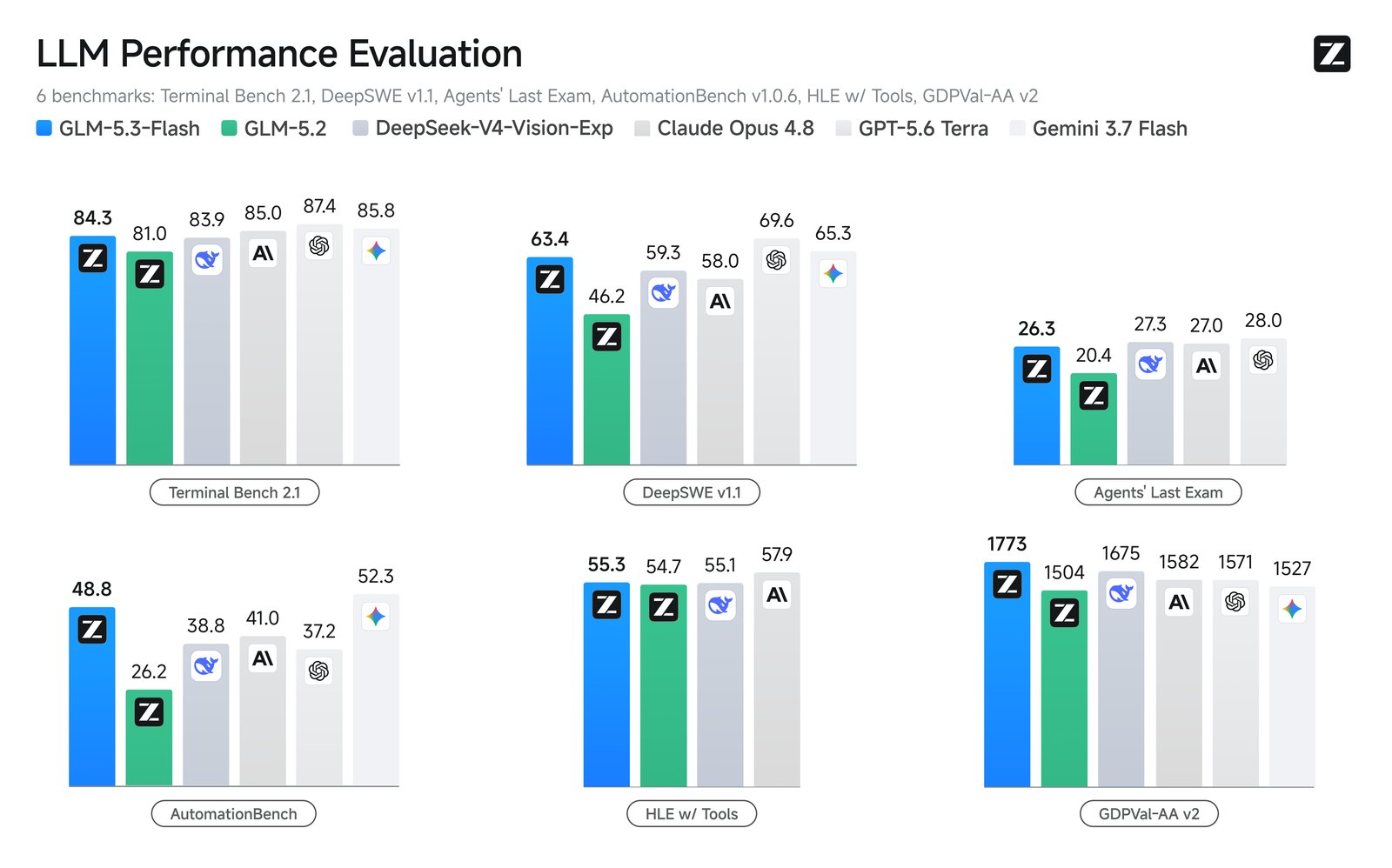
Image: Z.ai, benchmark chart published with the GLM-5.3-Flash model card, 26 August 2026.
That chart is Z.ai’s own. We did not make it, we did not reorder it, and it is worth reading carefully because a vendor slide showing your model in blue is usually arranged to flatter.
Six benchmarks. GLM-5.3-Flash finishes top of the field on exactly one of them, GDPVal-AA v2, where it scores 1773 against 1675 for DeepSeek-V4-Vision-Exp and 1582 for Claude Opus 4.8.
Everywhere else it is somewhere in the pack. Terminal Bench 2.1: 84.3, which is fourth, behind GPT-5.6 Terra at 87.4, Gemini 3.7 Flash at 85.8 and Claude Opus 4.8 at 85.0. DeepSWE v1.1: 63.4, third. Agents’ Last Exam: 26.3, which is last among the five models plotted. AutomationBench: 48.8, beaten by Gemini 3.7 Flash at 52.3. HLE with tools: 55.3, under Opus 4.8’s 57.9.
Also worth noticing, and I might be reading too much into it: the number of bars changes between charts. Agents’ Last Exam has five, HLE has four. Gemini 3.7 Flash is missing from both.
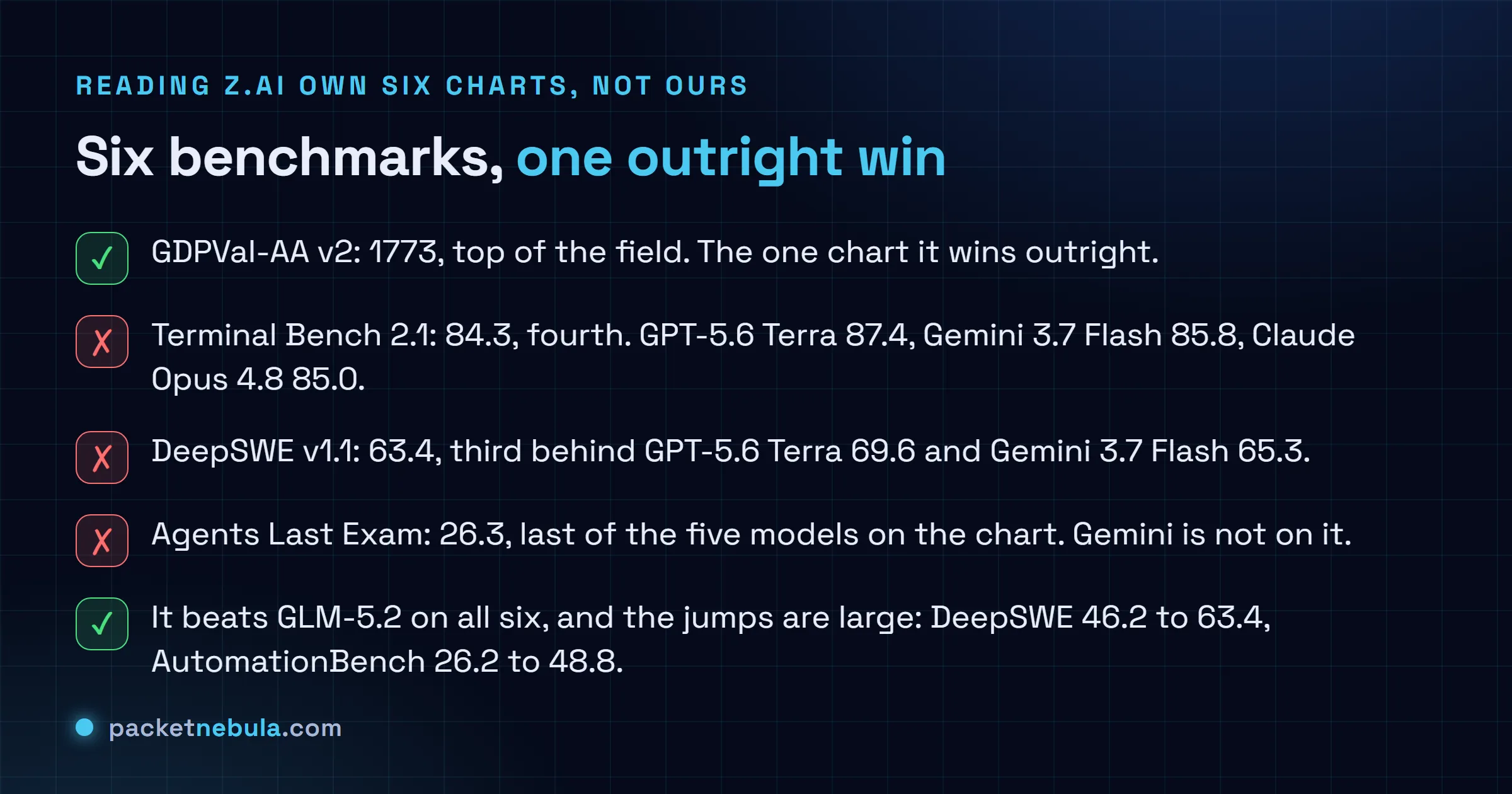
So no, this is not a frontier model that quietly beats Opus. What it is, and this part is genuinely impressive, is a generational jump over its own predecessor. DeepSWE goes 46.2 to 63.4. AutomationBench nearly doubles, 26.2 to 48.8. That is the kind of movement you normally see across a year, not across a point release, and it comes with an activation count of 18 billion.
The price, which is the actual news
Here is what everyone quoting the OpenRouter listing is missing.
We pulled the numbers straight from the models API this evening. GLM-5.3-Flash reads $0.075 per million input tokens, $0.25 per million output, $0.015 on cache reads. Genuinely cheap. Set against the GLM-5.3 flagship at $1.40 in and $4.40 out, that is 18.7 times cheaper on input and 17.6 times cheaper on output.
But the listing also carries a discount field set to 0.5, and a promotion banner that reads, word for word, “Limited-time 50% discount via ZAI through September 9, 2026 at 16:00 UTC.”
Which means the real rate card is $0.15 in and $0.50 out. Still cheap. Still roughly nine times under the flagship. Just not the number you are budgeting against if you priced your agent loop on a Wednesday in August and never looked again.
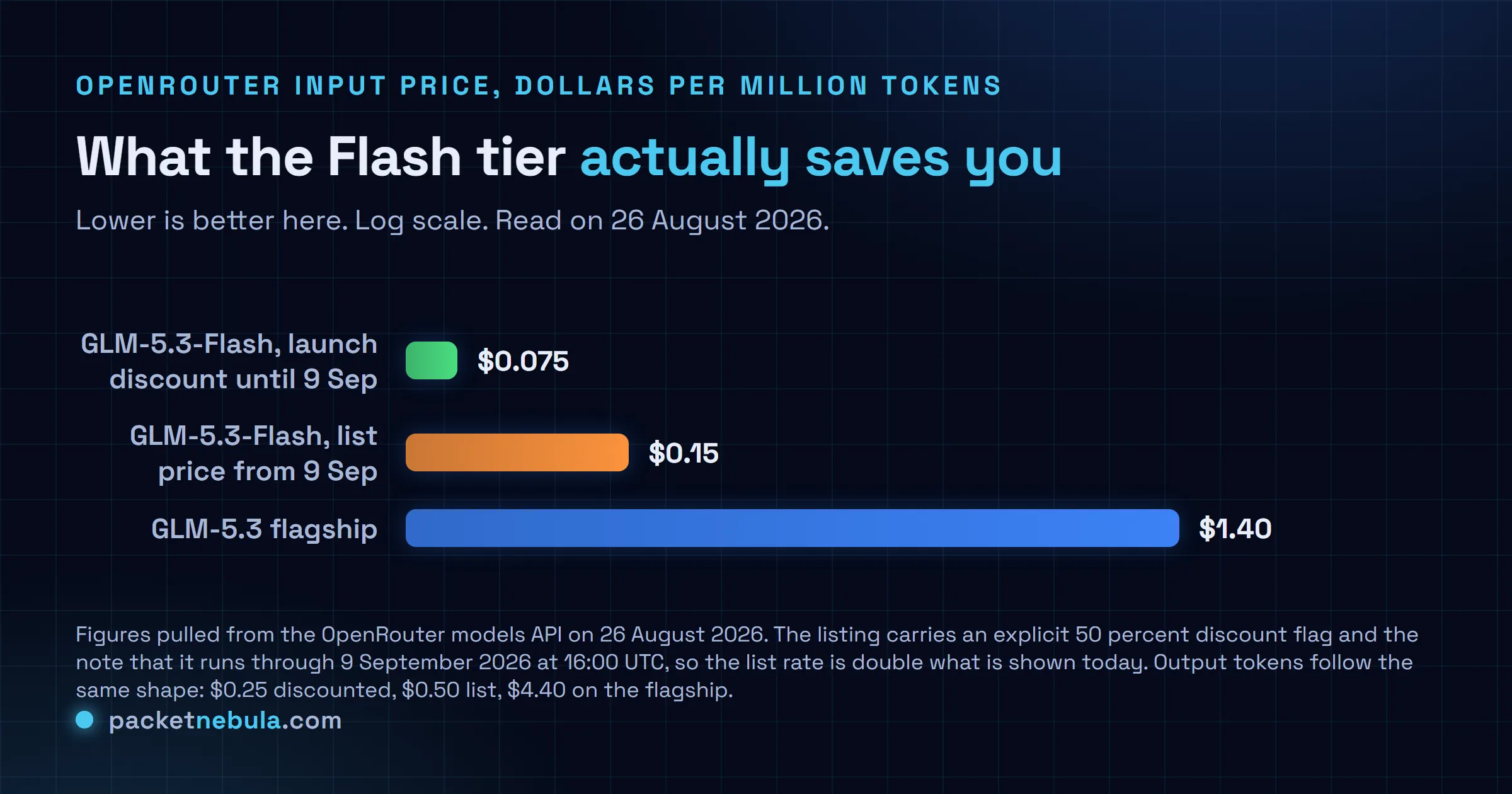
Put a reminder in for 9 September. That is the whole advice.
What changed for anyone who used Ox Alpha
When we wrote up Ox Alpha on 23 August, the objection was not capability. The spot checks were fine. The objection was that OpenRouter’s own listing said prompts and completions were retained by a provider who would not give a legal name, a jurisdiction or a retention period, and that this is a bad trade for anything under an NDA.
That objection is now mostly answered, and I’ll take the win on the fingerprinting call, which pointed at the GLM family a week early.
The provider entry reads Z.AI, headquartered in Singapore, serving from Singapore datacentres. The data policy declares training false and retainsPrompts false. The stealth listing itself has been pulled from the catalogue, so there is nothing left to accidentally route to.
And the stronger answer, for anyone whose compliance team does not care what a routing page declares: the weights are MIT. Pull them, run them on your own metal, and the retention question stops being someone else’s promise. 320B total is not a laptop job, but at 18B active it is a far friendlier serving profile than the flagship GLM-5.3, and the vLLM and SGLang recipes are already published rather than promised.
Should you switch to it
If you were already on GLM-5.2 for agent work, move. The benchmark gaps against your current model are large and consistent, and the price goes down rather than up.
If you are on a frontier model for coding and it works, this does not obviously beat it, whatever the launch coverage says. Read the chart again. Fourth on Terminal Bench.
The interesting case is the one in between: long-horizon agent loops where you burn tokens by the tens of millions and 84.3 versus 87.4 matters less than paying a twentieth of the rate. That is the workload this was built for, and it is why the thing topped OpenRouter for a week while wearing no name at all.
I’d run it for a week on real tasks before rewriting anything. Benchmarks measure benchmarks.
Sources
Model card and weights: zai-org/GLM-5.3-Flash on Hugging Face, including the benchmark chart reproduced above and the evaluation footnotes. Official announcement: the GLM-5.3-Flash post on the Z.ai blog, with the GLM-5 technical report at arXiv 2602.15763. Pricing, context limits, the 50 percent discount flag and the provider data policy were read from the OpenRouter model page and its public models API on 26 August 2026. Licence and launch coverage: TestingCatalog.
Frequently asked questions
Was Ox Alpha really GLM-5.3-Flash?
Yes. Z.ai released GLM-5.3-Flash on 26 August 2026 and confirmed the model had run anonymously as ox-alpha on OpenRouter and OpenCode before launch, where it became the most used model of the week. The stealth listing is gone from the OpenRouter catalogue now.
How much does GLM-5.3-Flash cost?
On OpenRouter it reads $0.075 per million input tokens and $0.25 per million output on 26 August 2026, with cache reads at $0.015. Those are discounted numbers. The listing carries an explicit 50 percent launch discount that runs through 9 September 2026 at 16:00 UTC, so the list rate is $0.15 in and $0.50 out.
Can I self-host GLM-5.3-Flash?
The weights are on Hugging Face as zai-org/GLM-5.3-Flash under the MIT licence, and Z.ai lists recipes for SGLang, vLLM, TokenSpeed and KTransformers. It is 320 billion total parameters with 18 billion active, so the activation count is modest but you still have to hold the whole thing in memory. This is a small cluster job, not a single consumer card.
Does Z.ai keep my prompts now?
The OpenRouter provider entry for Z.ai declares training false and retainsPrompts false, with the company headquartered in Singapore and serving from Singapore datacentres. That is a stronger position on paper than the anonymous listing carried, since that one stated prompts and completions were retained. Their own terms and privacy policy are the documents that actually bind them, so read those if the data matters.
Is GLM-5.3-Flash better than Claude Opus 4.8 or GPT-5.6?
Not on most of the benchmarks Z.ai chose to publish. On its own six chart slide it finishes top of the field on one, GDPVal-AA v2. It sits fourth on Terminal Bench 2.1 with 84.3 against 87.4 for GPT-5.6 Terra, and third on DeepSWE v1.1. What it does beat, comprehensively, is GLM-5.2, at a fraction of the cost.


