

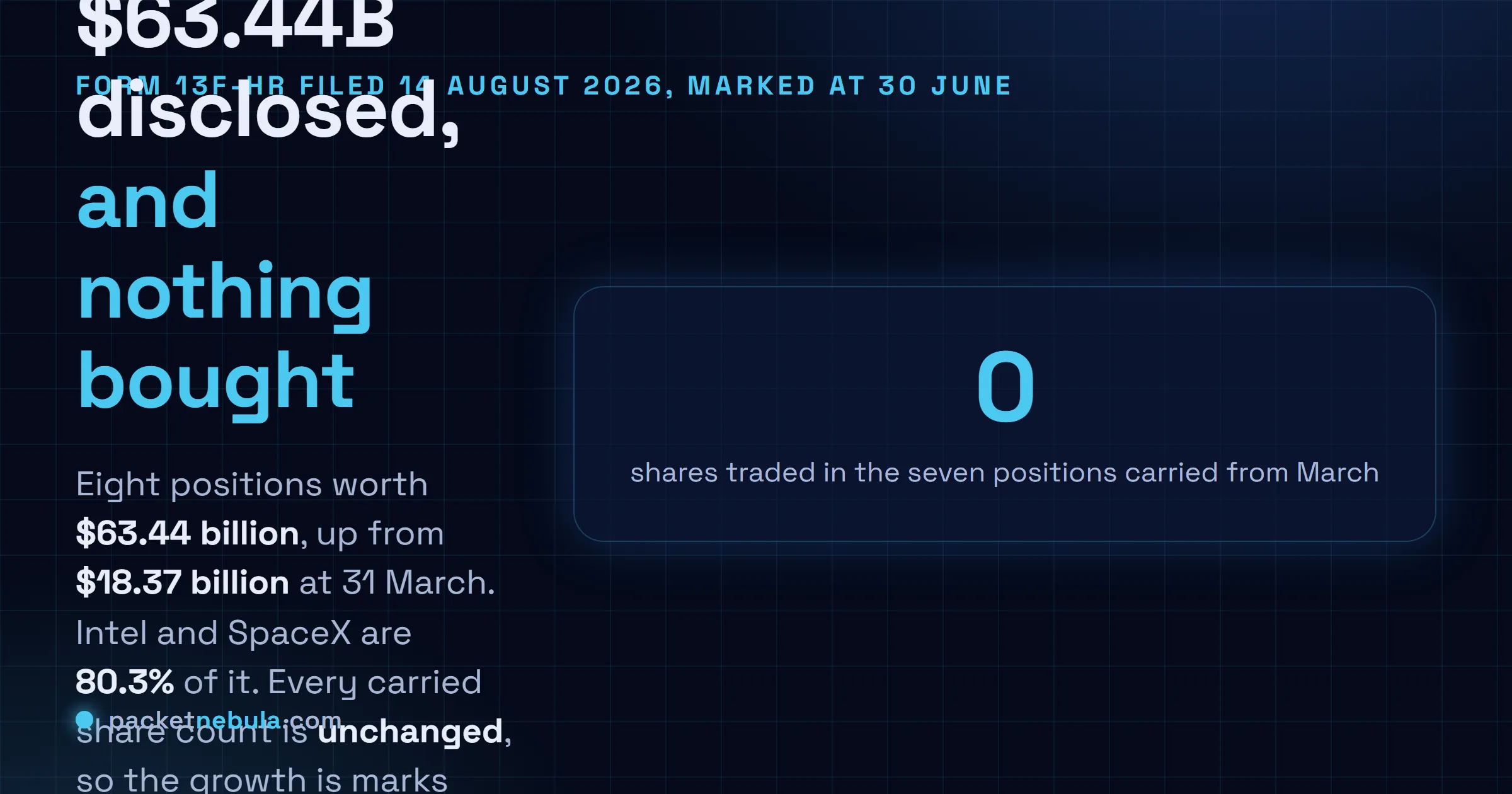
A 13F is a photograph of a day that is already six weeks gone, which is usually why nobody bothers reading Nvidia's. This one repays the click. The filing Nvidia sent the SEC on 14 August puts its US equity portfolio at $63.44 billion as of 30 June, against $18.37 billion three months earlier, with Intel and SpaceX together at 80.3% of the whole thing. Here is the bit the headlines skipped. Nvidia did not buy any of it. Every share count carried over from the March filing is identical to the digit, so the extra $45 billion is prices moving and one position that used to be private showing up on a public form.
The short answer
Nvidia’s 13F for the June quarter, filed 14 August 2026, lists eight positions worth $63.44 billion. Intel is $29.99 billion of that and SpaceX Class A is $20.98 billion. The portfolio tripled in three months without a single trade in anything already held, because Intel roughly tripled in price and the SpaceX line arrived by conversion rather than purchase. Read it as a snapshot of 30 June, not of today. Both big positions have fallen since.
Eight lines, and the two that matter
The whole filing fits on one screen. Eight positions, $63,439,974,569, marked at 30 June 2026 and signed on 14 August.
| Position | Shares | Value at 30 June | Weight |
|---|---|---|---|
| Intel | 214,776,632 | $29.99B | 47.3% |
| SpaceX Class A | 122,764,805 | $20.98B | 33.1% |
| CoreWeave | 47,213,353 | $4.70B | 7.4% |
| Coherent | 7,788,161 | $3.07B | 4.8% |
| Nokia ADR | 166,389,351 | $2.21B | 3.5% |
| Synopsys | 4,821,717 | $2.15B | 3.4% |
| Nebius Class A | 1,190,476 | $329M | 0.5% |
| Generate Biomedicines | 833,325 | $14M | 0.0% |
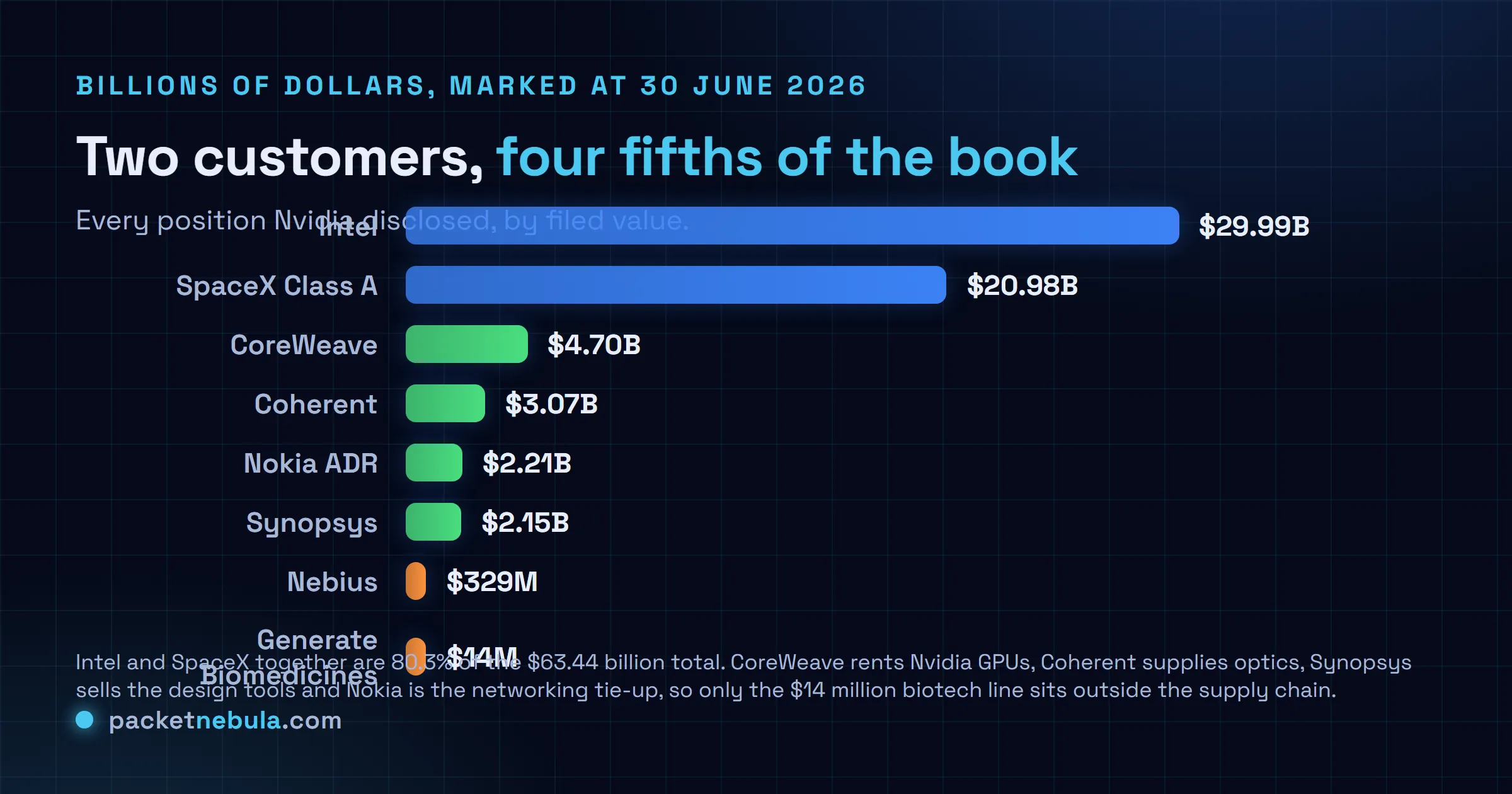
Intel and SpaceX come to 80.3% between them. That concentration is the story, and it is not really an investment story. Both companies buy Nvidia silicon at scale, so Nvidia has ended up with four fifths of its disclosed equity book riding on customers.
The smaller lines fit the same shape. CoreWeave rents Nvidia GPUs for a living. Coherent makes optics for the interconnect. Nokia is the networking tie-up. Synopsys sells the EDA tools that design the chips. Only Generate Biomedicines, at $14 million, sits outside the supply chain, and at 0.02% of the book it is a rounding error.
Nobody bought anything
Put the two filings side by side and the interesting thing falls out immediately.
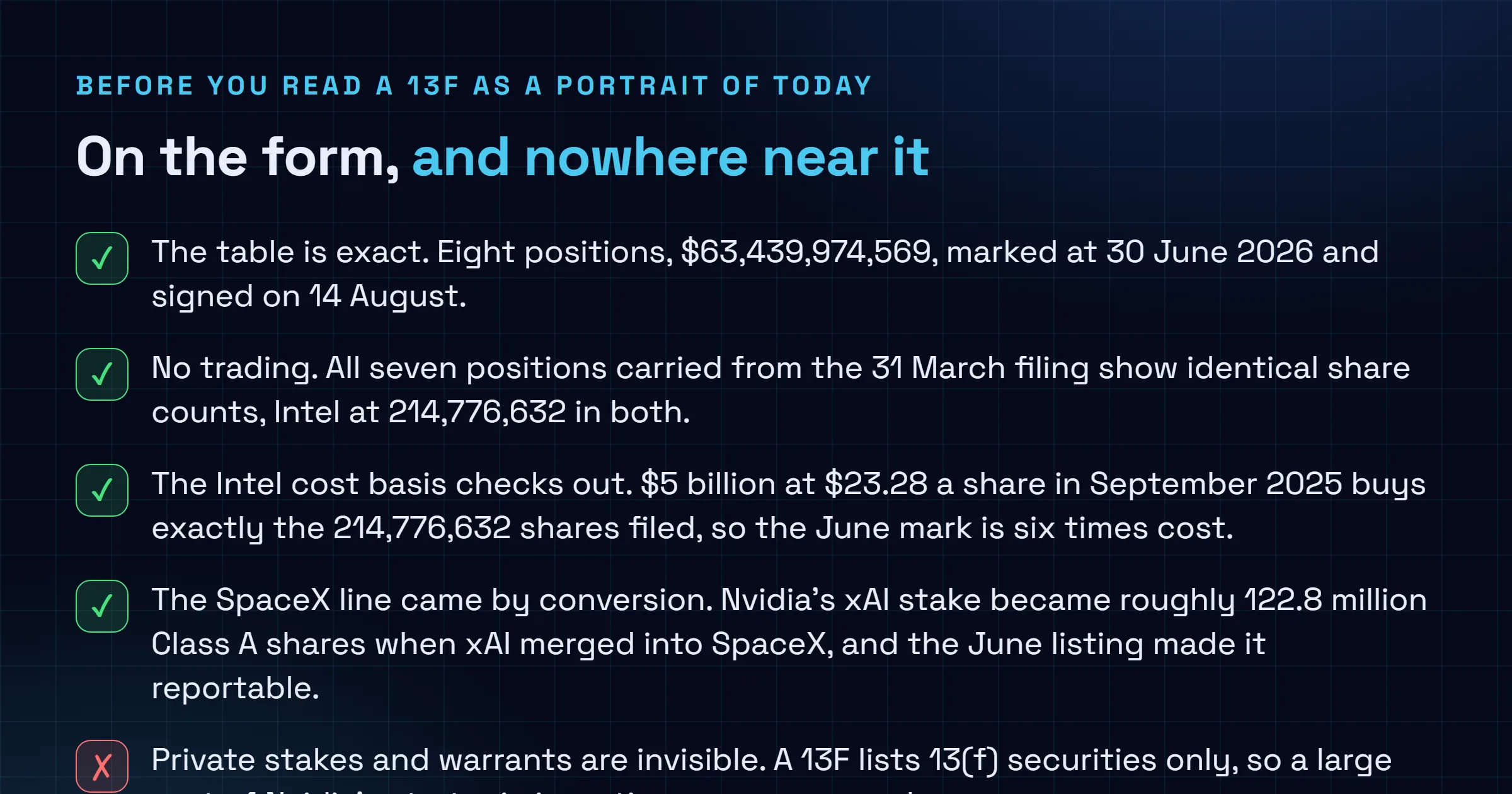
Every position that existed in the 31 March filing carries the same share count on 30 June. Intel, 214,776,632 in both. CoreWeave, 47,213,353 in both. Synopsys, Coherent, Nokia, Nebius, Generate, all unchanged to the share. Nvidia neither added nor trimmed a single line it already owned.
So where did $45 billion come from? Prices, mostly. Intel went from roughly $44 a share at the end of March to roughly $140 at the end of June, which on an unchanged holding is $20.5 billion of pure mark. Nebius went up 2.7x, Coherent 1.7x, Nokia 1.7x. The rest is the SpaceX line appearing for the first time.
Worth doing the Intel arithmetic properly, because it is the most quoted number in the coverage and the most misread. Nvidia put $5 billion into Intel in the September 2025 deal at $23.28 a share, which buys exactly the 214,776,632 shares on the filing. At the 30 June mark that stake was worth six times what it cost. It is also, and this matters more, a position Nvidia has never touched since.
I might be wrong about the intent here, but a book with zero turnover in a quarter that violent does not look like a portfolio being managed. It looks like strategic positions being held because they are strategic.
Where the SpaceX line came from
This one confuses people, so it is worth being exact. Nvidia did not buy SpaceX shares in the June quarter.
The position traces back to xAI. xAI merged into SpaceX in an all stock deal that closed in February 2026, reported at a combined $1.25 trillion valuation, and Nvidia’s xAI holding converted into roughly 122.8 million SpaceX Class A shares. SpaceX then listed publicly on 12 June 2026 at $135 a share in what was widely reported as the largest IPO ever done. Only after that listing does the stake become a 13(f) security, which is the only reason you are seeing it now.
At the IPO price those shares were worth about $16.6 billion. By 30 June the mark implied $170.86 and the position was $20.98 billion. By 14 August, with SpaceX around $140, it was back near $17 billion.
What a 13F does not tell you
Plenty, and the gaps are bigger than the disclosures.
A 13F covers 13(f) securities only. Private company stakes, convertible notes and pre-funded warrants stay off it entirely, which for a company doing as much strategic investing as Nvidia means the form shows a slice rather than the picture. It also has no cost basis, no dates and no intent, so a position held since 2025 and one converted in February look identical on the page.
Then there is the staleness. The 30 June marks were already wrong by the time they were public. Intel sold $20 billion of new stock that closed on 12 August, an offering that still names no 14A foundry customer, and reporting on the day of the filing put Nvidia’s Intel stake nearer $22 billion. TNW noted the same day that Nvidia’s backstop on OpenAI’s compute financing had come down from $250 billion to under $120 billion. None of that is in the filing, because none of it happened before 30 June.
Does it change anything you buy
No. Not a wafer, not a lead time, not a price.
None of these holdings is an operating asset, and Nvidia’s stock book has no mechanism to make a GPU cheaper or an allocation larger. If you are budgeting compute for the next two quarters, the constraints are the ones you already knew about, which are packaging capacity and memory pricing.
The structural read is the one worth keeping. Nvidia is now financially exposed to the demand it books, through equity in Intel and SpaceX, through equity in CoreWeave, and through financing arrangements that never touch a 13F at all. That is not a scandal and it is fairly normal for a company sitting on this much cash in a market this concentrated. It does mean a downturn would hit Nvidia twice, once in revenue and once in the balance sheet, and that second hit is now large enough to see from orbit.
What we would actually watch is the November filing. If the share counts move for the first time in two quarters, that is Nvidia deciding these positions are trades after all.
Sources
- Nvidia Form 13F-HR information table, filed 14 August 2026 for the quarter ended 30 June 2026, the primary source for all eight positions, every share count, every value and the $63,439,974,569 total.
- Nvidia Form 13F-HR information table, filed 15 May 2026 for the quarter ended 31 March 2026, for the seven prior positions and the $18,374,354,150 total, which is how the unchanged share counts were verified.
- Fortune, carrying Bloomberg, 15 August 2026, for the first disclosure of the SpaceX position value, the $5 billion Intel investment origin and the roughly $9.5 billion Intel mark three months earlier.
- TNW, on the 13F and the OpenAI backstop, for the SpaceX close of $140 on 14 August, the Intel stake near $22 billion after the offering, and the backstop falling from $250 billion to under $120 billion.
- TS2, 15 August 2026, for an independent read of the same table, including the observation that the seven carried holdings show unchanged share numbers against the March report.
- The Motley Fool, 31 March 2026, for the xAI merger into SpaceX at a combined $1.25 trillion valuation, which is how the Nvidia position converted into Class A stock.
Frequently asked questions
What exactly did Nvidia disclose, and when?
Nvidia filed a Form 13F-HR with the SEC on 14 August 2026 covering the quarter ended 30 June 2026. It lists eight positions worth $63,439,974,569 in total. The two big ones are Intel at 214,776,632 shares worth $29.99 billion and SpaceX Class A at 122,764,805 shares worth $20.98 billion. The rest are CoreWeave at $4.70 billion, Coherent at $3.07 billion, Nokia ADRs at $2.21 billion, Synopsys at $2.15 billion, Nebius at $329 million and Generate Biomedicines at $14 million.
Did Nvidia actually buy shares during the quarter?
Not in anything that was already on the list. Compare the 30 June filing with the 31 March one and all seven carried positions have exactly the same share counts, down to the last share. Intel sat at 214,776,632 in both. CoreWeave at 47,213,353 in both. The portfolio still tripled, because Intel went from about $44 a share to about $140 and every other line rose too. The only new entry is SpaceX, which is not a purchase either, since the shares came from Nvidia's xAI position after xAI merged into SpaceX.
Why does SpaceX appear on a 13F at all?
Because it is publicly traded now. A 13F only lists 13(f) securities, which in practice means US exchange listed equities and a few similar instruments, so a private company never shows up. SpaceX went public on 12 June 2026, and xAI had already been folded into it in an all stock deal that closed in February 2026 at a combined valuation reported at $1.25 trillion. Nvidia's xAI stake converted into roughly 122.8 million SpaceX Class A shares, and the first quarter end after the listing is the first time the position was legally visible.
Is the $63 billion figure still accurate today?
No, and this is the standard trap with 13F coverage. The numbers are marked at 30 June and published six weeks later. Intel has come off since, partly because Intel itself sold $20 billion of new stock that closed on 12 August, and reporting on 14 August put Nvidia's Intel stake nearer $22 billion. SpaceX closed around $140 on 14 August against the $170.86 implied by the filing, which puts that stake nearer $17 billion. So the real portfolio is well below the headline number already.
Does any of this change what I can buy or spec this year?
Directly, no. Nvidia holding Intel stock does not add a wafer, cut a GPU price or change a lead time, and none of these positions is an operating asset. What it tells you is where the coupling is. Nvidia's balance sheet now rises and falls with two companies that are also large buyers of Nvidia silicon, and the same pattern shows up in its financing commitments elsewhere. If you are modelling supplier risk over several years rather than this quarter, that circularity is the thing to write down, not the dollar total.


