
Read the fourth paragraph of the press release and the interesting sentence is right there, unhedged: Palmyra X6 was post-trained on top of GLM-5.2, which Writer calls the strongest available open weight model. So the new enterprise flagship from a San Francisco company backed by Salesforce and Adobe and IBM is a Chinese open weight model with a finishing pass on it, and Writer prints that fact rather than burying it. It shipped on 13 August at $2 per million input tokens and $8 per million output, with a headline score of 0.87 that beats Claude Opus 4.8 by a hundredth of a point. That score is worth about ten minutes of your attention, and not for the reason the headline suggests.
The short answer
Writer shipped Palmyra X6 on 13 August, post-trained on Z.ai’s open weight GLM-5.2, at $2 per million input and $8 per million output. It claims 0.87 out of 1.00 against Claude Opus 4.8’s 0.86 on nine internal evaluations of enterprise marketing workflows. The score is vendor run and narrow by design. The harness result underneath it is the part worth stealing.
What shipped
Three things on 13 August, and the model is only one of them.
Palmyra X6, the new flagship, aimed squarely at marketing and revenue workflows. A rebuilt Writer Agent harness, which is the orchestration layer that plans a task, calls tools and hands work to sub-agents. And a governance console that shows admins which agent workflows are burning tokens, with alerts and spending limits attached.
That last one is the least glamorous and probably the reason anyone signs the renewal. Writer quotes IDC saying three quarters of organisations now name excessive AI spending as a major risk to their plans, which sounds like vendor framing until you have watched an agent loop for four minutes on a task a human would have finished in one.
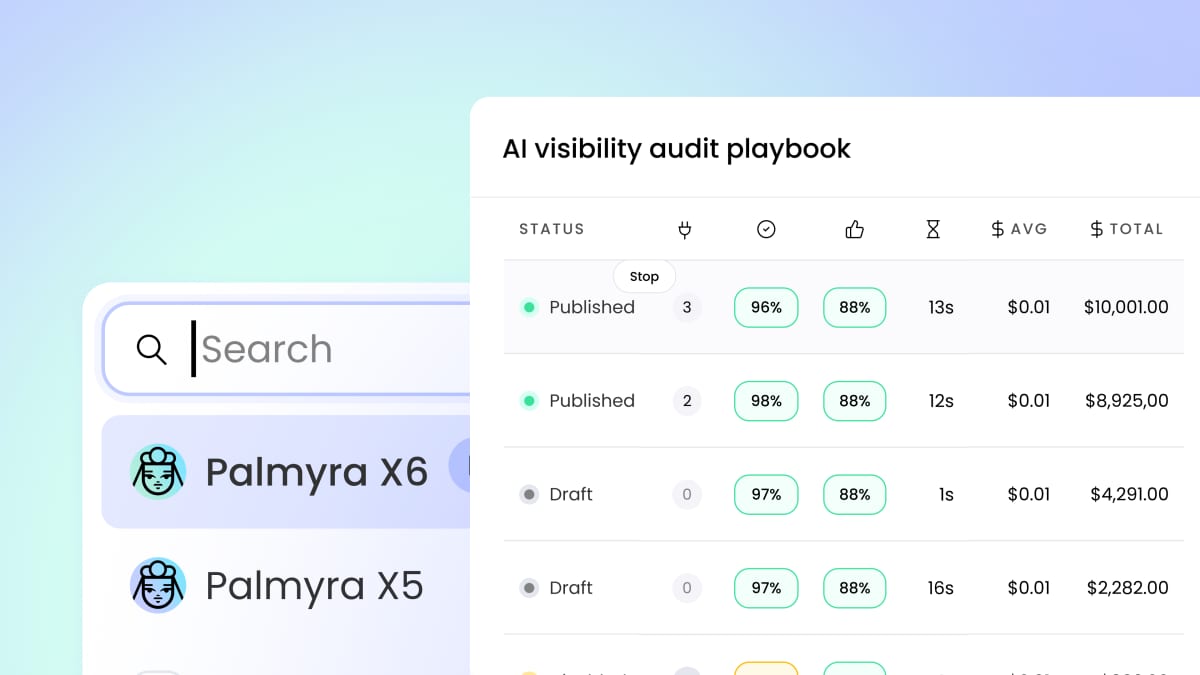
Image: WRITER
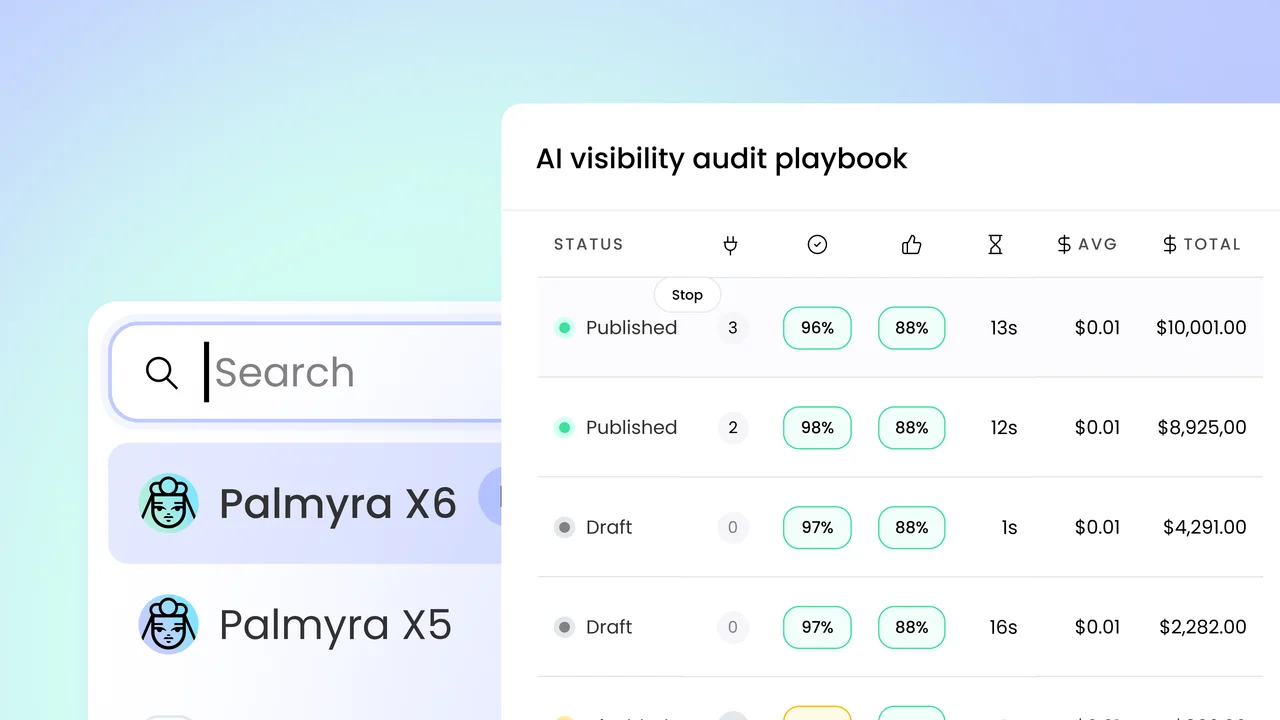
Look at what the announcement image is actually showing. A model picker on the left, and on the right a spend dashboard with a dollar column per row. Not a benchmark chart. That is the pitch.
The base model is the story
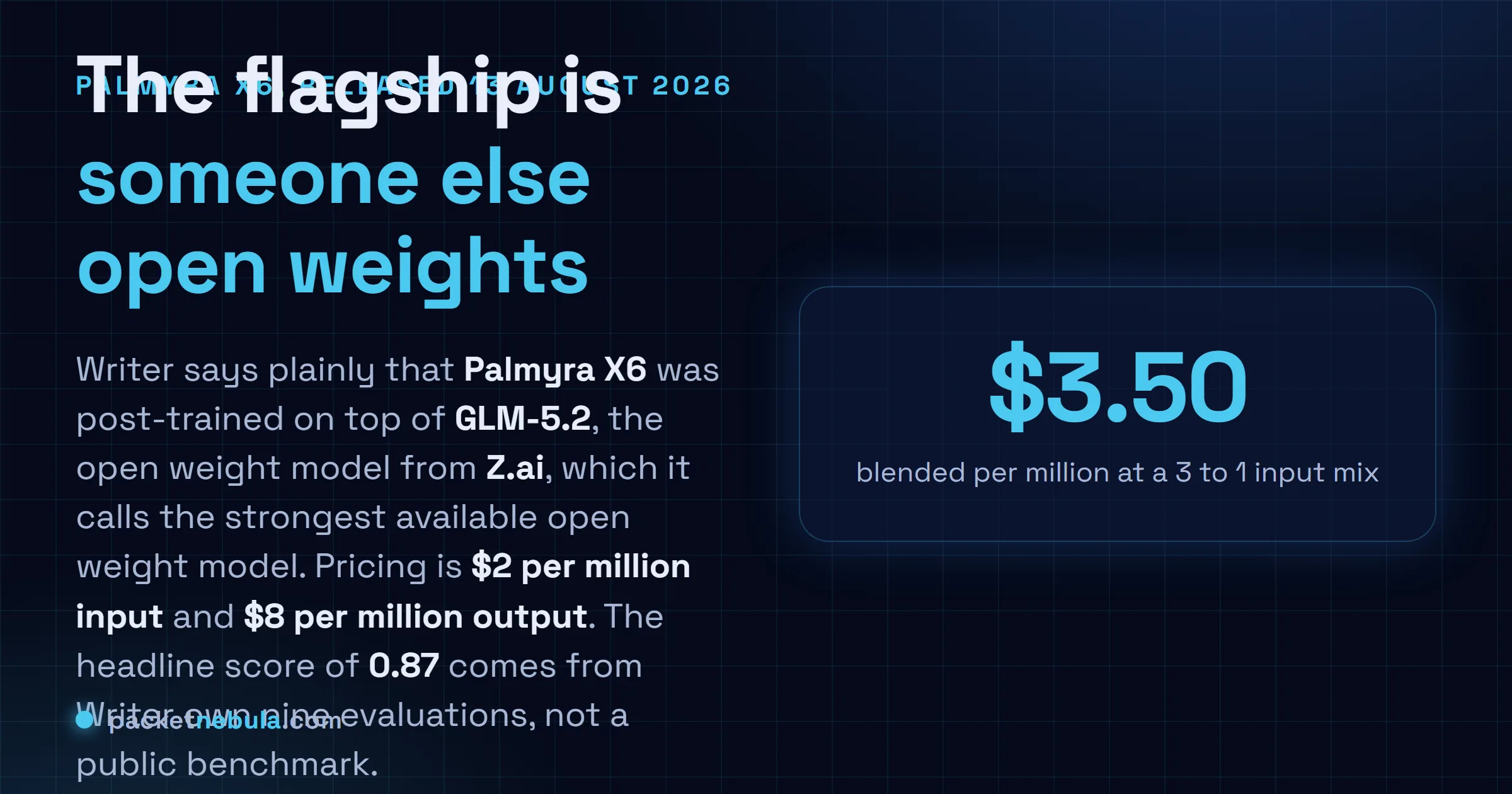
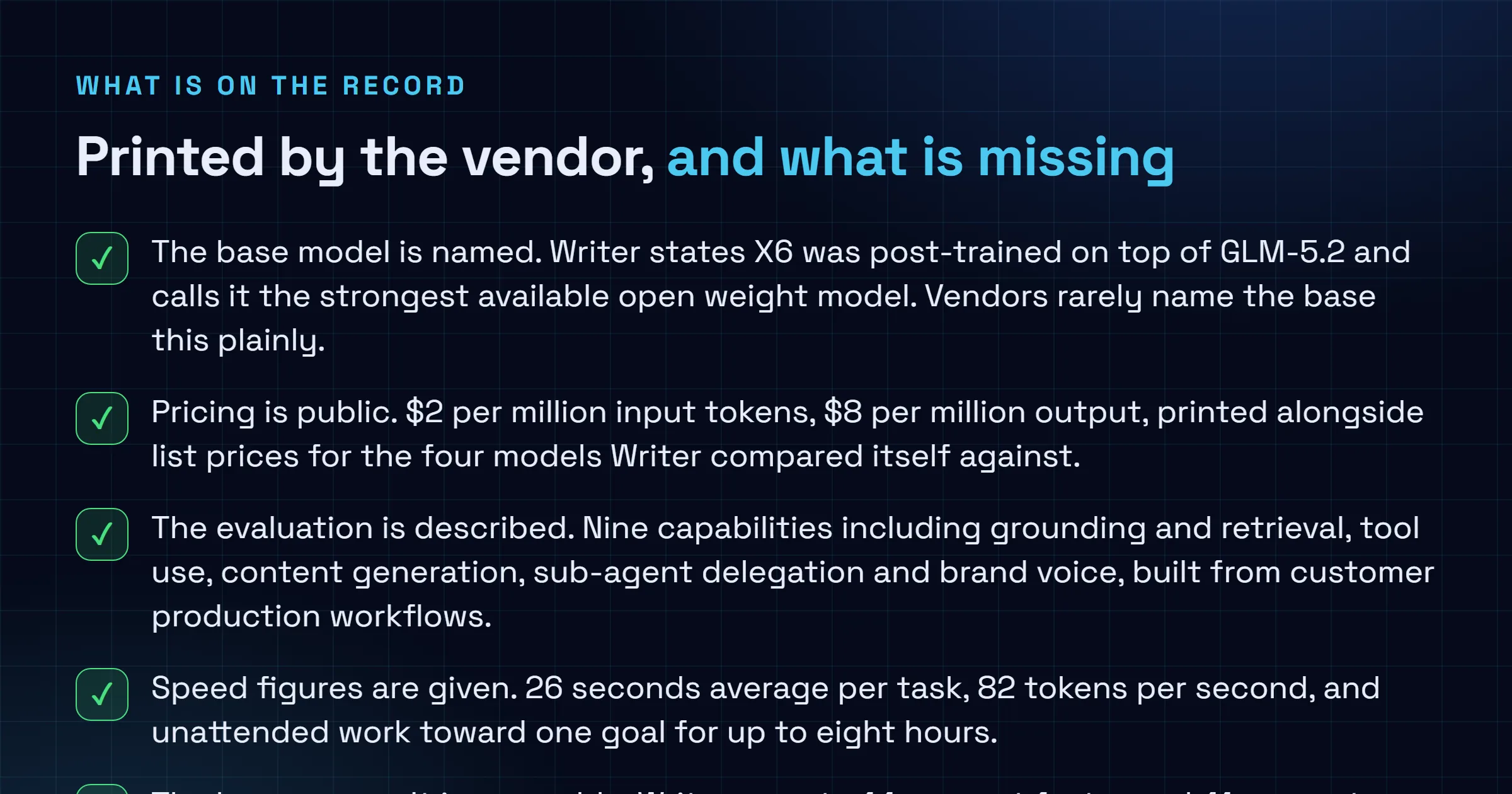
X6 was post-trained on top of GLM-5.2.
Writer states it directly, in the paragraph where a vendor would normally reach for the word “proprietary”. We covered GLM-5.2 when it landed as a 753 billion parameter mixture of experts with only eight experts active per token, and GLM-5.3 arrived a couple of days ago with the weights promised on a two week delay. So the lineage here is public, and the base is downloadable by anyone.
What Writer sells on top is the post-training recipe, the harness, the governance layer and an enterprise contract with a US company. That is a defensible business. It is also a quietly enormous signal about where the open weight frontier sits in August 2026: an enterprise vendor with Fortune 500 logos on the wall looked at everything available, picked a model out of Beijing as its foundation, and said so in a press release.
If your procurement process has a question about model provenance, this is the release that will surface it. Better you find that out from a paragraph than from a security review three months into a rollout.
Read the 0.87 properly
Writer built its own evaluation suite. It says so, it explains why, and it describes what is in it: nine capabilities including grounding and retrieval, tool use, content generation, sub-agent delegation and brand voice, drawn from workflows its customers actually run.
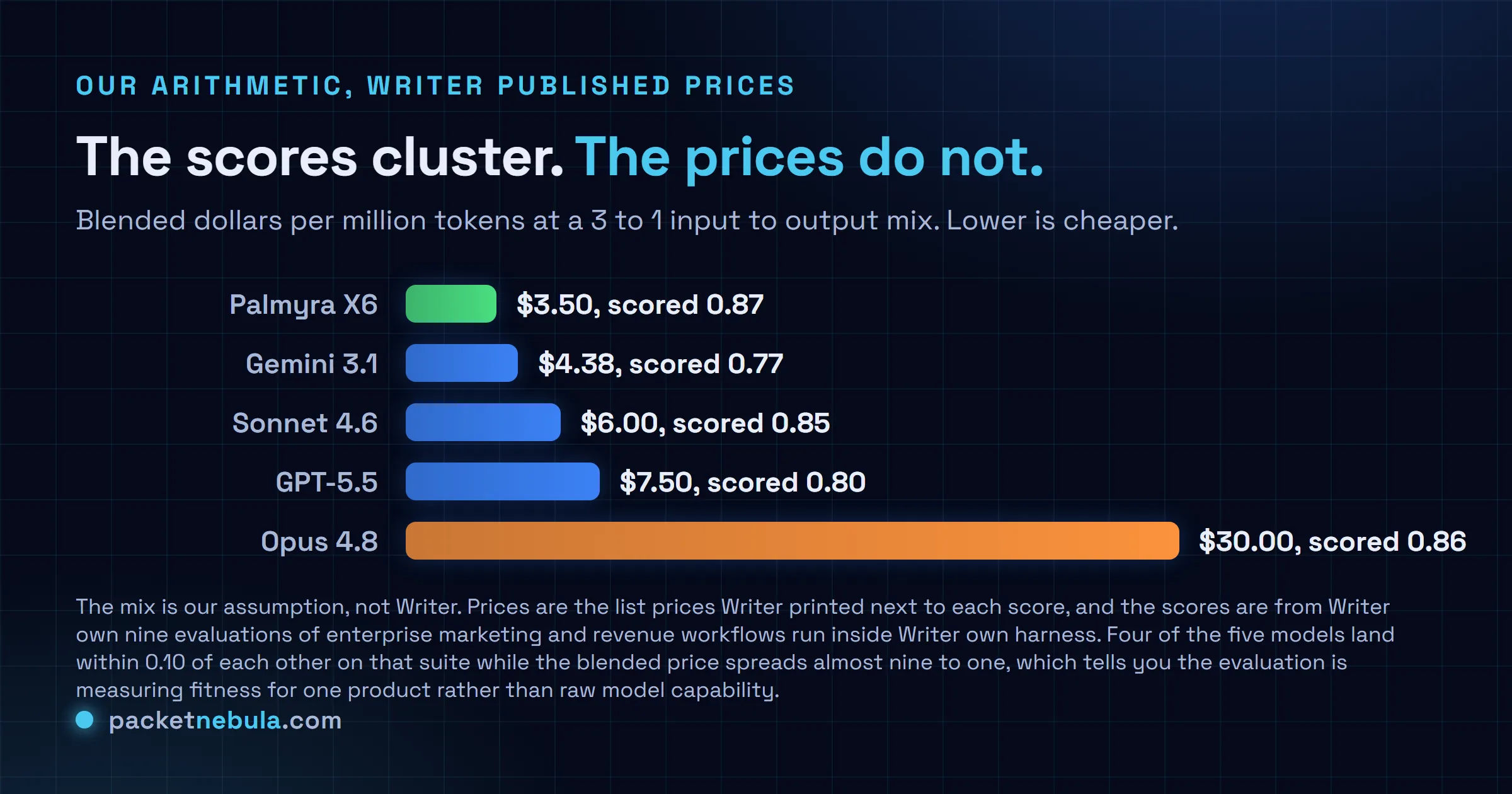
X6 scored 0.87 out of 1.00. Claude Opus 4.8 got 0.86 at $15 and $75 per million. Claude Sonnet 4.6 got 0.85 at $3 and $15. GPT-5.5 got 0.80 at $5 and $15. Gemini 3.1 got 0.77 at $2.50 and $10.
Now, the honest reading. This is not a leaderboard result and Writer never claims it is. It is a vendor measuring five models on its own workloads, inside its own orchestration harness, with one of the five tuned specifically to run in that harness. Of course it wins. The finding is not “X6 beats Opus”, it is “for this narrow class of work, the cheap tuned model was good enough that the expensive one stopped being worth nine times the money”.
Which is a real finding. I just would not carry that 0.87 into any sentence about general capability, and neither should the deck someone builds from it.
The cluster is the tell. Four of the five models sit within 0.10 of each other while the blended prices spread from $3.50 to $30. When a benchmark stops separating models, it has usually stopped measuring the thing you are choosing between.
The number we would actually steal
Buried under the model launch is the part that applies whether or not you ever open a Writer contract.
Writer published research on its own orchestration layer, and reports that the rebuilt harness completed tasks 44 percent faster at 41 percent lower cost per task across every model it tested, including third party ones. Not just its own. The mechanism it describes is unglamorous: adapt reasoning depth to the task instead of planning everything, batch high volume work, delegate to sub-agents so context stops getting resent.
Paired specifically with X6 the figures are 52 percent lower cost, 48 percent faster, 10 percent higher quality.
We have seen the same shape in our own agent work at a much smaller scale. The token bill is set by how many times you resend context, not by which model reads it. Swapping a frontier model for a cheap one saves you maybe half. Fixing a harness that re-sends the full history on every tool call saves you more than that, and it works on whichever model you switch to next.
One caveat on the per task dollar figures floating around. Coverage puts the new cost per task near $0.12, down from either $0.21 or $0.25 depending on which write up you read. Writer’s own release does not print a per task figure at all, so treat the specific dollars as reporting rather than as published data.
Would we use it
Depends entirely on what you are.
If you run marketing or revenue operations at a company with a compliance function, this is a straightforward pitch, and the governance console is the reason rather than the model. Per workflow spend visibility with limits attached is the thing most agent deployments are missing right now, and it is why pilots stall at pilot.
If you are a developer building your own agents, X6 is not for you and Writer is not pretending otherwise. There is no weights release and no self hosting path. The base is right there though, and GLM-5.2 is downloadable today. You would be doing your own post-training and your own harness, which is exactly the work Writer is charging for.
And if you are just tracking prices, the useful data point is that a vendor put $2 and $8 next to Opus 4.8’s $15 and $75 in its own comparison table and expected that to read as reasonable. Six months ago the flagship premium was assumed. It is now something you have to justify per workload.
X6 completes tasks in 26 seconds on average, generates 82 tokens per second, and Writer says it can work unattended toward a single goal for up to eight hours. That last claim is the one I would want to test before believing. Eight hours of coherent unattended agent work is a strong statement, and nothing in the release explains what “sustaining coherent reasoning” was measured against.
Sources
WRITER, WRITER Makes Agentic AI Economically Sustainable at Enterprise Scale With Palmyra X6 Release and Major Harness Upgrades, for the 13 August 2026 release date, the statement that X6 was post-trained on top of GLM-5.2, the $2 and $8 pricing, the 0.87 score and the list prices and scores for Claude Opus 4.8, Claude Sonnet 4.6, GPT-5.5 and Gemini 3.1, the nine evaluated capabilities, the 26 second average task, 82 tokens per second and eight hour unattended figures, the 52 percent, 48 percent and 10 percent harness numbers with X6, the 44 percent and 41 percent figures across all models tested, the IDC quote on AI spending as a risk, and the governance and consumption control features. TechCrunch, Writer introduces new AI model and upgraded harness to contain token costs, for independent confirmation of the GLM-5.2 base, the availability date for Writer customers, and the model agnostic positioning. SiliconANGLE, Writer launches major agentic AI improvements with Palmyra X6 flagship model, and CMSWire, WRITER Releases Palmyra X6, Upgrades Enterprise AI Agent Platform, for the Palmyra X5 lineage, the cost per task reporting and the multi model support through Azure, Bedrock and NVIDIA NIM. Announcement image by WRITER.
Frequently asked questions
What model is Palmyra X6 built on?
GLM-5.2, the open weight mixture of experts model from Z.ai in Beijing. Writer says so in its own release: X6 was post-trained on top of GLM-5.2, which it describes as the strongest available open weight model. Writer does not publish a parameter count for X6 itself, so the only public size figures belong to the base.
How much does Palmyra X6 cost?
$2 per million input tokens and $8 per million output tokens. At a 3 to 1 input to output mix that blends to about $3.50 per million, which is our arithmetic rather than a Writer figure. For comparison, the list prices Writer printed next to its own were $15 and $75 for Claude Opus 4.8, $3 and $15 for Claude Sonnet 4.6, $5 and $15 for GPT-5.5, and $2.50 and $10 for Gemini 3.1.
Is the 0.87 score a public benchmark?
No, and Writer is upfront about that. The suite is nine internal evaluations built from customer production workflows, covering grounding and retrieval, tool use, content generation, sub-agent delegation and brand voice. It measures fitness for marketing and revenue work inside the Writer Agent harness. You cannot line those numbers up against any public leaderboard.
Can I download or self host Palmyra X6?
No. X6 is available to Writer customers on the Writer platform, and there is no weights release. The base model is a different story: GLM-5.2 is open weight, so the thing underneath X6 is downloadable even though X6 is not.
What did the harness upgrade actually change?
Writer rebuilt the orchestration layer to adapt reasoning depth to the task, batch work and delegate to sub-agents. It reports 44 percent faster completion at 41 percent lower cost per task across every model it tested, its own and third party alike. Paired specifically with X6 the figures are 52 percent lower cost, 48 percent faster and 10 percent better quality.


