
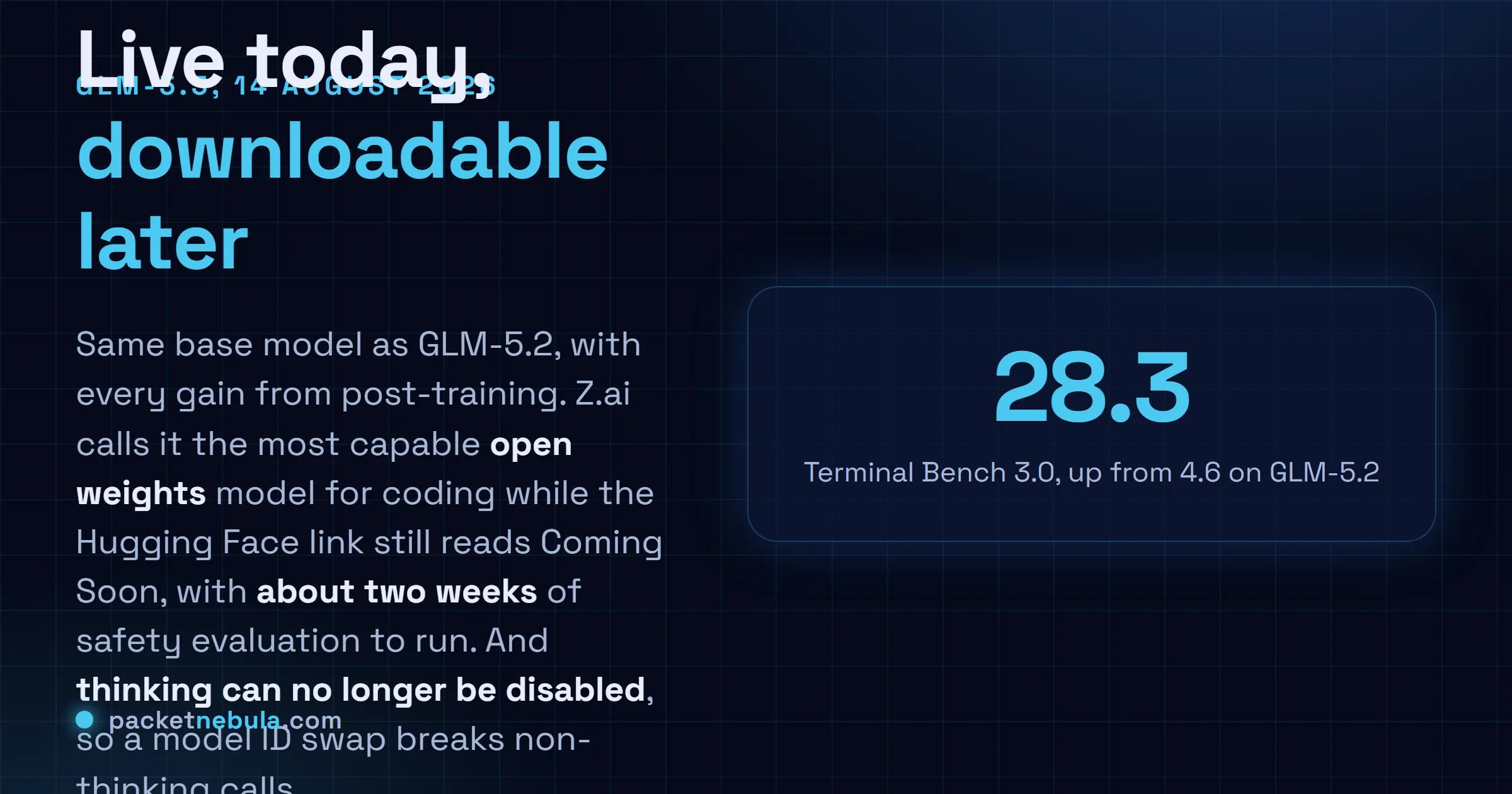
Z.ai put a Hugging Face button on its own GLM-5.3 announcement page, and the button says Coming Soon. That is the launch in one image: the model went live on 14 August through the API and the Coding Plan, billed as the most capable open weights model for coding, while the weights themselves sit behind a two week safety review. There is a second catch that matters more if you already run GLM-5.2. Thinking can no longer be switched off. Send thinking.type disabled to glm-5.3 and the request fails, so pointing an existing integration at the new model ID is not the one line change it looks like. Same base model as 5.2, incidentally. Every gain here comes from scaled post-training, and on Terminal Bench 3.0 that took the score from 4.6 to 28.3.
The short answer
GLM-5.3 went live on 14 August on the Z.ai API and the Coding Plan. It reuses the GLM-5.2 base model and gets everything from post-training, which moved the coding and agent scores a long way. Two things to handle before you touch it: the weights are not out yet, and non-thinking calls now fail outright.
What Z.ai shipped
GLM-5.3 is a post-training release. Not a new pretrain, not a new size. Z.ai opens its own write up by saying scaling post-training is all it did, on the same stack GLM-5.2 introduced, with more environments and more compute thrown at them over the past month.
That framing is unusually honest and it sets the expectation correctly. A month of reinforcement learning on harder environments is exactly the kind of work that lifts long horizon agent scores and leaves single turn quality roughly where it was.
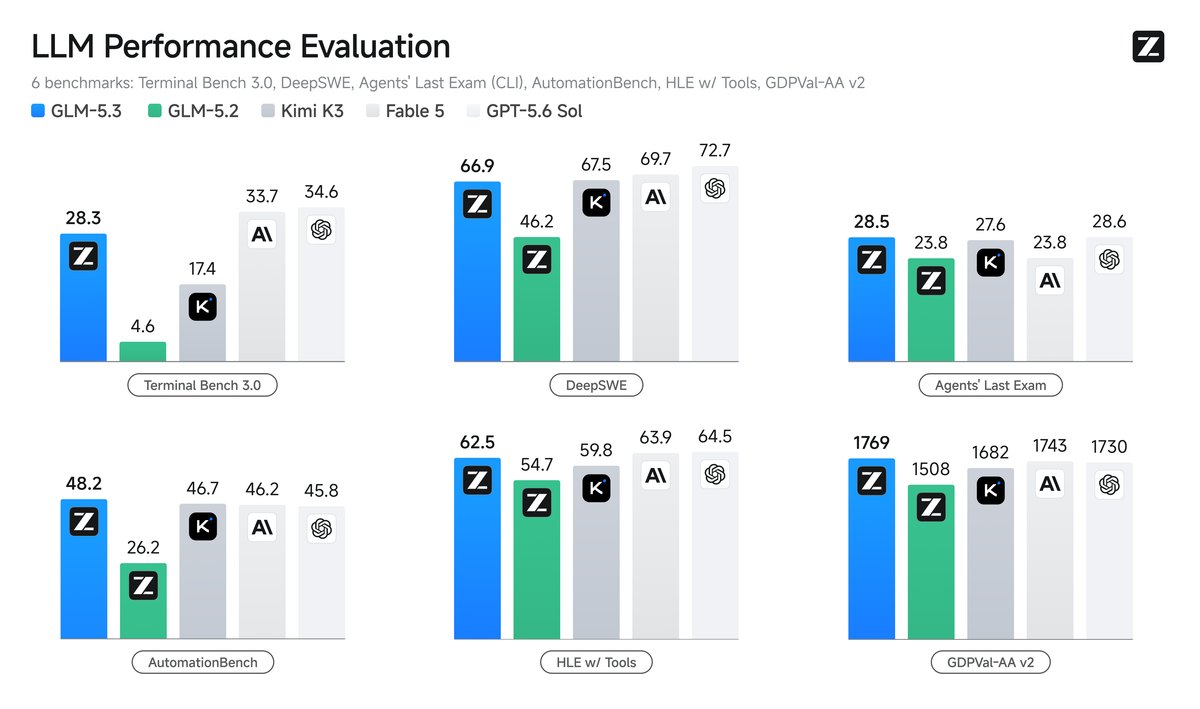 Image: Z.ai
It is available now through the Z.ai API, in ZCode, and in the GLM Coding Plan, where Z.ai says it has already rolled out to every existing subscriber. No per token API rate appeared in the announcement, so if you bill by the token rather than by subscription you are waiting on the pricing page.
The migration note nobody put in the headline
Here is the part that will cost somebody an afternoon.
GLM-5.3 supports three thinking effort levels, low, high and max, with max as the default. And thinking.type: disabled is gone. Z.ai’s own wording is that disabling thinking is no longer supported, and that a request carrying the old parameter will fail. The documented migration is to set thinking to enabled and reasoning_effort to low first, then change the model ID.
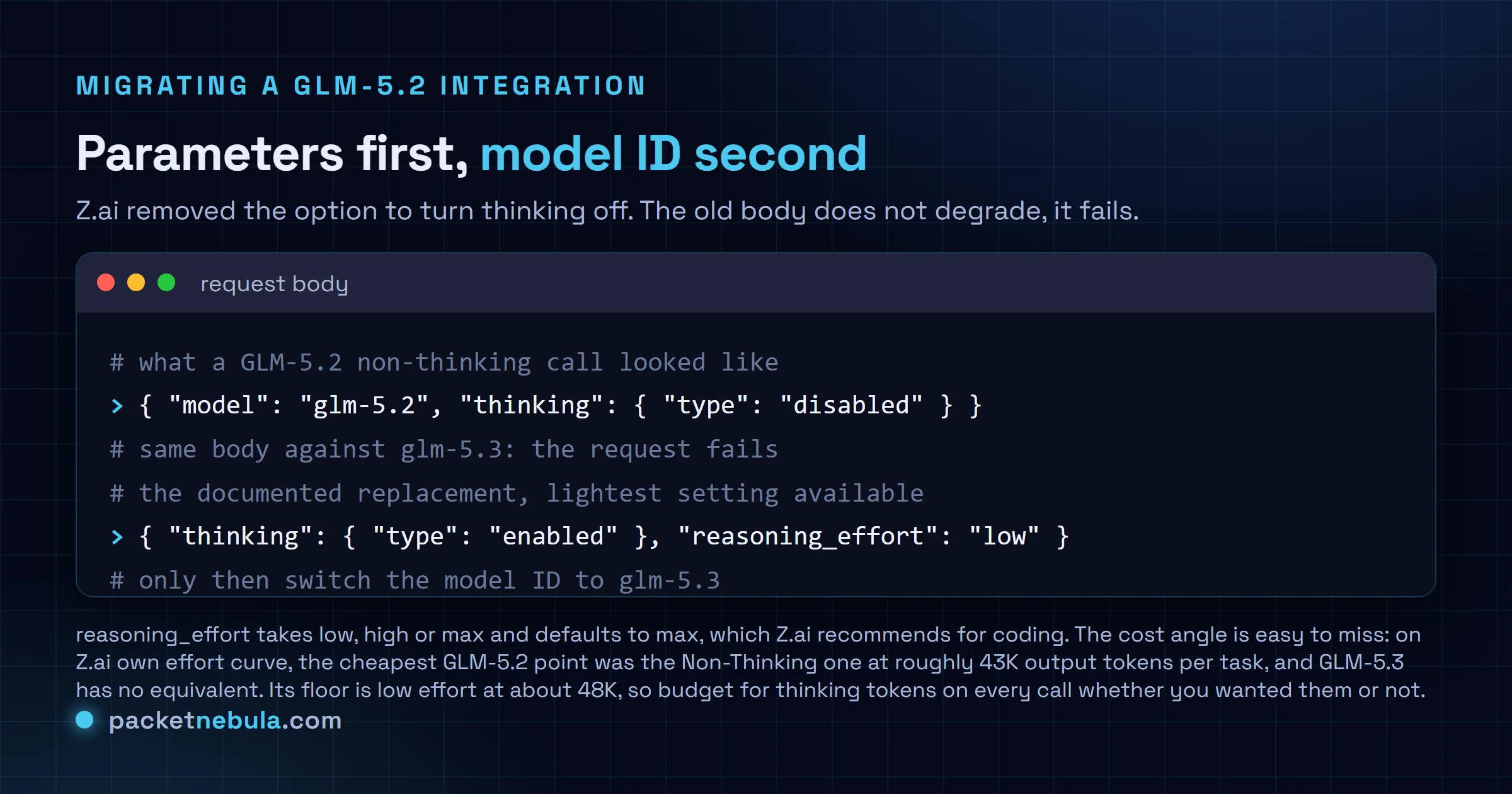
Look at what that does to the cheap end of the range. On Z.ai’s own effort curve, GLM-5.2’s leftmost point is labelled Non-Thinking, sitting at roughly 43K output tokens per task. GLM-5.3 has no such point. Its floor is Low, at about 48K. So the cheapest way to call this model family just stopped existing, and low effort thinking is what replaces it.
For a chat feature or a classification pass where you deliberately turned thinking off to keep latency down, that is a real change, not a parameter rename. I’d test the latency before assuming low effort behaves like the old non-thinking mode. I doubt it will.
The coding numbers, and what they are worth
The public benchmark jumps are large.
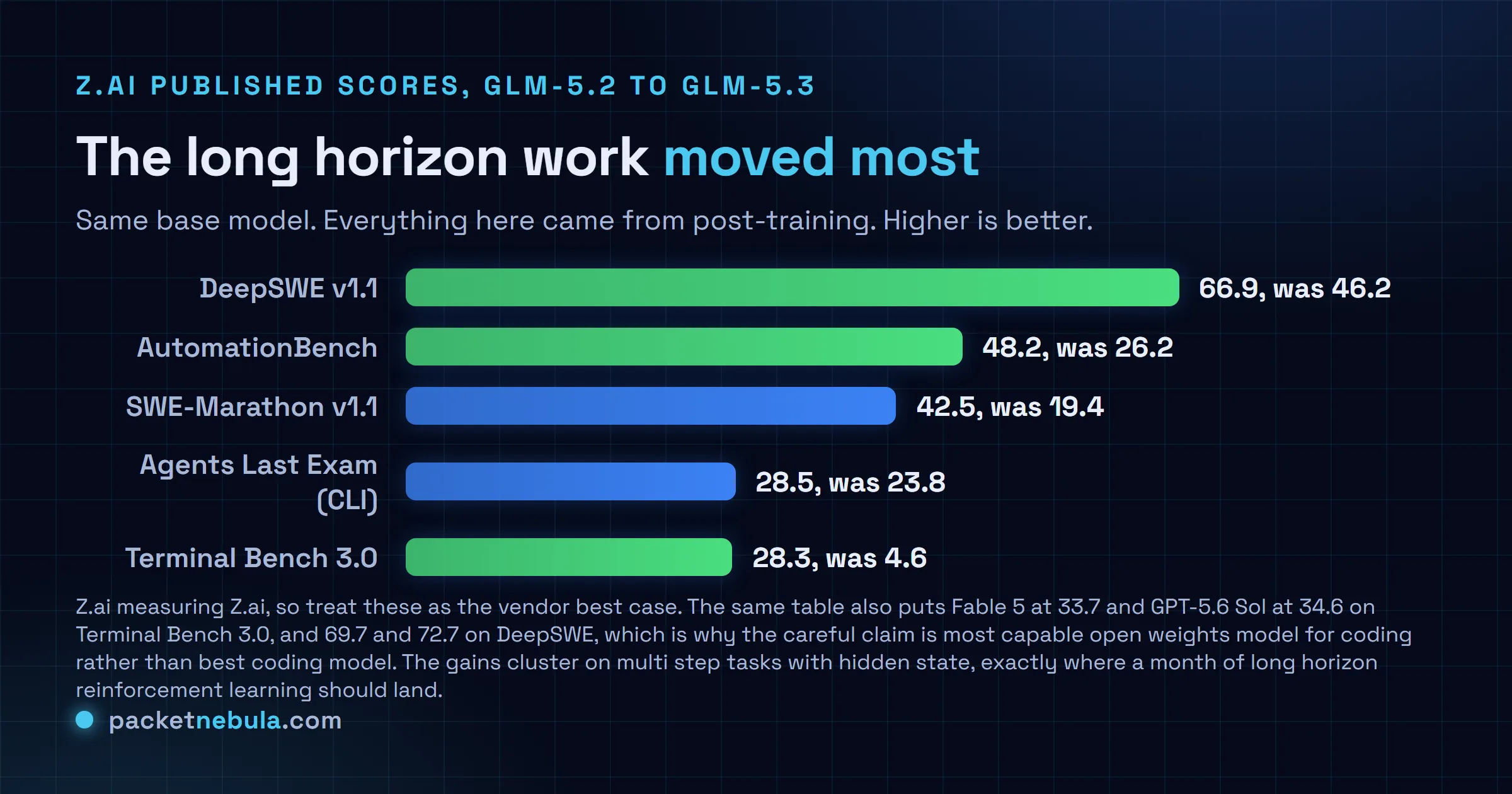
Terminal Bench 3.0 went from 4.6 to 28.3. SWE-Marathon v1.1 more than doubled, 19.4 to 42.5. AutomationBench went 26.2 to 48.2, DeepSWE v1.1 46.2 to 66.9, GDPval-AA v2 1508 to 1769. The gains cluster where you would expect a month of long horizon RL to land: multi step work with hidden state, where the model has to recover from its own mistakes instead of answering once.
Now the caveat, and it is the usual one. Same table, same page: Fable 5 scores 33.7 on Terminal Bench 3.0 and GPT-5.6 Sol 34.6, against GLM-5.3’s 28.3. DeepSWE reads 69.7 and 72.7 against 66.9. Kimi K3 is ahead on SWE-Marathon and Toolathlon. So the claim to read carefully is the specific one Z.ai makes, most capable open weights model for coding, not best coding model.
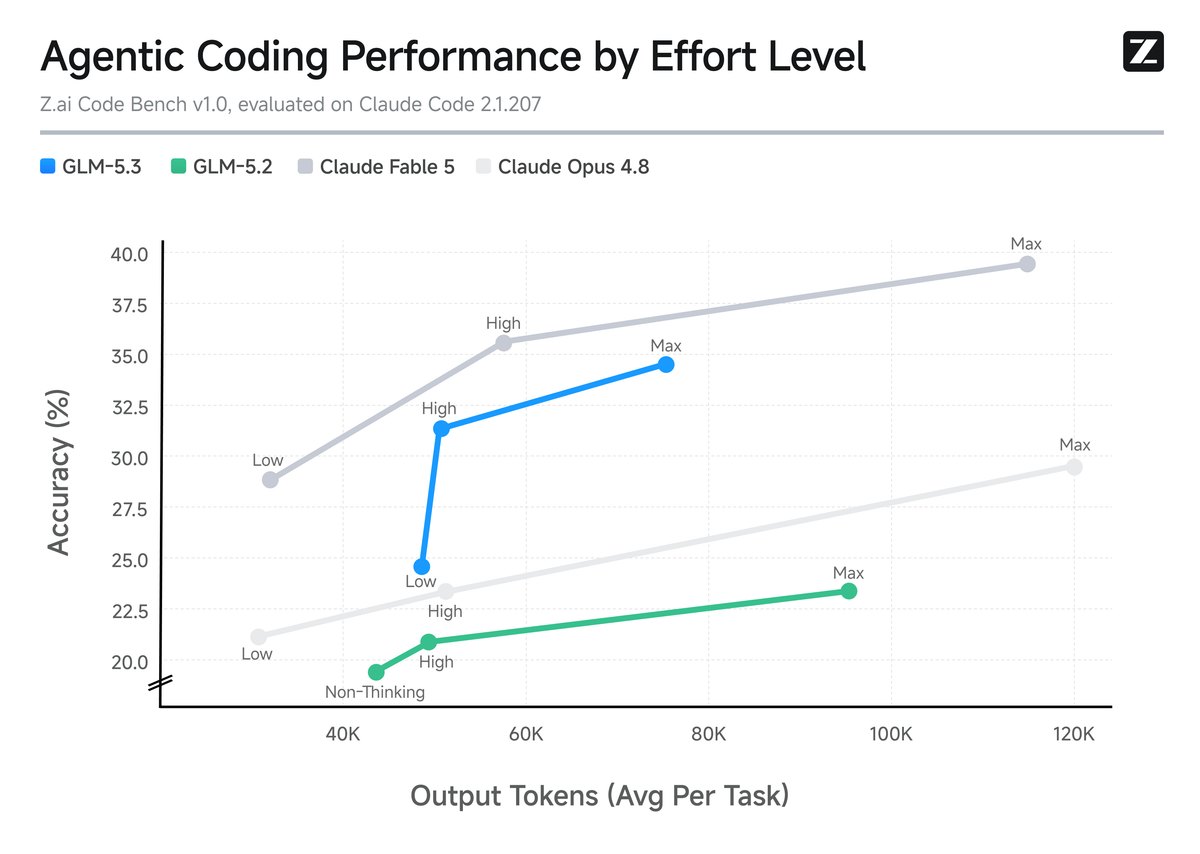 Image: Z.ai
The token efficiency chart is the one Z.ai clearly likes best, and it is the one to trust least, because Z.ai Code Bench is private. At high effort GLM-5.3 hits 31.4 percent at around 50K output tokens per task, above Opus 4.8’s 29.5 percent at 120K. At max it reaches 34.5 percent at roughly 75K, against 23.4 percent at 96K for GLM-5.2. Fable 5 still tops the chart at 39.5 percent.
Being right at half the output tokens is worth money, and nobody outside Z.ai can reproduce that measurement. Both things are true. We said much the same when GLM-5.2 landed against GPT-5.5 and Opus 4.8, and the pattern has not changed.
Open weights, in two weeks
Z.ai will publish the weights about two weeks after launch, once safety evaluation and hardening are done. The stated reason for the delay is that one capability grew faster than the lab expected as post-training scaled, specifically vulnerability discovery, where GLM-5.3 posts the top score on the CyberGym benchmark at 84.5 percent. Z.ai has paired that with a public disclosure ledger for the findings its security partners have filed.
Whatever you make of the reasoning, the practical consequence is simple. If the reason you run GLM is that you can host it yourself, GLM-5.3 does not exist for you today. GLM-5.2 does. And “about two weeks” is not a date, so if you have a launch pinned to self-hosted 5.3, pin it to something else. Kimi K3 published its weights on day one, which is the comparison the open weights crowd will make.
The Coding Plan clock
Worth ten seconds of attention if you subscribe. The plan moved to a points based quota, counted separately for input, cached input and output tokens, and calls made outside peak hours cost half the points.
Peak is 14:00 to 18:00 UTC+8, Monday to Friday. Everything else, weekends included, is half price. Run that through a European clock and peak becomes 08:00 to 12:00 in Paris during summer time. On the US east coast it is roughly 02:00 to 06:00, so an American team is off peak for its entire working day without doing anything. There is also a 1.5x quota boost on ZCode running to 31 August.
Would we move
If you are on GLM-5.2 through the Coding Plan, yes, it is already there and the agent scores went one direction. Budget an hour for the thinking parameter, not five minutes.
If you self host, wait. There is nothing to download and no date for when there will be.
And if you were choosing between this and a closed frontier model on raw coding quality, the table still says you would be trading a few points for the price. That was true in July and it is true now, just with a smaller gap.
Sources
Z.ai, GLM-5.3: Frontier Coding with Emergent Cyber Capabilities, 14 August 2026, for the benchmark table, the effort level charts, the API changes and the Coding Plan terms. Z.ai, Z.ai developer pack overview. Unite.AI, Z.ai launches GLM-5.3 with frontier coding, 14 August 2026. BigGo Finance, Zhipu AI releases GLM-5.3, open source weights coming in two weeks. Both charts reproduced above are Z.ai’s own, from the announcement page.
Update, 7 October 2026. The GLM-5.3 weights were published on 27 August, 13 days after Z.ai's 14 August launch announcement (its docs changelog dates the API entry 18 August), under a new GLM-5.3 License rather than MIT. Kimi K3's weights arrived 11 days after its API, not on day one as this article says. See the open-weight tracker.
Frequently asked questions
When are the GLM-5.3 weights released?
Z.ai says about two weeks after the 14 August launch, once safety evaluation and hardening are complete, which points at the end of August 2026. No exact date has been published. The Hugging Face link on the announcement page reads Coming Soon, and the local serving section says only that the weights will be publicly available soon.
Can you disable thinking on GLM-5.3?
No. Z.ai's API notes state that thinking.type disabled is no longer supported on glm-5.3, and that a request sending it will fail. The replacement is reasoning_effort with three values, low, high and max, defaulting to max. Z.ai's migration instruction is to switch thinking.type to enabled and set reasoning_effort to low before you change the model ID.
Is GLM-5.3 a new base model?
No, it uses the same base model as GLM-5.2. Z.ai is explicit that every gain comes from post-training, specifically more reinforcement learning environments and more compute spent on them, running on the same IndexShare, SAO and slime stack that GLM-5.2 introduced.
How does GLM-5.3 compare to Claude Fable 5 and GPT-5.6 Sol on coding?
Still behind, on Z.ai's own published table. Terminal Bench 3.0 reads 28.3 for GLM-5.3 against 33.7 for Fable 5 and 34.6 for GPT-5.6 Sol. DeepSWE v1.1 reads 66.9 against 69.7 and 72.7. On Z.ai Code Bench, the vendor's private benchmark, GLM-5.3 reaches 31.4 percent at high effort while Fable 5 reaches 39.5 percent at max.
What changed in the GLM Coding Plan?
It moved to a points based quota, counted separately for input, cached input and output tokens. Calls outside peak hours cost half the standard points. Peak is 14:00 to 18:00 UTC+8, Monday to Friday, which is 08:00 to 12:00 in Paris during summer time and the small hours in North America.


