
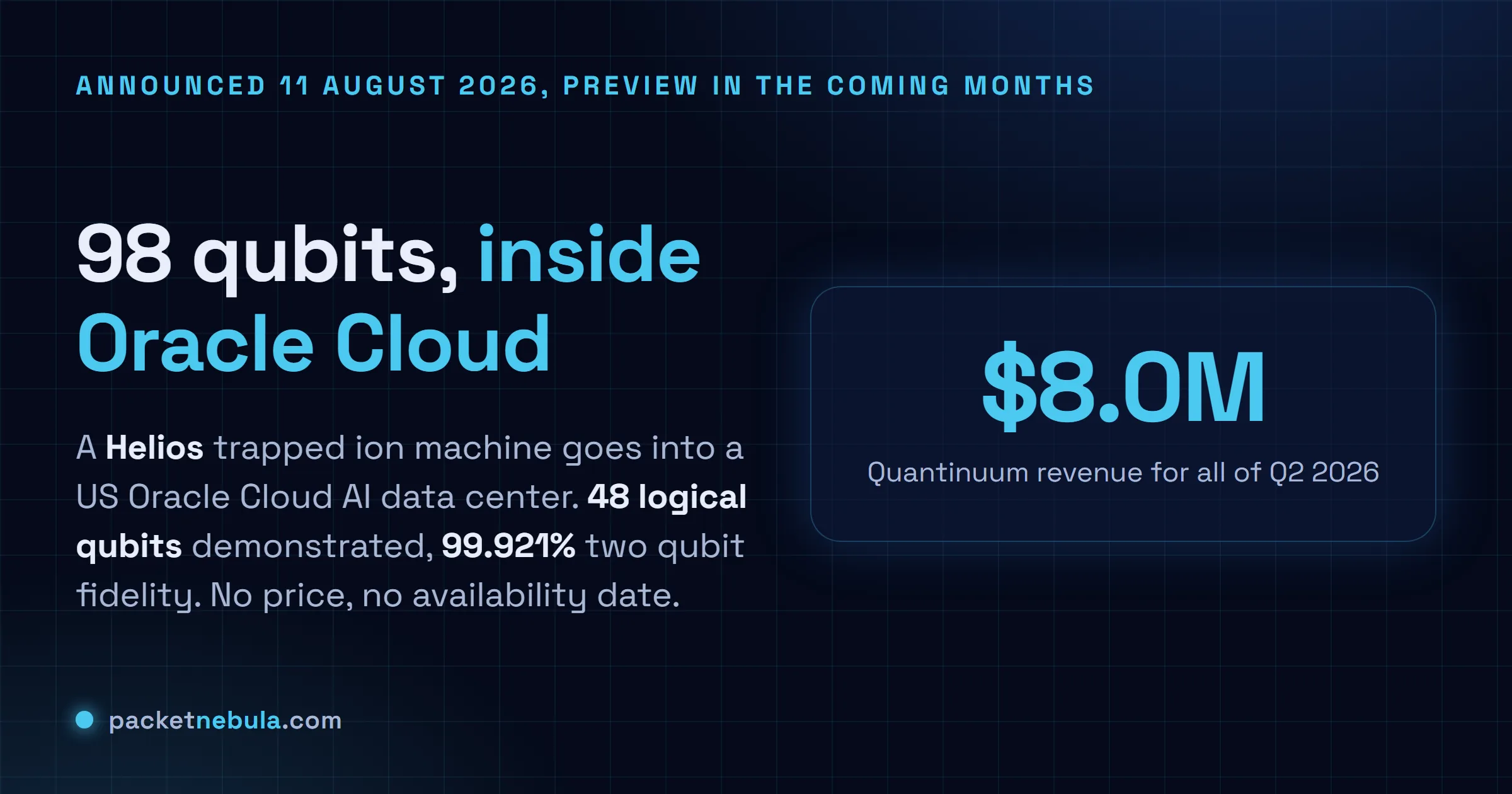
Your cloud console is about to grow a tab you can't use yet. On 11 August, Quantinuum and Oracle said they'd install Helios, a 98 qubit trapped ion machine, inside a US based Oracle Cloud AI data center, with an OCI quantum service due to preview in the coming months. That's a real computer in a real room next to the GPUs, not another simulator behind an API, and the hardware numbers are published: 48 logical qubits demonstrated at 99.921% average two qubit gate fidelity. Then there's the part most of the coverage skipped. Quantinuum booked $8.0 million of revenue in the entire second quarter and guides to $28 million to $32 million for the full year. The machine is genuine. The business is small. Both facts matter when you work out how much of your 2027 planning to hand over to this.
The short answer
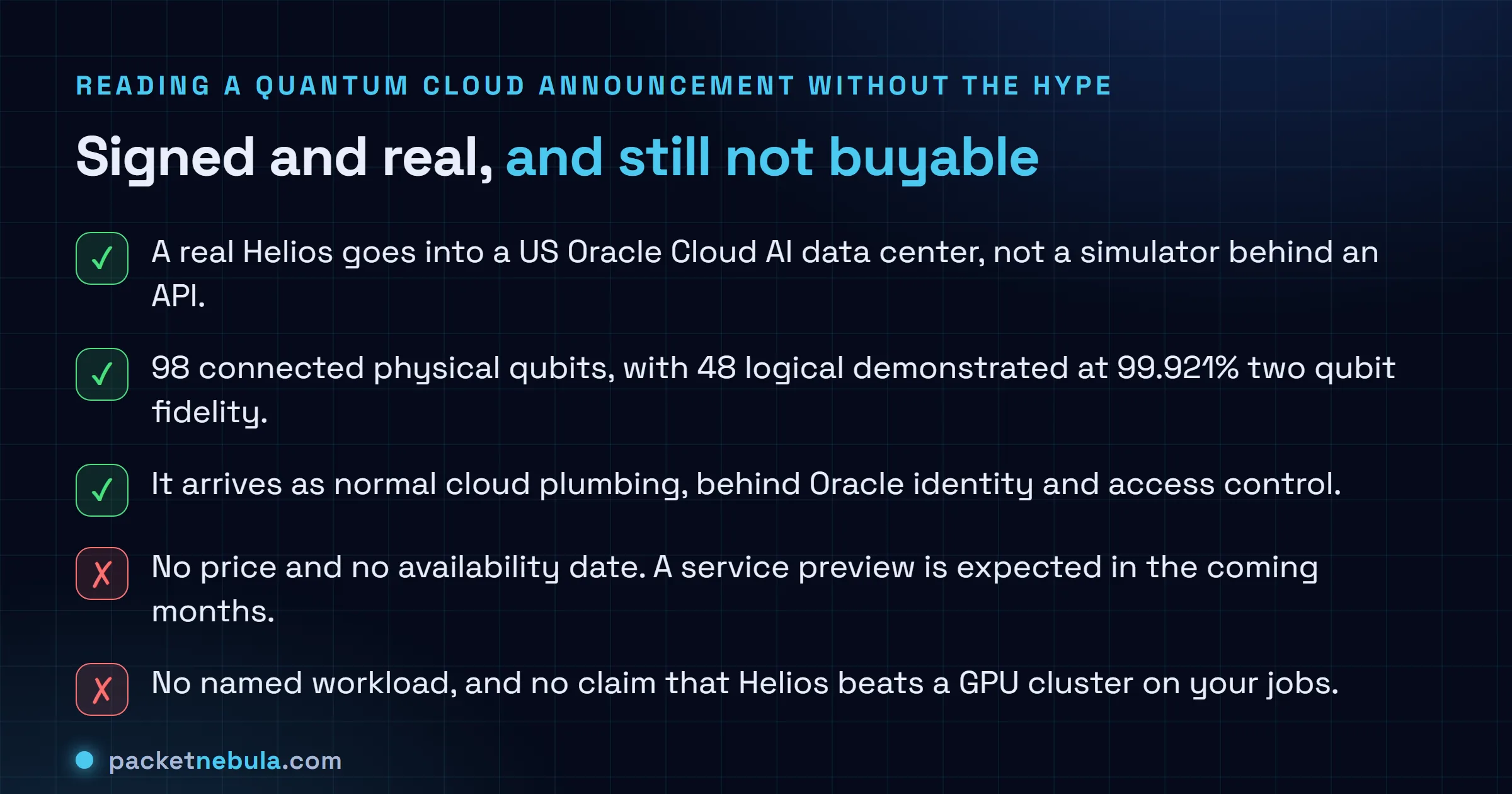
Quantinuum and Oracle announced on 11 August that a Helios trapped ion quantum computer will sit inside a US based OCI AI data center, reachable through a planned OCI quantum service that previews in the coming months. The hardware is real and the fidelity figures are published. What is not published: any price, any availability date, any named production workload. Useful as a skills and prototyping move. Not something to put in a 2027 capacity plan.
A quantum computer moves in next door
The framing here is what’s new, not the hardware. Quantum computers have been reachable over the internet for years, usually as a queue you submit a circuit to and collect results from later. This is different in one specific way: the box goes inside Oracle’s own AI data center, next to the GPU and HPC capacity, behind Oracle identity and access control.
That matters more than it sounds. The awkward part of quantum access has never been the qubits, it’s the plumbing around them. A hybrid job spends most of its life on classical hardware, preparing parameters and processing measurement results, and bouncing that back and forth across the public internet to somebody else’s lab adds latency and a procurement conversation nobody wanted. Putting the machine in the same building as the classical half removes both.
Image: Quantinuum, announcement visual from its Oracle partnership release, 11 August 2026.
Quantinuum calls the arrangement an industry first. We’d take that lightly, since every vendor’s press release contains one, but the physical colocation is genuinely unusual and the power figure explains why it’s even possible. Quantinuum states roughly 60 kW for Helios. That’s less than one rack of dense AI servers, so a quantum machine is, oddly, one of the easier things to find room for in a data center that’s fighting for megawatts. (Worth a footnote for anyone searching: this Helios has nothing to do with AMD’s Helios rack. Two companies, one name, no relation.)
The published numbers, and the two ratios worth holding on to
Helios is a third generation trapped ion machine that launched commercially in November 2025, running 98 fully connected physical qubits on barium ions. Quantinuum reports 99.921% average two qubit gate fidelity and 99.9975% on single qubit gates. Full connectivity is the quiet advantage of trapped ions: any qubit can interact with any other, so you don’t burn depth on shuffling states around a fixed lattice the way superconducting architectures often do.
Now the ratio. Those 98 physical qubits have been used to demonstrate 48 logical qubits. Roughly two to one, which is remarkable by the standards of a field where the textbook overhead runs to hundreds of physical qubits per logical one. Quantinuum’s next machine, Sol, is targeted at 192 physical and 100 logical for 2027, holding the same ratio while chasing a logical error rate of ten to the minus five. Apollo, the fully fault tolerant design with thousands of physical qubits, is a 2029 target.
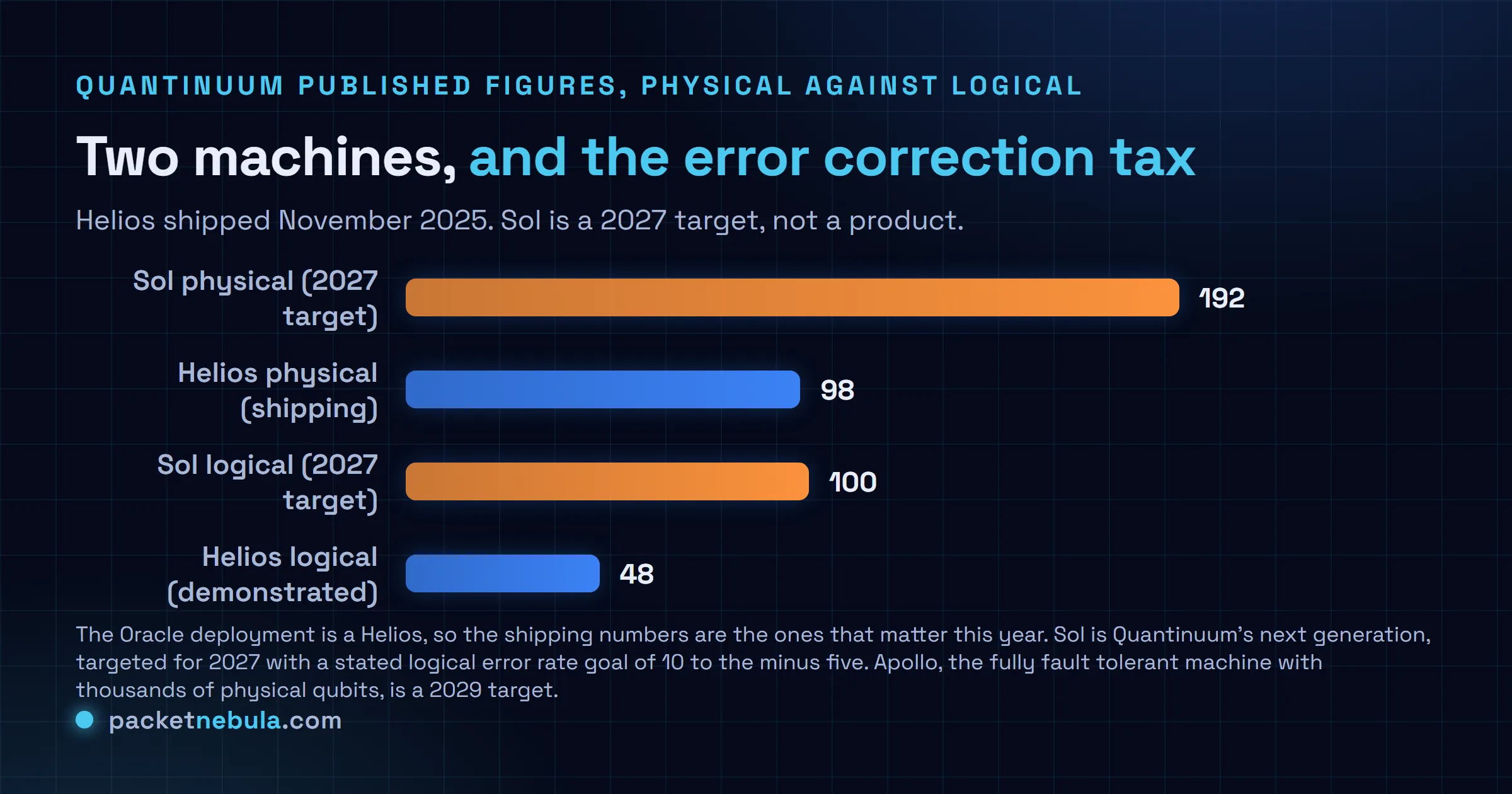
Here’s the honest reading of 48 logical qubits, though. It’s a genuine engineering achievement and it’s still far short of anything commercially decisive. Useful quantum chemistry estimates start in the hundreds of well corrected logical qubits and go up quickly from there. I might be wrong about the exact threshold, nobody really agrees on it, but the gap is orders of magnitude rather than a couple of product cycles.
Eight million dollars, and what you should actually do
Quantinuum reported its second quarter results in the same week. Revenue of $8.0 million, up 279% from $2.11 million a year before. Full year guidance of $28 million to $32 million. GAAP net loss of $596.5 million, most of which ($447.5 million) is a one off stock compensation charge from the June IPO, with an adjusted EBITDA loss of $68.3 million underneath. Cash sits at about $2.11 billion after the $1.7 billion raise, so nobody is running out of money soon.
Put those two stories side by side and the shape becomes clear. This is a well funded research programme selling access to extremely good lab equipment, not a compute business. Annual revenue guidance tops out around what a single large enterprise spends on GPU capacity in a quarter. That’s not a criticism, it’s just the scale, and it should calibrate how you read “quantum is arriving in the cloud” headlines for the next couple of years.
So what do you do with it? If you have a genuine optimisation or simulation problem and a person who can spend real time on it, an OCI quantum preview is a cheap way to build that skill inside normal cloud governance instead of a bespoke research agreement. That’s a real benefit and it’s the whole point of the deal.
If you don’t have that person, do nothing. Genuinely nothing. The quantum item that belongs on your roadmap this year isn’t access to a 98 qubit machine, it’s post quantum cryptography, and that’s true whether Helios ships to twenty clouds or none. Harvest now and decrypt later doesn’t wait for fault tolerance, the migration takes years of certificate and library work, and it’s already landing in production stacks. We wrote up which post quantum signature actually ships in TLS and what turning on ML-DSA-44 to origin looks like in practice. That’s the work. This announcement doesn’t change a line of it.
The interesting long game is which modality wins, and the money still isn’t sure. Trapped ions get fidelity and connectivity but slow gate speeds. Superconducting gets speed and a fab path, which is why IBM bought a silicon spin qubit lab. Photonics has its own backers. Oracle picking a trapped ion partner is a vote, not a verdict.
Sources
Quantinuum’s announcement on the Quantinuum newsroom and Oracle’s matching release, both dated 11 August 2026. Specifications, roadmap dates and caveats from Unite.AI and The Quantum Insider. Second quarter financials from Quantum Computing Report and Quantinuum’s own condensed consolidated statements published alongside the results.
Frequently asked questions
What did Quantinuum and Oracle actually announce?
A multi year strategic partnership, announced 11 August 2026, under which a Quantinuum Helios quantum computer is installed inside a US based Oracle Cloud Infrastructure AI data center. OCI customers would reach it through a planned OCI quantum service, using the same Oracle identity and access controls as the rest of their tenancy, alongside Oracle's GPU and HPC capacity. Oracle says the service will preview in the coming months. No general availability date and no pricing were published.
How many qubits does Helios have, and how good are they?
Helios is a third generation trapped ion system with 98 fully connected physical qubits, running barium ions. Quantinuum reports an average two qubit gate fidelity of 99.921%, which clears the widely quoted "three nines" mark, and single qubit fidelity of 99.9975%. It has been used in demonstrations with 48 logical qubits, meaning error corrected qubits built out of the physical ones. Helios launched commercially in November 2025, so this is a shipping machine rather than a prototype.
Can I run something useful on it today?
Almost certainly not, if "useful" means beating what you already run on classical hardware. Neither company named a production workload or published a benchmark against a GPU cluster. The stated targets are drug discovery, materials science, financial modelling and large scale optimisation, all of which are research programmes rather than shipped results. Treat access as a way to build skills and test circuits, not as capacity you can put in a delivery plan.
Does this change anything for my security roadmap?
No. A 98 qubit machine with 48 logical qubits is nowhere near breaking RSA or elliptic curve cryptography, which needs millions of physical qubits by current estimates. The quantum item that genuinely belongs on your 2026 roadmap is post quantum cryptography, because the migration takes years and the "harvest now, decrypt later" risk starts the day your traffic is captured. That work is independent of anything Quantinuum ships.
How big is Quantinuum as a business?
Small, and losing money fast. Revenue was $8.0 million in the second quarter of 2026, up 279% from $2.11 million a year earlier, with full year guidance of $28 million to $32 million. GAAP net loss for the quarter was $596.5 million, though $447.5 million of that was a one off stock compensation charge triggered by the June IPO. Adjusted EBITDA loss was $68.3 million. The company holds about $2.11 billion in cash after raising $1.7 billion in that IPO, so the runway is long even if the revenue is not.


