
Paste a Claude answer into a doc and something invisible travels with it. Since 2 August, every new model Anthropic ships marks its own prose, and on 15 August the company explained how: a version of SynthID-Text, the Google DeepMind method that nudges word choice rather than hiding characters in the string. It covers the API, claude.ai, Claude Code, Cowork and Tag. Worldwide, not only the EU, with no flag to turn it off. We read the official pages instead of the reaction, because the reaction got the mechanism wrong in both directions, and the part that matters for work is duller than the outrage: the mark is weakest exactly where developers spend their day.
The short answer
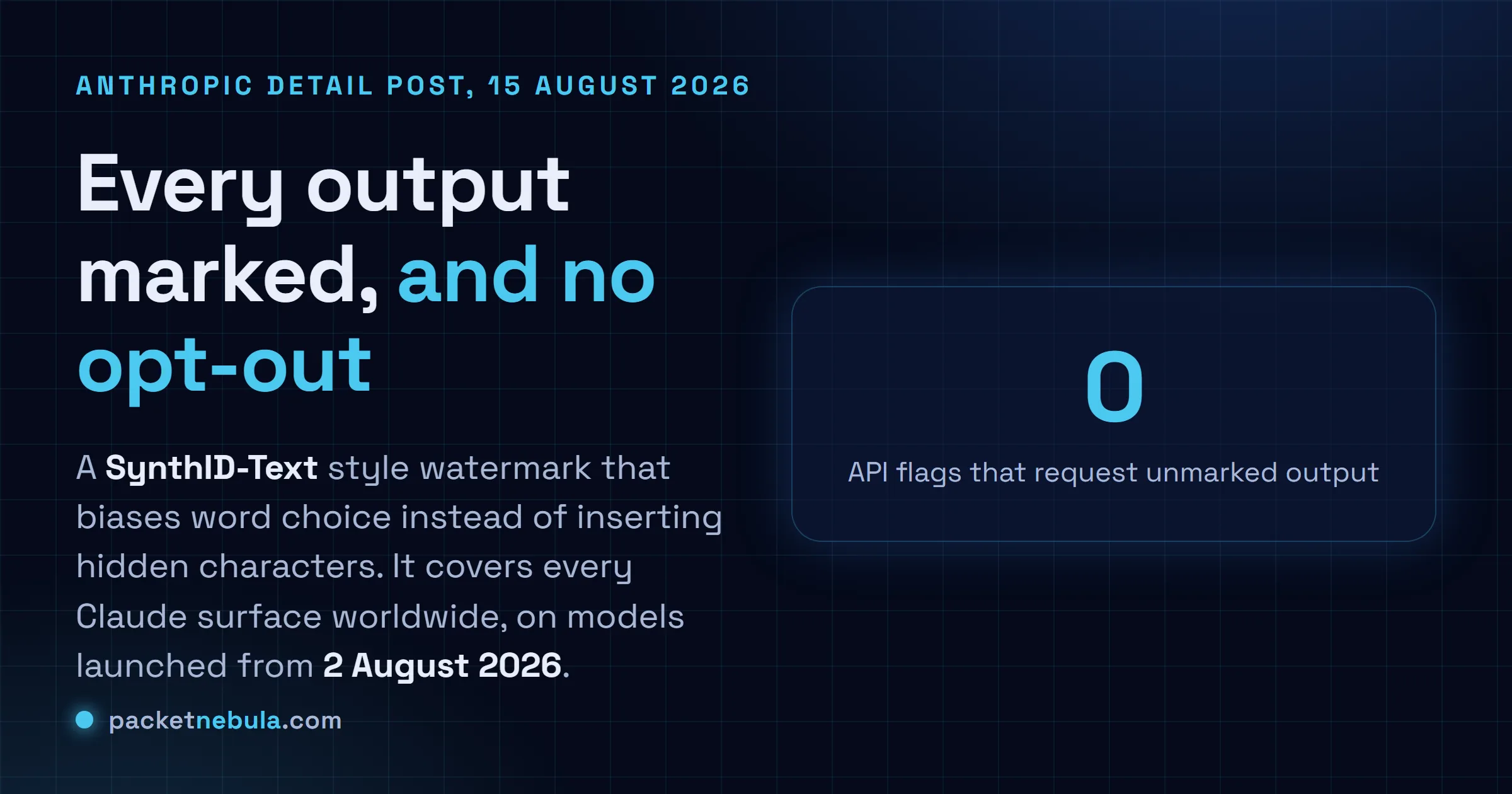
Anthropic published the mechanics on 15 August. Claude’s text watermark is a SynthID-Text style statistical mark that biases word choice where several words fit, survives copy and paste, and covers every Claude surface worldwide. There is no opt-out. The catch for anyone hoping to use this: the mark thins out on short answers and on code, and the public detector Anthropic promised is not callable yet. Marked output, and nobody outside Anthropic can check it.
It isn’t hidden characters, and that matters
Half the internet spent last week hunting for zero width spaces in Claude output. Wrong tree. Nothing is inserted into the string, so stripping invisible Unicode does nothing to this mark, and neither does retyping the text by hand into a fresh file.
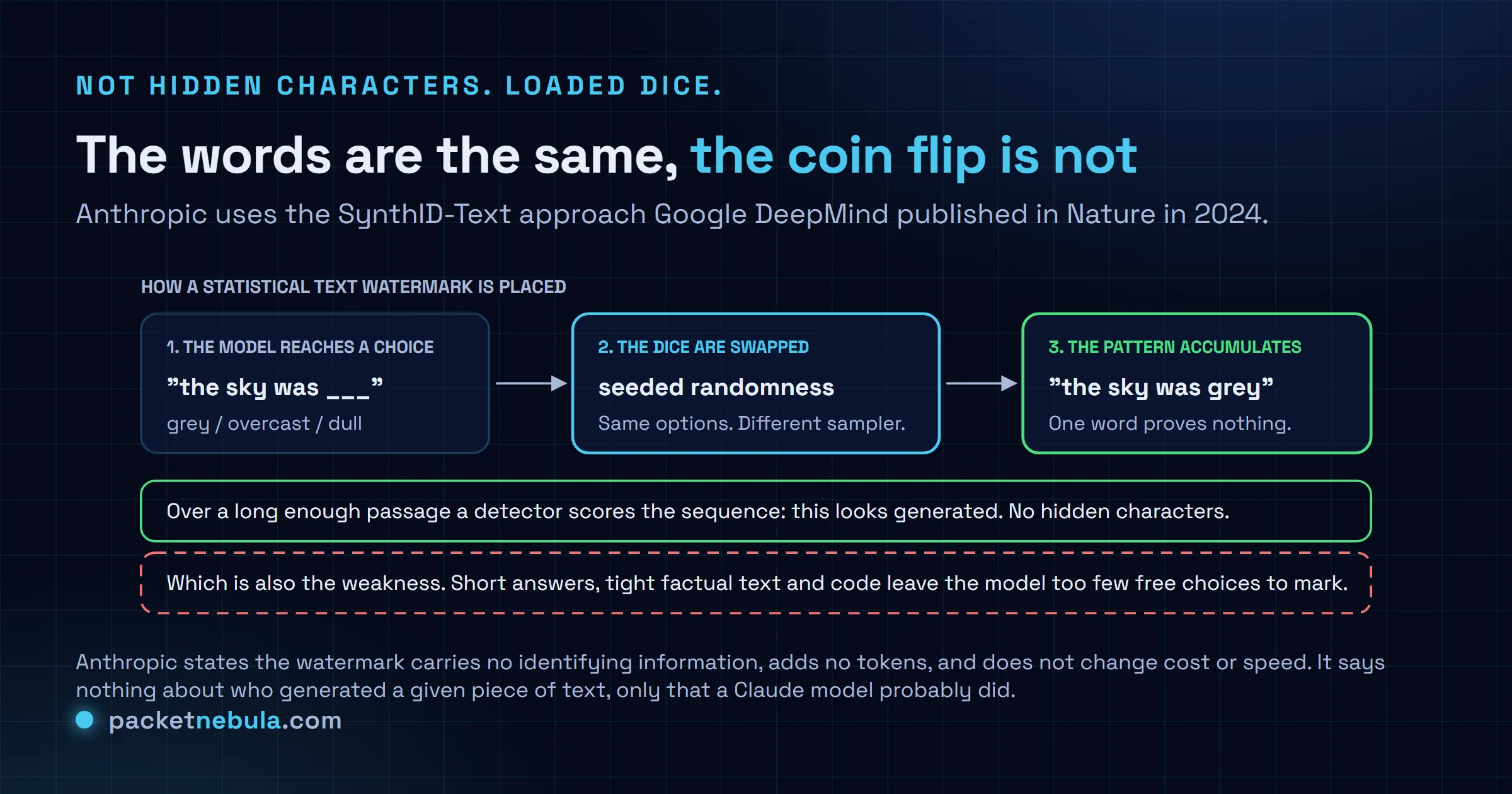
What Anthropic uses is SynthID-Text, published by Google DeepMind in Nature in 2024, itself descended from a 2022 proposal by Scott Aaronson. The idea is small and quite elegant. When a model generates, it picks the next token from a distribution, and at plenty of points several words are equally fine. Grey or overcast. The watermark doesn’t override that choice. It changes the source of the randomness used to make it, seeded so that the resulting sequence carries a faint statistical bias only a detector holding the key can measure.
Image: Anthropic, announcement illustration from its How Claude’s text watermarking works post, 15 August 2026.
One word proves nothing, which is the whole point. The signal only exists in aggregate, and Anthropic says it costs nothing. No extra tokens. Nothing in it identifies you or your account, and DeepMind’s own human rater tests found no quality difference in the output. I’m inclined to believe that part, since the sampling change is genuinely tiny, though “no practical impact” is the sort of claim that only gets tested properly once thousands of people go looking.
Where the mark holds, and where it thins out
Now the part that decides whether any of this touches your work. The signal comes from free choices, so it fades wherever the model has none.
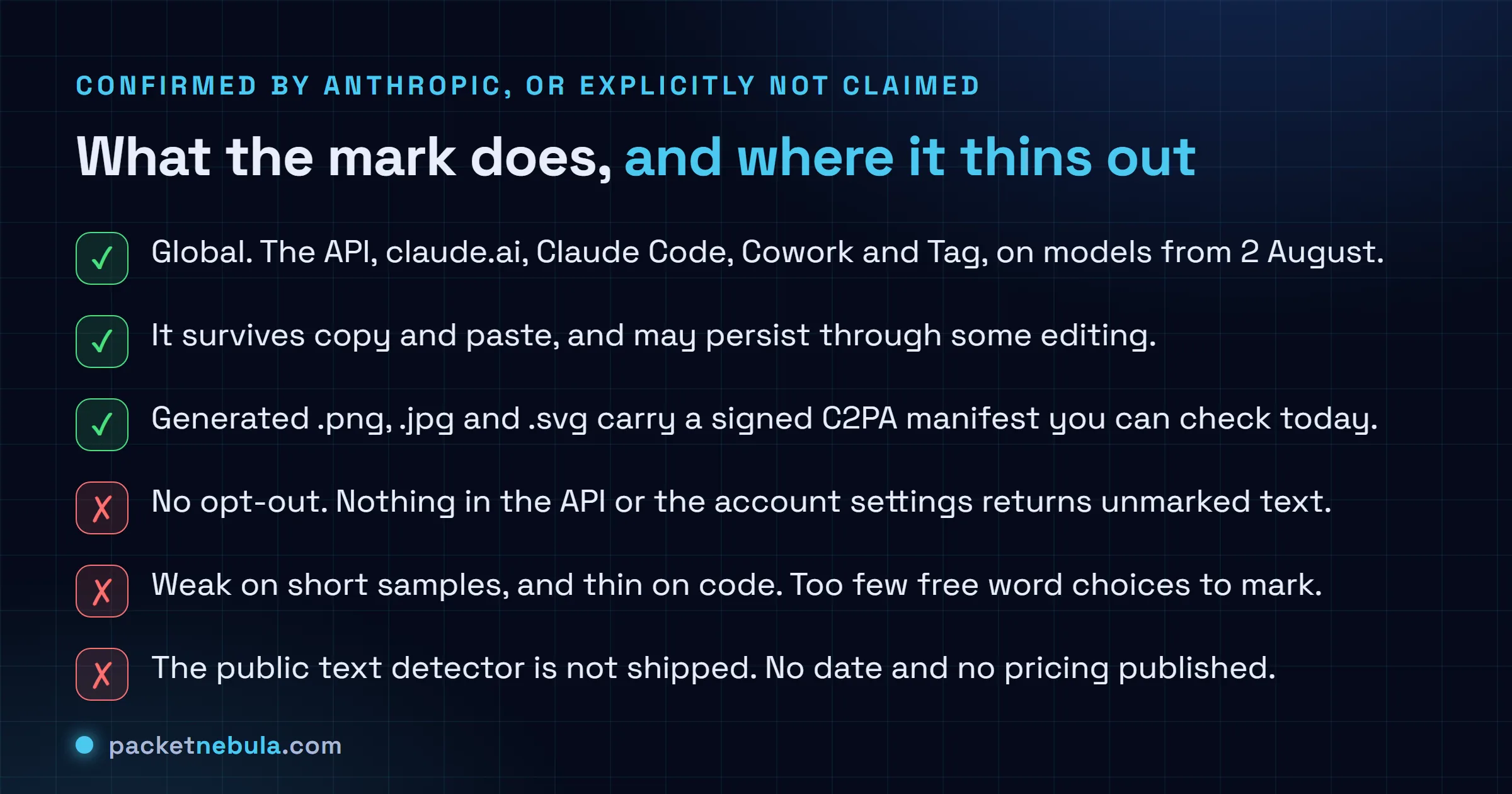
Short answers carry little. A tight factual paragraph carries less than an essay, because facts pin the wording down. And code carries, in Anthropic’s own words, generally less watermarking than other forms of text, with what little there is landing in arbitrary places like comments. A function is not marked in any useful sense.
Copy and paste keeps it. Light editing “probably won’t remove the watermark completely”, per Anthropic, while a full rewrite does, and the company concedes the obvious follow up: at that point it’s arguable whether the text is still AI generated at all. Translation and format conversion break it too.
So the honest reading is a mark built for volume. It can tell a platform that a flood of submissions looks generated. It cannot tell a lecturer that one paragraph of a student essay was, and treating it that way would be a mistake with real consequences for the person on the wrong end.
No opt-out, and no detector
Two things sit awkwardly together right now.
There’s no way to ask for unmarked text. Not on the consumer plans, and not through any parameter on the Claude Platform API. If you build a product on Claude and pass its output to your users, that output is marked. Anthropic points at Article 50 of the EU AI Act as the reason, which does require machine-readable marking of generative output. We went through what Article 50 actually binds you to when it applied on 2 August. Worth noting that the obligation is European and the global rollout is a company decision, not a legal one.
And the detector isn’t there. Anthropic says one is coming, “soon”, with no date and no pricing. Until it lands, the mark is readable by exactly one party. Files are the exception: generated .png, .jpg and .svg carry a signed C2PA manifest you can verify yourself today with c2patool, which is a genuinely useful provenance signal for images if nobody screenshots them.
The reaction was quick. A multi-vendor tool for stripping provenance marks appeared on GitHub on 11 August, the day the news broke, and passed 12,700 stars inside six days. Some of that is principle and some is people who dislike being measured, and the number says more about the mood than about the technology. This is roughly the same argument that followed Twitch turning AI training on by default: the thing people object to is the absence of a switch, more than the feature behind it.
What we’d actually do about it. Nothing, for code. For prose you publish under a client’s name, read your contracts, because “AI generated” is now a property somebody else can test for later, and an agency that promised human writing has a new kind of exposure. If provenance genuinely matters to your pipeline, C2PA on files is the piece you can verify today. For text, wait for the detector, then test it on your own material before trusting a score. The most likely outcome is that this changes very little for engineers and quite a lot for whoever runs your content review.
Sources
Anthropic’s How Claude’s text watermarking works, 15 August 2026, and the support article on how Claude marks AI-generated content for the surface list and the transition period. Coverage and dates from TechCrunch and The Decoder. Star count and creation date read from the GitHub API on 17 August 2026.
Frequently asked questions
How does Claude's text watermark actually work?
It is a version of SynthID-Text, the approach Google DeepMind published in Nature in 2024. When the model reaches a point where several words would do equally well, the watermark changes the source of the randomness used to pick between them rather than changing the words themselves. One word tells you nothing. Across a long enough passage the choices form a statistical pattern a detector can score. Anthropic says the mark adds no tokens, carries no identifying information about who prompted it, and does not change cost or speed.
Can I turn the watermark off on the API?
No. Anthropic's documentation describes no API parameter, consumer setting or enterprise tier that returns unmarked output. The marking applies to Claude Platform (API), claude.ai, Claude Code, Claude Cowork and Claude Tag, and Anthropic chose to apply it worldwide rather than only to European traffic. If you resell Claude output inside your own product, that output carries the mark whether or not you disclose it.
Does it watermark code?
Barely. Anthropic states that code carries generally less watermarking than other kinds of text, because the model rarely gets a free choice between equally valid options. Where a mark does land in code it tends to be in the arbitrary parts, comments for instance. Treat a clean detector result on a function as meaning nothing at all.
Can I check a piece of text myself?
Not yet for text. Anthropic says a detection API is coming and has published no date, no pricing and no access tier for it. Files are different: .png, .jpg and .svg generated by Claude carry a signed C2PA manifest, and you can inspect that today with c2patool or any Content Credentials viewer. Format conversion or a screenshot strips it.
Which models are covered?
Models launched on or after 2 August 2026 mark text from launch. Anthropic says it is still adding marking support to models released before that date, under the transition period in the law, and has given no completion date. So an absent mark can simply mean an older model answered.


