




Six phone calls, and nobody said no. That is roughly how Jensen Huang described it, and on 10 August NVIDIA announced memorandums of understanding with Apollo, BlackRock, Blackstone, Brookfield, Goldman Sachs and KKR to build financing platforms aimed at mobilizing more than $500 billion of third-party capital for AI compute. The pitch is that GPUs stop being a depreciating expense and start being collateral. Debt gets raised through special purpose entities secured on the machines, and NVIDIA customers borrow at rates they would never get on their own balance sheet. We have read a lot of enormous round numbers this year. This one has a much smaller number buried inside it that we think matters more, and it is 25%.
The short answer
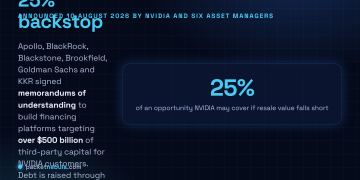
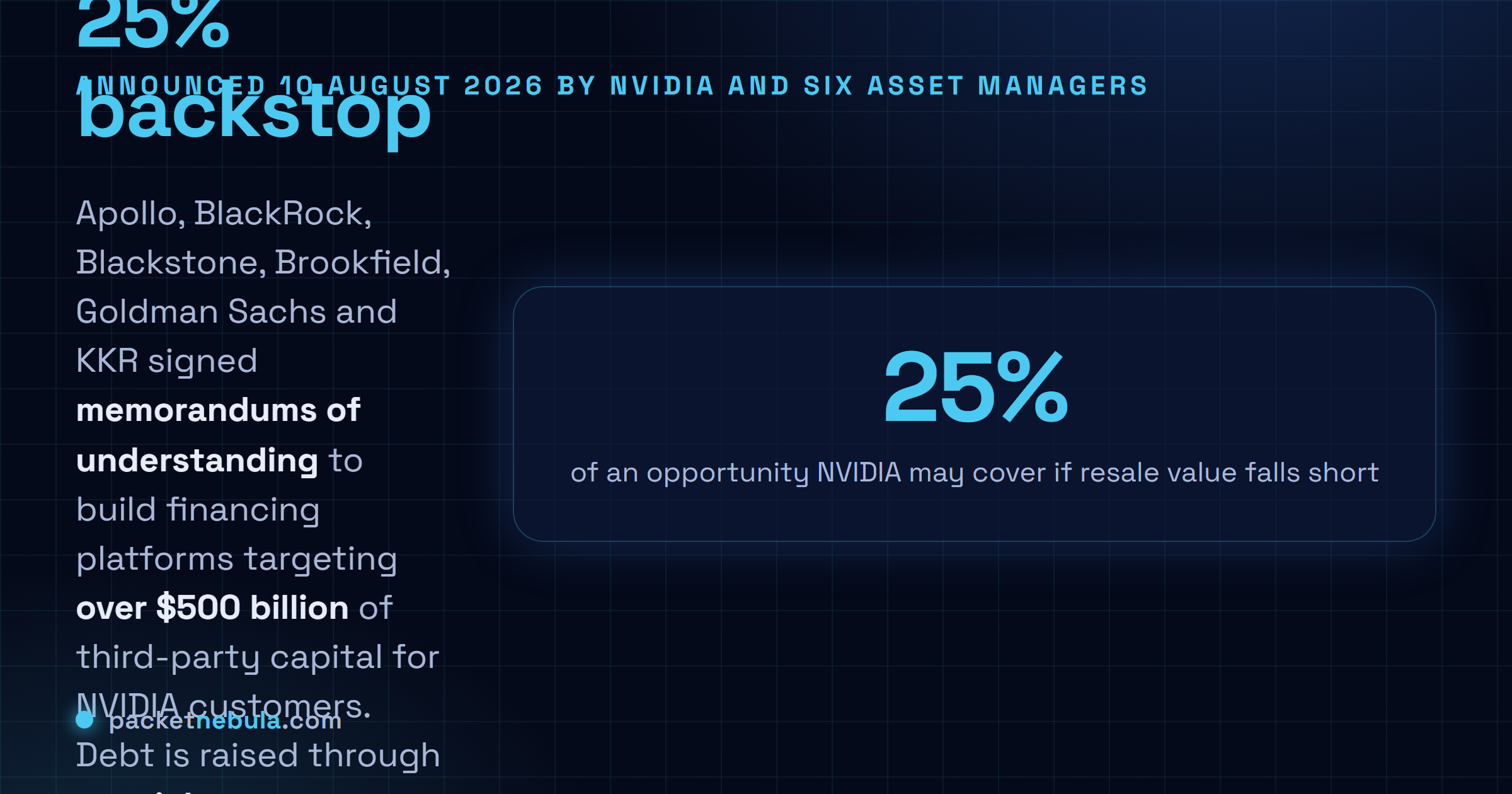
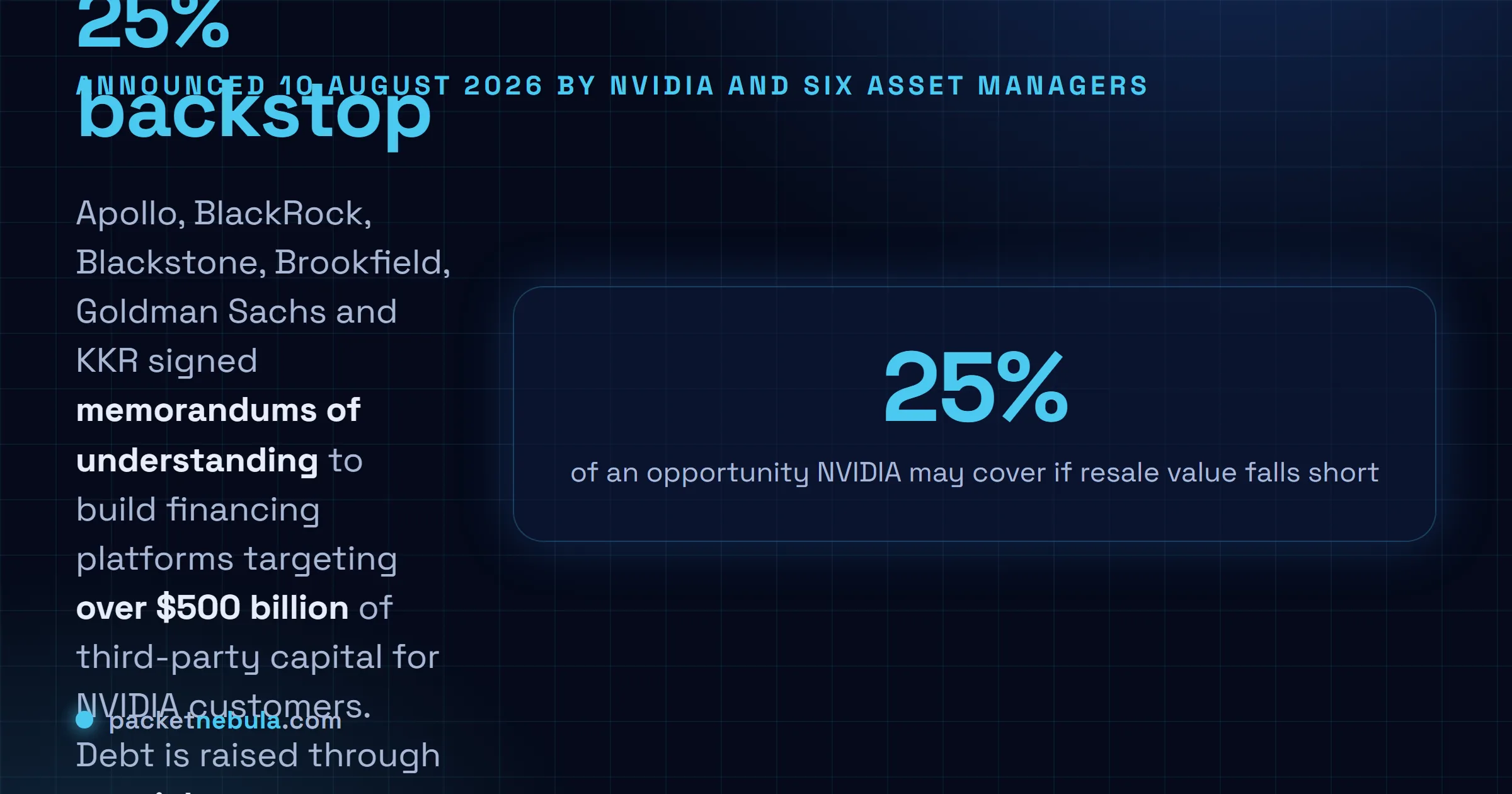
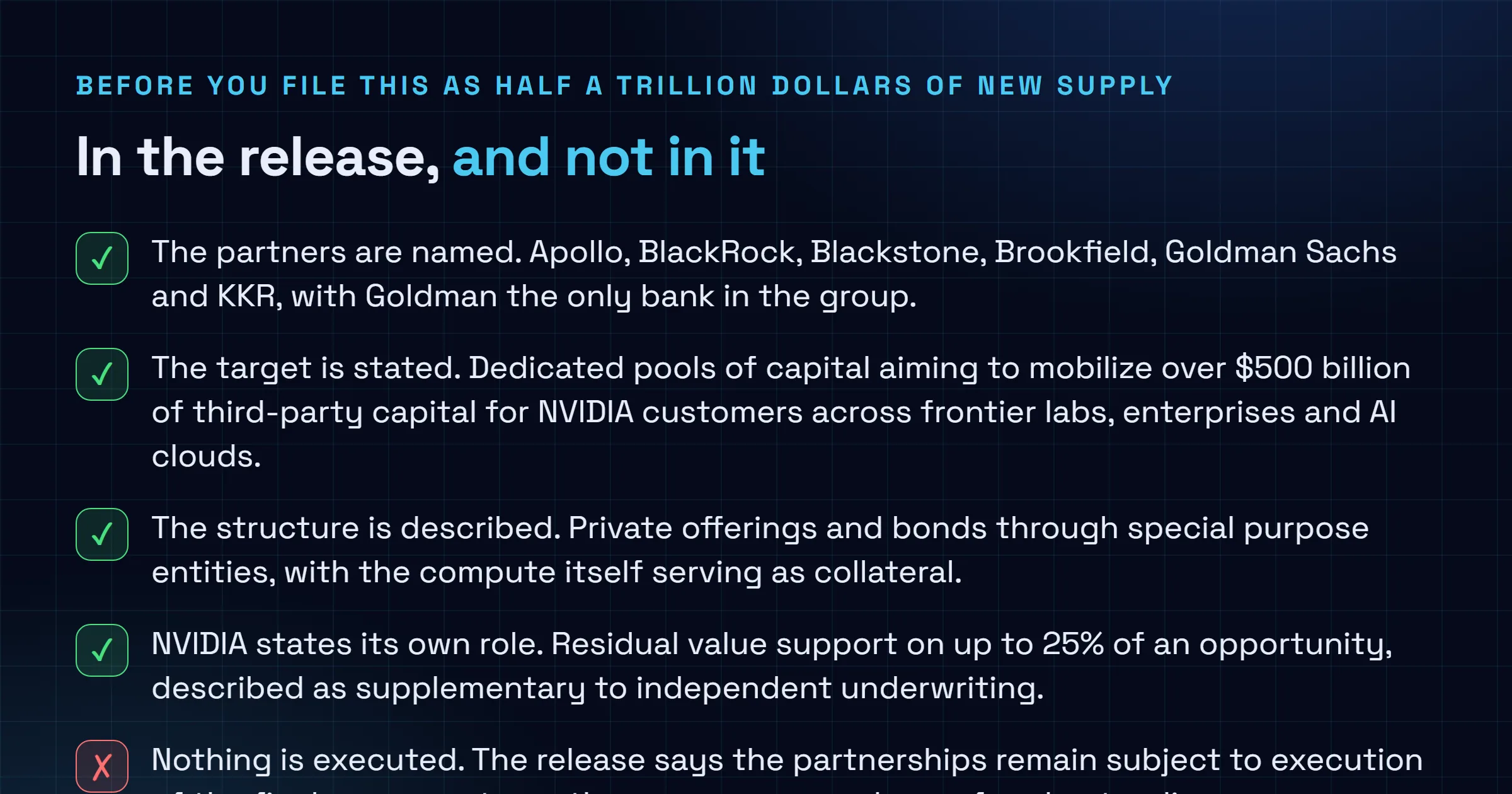
On 10 August 2026 NVIDIA signed memorandums of understanding with Apollo, BlackRock, Blackstone, Brookfield, Goldman Sachs and KKR to create financing platforms for AI compute, targeting over $500 billion of third-party capital for NVIDIA customers. Debt is raised through special purpose entities with the compute itself as collateral. NVIDIA may provide residual value support on up to 25% of an opportunity. Nothing is executed yet, no rate or term has been published, and the useful life the whole model depends on is assumed rather than stated.
What was actually signed
Six firms, one instrument, no money yet.
Apollo, BlackRock, Blackstone, Brookfield and KKR come in as capital providers. Goldman Sachs is the only bank in the group, positioned as lead bookrunner on public debt deals while its asset management arm collects the returns. Together they signed MOUs to set up dedicated pools of capital that NVIDIA customers can borrow from at rates NVIDIA describes as attractive, covering frontier AI labs, enterprises and AI clouds.
The mechanics are ordinary infrastructure finance pointed at an unusual asset. Special purpose entities issue private offerings and bonds. The collateral is the compute. Larry Fink pitched it to investors as high credit quality with attractive yields in debt, which is exactly the sentence you say when you want an insurance company to buy the paper.
And that is the actual innovation here. Not the size. The reclassification.
The 25% is the part worth arguing about
Huang said NVIDIA may provide residual value support on up to 25% of an opportunity, covering part of the gap if a chip’s resale or reuse value falls short at the end of a financing term. He was careful to frame it as supplementary, not as a guarantee underneath the whole thing.
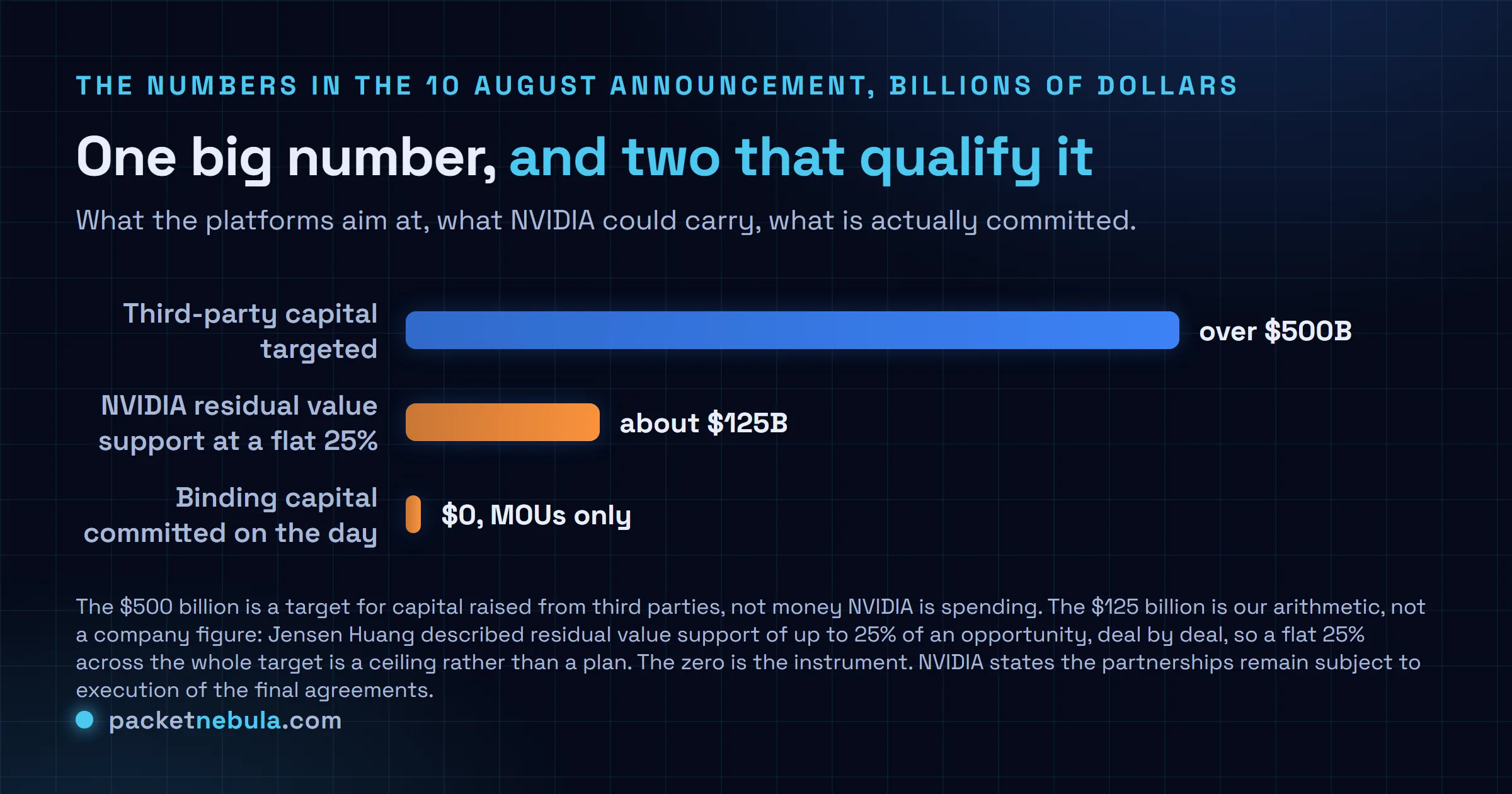
Run the arithmetic anyway. A flat 25% across a $500 billion target lands near $125 billion of NVIDIA exposure. That is not the plan NVIDIA published, it is deal by deal, and we would not quote it as a commitment. But it is the right order of magnitude to hold in your head, because it tells you who is really taking the depreciation view.
Felix Wang at Hedgeye called it making NVIDIA’s product cheaper without really cutting GPU prices, and said it makes future demand more sensitive to credit conditions. Honestly, that is the cleanest summary anyone gave. A vendor that partially guarantees the residual value of its own hardware is doing vendor financing with extra steps, and the risk does not vanish because it moved into an SPE.
The unresolved question is useful life. Amazon shortened server useful life from six years to five effective 1 January 2025, citing the pace of AI development, and took roughly $1.4 billion of extra depreciation in that year. NVIDIA argues the other way, pointing at A100s from 2020 still under multi-year commitments and implying a life closer to a decade. Both cannot be the basis for pricing the same bond.
This is the second $500 billion NVIDIA number in three weeks
They are not the same money, and the conflation is already happening.
On 24 July, SK Group and NVIDIA announced a partnership worth more than $500 billion on letters of intent, with a named 2GW AI factory attached. That number is a projected value of goods and services flowing between two companies. This one is a target for third-party capital that other people lend to NVIDIA’s customers. Same headline figure, completely different thing, and neither is a signed contract.
There is also a pattern forming across the industry that we flagged in June. The $35 billion private credit package behind Anthropic’s TPU vehicle came with Broadcom adding residual value guarantees, and the same lab has since gone further off balance sheet with a landlord platform owned by Macquarie and GIC. Chip vendors backstopping the resale value of their own silicon is quietly becoming the standard tool for getting these deals financed. NVIDIA just did it at a scale that makes it a market structure rather than a one-off.
Does it change what you pay
Not this quarter, and probably not this year.
No new fab capacity appears because a bond got issued. Nothing in the announcement adds a single accelerator to the supply that exists, and the lead times you are quoted today were set by packaging and memory, not by credit. If you are pricing a build for 2027, this changes nothing you can act on.
The second-order effect is real though, and it cuts both ways. Cheaper debt for neoclouds means more rentable capacity gets stood up, which over a couple of years should pull hourly rental prices down. It also means a meaningful slice of AI buildout demand now depends on credit markets staying friendly. When financing is the thing enabling the purchase, a spread widening does what a demand collapse would do, only faster.
I might be wrong about the timing, but the signal I would actually track is not the $500 billion. It is the first definitive agreement, and what useful life the underwriters put in it. That number, whenever somebody publishes it, is the entire trade.
Sources
- NVIDIA newsroom, “NVIDIA Partners With Apollo, BlackRock, Blackstone, Brookfield, Goldman Sachs and KKR to Establish AI Compute Infrastructure Financing Platforms to Mobilize Over $500 Billion of Third-Party Capital”, 10 August 2026, the primary release, for the six partners, the over $500 billion third-party capital target, the dedicated pools of capital for frontier labs, enterprises and AI clouds, and the statement that the partnerships remain subject to execution of the final agreements.
- Fortune, “Nvidia taps Wall Street for $500 billion funding commitment”, 11 August 2026, for Huang approaching only six firms with none turning him down, the special purpose entity structure with compute as collateral, Goldman as the only bank and lead bookrunner, the residual value support of up to 25% of an opportunity, and the Felix Wang comment from Hedgeye Risk Management.
- Forbes, “Nvidia’s $500B Bet To Make AI Compute Wall Street’s Next Asset Class”, 10 August 2026, for the framing of residual value support as limited and supplementary, the undisclosed first loss allocation, Amazon’s move from six year to five year server useful life effective 1 January 2025 with roughly $1.4 billion of added depreciation, and NVIDIA’s counter-argument about 2020 A100s.
- The National, “Nvidia turns to Wall Street giants to raise $500bn for AI infrastructure”, 11 August 2026, for independent confirmation of the six partners and the 25% figure, and for the quotes from Larry Fink and David Solomon.
- CNBC, “Nvidia lines up $500 billion in financing as CEO Jensen Huang tells CNBC his chips are ‘investable asset’”, 10 August 2026, for Huang describing chips as an investable asset class and the assets as revenue-generating, productive, long-lived, fungible and flexible.
Frequently asked questions
What did NVIDIA announce on 10 August 2026?
Memorandums of understanding with Apollo, BlackRock, Blackstone, Brookfield, Goldman Sachs and KKR to establish AI compute infrastructure financing platforms. The stated goal is to mobilize over $500 billion of third-party capital and create dedicated pools of capital at attractive rates for NVIDIA customers, including frontier AI labs, enterprises and AI cloud providers. The release states plainly that the partnerships remain subject to execution of the final agreements.
Is NVIDIA spending $500 billion?
No. The $500 billion is a target for capital raised from third parties, not NVIDIA money. NVIDIA's own exposure is the residual value support Jensen Huang described, which he framed as up to 25% of an opportunity and supplementary to the underwriting the asset managers do themselves. At a flat 25% across the full target that arithmetic reaches roughly $125 billion, but that is a ceiling we calculated rather than a figure NVIDIA published.
What does using compute as collateral actually mean?
Debt is issued through special purpose entities, and the accelerators plus the revenue they earn secure that debt. If a borrower defaults, the lender takes machines that can be redeployed to a different customer rather than a warehouse of dead stock. That fungibility is the whole argument. Huang told CNBC that these are revenue-generating assets now, and that they are productive, long-lived, fungible and flexible.
Does this make GPUs cheaper?
Not directly, and that is the sharpest criticism of it. Felix Wang at Hedgeye Risk Management put it as making NVIDIA's product cheaper without really cutting GPU prices, while making future demand more sensitive to credit conditions. Cheaper financing lowers the total cost of getting compute deployed. The sticker price on the hardware does not move, and the new variable is what happens to that demand if credit tightens.
What should I watch next?
The first definitive agreement and the first actual issue, because everything today is an MOU. After that, the terms that decide whether this works: the assumed useful life of the accelerators, the tenor of the loans against the refresh cycle, and who takes the first loss if secondary value disappoints. None of those are in the announcement.