
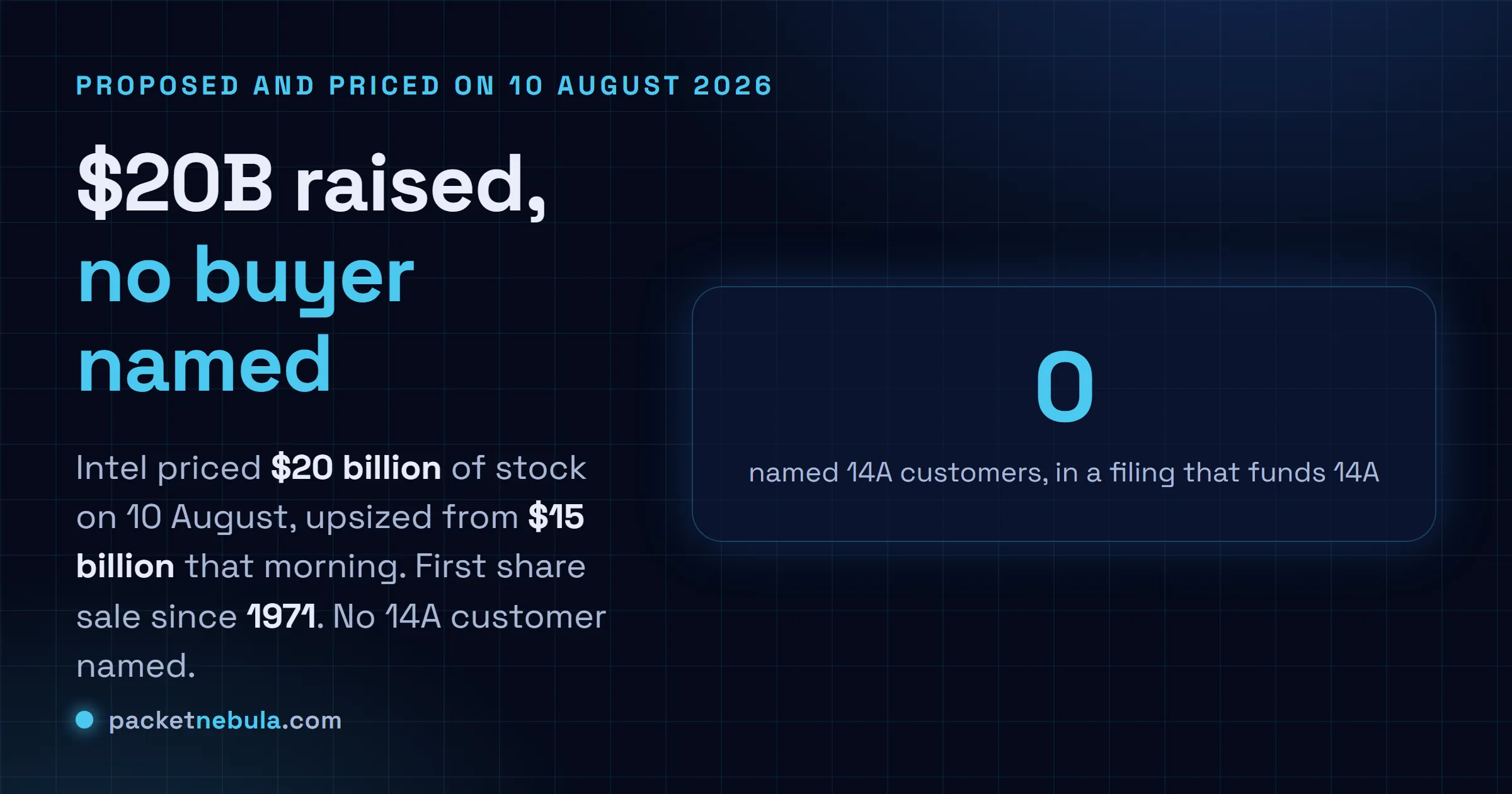
Intel's investor page updated at 7:45 in the morning New York time with a proposal to sell $15 billion of stock. By the close the number was $20 billion, priced at $95 a share, and the first public share sale since the 1971 listing was done in a single day. So Intel walks away with roughly $19.7 billion in net proceeds pointed at factories. Here's the part we keep circling back to. The filing says the money goes to general corporate purposes including capital expenditure, and it names nobody. Not one 14A customer. The company that spent about $82 billion retiring its own shares through the 2010s just asked for a quarter of it back, and the demand it cites is a sentence in a press release rather than a signature on a wafer agreement.
The short answer
Intel proposed a $15 billion stock offering on 10 August 2026 and priced it the same day at $20 billion, its first public share sale since the 1971 listing. Net proceeds land near $19.7 billion, earmarked for general corporate purposes including capital expenditure. Intel raised 2026 capex above $20 billion in July and says 2027 goes significantly higher. What the filing does not contain is the thing the foundry story rests on, which is a named external customer for the 14A node that starts volume production in 2028.
What Intel actually sold
The mechanics are unusually clean, so they are worth writing down before the interpretation starts.
At 7:45 EDT on 10 August, Intel put out a release headed “Intel Announces Proposed $15 Billion Common Stock Offering”. No price, no share count, no delivery date. Underwriters got a 30 day option on another $2.25 billion. Standard shape for a book that has not been built yet.
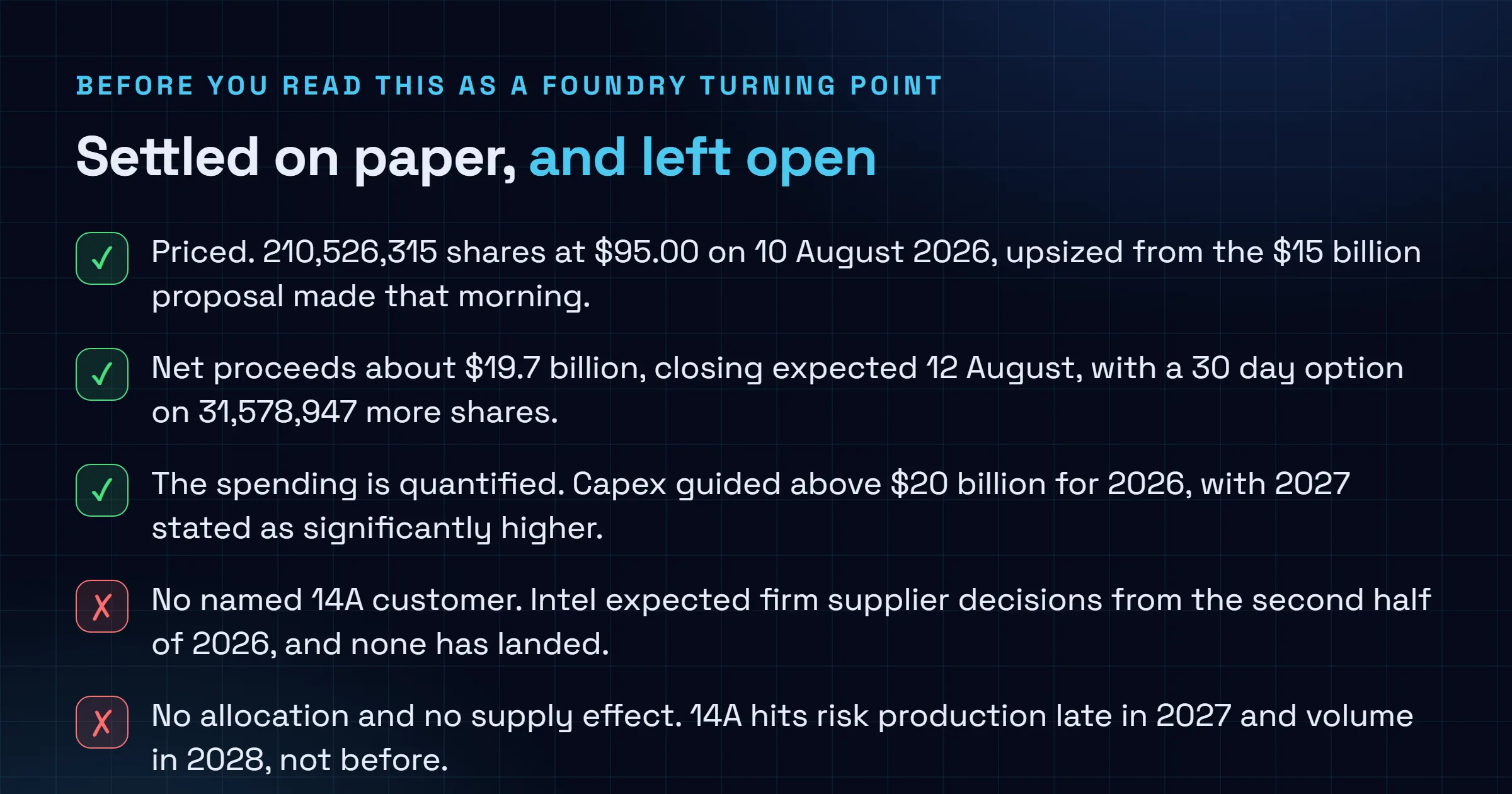
By that evening the book was built and considerably hotter than the proposal implied. Intel upsized to $20 billion and priced 210,526,315 shares at $95.00, with net proceeds of about $19.7 billion before any option exercise. The option survived the upsize as 31,578,947 additional shares. Closing was set for 12 August. J.P. Morgan, Goldman Sachs, Morgan Stanley and Citigroup ran it.
Stated use of proceeds, verbatim: “general corporate purposes, which may include, but are not limited to, capital expenditures and working capital.” That is the widest language available and it commits Intel to nothing.
The justification in the release is worth quoting too, because it is the whole thesis in one line. Customers, Intel says, “continue to signal a strong and sustainable demand environment, driven by unprecedented investment in AI compute”, with growth coming from physical AI, purpose-built silicon, advanced packaging and external wafers. Signal is doing heavy lifting in that sentence.
Eighty-two billion out, twenty billion back
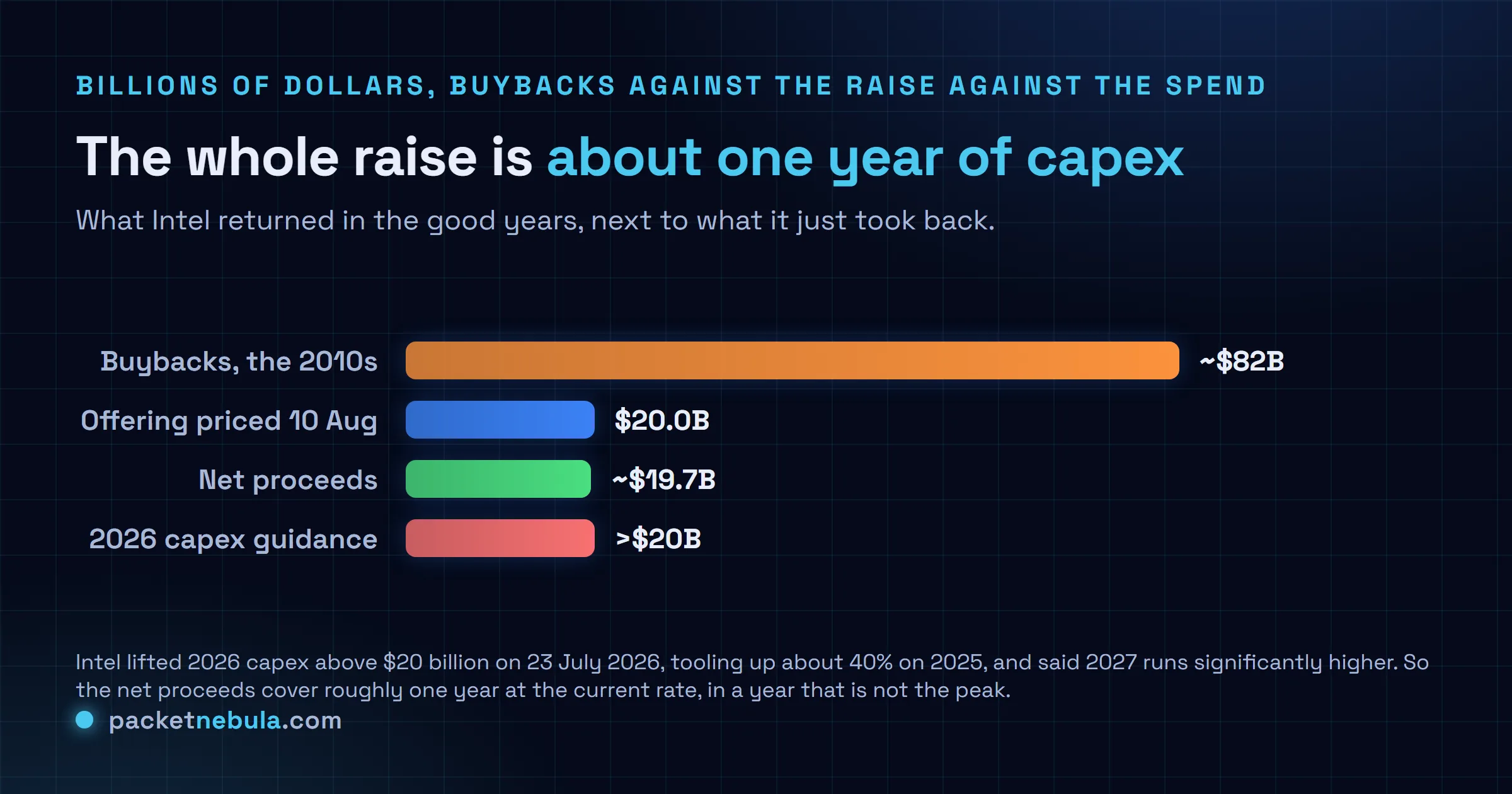
Intel spent something like $82 billion retiring its own shares through the 2010s, in the years when it owned the server and PC processor markets outright and could not think of anything better to do with the cash. Then the node roadmap slipped, the foundry bet arrived late, and the cash stopped being spare.
So the shape of this raise is not subtle. Money that left as buybacks is coming back as dilution, at a price the market set rather than one Intel chose.
Size it against the spending and it gets clearer. Intel lifted 2026 capital expenditure to more than $20 billion at its second quarter results on 23 July, up roughly $2 billion from where the year started, with tooling spend alone up about 40% on 2025. CFO David Zinsner said 2027 would run significantly above 2026. Set the $19.7 billion of net proceeds beside that and you get a rough answer: this raise funds about one year at the current rate, and 2027 is bigger.
I read the upsize as the market’s verdict rather than Intel’s plan. You do not go from $15 billion to $20 billion in a session because you suddenly found another $5 billion of tooling to buy. You do it because the book was oversubscribed and the treasury team took the money while the window was open. Intel stock has run from around $20 to around $100 since Lip-Bu Tan took over in March 2025. Selling equity into that is ordinary competence.
Dilution is real but not dramatic. One published analysis put a $15 billion raise at roughly 150 million shares and about a 3% increase in the count. Scale it to 210.5 million and you are somewhere a little over 4%, which for a company rebuilding its manufacturing base is a cheap trade.
The sentence with nobody’s name on it
Here is the gap, and it has not closed.
Intel 14A is the 1.4 nanometre class node that follows 18A. Risk production lands in the later part of 2027, volume production in 2028, and Intel committed to that timeline in July. Before that commitment the company had said out loud that 14A might never get built if outside customers did not show up, which is an unusual thing for a chipmaker to admit in public and the reason the customer question is not a nitpick.
Intel has said it expects firm supplier decisions from prospective external customers starting in the second half of 2026 and continuing into the first half of 2027. We are in that window now. Nothing has been announced.
The only publicly named Intel Foundry customer is Fortinet, announced 21 July 2026, building its next generation Security Processor 6 on Intel 4 with EMIB packaging. Terms undisclosed. Intel 4 is several generations behind 14A, so read that as proof the foundry can take an external design through to silicon, not as proof the leading edge has buyers. Analysts widely assume Tesla has committed to 14A. Intel has never confirmed it, and this filing does not either.
A $20 billion raise with no customer disclosure attached is a bet that the customers arrive. It might be a good bet. It is still a bet.
Does this change what you can buy
Not this year. Probably not next year either.
Capital raised in August 2026 buys tooling that gets installed, qualified and ramped over a couple of years. The node it feeds reaches volume in 2028. If you are planning server refreshes, allocating GPU budget or arguing with a vendor about lead times, none of that moved on Monday. Your constraints are the ones you already had, which are packaging capacity and memory pricing, the same squeeze that has been driving consumer hardware prices up all year.
The directional read is more interesting than the transactional one. Everybody with a serious compute bill is trying to own more of their own supply chain right now, whether that means building a fab outright or funding the machines that make the machines. Intel is the incumbent trying to become the alternative in that story, and it needs a second leading edge foundry to exist as badly as its customers do.
What we would watch is narrow and specific. A named 14A customer, with a product and a date. That single announcement tells you more about whether TSMC gets a real competitor than any capital raise will, and it is the one thing $20 billion cannot buy directly.
Sources
- Intel Newsroom, “Intel Announces Proposed $15 Billion Common Stock Offering”, 10 August 2026, for the proposal, the $2.25 billion underwriter option, the use of proceeds language, the demand quote and the investment grade commitment.
- Intel, “Intel Announces Upsize and Pricing of $20 Billion Common Stock Offering”, 10 August 2026, for the 210,526,315 shares at $95.00, the roughly $19.7 billion of net proceeds, the 31,578,947 share option and the 12 August closing date.
- Electronics Weekly, 10 August 2026, for the four joint book-running managers and the share price move from around $20 to around $100 since March 2025.
- TNW, “Intel spent $82bn buying its own shares. Now it wants $15bn back”, for the buyback total, the 2028 14A volume commitment made in July 2026, the Fortinet detail and the absence of customer disclosure in the filing.
- Tom’s Hardware, 21 July 2026, for Fortinet as the first named Intel 4 foundry customer, the Security Processor 6 and the EMIB packaging.
- Tom’s Hardware, on 14A customer timing, for the expectation of firm supplier decisions from the second half of 2026 into the first half of 2027, and the 2027 risk production into 2028 volume timeline.
- Investing.com analysis, August 2026, for the dilution arithmetic of roughly 150 million shares and about 3% at the original $15 billion size.
- Coverage of Intel’s Q2 2026 earnings call, 23 July 2026, for capex above $20 billion in 2026, tooling spend up about 40% on 2025, and David Zinsner’s comment that 2027 runs significantly above 2026.
Update, 7 October 2026. In April, Musk said Terafab plans to use Intel's 14A process, and Intel said it joined Terafab. No Intel wafer agreement has been published, so the headline of this article still holds, with that context. The pricing release is stamped 11 August UTC, the evening of 10 August in New York. See the ledger row.
Frequently asked questions
How much did Intel actually raise, and when?
Intel announced a proposed $15 billion underwritten offering of common stock on the morning of 10 August 2026, then upsized and priced it the same day at $20 billion. That is 210,526,315 shares at $95.00 each, for net proceeds of roughly $19.7 billion after underwriting discounts and expenses, assuming the underwriters do not take their option. Closing was expected on 12 August 2026. J.P. Morgan, Goldman Sachs, Morgan Stanley and Citigroup ran the book, and they hold a 30 day option on a further 31,578,947 shares.
Is this really Intel's first share sale since 1971?
That is how it has been reported across the coverage, and it lines up with the company's history. Intel listed on Nasdaq in 1971 and funded itself afterwards from cash flow, debt and, more recently, outside equity stakes taken directly in the company rather than sold to the public market. So this is a genuinely unusual instrument for Intel, which is part of why the announcement moved the stock. Shares fell around 5% on the proposal before the pricing landed at $95.
What is 14A and why does the customer question matter so much?
Intel 14A is the company's 1.4 nanometre class process, the node after 18A, and it is the one Intel wants to sell to outside chip designers rather than only use for its own products. Intel has committed to high volume production on 14A in 2028, with risk production in the later part of 2027. The catch is that the company previously warned the node might not get built at all without major external commitments. Intel has said it expects firm supplier decisions starting in the second half of 2026 and running into the first half of 2027. None have been announced.
Does Intel Foundry have any named external customer today?
One, publicly. On 21 July 2026 Intel and Fortinet announced a collaboration to build the next generation Security Processor 6 on Intel 4, using Intel's EMIB advanced packaging. Financial terms were not disclosed. Intel 4 is a mature node several generations behind 14A, so the win is real but it is not the leading edge commitment the foundry thesis needs. Analysts have inferred that Tesla signed for 14A capacity. Intel has not confirmed it, and nothing in the offering filing does either.
Should this change how I spec servers or buy silicon this year?
No. An equity raise does not add a wafer to anyone's allocation, and nothing Intel funds with this money produces sellable volume before 2028. Your 2026 and 2027 purchasing is governed by what is already in the fabs, by packaging capacity and by memory pricing. If you are tracking Intel as a possible second source to TSMC, the signal to wait for is a named 14A customer with a date attached, not a capital raise.


