
• Latest
  • Trending
  • All
Answer card stating that Jev 1.13 from TypeSafe AI is a decision model in early access since 15 September 2026 that returns typed probabilities instead of text, priced at 42 dollars per billion input tokens with output tokens free, answering in 70 to 500 milliseconds, with a 64K token request budget, text input only, and a documented list of things it does badly, including counting and dates.

Jev 1.13 bills $42 a billion tokens, and it can’t count

19 September 2026
Answer card stating that Ternary Bonsai 2 27B, released by PrismML on 17 September 2026 under Apache 2.0, packs Qwen3.8 27B into 5.95 gigabytes at 1.72 bits per weight, keeps 98.2 percent of the 14-benchmark average, about 75 percent on SWE-bench Verified and Terminal-Bench 2.1, and needs PrismML's llama.cpp fork to run.

Does Bonsai 2 27B really keep 98% of Qwen3.8 in 5.95 GB?

20 September 2026
Answer card stating that Qwen3.8-Omni-Flash launched on 17 September 2026 as an API only model on Alibaba Cloud Model Studio, taking text, images, audio and video in a 1M token context and returning text only, priced at 0.15 dollars per million input tokens for every modality and 0.47 dollars per million output tokens in the international regions, with no open weights published and the Qwen-Live Harness GitHub repository returning 404.

Qwen3.8-Omni-Flash bills audio at $0.15 and ships no weights

18 September 2026
Answer card stating that on 15 September 2026 AWS said it is unable to restore access to resources and data hosted exclusively in the Middle East Bahrain region me-south-1 and in the mec1-az2 zone of the UAE region, because the damage spanned multiple Availability Zones and exceeded what multi-AZ services are designed to withstand.

AWS can’t restore me-south-1, six months after the drone strikes

17 September 2026
Answer card stating that Google released Gemini 3.8 Live and Gemini 3.8 Live Extended Thinking on 15 September 2026 at 3 dollars per million audio input tokens and 12 dollars out, that the thinking model requires asynchronous tools, and that Artificial Analysis scores it 82.6 on its Speech to Speech Quality Index.

Gemini 3.8 Live Extended Thinking rejects any tool that blocks

16 September 2026
Answer card summarising the Atria Dawn Preview release: 744B GLM-5.2 base, MIT licence, 1.5 TB BF16 and 756 GB FP8 checkpoints, 256K context, top on five of sixteen benchmark rows and trailing on SWE-bench Pro.

Atria Dawn Preview is 744B under MIT, and the BF16 weighs 1.5 TB

15 September 2026
Answer card stating that OpenAI released the Agents API in public beta on 10 September 2026 with no separate fee, billed through model tokens, tool calls and hosted sandbox time, with a choice of OpenAI hosted, self hosted or partner sandboxes, US only data residency and no Zero Data Retention support.

OpenAI’s Agents API has no fee, no ZDR and a one hour sandbox clock

14 September 2026
Answer card: Sakana Fugu Max at $2 and $6 per million tokens, Fugu Ultra v2 unchanged at $5 and $30, and Sakana saying Ultra v2 scores without Fable 5 or GPT-6 Astra in its pool.

Fugu Max costs $2 and $6 while Fugu Ultra v2 runs without Fable 5

13 September 2026
Answer card stating that DeepSeek released DeepSeek-V4.1-Flash on 10 September 2026 as a 552 billion parameter mixture of experts model with a new causal encoder decoder architecture that activates 8 billion parameters on input and 16 billion on output, with native vision, a one million token context and MIT licensed weights, that the API model name is now deepseek-flash at 0.15 dollars per million input tokens and 0.60 dollars per million output tokens off peak, and that DeepSeek announced V4 Pro would be routed to V4.1-Flash from 14 September and reversed that on 11 September.

DeepSeek V4.1-Flash arrived, and the V4 Pro retirement lasted a day

12 September 2026
Answer card stating that Cognition released SWE-2 on 10 September 2026, a coding model post-trained from Kimi K3, scoring 50.0 percent on FrontierCode 1.1 Main against 50.9 percent for Claude Fable 5.1 and 27.3 percent on Terminal-Bench 4 against 55.8 percent, available only inside Devin.

SWE-2 trails Fable 5.1 by one point, and by 28 on Terminal-Bench 4

11 September 2026
Answer card for Meta Muse, free to 100 million tokens a week then $20 a month, launched 8 September 2026 for United States adults only, running in a dedicated per user virtual machine.

Does Meta Muse do enough to earn your inbox and a card on file?

9 September 2026
Answer card stating that the public download pages for the VMware Virtual Disk Development Kit on developer.broadcom.com began returning 404 errors on 25 August 2026 with no announcement or deprecation notice, that Broadcom support tells customers the kit is no longer available for use or download, and that release lines 7.0.3.1, 8.x and 9.x are all affected.

Broadcom pulled VDDK 8.0 and 9.0, and the 404 is the only notice

8 September 2026
Answer card stating that OpenAI published its research acceleration measurements on 6 September 2026, that as of mid August 2026 its research organisation logged 3.1 agent workdays of coding agent runtime for every workday of human labour normalised to a standard eight hour day, and that OpenAI states this should not be read as a 3.1 times productivity gain because it measures runtime rather than delivered output.

OpenAI’s 3.1 agent-workdays per human day is not a 3.1x gain

7 September 2026
  • About
  • Contact
  • Privacy
  • Legal
Sunday, September 20, 2026
  • Login
Packet Nebula
  • Home
  • Articles
    • Security
    • Network
    • Dev
    • Sysadmin
    • SEO
    • Email & DNS
  • Tools
    • Network tools: free, fast, no signup
    • Security tools: free, fast, no signup
    • Developer tools: free, fast, no signup
    • Sysadmin tools: free, fast, no signup
    • SEO tools: free, fast, no signup
    • Email & DNS tools: free, fast, no signup
  • Download
  • About
No Result
View All Result
Packet Nebula
No Result
View All Result
Home Dev

Jev 1.13 bills $42 a billion tokens, and it can’t count

by stephane
19 September 2026
in Dev
0
Answer card stating that Jev 1.13 from TypeSafe AI is a decision model in early access since 15 September 2026 that returns typed probabilities instead of text, priced at 42 dollars per billion input tokens with output tokens free, answering in 70 to 500 milliseconds, with a 64K token request budget, text input only, and a documented list of things it does badly, including counting and dates.
496
SHARES
1.4k
VIEWS
Share on FacebookShare on Twitter

We've got a support inbox that gets triaged by a frontier model at $10 a million tokens, and most of what it does is answer "is this urgent" and "which team". That's a lot of money for a yes or a no. On 15 September 2026 TypeSafe AI, the company Diogo Almeida (one of the RLHF authors behind the original ChatGPT) founded, put a model into early access that only answers questions like those. It's called Jev, the docs list it as jev-1.13.0, and it charges $42 per billion input tokens with nothing at all for output. So we read the launch post, the models page and the part of the docs the launch post doesn't link to, the one titled "jaggedness".

The short answer

Jev 1.13 is a text-in, probability-out model. You send a state (a string or a JSON object) and up to a 64K-token budget of typed questions, and it returns a choice with a probability per option, a score against a rubric you wrote, or a single yes/no probability. It never writes a sentence. Price is $0.042 per million input tokens, output free, 70 to 500 ms end to end per TypeSafe. It's English-first, text-only, in early access with rate limits that move without notice, and its own docs say it doesn't count reliably, can't order dates, and reads your instructions literally. The 238x cheaper claim is real arithmetic and only applies to work that already fits in a probability.
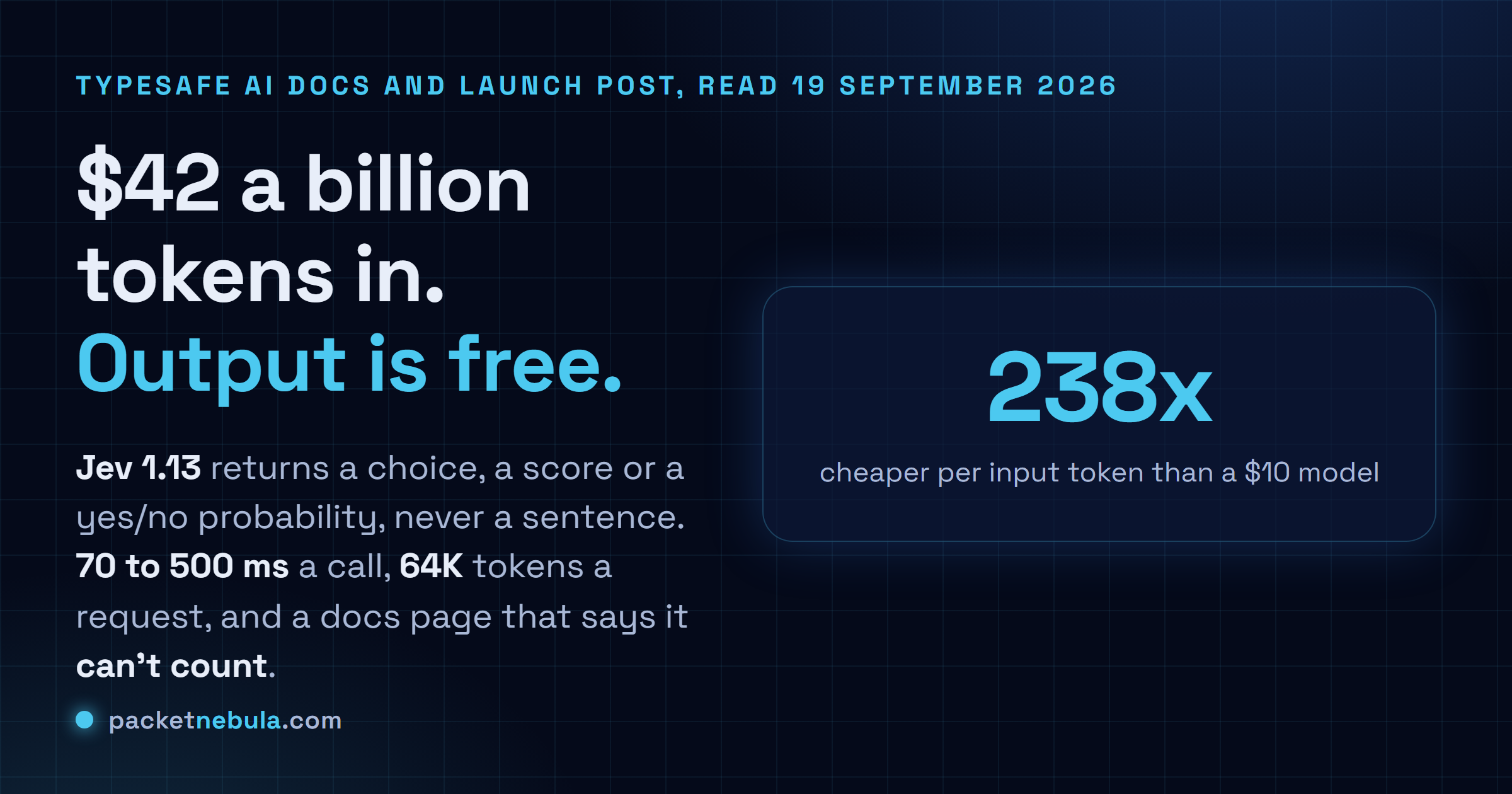
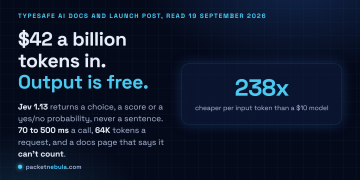
$42 / Btokper billion input tokens, output free, per the models page
64Ktokens per request, 32K for the state plus the longest question
9failure modes listed on TypeSafe's own jaggedness page
Answer card stating that Jev 1.13 from TypeSafe AI is a decision model in early access since 15 September 2026 that returns typed probabilities instead of text, priced at 42 dollars per billion input tokens with output tokens free, answering in 70 to 500 milliseconds, with a 64K token request budget, text input only, and a documented list of things it does badly, including counting and dates.
The pricing unit is the tell. Nobody quotes per billion unless the per-million number would look like a typo.

What you get back, and what you never will

Three question types. A Choice picks one option from a set you define, and comes back with a probability for every option plus a confidence number. A Score rates the state against an ordered rubric you wrote (calm, frustrated, very angry) and returns a probability-weighted expectation, so you'll see 1.035 rather than 1. A Noul is a yes/no and returns one number, the probability the answer is yes. You can pack all three into one request, they're evaluated in parallel against the same state, and the docs recommend sending speculative questions you may not need because extra questions don't add latency.

What it can't do is the whole rest of the job. No reply, no summary, no code, no explanation of why. Ask it something that needs a string and there's no field for the string to go in. TypeSafe calls that "zero hallucinations", which is technically true and a bit cheeky: a model that can't emit text can't emit a wrong sentence. The Register made the same point on 16 September. What's actually interesting is the calibration claim, that across many predictions a 0.8 should come true about 80% of the time. That's a property you can test on your own labelled data in an afternoon, and it's the one we'd test before anything else.

curl
curl https://api.typesafe.ai/v1/systemone -H "Authorization: Bearer $TYPESAFE_API_KEY" -H "Content-Type: application/json" -d '{"state":"My card was charged twice for order A-104. Please refund the duplicate.","model":"jev-latest","questions":{"refund":{"type":"noul","instructions":"The customer is explicitly asking for a refund"},"team":{"type":"choice","instructions":"Which team should handle this","criteria":{"billing":"Payments, refunds, invoices","technical":"Bugs, outages, integrations"}}}}'

The response carries a usage block with input and output tokens, and the output ones are billed at zero. jev-latest and jev-preview both point at jev-1.13.0 today, and the docs say to pin the versioned ID if you've tuned confidence thresholds, because an alias moves when a release ships. There's a Python SDK (pip install typesafe-sdk, Python 3.10 or newer) and a JavaScript one, and a GET /v1/models that lists the aliases.

The price, next to what it replaces

$42 per billion is $0.042 per million. The models page prints both, which we appreciate, because per-billion pricing reads like a marketing unit until you do the division. Against the $10 input rate on Claude Fable 5.1 that's 238x, exactly the figure on TypeSafe's homepage. Against the $2 on GPT-5.6 Terra, the model most triage pipelines we know actually run on, it's about 48x, and that's before you count the output tokens Terra bills at $12 and Jev bills at nothing. TypeSafe's own workflow demo puts one run at $0.000081 and 0.114 seconds against 8.566 seconds for a frontier model.
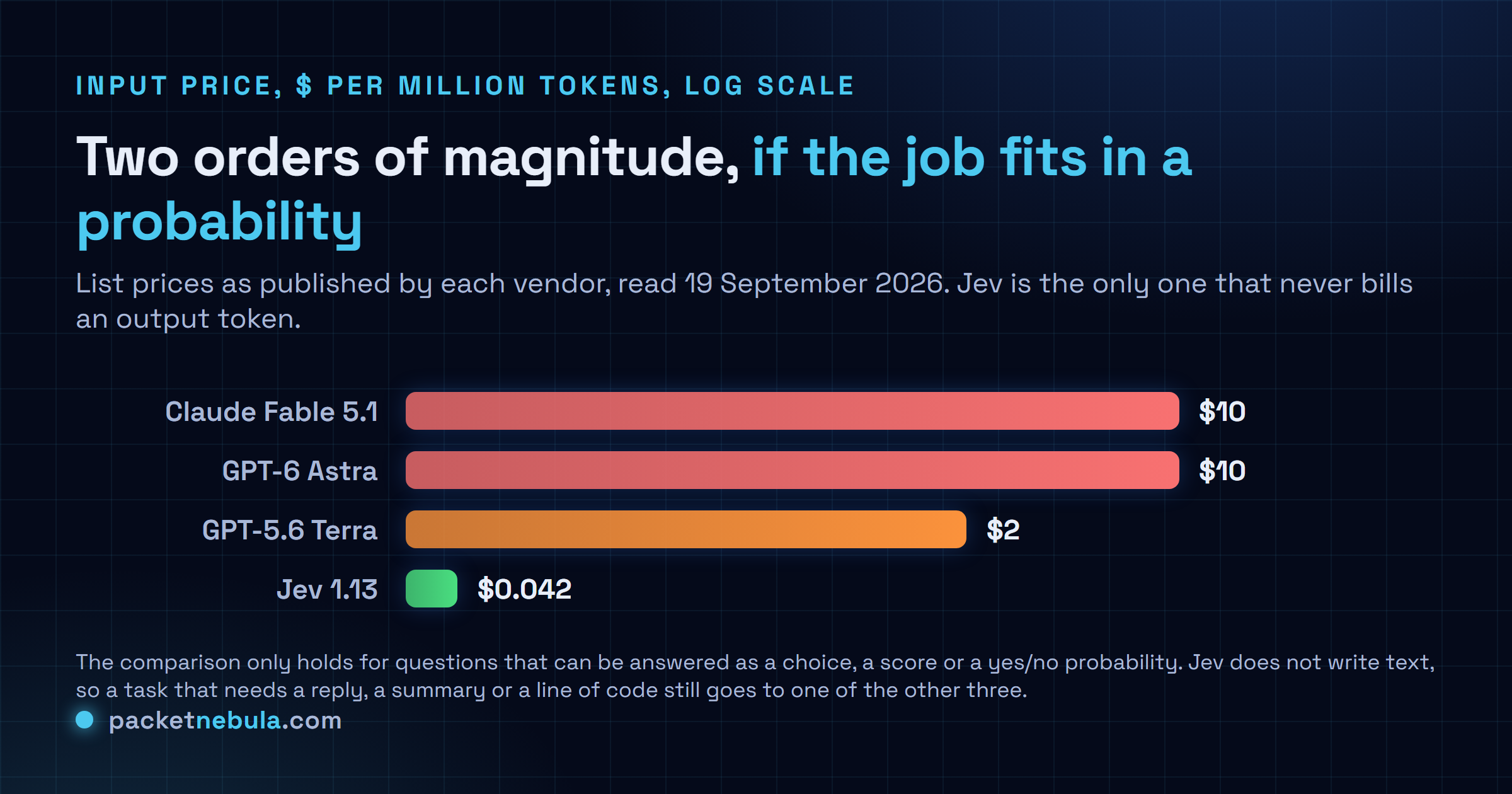
Horizontal bar chart on a log scale of input prices in dollars per million tokens, showing Claude Fable 5.1 and GPT-6 Astra at 10 dollars, GPT-5.6 Terra at 2 dollars and Jev 1.13 at 0.042 dollars, with a note that Jev charges nothing for output tokens and returns probabilities rather than text.
Log scale, because on a linear one the Jev bar is a rounding error. That's the point and also the caveat.

Now the fine print, which is longer than the price. Input is text only: strings, JSON objects, arrays of text. No images, audio or video, and the docs say "yet". English is the primary training language; other languages, CJK included, are accepted with lower accuracy and a suggestion to watch the confidence field. The request budget is 64K tokens for state plus all questions combined, with a 32K ceiling on the state plus the single longest question. Rate limits are 250,000 tokens a second and 1,200 requests a minute, and there's a warning box saying both "can change without notice" while they let people off the waitlist. There's no fine-tuning: the same weights serve every account, and your domain goes into the state and the criteria. TechCrunch reported the API buckling under demand in launch week, and the docs' own sentence about "upcoming large GPU deals" reads like a company that got more traffic than it planned for. The Register puts the funding at $40 million.

The page you should read before the pricing page

TypeSafe publishes a document called "Jev 1.13 jaggedness", last reviewed 17 September, and honestly it's the most useful thing on the site. Nine failure modes, each with a "do this instead". Jev doesn't count, whether that's characters in a word or items in a list, and the error grows with the size of the thing. It doesn't compare dates; it reads them as text, so "which comes first" is unreliable and gets worse with mixed formats. It's literal: it answers the question you wrote, not the one you meant, so negations and scoping words get read at face value. Double negatives and questions about a property of a property cost accuracy. A large state full of irrelevant detail hurts. Score outputs shouldn't be used to reconstruct a precise number between two rubric levels. And the ninth mode is generation, for which the advice is to use a generative model.

Read that list twice and a pattern falls out. Every fix is the same fix: move the arithmetic into code and leave the model the judgment. Their counting example literally iterates over a list in Python and asks one Noul per item, then sums in code. Their date advice is to extract month, day and year as three Choice questions with an explicit "not stated" option and assemble the date yourself. That's a sound way to build with any model, and it's the opposite of how most teams use a chat model, where the prompt asks for the whole answer and the code trusts the string. I might be wrong, but I think the discipline is the product here more than the weights are.

Which brings us to what we'd do. If you've got a classifier or a router running on a frontier model, this is worth a week. Pull 500 labelled examples and run them through the playground or the API. Then check whether the probabilities are calibrated on your data, not TypeSafe's. If they are, the cost of that pipeline drops by two orders of magnitude and the latency by one. If you've got a guard model already, like the 3B Shieldstral you run locally, Jev competes on the same job at a different price point and with no weights to host. What we wouldn't do is sign an enterprise contract this month. The limits are moving and there's exactly one model version. And a company that says "not yet" about images and non-English text is telling you where 1.14 is going. We'd rather see it land first.
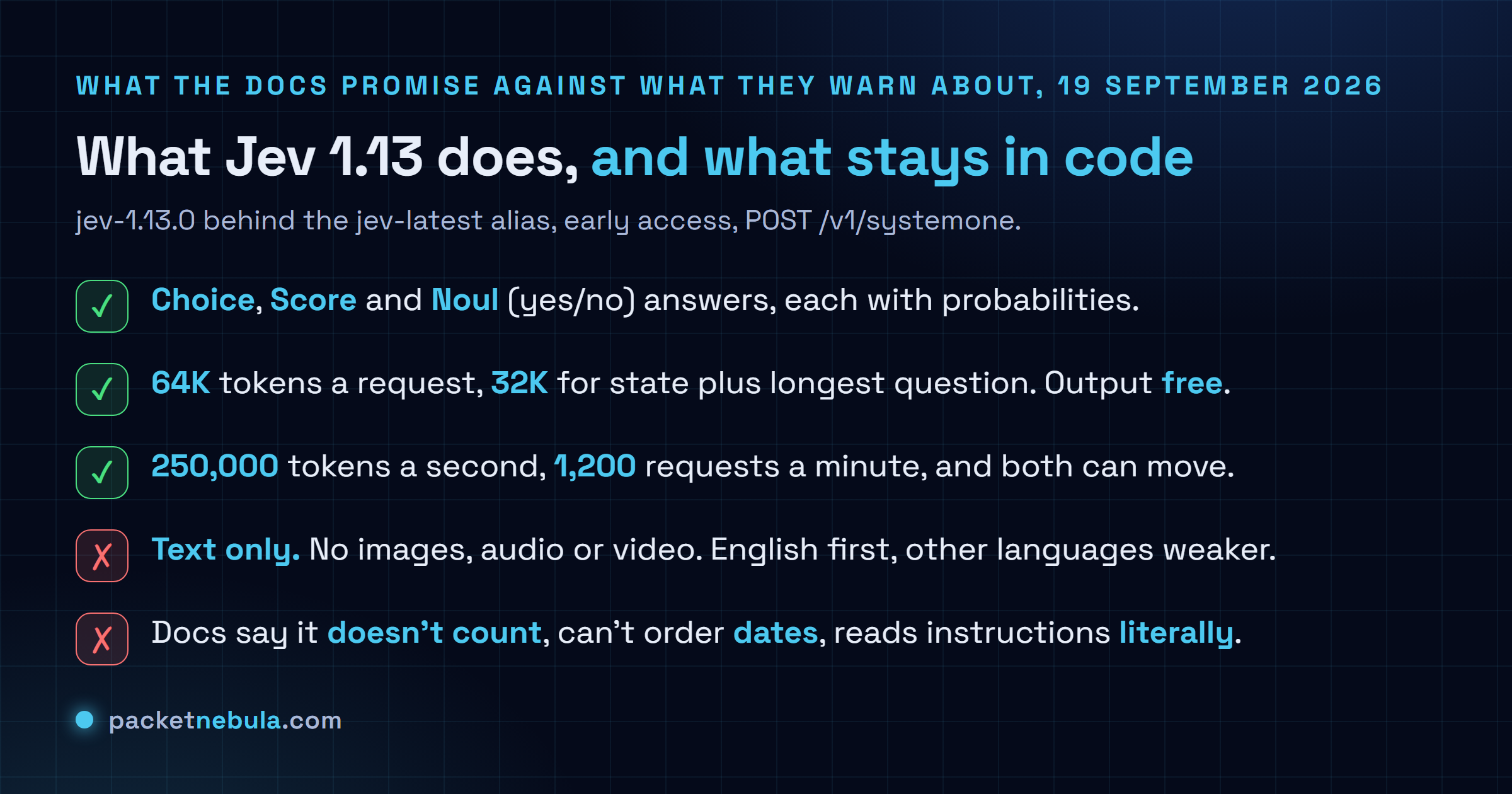
Checklist of what Jev 1.13 ships and does not ship as of 19 September 2026, listing that it returns Choice, Score and Noul answers with probabilities, that a request takes 64K tokens with 32K for the state, that output tokens are free, that input is text only with no image, audio or video, that TypeSafe's own jaggedness page says it does not count or compare dates reliably, and that rate limits change without notice during early access.
Three green rows from the models page, two red rows from the jaggedness page. Both pages are official.

Sources

TypeSafe AI, Introducing System One Models & Jev, Diogo Almeida, 15 September 2026 (the 70 to 500 ms latency, the $0.042 per million input and free output, RLCD, the parallel sampler, early access and waitlist). TypeSafe AI docs, Models, read 19 September 2026 (jev-1.13.0, the $42 per Btok row, the 250,000 tokens per second and 1,200 requests per minute limits, the 64K and 32K budgets, text-only input, the aliases, no fine-tuning, language support). TypeSafe AI docs, Jev 1.13 jaggedness, last reviewed 17 September 2026 (the nine failure modes and the counting and date examples). TypeSafe AI docs, API reference and Confidence, read 19 September 2026 (the request and response shapes, the three primitives, the usage block). TypeSafe AI, homepage, read 19 September 2026 (the 0.114 s against 8.566 s workflow demo, the $0.000081 per workflow, the 238x figure). TechCrunch, A new kind of AI model from a ChatGPT inventor is thrilling developers, 18 September 2026 (Almeida's background, developer cost reports, the launch-week API strain). The Register, TypeSafe AI debuts model for machines that plays Doom, 16 September 2026 (the $40 million funding, the hallucination-free framing critique, the Terra comparison).

Frequently asked questions

How much does Jev 1.13 cost?

$42 per billion input tokens, which is $0.042 per million. Output tokens are free. That's the only row on the models page as of 19 September 2026; there's no separate tier, no cached-input rate and no batch discount listed. Higher rate limits are sold on custom and enterprise plans.

Can Jev write text or code?

No. It returns a Choice (one option plus probabilities), a Score (a number against your rubric) or a Noul (a yes/no probability). TypeSafe's own jaggedness page lists generation as a failure mode and tells you to use a generative model for it.

What's the context limit on Jev 1.13?

64K tokens per request covering the state and all questions together, with a 32K limit on the state plus the single longest question. Input is text only: strings, JSON objects or arrays of text. Images, audio and video aren't supported.

Is Jev open weights, and can we fine-tune it?

Neither. It's an API model in early access, the same weights serve every account, and the docs say it isn't fine-tuned or LoRA-adapted with customer data. You adapt it through the state and the question criteria. TypeSafe says it doesn't train on customer requests, with zero data retention on enterprise plans.

Is Jev really 238x cheaper than a frontier model?

On input tokens, against a $10 per million model, yes: $10 divided by $0.042 is 238. The comparison only makes sense for questions that can be answered as a probability, and it ignores that the frontier model also bills output. For a pure classification or routing job the gap is real. For anything that needs a written answer there's no comparison to make.

Tags: apiclassificationJevLLM pricingnewsRLCDSystem OneTypeSafe AI
Share198Tweet124
stephane

stephane

  • Trending
  • Comments
  • Latest
Answer card: Proton Lumo 2.0 is private by policy, not by locality. Saved history is locked so even Proton cannot read it, but the prompt is decrypted on a Proton EU server to answer it, then forgotten.

Proton Lumo 2.0 review: how private is it, really?

3 September 2026
The Agentic Coding section of the official Hy4 preview benchmark appendix published by Tencent, a table comparing Hy3 and Hy4 preview against DeepSeek V4 Pro 0813, Qwen 3.8 Max, GLM 5.3, Kimi K3, GPT 5.6 Sol and Claude Opus 5 across SWE-bench Multilingual, SWE-bench Pro, DeepSWE, three SWE Atlas tasks, SWE-Marathon, Terminal-Bench 2.1, NL2Repo-Bench, CyberGym, ProgramBench, PostTrainBench and Harbor-Index.

Tencent’s 770B Hy4 tops one benchmark row in 46

3 September 2026
Answer card: Qwen 3.7 Max is API-only and cannot run locally yet; the open Qwen models (Qwen 3.6 27B, qwen3:8b to 32b) run offline via Ollama.

Qwen 3.7 local: what you can actually run offline

22 June 2026
Answer card: JWTs are not encrypted, anyone can read them; the signature proves who issued the token, not who may read it.

Are JWTs encrypted? No, and the difference will bite you

0
Answer card: a random 8 character password falls in under 2 hours offline, while 16 random characters hold for 1.4 trillion years at the same speed.

How long does it take to crack a password in 2026?

0
Answer card: three DNS records decide if your mail lands or bounces; SPF lists allowed senders, DKIM signs messages, DMARC sets the failure policy.

SPF, DKIM and DMARC explained: the records your email needs

0
Answer card stating that Ternary Bonsai 2 27B, released by PrismML on 17 September 2026 under Apache 2.0, packs Qwen3.8 27B into 5.95 gigabytes at 1.72 bits per weight, keeps 98.2 percent of the 14-benchmark average, about 75 percent on SWE-bench Verified and Terminal-Bench 2.1, and needs PrismML's llama.cpp fork to run.

Does Bonsai 2 27B really keep 98% of Qwen3.8 in 5.95 GB?

20 September 2026
Answer card stating that Jev 1.13 from TypeSafe AI is a decision model in early access since 15 September 2026 that returns typed probabilities instead of text, priced at 42 dollars per billion input tokens with output tokens free, answering in 70 to 500 milliseconds, with a 64K token request budget, text input only, and a documented list of things it does badly, including counting and dates.

Jev 1.13 bills $42 a billion tokens, and it can’t count

19 September 2026
Answer card stating that Qwen3.8-Omni-Flash launched on 17 September 2026 as an API only model on Alibaba Cloud Model Studio, taking text, images, audio and video in a 1M token context and returning text only, priced at 0.15 dollars per million input tokens for every modality and 0.47 dollars per million output tokens in the international regions, with no open weights published and the Qwen-Live Harness GitHub repository returning 404.

Qwen3.8-Omni-Flash bills audio at $0.15 and ships no weights

18 September 2026
  • About
  • Contact
  • Privacy
  • Legal

Copyright © 2026 Stephane Cardon.

Welcome Back!

Login to your account below

Forgotten Password?

Retrieve your password

Please enter your username or email address to reset your password.

Log In
No Result
View All Result
  • Home
  • Articles
    • Security
    • Network
    • Dev
    • Sysadmin
    • SEO
    • Email & DNS
  • Tools
    • Network tools: free, fast, no signup
    • Security tools: free, fast, no signup
    • Developer tools: free, fast, no signup
    • Sysadmin tools: free, fast, no signup
    • SEO tools: free, fast, no signup
    • Email & DNS tools: free, fast, no signup
  • Download
  • About

Copyright © 2026 Stephane Cardon.