

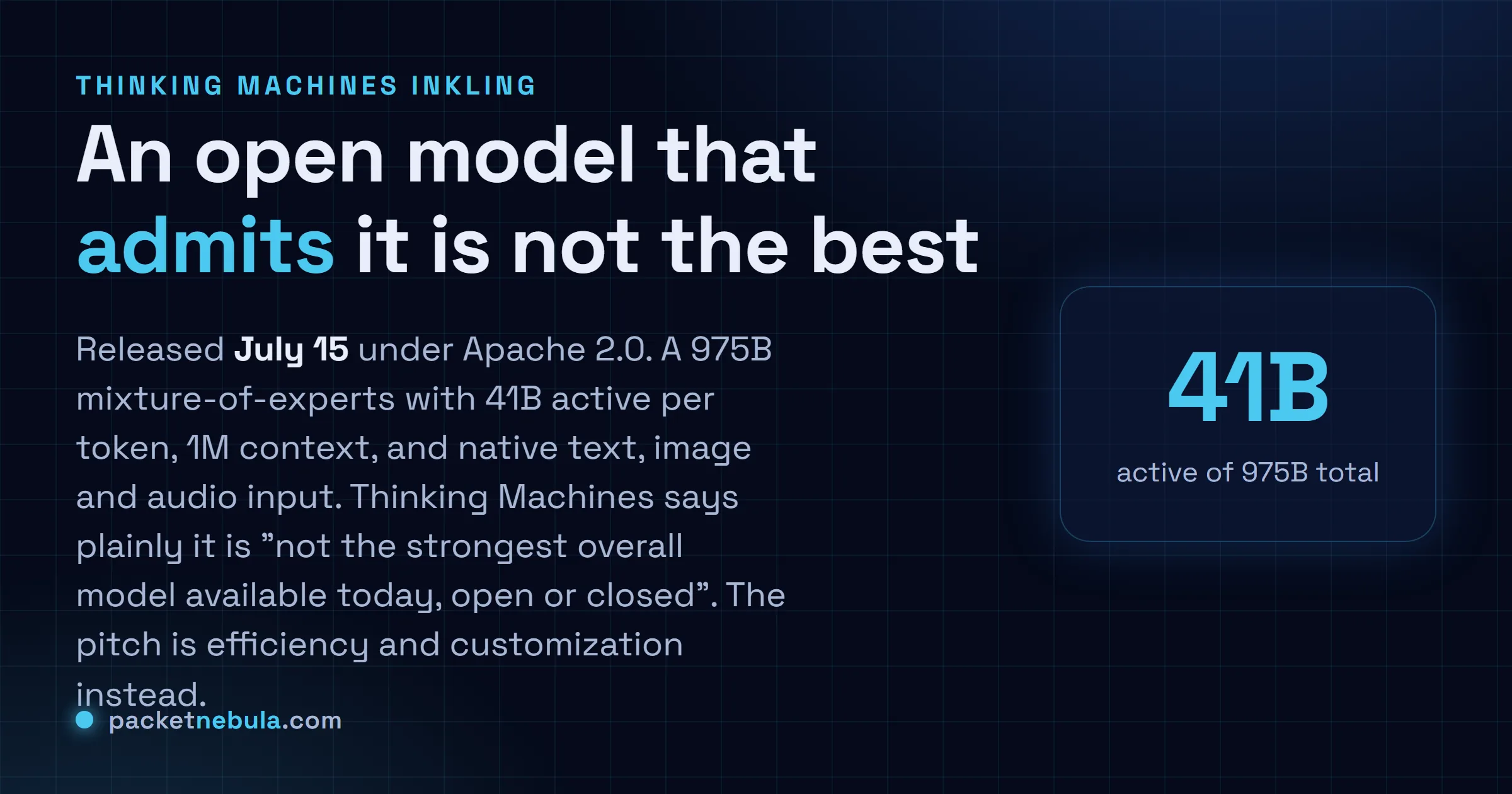
Mira Murati's lab spent about nine months in near silence, and on July 15 it shipped weights instead of a waitlist. Inkling is a 975B mixture-of-experts model under Apache 2.0, 41B active per token, and Thinking Machines says out loud what most labs bury in a footnote: it isn't the strongest model available today, open or closed. We went hunting for the catch. Found an honest pitch instead. The bet is that a model you can bend beats a model that tops a leaderboard, and the numbers back the modesty. On Terminal Bench 2.1 it posts 63.8 while GLM 5.2 sits at 82.7. So why would you look twice? Because it gets there on roughly a third of the tokens Nemotron 3 Ultra burns, and because you get a thinking-effort dial nobody else hands you.
The short answer
Thinking Machines Lab shipped Inkling, a 975B mixture-of-experts model with 41B active parameters, 1M context, and native text, image and audio input. The lab openly says it isn’t the best model out there. It’s built to be a customization base: Apache 2.0 weights, a thinking-effort dial, and roughly a third of the token spend of Nemotron 3 Ultra for the same terminal score.
What the lab actually shipped
Weights, a license, and an unusual amount of candour. On July 15 Thinking Machines put Inkling on Hugging Face under Apache 2.0, which means you can download it, fine-tune it and ship it commercially without asking anyone. No research-only clause. No gate.
The shape: a 66-layer decoder-only transformer with a sparse mixture-of-experts backbone. Each MoE layer holds 256 routed experts plus 2 shared ones, and a sigmoid router sends every token to 6 of them. That’s how you get 975B total parameters but only 41B lighting up per token. It’s pretrained on 45 trillion tokens spanning text, images, audio and video, with a context window up to 1M. Some of the design choices are quietly contrarian, like relative positional embeddings instead of RoPE, and short convolutions after the key and value projections.
Input is multimodal. Output isn’t. It reads images at 40px and up, and audio as dMel spectrograms at 16kHz for up to 20 minutes, then it writes text. That’s it. Worth knowing before you plan a product around it.
The sentence that made us pay attention
From the lab’s own announcement: Inkling “is not the strongest overall model available today, open or closed.”
Labs don’t write that. We’ve read a lot of launch posts where a model wins six cherry-picked benchmarks and the losses never surface, so seeing the weakness stated in the second paragraph is disarming. It’s the most credible thing about the release.
And it’s true. Here’s where it actually lands on agentic terminal work.
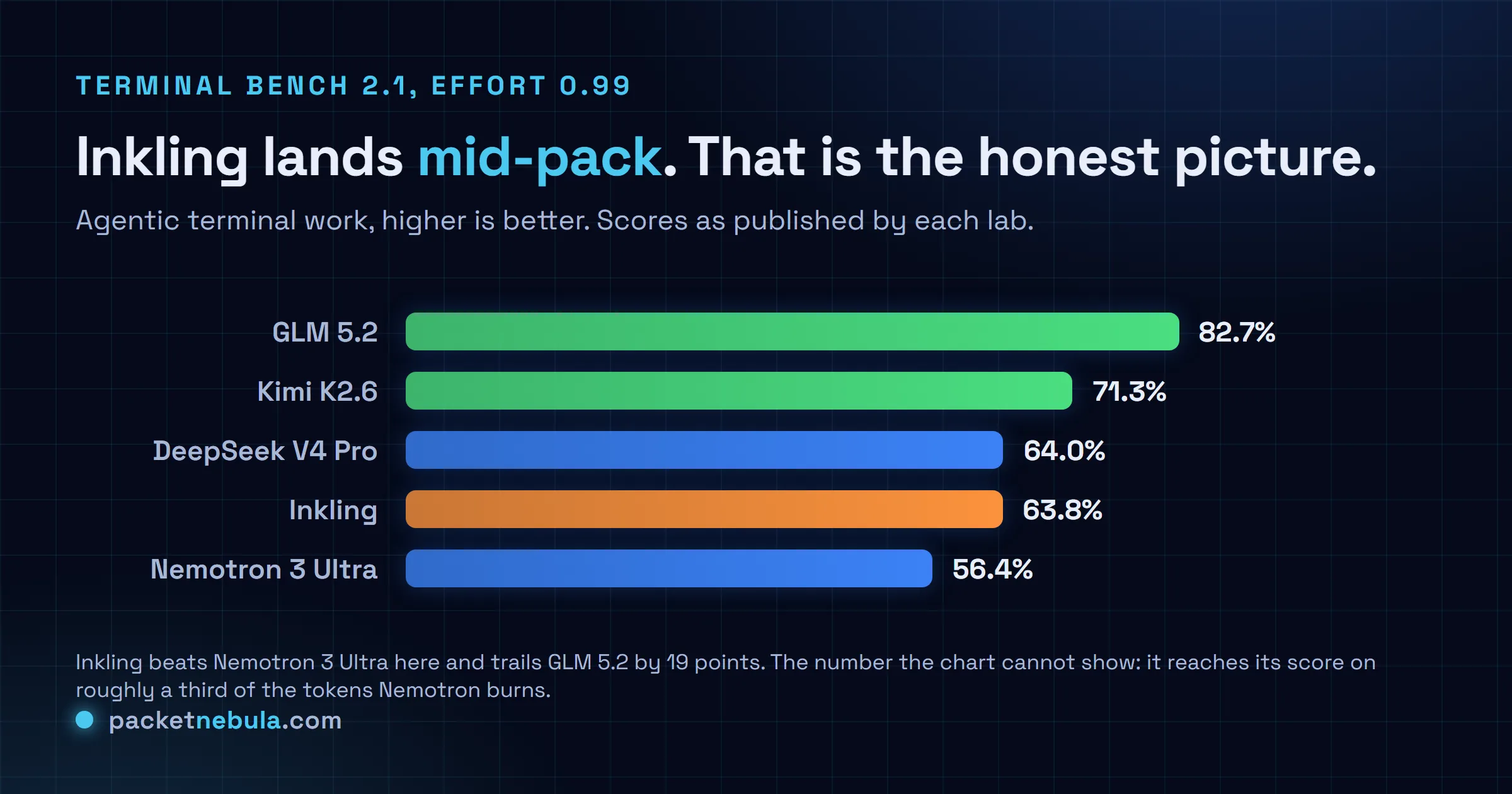
The rest of the table rhymes. On Humanity’s Last Exam it takes 29.7% while GLM 5.2 posts 40.1%. SWEBench Verified gives it 77.6% against roughly 80% for Kimi K2.6, GLM 5.2 and DeepSeek V4 Pro. SimpleQA Verified is the ugly one: 43.9% versus DeepSeek’s 57.0%, which is a real gap on factual recall.
Two places it does win. It beats Nvidia’s Nemotron 3 Ultra almost everywhere, and it tops that group on FORTRESS Adversarial at 78.0% with StrongREJECT at 98.6%. If you’re shipping something public-facing, that second one isn’t nothing.
The dial
Here’s the part we’d actually use. Thinking effort is exposed as a number from 0.2 to 0.99, trained in by varying system messages and charging a per-token cost during reinforcement learning. In transformers it shows up as a reasoning_effort argument with named levels.
So instead of keeping a cheap model and an expensive model behind a router you maintain, you keep one model and turn a knob per call. Simple classification at 0.2. Hard debugging at 0.99. Same weights, same endpoint.
That feeds the one benchmark Inkling genuinely wins: token spend. It matches Nemotron 3 Ultra’s Terminal Bench score on about a third of the tokens. For something you invoke a few million times a month, that’s the number on the invoice, and it beats a leaderboard rank you’ll never notice in production. A Bridgewater collaboration reportedly hit 84.7% on financial reasoning at roughly a fourteenth of the running cost of the proprietary models it was measured against. That last figure comes via reporting, not a paper, so we’d hold it loosely.
The hardware bill
Open doesn’t mean local. It never does at this size.
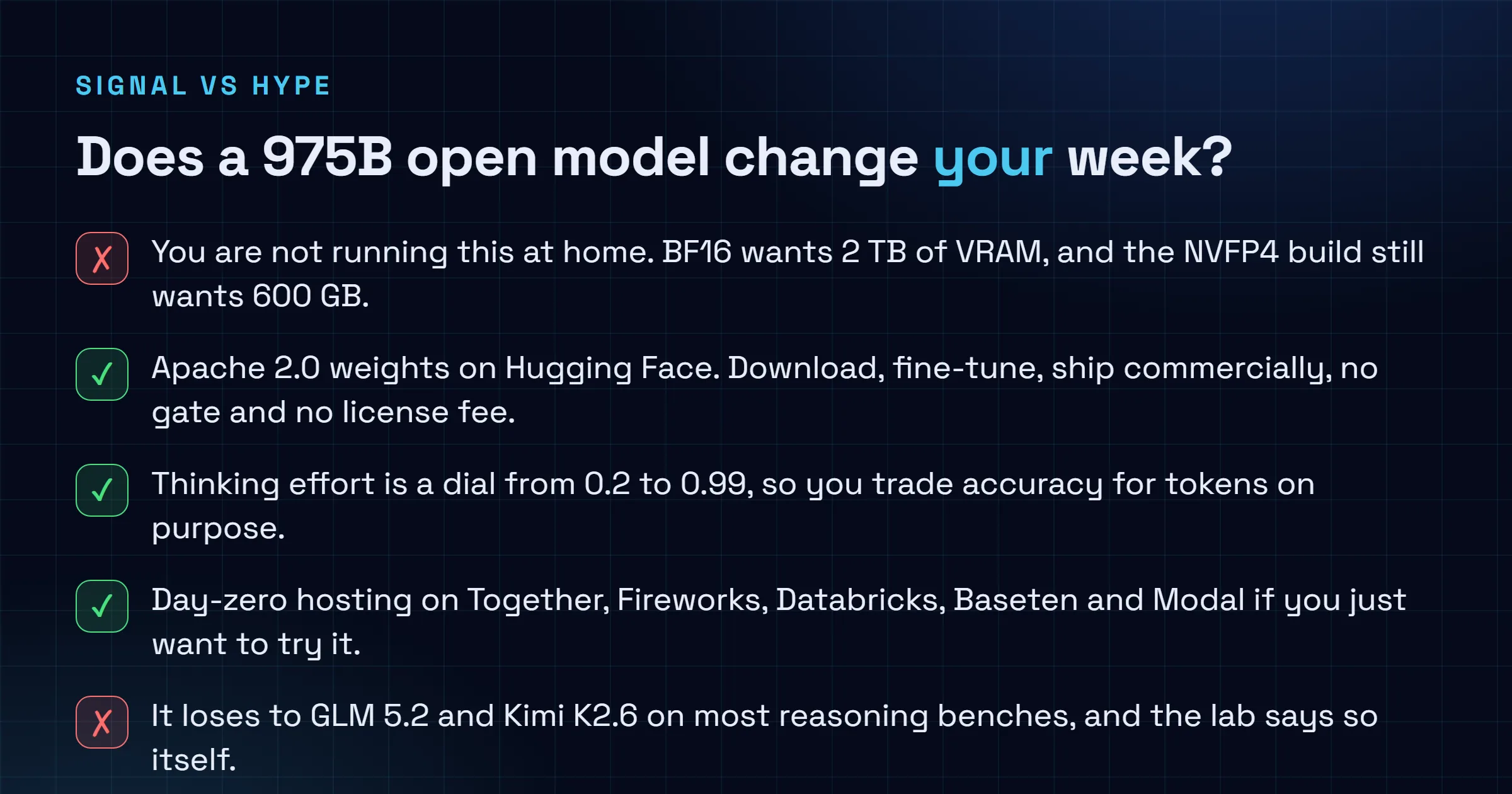
BF16 wants 2 TB of aggregated VRAM, which is 8 B300s or 16 H200s. The NVFP4 checkpoint cuts it to about 600 GB, so 4 B300s or 8 H200s. That’s the same wall we hit with Tencent’s Hy3, and if you want weights that run on metal you already own, Qwen 3.7 offline remains the sane answer. Runtimes are covered though: SGLang, vLLM with an OpenAI-compatible server, llama.cpp via Unsloth, plus hosted day-zero endpoints on Together AI, Fireworks, Modal, Databricks and Baseten. There’s a free playground if you just want to poke it.
Who this is for
Not you, if you want the best answer to a hard question. Get an API key for something else.
It’s for teams who plan to fine-tune. The whole strategy points at Tinker, the lab’s customization platform and its actual revenue model, and the thesis is that a model an organization adapts for itself will beat a generalist that serves everyone. Murati got here in about nine months with roughly 200 people, which is genuinely fast.
One wrinkle worth flagging: some of Inkling’s early post-training data was generated with help from other open-weight models, Moonshot’s Kimi K2.5 among them. The lab says future models will be fully self-contained. It’s not a scandal, but it’s a funny look for a lab selling independence from other people’s models.
The honest read
I like this release more than its benchmark table deserves, and I’m aware that’s a soft reason. A permissive license on a 975B multimodal model is a real gift, the effort dial is the kind of control that saves money quietly every day, and a lab that publishes the charts it loses has earned a little trust.
What we wouldn’t do is treat “open” as “cheap”. You’re still renting eight big GPUs or paying someone who did. And if nobody who downloads Apache 2.0 weights owes them a cent, the Tinker bet has to work. Pull it up in the playground this week, throw the prompts that actually matter to you at it, then check what it cost in tokens. That comparison is the only one that pays your bills.
Sources: Thinking Machines Lab’s Inkling announcement and official model card, with reporting and independent specs via TechCrunch and MarkTechPost, July 2026. Benchmark figures are as published by each lab and are not independently reproduced. The Bridgewater cost comparison comes from reporting rather than a published paper.
Frequently asked questions
What is Thinking Machines Inkling?
Inkling is the first in-house model from Thinking Machines Lab, the startup founded by former OpenAI CTO Mira Murati, released July 15, 2026. It is a 975B-parameter sparse mixture-of-experts transformer with 41B active parameters per token, 66 layers, a context window up to 1M tokens, and Apache 2.0 open weights. It takes text, images and audio as input, and returns text only.
Can I run Inkling on my own machine?
Not on a desktop. Thinking Machines lists a 2 TB aggregated VRAM minimum for the BF16 weights, roughly 8 Nvidia B300s or 16 H200s. The NVFP4 quantized checkpoint drops that to about 600 GB, so 4 B300s or 8 H200s. For a single-GPU box, a smaller open model is the realistic choice.
Is Inkling better than GLM 5.2 or Kimi K2.6?
Mostly no, and the lab does not claim otherwise. On Thinking Machines' own published table, Inkling scores 63.8% on Terminal Bench 2.1 against 82.7% for GLM 5.2 and 71.3% for Kimi K2.6, and it trails both on Humanity's Last Exam and GPQA Diamond. It does beat Nvidia's Nemotron 3 Ultra across most of that table, and it leads on FORTRESS Adversarial at 78.0%.
What is controllable thinking effort?
It is a dial, from 0.2 to 0.99, that sets how many tokens the model spends reasoning before it answers. Thinking Machines trained it by varying system messages and applying a per-token cost during reinforcement learning. The transformers library exposes it as a reasoning_effort argument with named levels, so you trade accuracy against latency and cost per call rather than swapping models.
How much does Inkling cost?
The weights are free under Apache 2.0, with no commercial gate. If you would rather not own the metal, day-zero hosted inference is available through Together AI, Fireworks, Modal, Databricks and Baseten at their own rates. Fine-tuning runs on the lab's Tinker platform, which offers 64K and 256K context options at a 50% discount, and Tinker is where the company actually expects to make money.


