
So you wired up deepseek-chat months ago, it's been humming along, and you'd more or less forgotten it was even there. Bad news: that name has an expiry date. DeepSeek is graduating its V4 family out of preview this month, and after July 24, 2026 at 15:59 UTC the old deepseek-chat and deepseek-reasoner aliases stop responding. Your code doesn't fail slowly. It just starts erroring out. The fix is genuinely small, a one-line change to the model name on the same URL and key, but there's a trap tucked inside it that can quietly shrink the model behind your reasoning calls. We'll walk through what actually changed and the swap to make before the deadline.
The short answer
DeepSeek V4 is graduating from preview this month. After July 24, 2026 at 15:59 UTC, the deepseek-chat and deepseek-reasoner aliases stop responding. Both already route to deepseek-v4-flash, so migrating is a one-line model-name change. The catch: deepseek-reasoner maps to v4-flash thinking mode, not the larger deepseek-v4-pro, so heavy reasoning can quietly get a smaller model.
What’s actually happening
DeepSeek shipped V4 as a preview back in April, and this month it’s promoting that preview to the stable, official release. Nothing dramatic there. The part that matters for anyone with DeepSeek in production is quieter, and it’s easy to miss if you only skim the launch notes.
The two model names most people call, deepseek-chat and deepseek-reasoner, are being retired. DeepSeek set a hard cutoff: July 24, 2026, at 15:59 UTC. After that, a request to either alias comes back as an error, not an answer. No grace period, no soft fallback. If your code still names the old models on July 25, it’s broken.
Here’s the thing people get wrong. The models behind those names already changed. Since the V4 preview in April, deepseek-chat and deepseek-reasoner have been routing to deepseek-v4-flash under the hood. So you’re most likely already running V4 and didn’t notice. What dies on July 24 is the old label, not some old model you’ve been clinging to.
Where the old names land
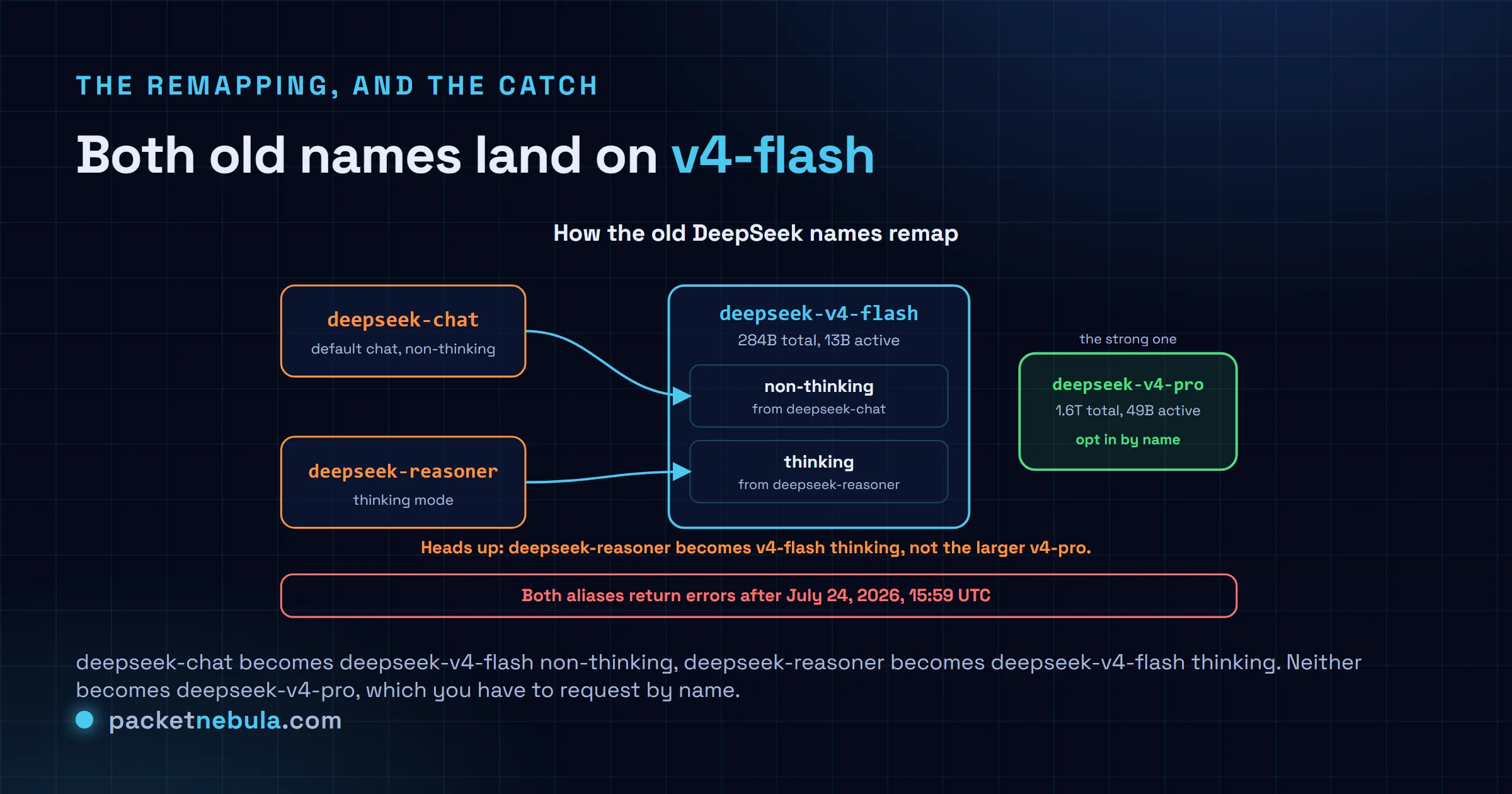
DeepSeek collapsed the two legacy aliases onto a single new model with two modes. deepseek-chat becomes deepseek-v4-flash in its plain, non-thinking mode. deepseek-reasoner becomes the same deepseek-v4-flash, but with thinking switched on. One model, one price, a toggle for whether it reasons out loud before answering.
That consolidation is fine for most workloads. deepseek-v4-flash is a 284B mixture-of-experts model that only lights up about 13B parameters per token, so it’s quick and cheap, and its reasoning mode is genuinely capable. For chat, extraction, classification, the everyday stuff, you probably won’t feel a thing beyond the rename.
The trap, and it’s a real one
Now the part to read twice. deepseek-reasoner does not become deepseek-v4-pro.
V4-pro is the big model: 1.6T total parameters, 49B active, the one DeepSeek positions against the top closed-source names. It’s a separate model ID that you have to request by name. It is not what the reasoner alias falls back to. So if you’d been leaning on deepseek-reasoner for your hardest problems, the ones where you really wanted the strongest thing DeepSeek has, the automatic path drops you onto v4-flash thinking, which is the smaller model. Same quality of output on easy tasks. A real step down on the ones that stretched the model in the first place.
This is the kind of change that doesn’t throw an error, so nobody catches it in code review. It just shows up weeks later as “the answers got a little worse and we’re not sure why.” If reasoning quality is load-bearing for you, switch those calls to deepseek-v4-pro on purpose and compare. Don’t let the default decide it for you.
What it costs now
Cheap. That’s the short version. DeepSeek V4 is priced well under most of what you’d reach for from the US labs, and the flash tier is almost aggressive about it.
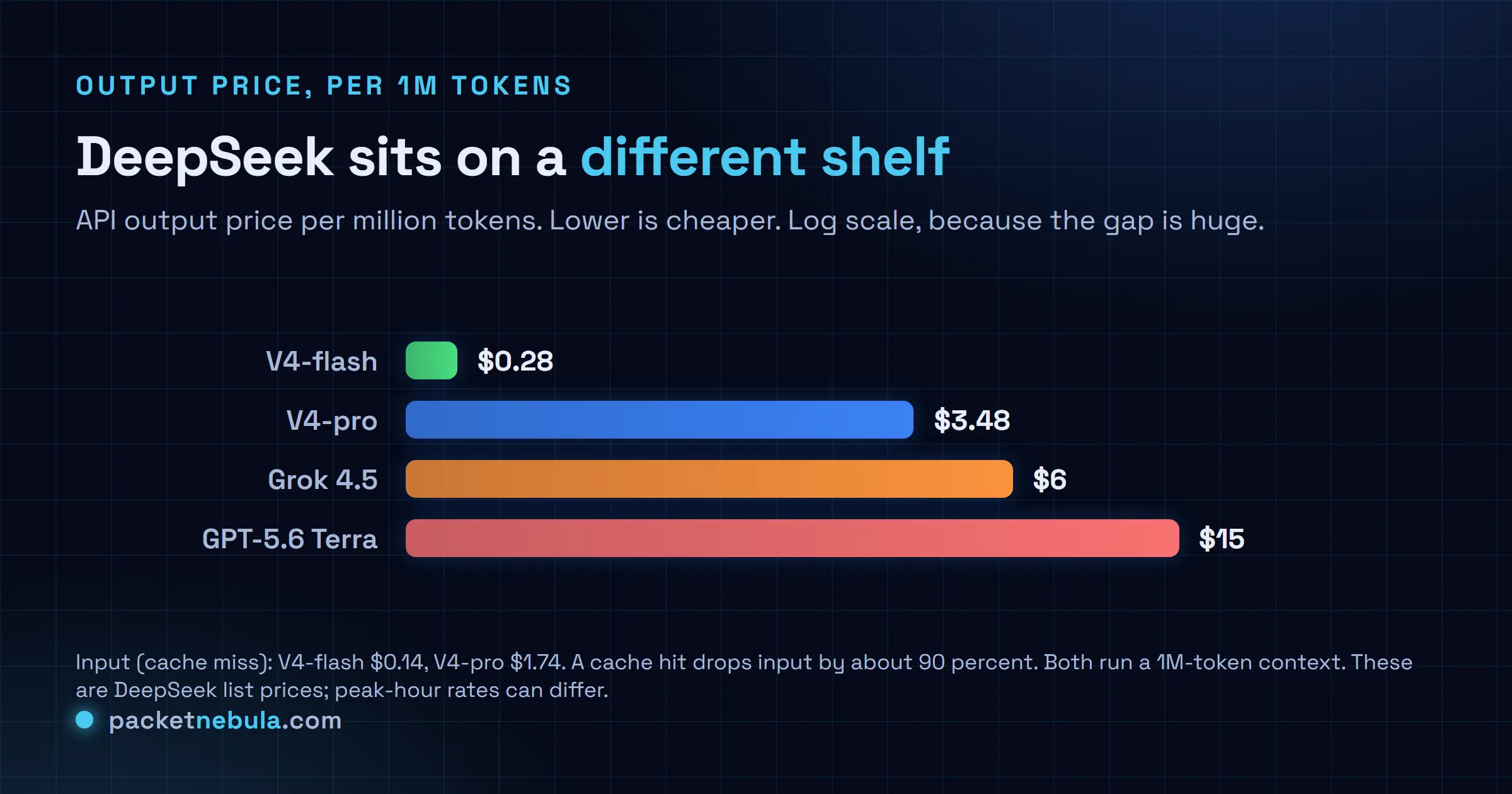
V4-flash runs about 0.14 dollars per million input tokens on a cache miss and 0.28 on output. V4-pro is roughly 1.74 in and 3.48 out, so the strong model costs more than ten times the flash one, which is worth remembering before you reach for it by reflex. Cache hits knock roughly 90 percent off the input side, which adds up fast if you’re sending the same system prompt on every call. Both models carry a 1M-token context and up to 384K of output, so the size ceiling isn’t the thing you’ll bump into.
For the wider picture on how these cheap open models stack up against each other, our GLM-5.2 versus GPT-5.5 and Opus 4.8 breakdown covers where the value actually lands once you get past the launch numbers.
The swap to make before the deadline
The migration itself is boring, which is the good kind of migration. Same base URL, same API key. You change the model string and that’s basically it.
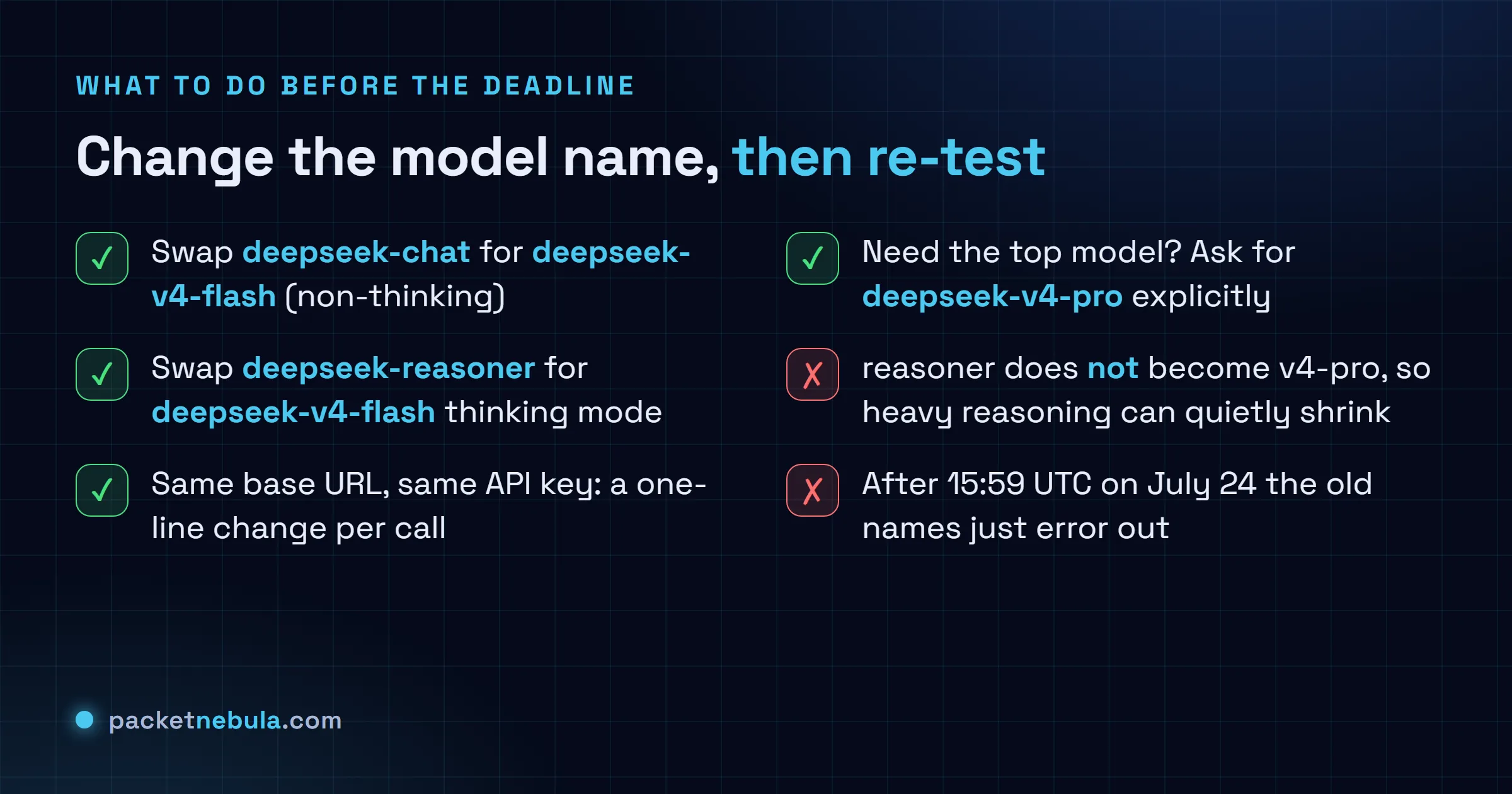
Find every place your code sends deepseek-chat and change it to deepseek-v4-flash. Find deepseek-reasoner and point it at deepseek-v4-flash with thinking enabled. If any of those calls were carrying real weight, the reasoning-heavy ones, decide deliberately whether they should go to deepseek-v4-pro instead. Then run your own evals against the new names before the cutoff, not after, so a surprise shows up in staging and not in front of a user.
If you’d rather not depend on a hosted alias policy at all, remember V4 is open-weight. DeepSeek published the models the same way it did before, so self-hosting is on the table if you’ve got the GPUs, the same trade we walked through for Tencent’s open 295B Hy3 model. The hosted API is just the path of least resistance.
Is V4 worth staying on
For most teams, yes, and the migration is too small to be a reason to leave. V4-flash is fast and cheap enough that it’s hard to argue with for the bulk of everyday calls, and v4-pro is there when a job genuinely needs the bigger model. The only real homework is the one we keep coming back to: know which of your calls were quietly relying on the reasoner being strong, because those are the ones the automatic remap doesn’t serve well. Fix those by hand, rename the rest, and you’re done well before the 24th.
Sources: DeepSeek’s official V4 preview and API documentation for the model IDs, the deepseek-chat and deepseek-reasoner deprecation date, and the routing details, and Tech Times for the mid-July stable timing. Prices are DeepSeek’s published list rates and can vary by peak-hour billing; benchmark positioning is DeepSeek-reported and not yet independently reproduced.
Frequently asked questions
When do deepseek-chat and deepseek-reasoner stop working?
After July 24, 2026 at 15:59 UTC. Past that timestamp, calls to those two aliases return errors instead of a response. They already route to deepseek-v4-flash today, so the model behind them changed back in April. July 24 is when the old names themselves go away.
What do I change my code to?
Point the model parameter at deepseek-v4-flash instead of deepseek-chat, on the same base URL and API key. If you were calling deepseek-reasoner, use deepseek-v4-flash in thinking mode. It's a one-line change per call, not a rewrite.
Does deepseek-reasoner become deepseek-v4-pro?
No, and that's the part that trips people up. deepseek-reasoner maps to deepseek-v4-flash thinking mode, the smaller 284B model, not the 1.6T deepseek-v4-pro. If your workload leaned on the strongest reasoning, you'll want to ask for v4-pro by name or you'll quietly land on the lighter model.
How much does DeepSeek V4 cost?
V4-flash is about 0.14 dollars per million input tokens on a cache miss and 0.28 output. V4-pro is roughly 1.74 in and 3.48 out. A cache hit drops the input cost by about 90 percent. Both models run a 1M-token context with up to 384K output.
Is DeepSeek V4 open source?
Yes. DeepSeek open-sourced the V4 weights alongside the hosted API, same as it did with earlier versions, so you can self-host if you have the hardware. The hosted API is just the easy path.


