




Somebody forwards you the headline: an open model that beats rivals ten times its size. Then you open Poolside's own benchmark table and Kimi K3 is sitting there at 88.3 percent while Laguna S 2.1 posts 70.2. Both numbers are Poolside's. Nobody lied, the headline just lost four words, in its weight class. What Laguna S 2.1 actually is, and this part is genuinely good, is 118 billion parameters with 8 billion active per token, a 1M context, open weights under a named licence, and a file that fits on a single DGX Spark at four bits. We did the division on that last claim this morning. It holds. It just doesn't hold at the same time as the 1M context.
The short answer
Poolside released Laguna S 2.1 on 21 July 2026 under OpenMDW-1.1, a real open licence with free outputs. It’s a 118B mixture-of-experts with 8B active, a 1M token context, and weights small enough at four bits to sit on one DGX Spark. The launch coverage oversold it. Poolside’s own claim, most capable in its weight class, survives scrutiny. The headlines about beating models ten times its size do not.
The weight class is doing all the work
Read Poolside’s sentence carefully and it’s honest: “the most capable agentic coding model in its weight class by a wide margin”. Every word in that clause is load-bearing, and the company did the unusual thing of printing the models that beat it right in the same table.
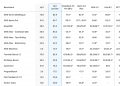
So here’s that table, on Terminal-Bench 2.1.
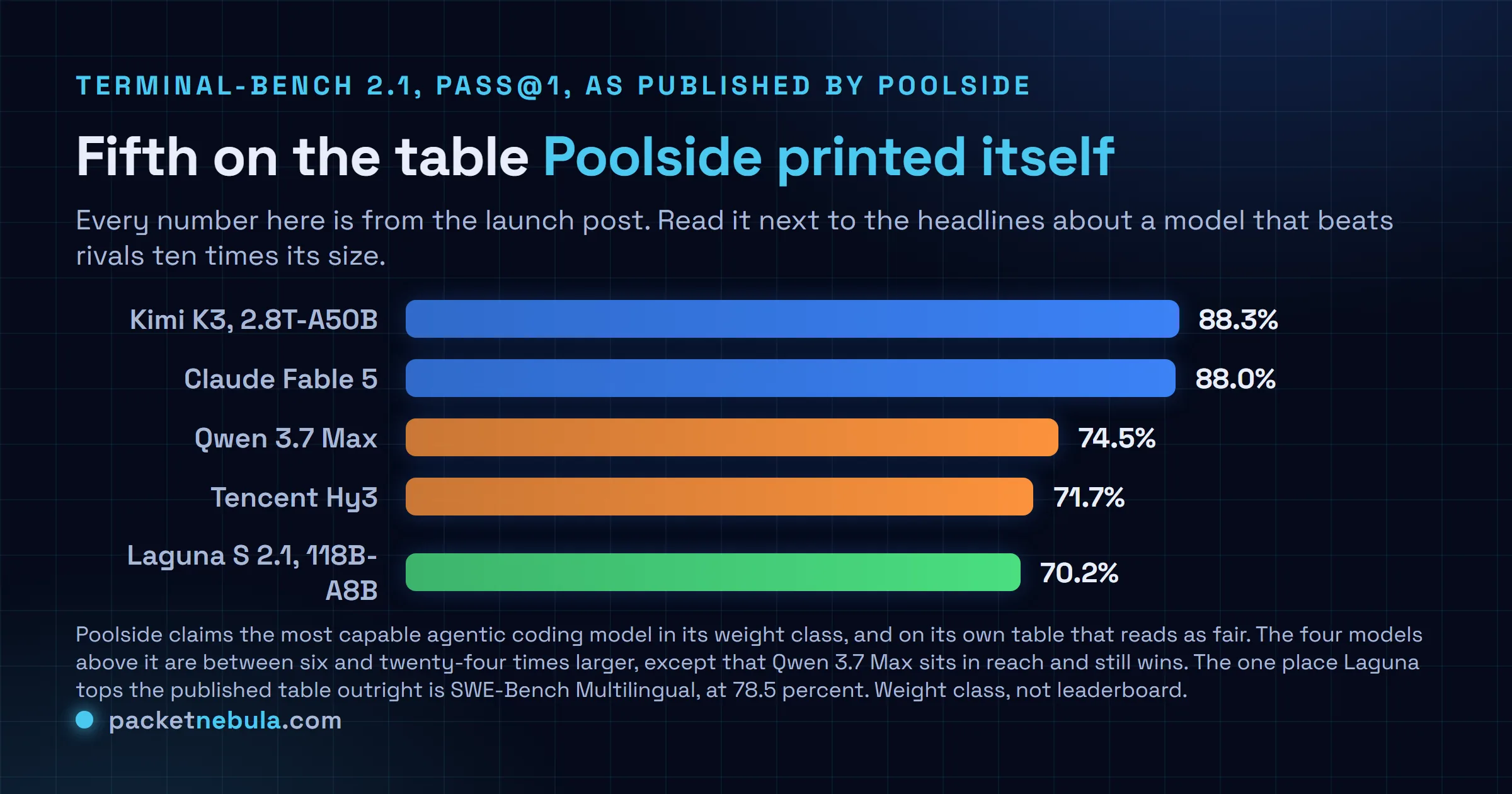
Fifth. And the model directly above it, Qwen 3.7 Max, isn’t ten times anything, it’s a competitor in roughly the same conversation. Kimi K3 at 88.3 is 2.8 trillion parameters with 50 billion active, so the gap there is real and so is the excuse for it.
One clean win though, and it’s not a small one: SWE-Bench Multilingual at 78.5 percent tops the published table outright, ahead of Qwen 3.7 Max at 78.3 and Tencent Hy3 at 75.8. Multilingual repo work is the benchmark I’d trust most of that set for real codebases, so honestly that one matters more to me than the terminal number everybody quoted.
What fits on a Spark, and what doesn’t fit next to it
The “runs on a single DGX Spark” line is the one that made this interesting to us, because it’s checkable.
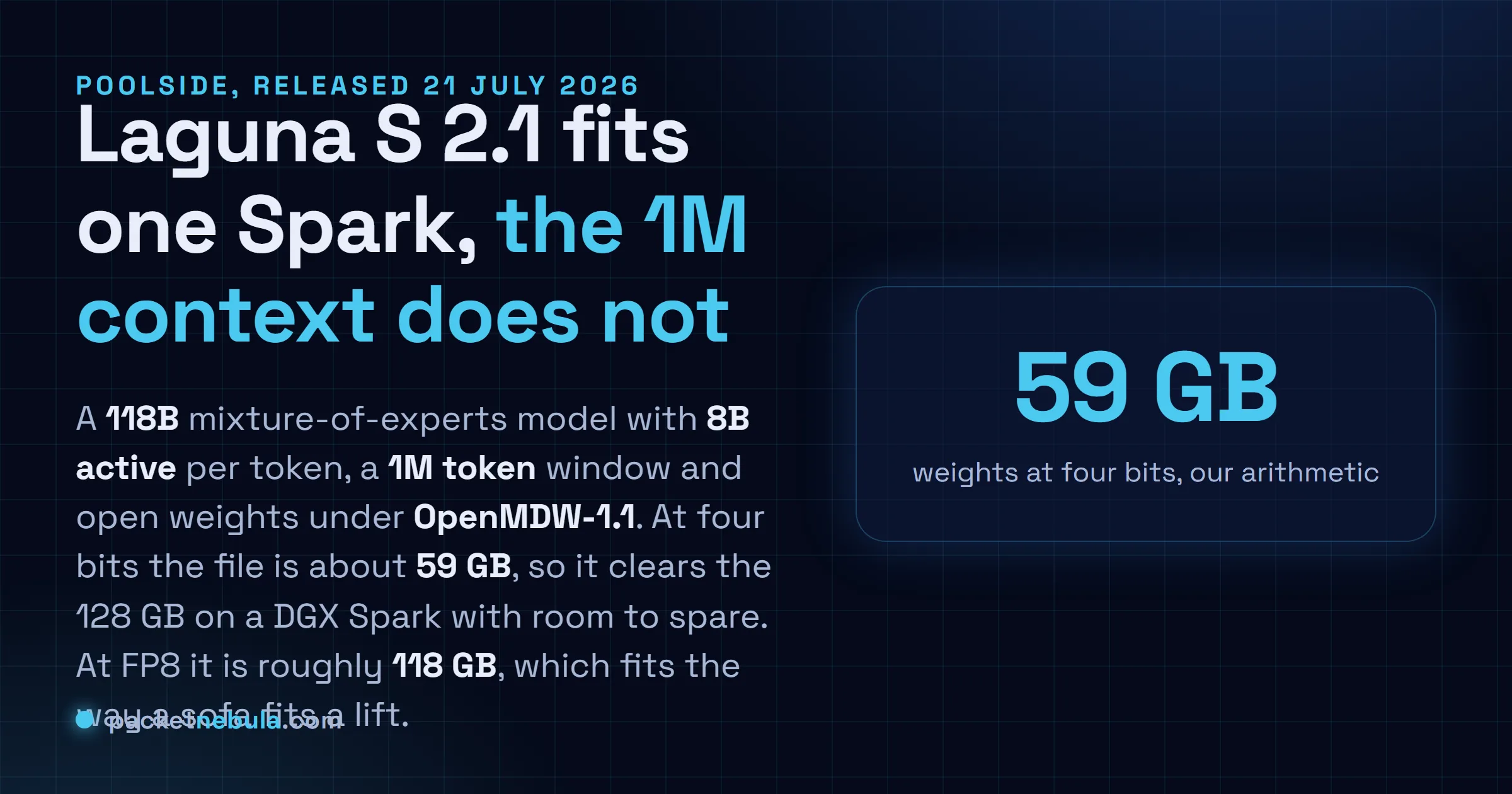
118 billion parameters. Four bits each, so half a byte. Multiply and you get about 59 GB of weights, against the 128 GB of unified LPDDR5x a Spark carries. Comfortable. FP8 doubles it to roughly 118 GB in that same 128 GB box, which is technically a fit and practically a dead end. BF16 lands near 236 GB, so two linked Sparks or a proper node.
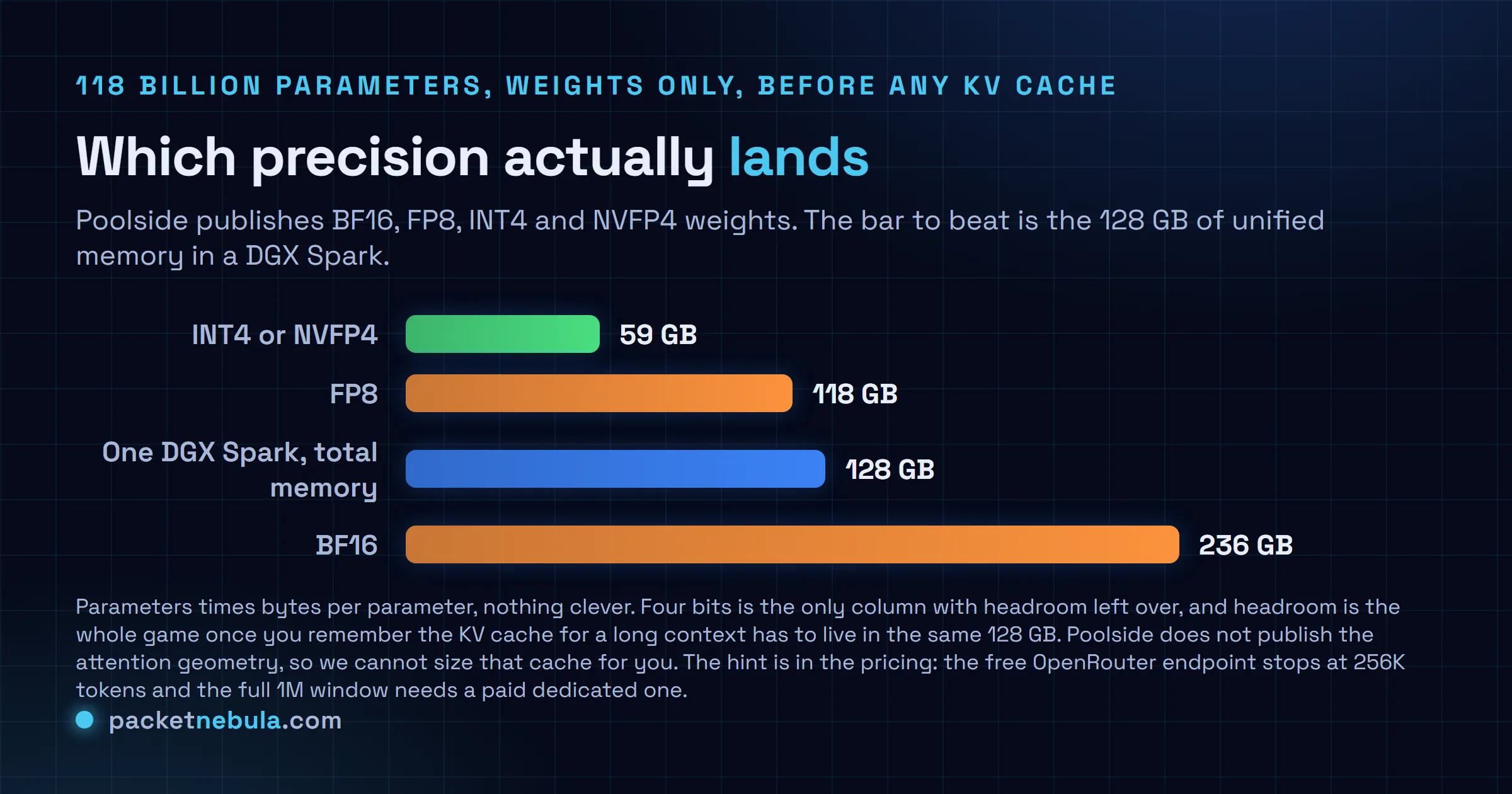
Now the part nobody put in a headline. That 273 GB/s of memory bandwidth in a Spark is what decides whether this feels usable, because decoding is memory bound. 8 billion active parameters at four bits means reading about 4 GB per token. Divide 273 by 4 and you get somewhere near 68 tokens per second as a ceiling.
A ceiling, not a throughput figure. That’s our arithmetic, not Poolside’s, and real decode lands under it once MoE routing scatters your reads and the KV cache starts competing for the same bus. Still, roughly 68 is a useful shape to hold in your head, and it’s a lot better than what a dense 118B would give you on the same hardware. The sparse design is earning its keep.
The KV cache is where we have to stop. Poolside doesn’t publish the attention geometry, so we can’t tell you what a 1M token context costs in gigabytes, and we’re not going to guess at it. What we can point at is the pricing: the free OpenRouter endpoint caps at 256K tokens and the full 1M window requires a paid dedicated one. Vendors don’t tier things that are cheap.
Image: Poolside, from the Laguna S 2.1 launch post.
The score lives inside thinking mode
Worth knowing before you benchmark it yourself and wonder why your numbers are low.
Max thinking lifts Terminal-Bench 2.1 from 60.4 percent to 70.2, and DeepSWE v1.1 from 16.5 to 40.4. That second one isn’t an improvement, it’s a different model behaviour. Ten points and twenty-four points respectively, bought with tokens.
And there are no user-configurable effort levels yet. You get thinking or you don’t, with no ladder in between, which is a gap against what Anthropic ships on the Opus and Fable lines. For a model whose entire pitch is cost efficiency, not being able to buy 65 percent instead of 70 percent for half the tokens is an odd hole. I’d expect it to close.
The hosted rates make the tradeoff cheap either way: $0.10 per million in, $0.20 out, $0.01 on cache reads. Set that against Kimi K3’s $3.00 cache-miss input and $15.00 output and you can see what weight class buys you at the invoice.
The licence is the quiet win
This is the part we’d actually flag to a legal team, and it’s the opposite of the K3 situation.
OpenMDW-1.1 is a named, readable Linux Foundation licence. It grants permission to deal in the model materials without restriction across copyright, patent, database and trade secret rights. Outputs are explicitly free of attribution requirements, which is the clause that decides whether you can ship a product on this. There’s a patent litigation termination mechanism. NVIDIA moved Cosmos, Isaac GR00T and Nemotron onto it, so you’re not the first to read it.
Compare that with K3, where the weights landed with the licence text still an open question. Poolside published a licence you can hand to counsel on day one. For anyone who has to get sign-off before a model touches production, that’s worth more than four points on a terminal benchmark.
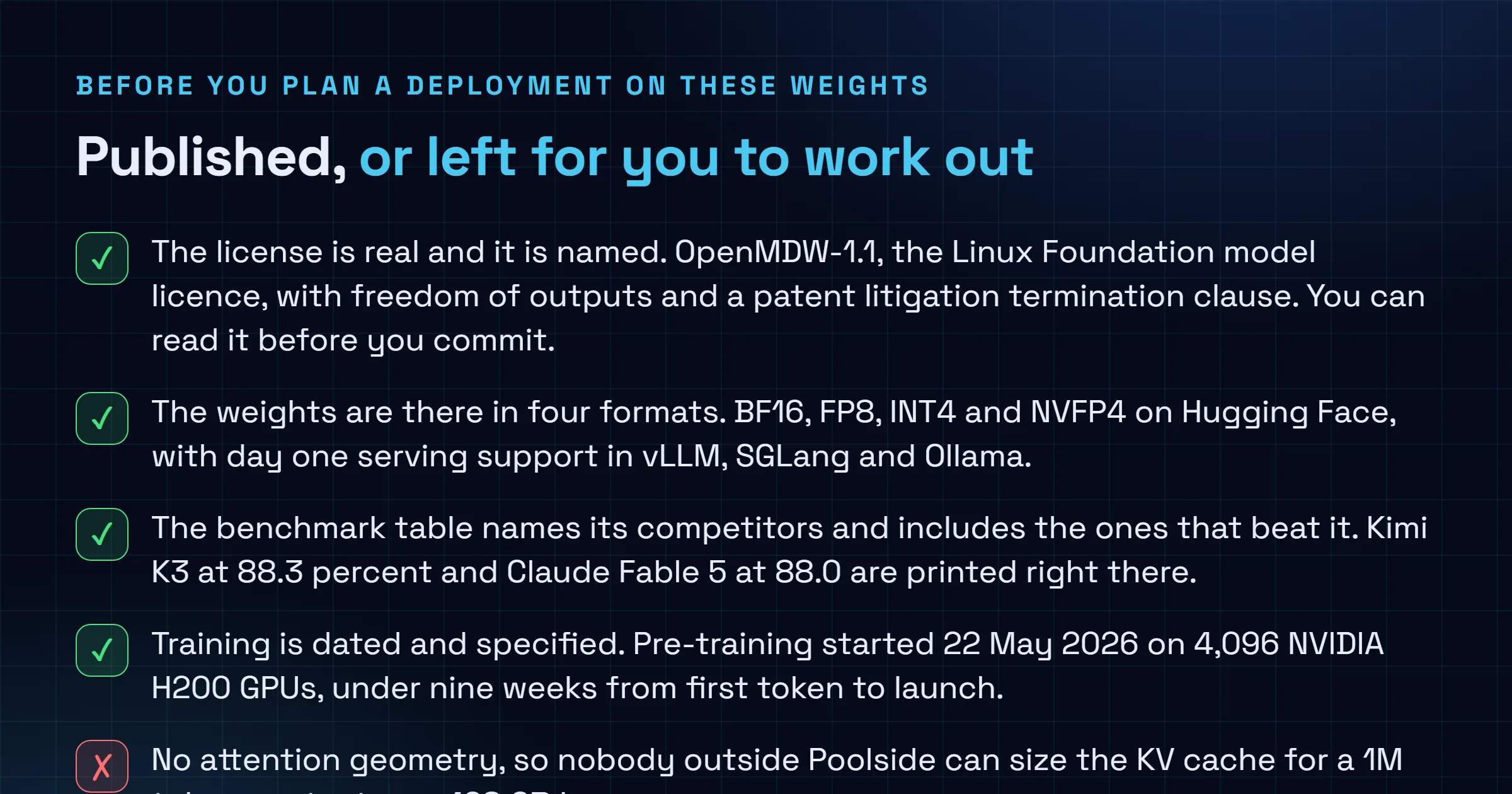
One more number worth keeping. Pre-training started 22 May 2026 on 4,096 NVIDIA H200 GPUs and the model shipped under nine weeks later, with a knowledge cutoff of November 2025. Nine weeks from first token to a public release that lands mid-table against frontier models. That cadence is the actual story here, more than any single benchmark row.
If you want something you can genuinely run on your own metal, this is the most interesting open release of the month, and it isn’t close. Qwen3.7 at the small end still wins if all you have is a workstation GPU. But a Spark plus 59 GB of weights plus a licence your lawyer signs off on is a real deployment path, and last month it wasn’t there.
Sources
The release date, parameter counts, 1M context, benchmark table with all competitor scores, the thinking mode deltas, the OpenRouter pricing, the training start of 22 May 2026 on 4,096 H200 GPUs and the single DGX Spark claim are from Poolside’s own Laguna S 2.1 launch post, which also hosts the announcement graphic. The per-precision footprints, the weight format list and the absence of configurable thinking effort are corroborated by MarkTechPost of 21 July. The 128 GB of unified LPDDR5x and 273 GB/s of peak bandwidth are NVIDIA’s published DGX Spark specifications. OpenMDW-1.1 terms come from the Linux Foundation release announcement. The 59 GB, 118 GB and 236 GB figures are multiplication on the published parameter count, and the roughly 68 tokens per second is our own bandwidth ceiling estimate rather than a measured or vendor-stated result.
Frequently asked questions
What is Poolside Laguna S 2.1?
An open-weight agentic coding model released on 21 July 2026. It is a mixture-of-experts design with 118 billion total parameters and 8 billion activated per token, roughly 6.8 percent of the model on any given token, and it supports a 1M token context in both thinking and no-thinking modes. Poolside publishes the weights on Hugging Face in BF16, FP8, INT4 and NVFP4, and shipped day one serving support for vLLM, SGLang and Ollama.
Can Laguna S 2.1 really run on a single NVIDIA DGX Spark?
At four bits, yes. 118 billion parameters at half a byte each is about 59 GB, and a DGX Spark carries 128 GB of unified LPDDR5x. FP8 puts the weights near 118 GB in that same 128 GB box, which leaves almost nothing for a KV cache, and BF16 at roughly 236 GB needs two linked Sparks or a datacentre node. Worth separating two claims that are both true and not simultaneous: the weights fit, and the model advertises a 1M token window. Poolside does not publish the attention geometry, so nobody outside the company can size that cache against the memory a Spark has left.
Does Laguna S 2.1 beat models ten times its size?
Not on Poolside's own table. On Terminal-Bench 2.1 it scores 70.2 percent against 88.3 for Kimi K3, 88.0 for Claude Fable 5 and 74.5 for Qwen 3.7 Max, all printed in the launch post. Poolside's actual wording is more careful, the most capable agentic coding model in its weight class, and by that reading it holds up well. It does top the published table outright on SWE-Bench Multilingual at 78.5 percent.
What licence do the Laguna S 2.1 weights ship under?
OpenMDW-1.1, the Linux Foundation model licence. It grants permission to deal in the model materials without restriction across copyright, patent, database and trade secret rights, and it explicitly leaves outputs free of attribution requirements, which is the clause that matters if you are shipping a product on top of it. There is a patent litigation termination clause. NVIDIA uses the same licence for its Cosmos, Isaac GR00T and Nemotron families, so it is not a one-off.
How much does hosted Laguna S 2.1 cost?
Through OpenRouter, $0.10 per million input tokens, $0.20 per million output and $0.01 per million on cache reads. A free endpoint runs at 256K context and the full 1M window needs the paid dedicated endpoint. There is also a no-login web chat at chat.poolside.ai, plus hosted access via Baseten, atomic.chat and the Vercel AI Gateway.