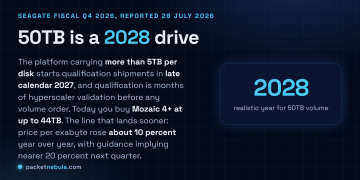





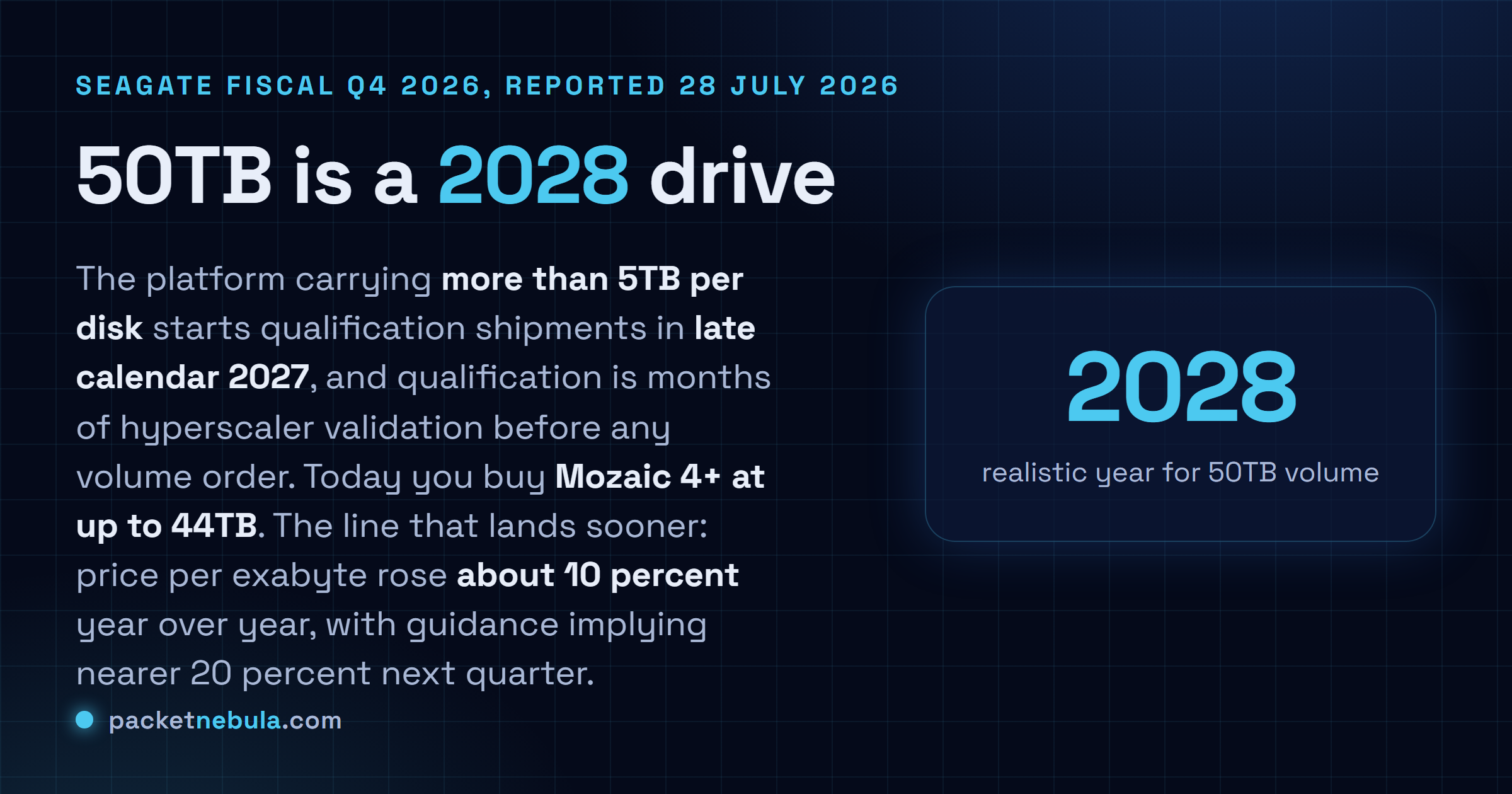
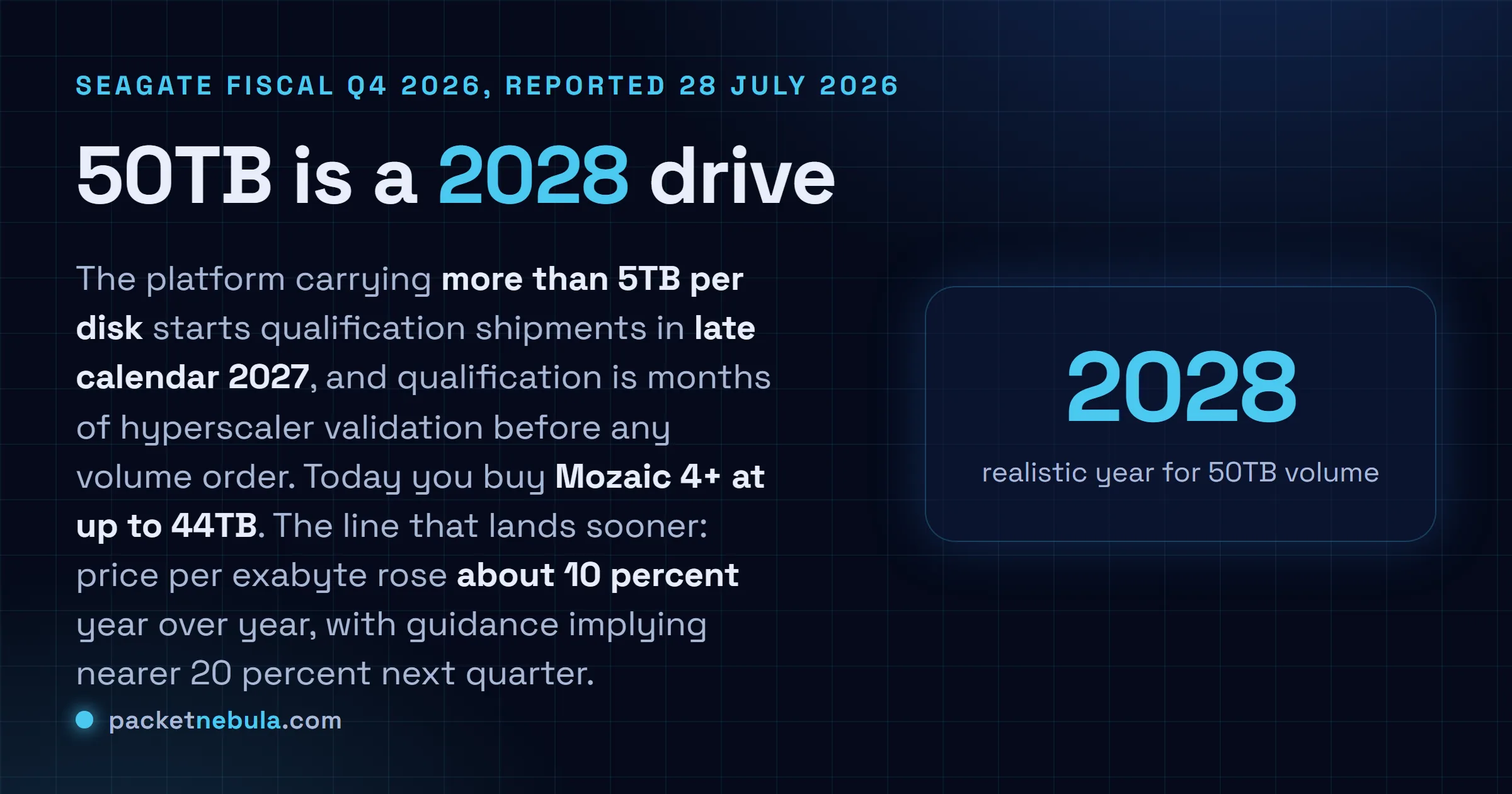
Every headline this week put 50TB in the title, which is fair, because a ten platter drive holding fifty terabytes is a genuinely absurd object. Read the actual timing though and the drive lands in 2028, not next year: Seagate told investors on 28 July that the platform doing 5TB or more per disk starts qualification shipments in late calendar 2027, and qualification is the step before customers get real volume. So that's the correction. The part we'd actually plan around is buried in the same call, where the CFO said the gap between supply and demand is now a little bigger than a few quarters ago, and price per exabyte climbed about 10 percent.
The short answer
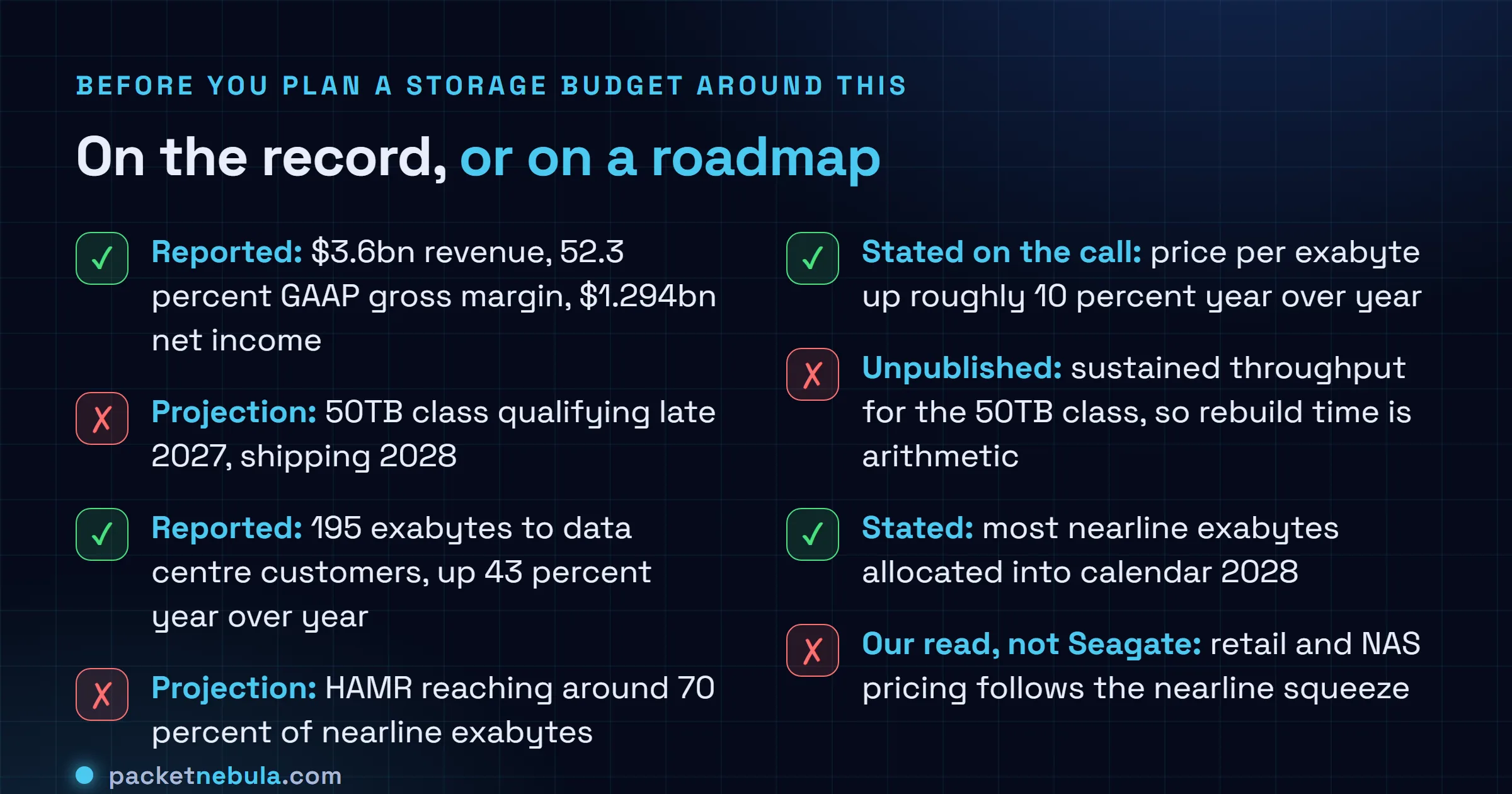
Seagate reported fiscal Q4 2026 on 28 July: $3.6 billion of revenue, 52.3 percent GAAP gross margin, and a roadmap where drives carrying more than 5TB per disk start qualification in late calendar 2027. That puts 50TB-class drives in 2028. Meanwhile the vast majority of nearline exabytes are already allocated into calendar 2028 and price per exabyte is rising. If you buy storage, the pricing line matters more this year than the capacity headline.
Qualification is not shipping
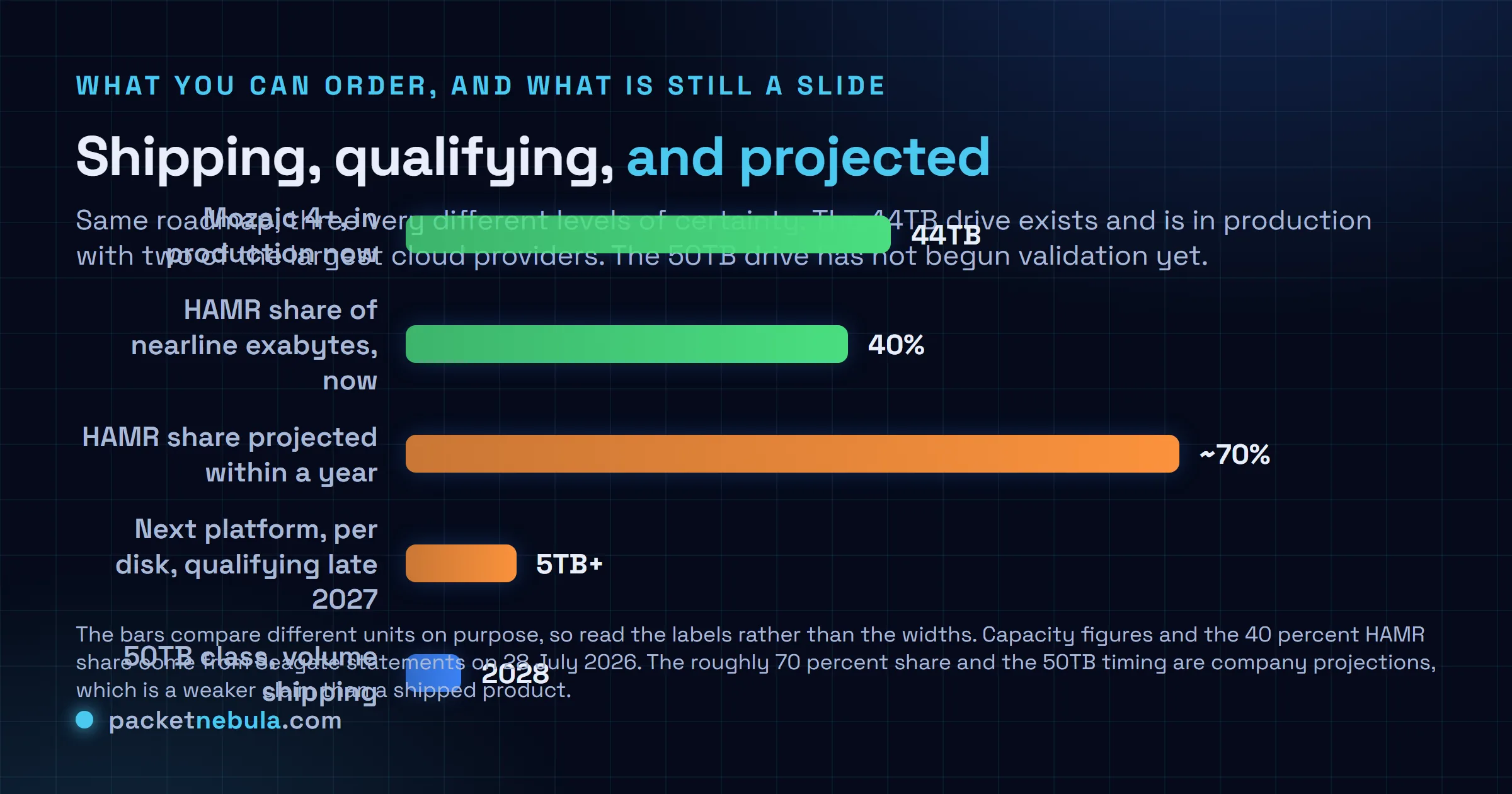
Here is where the 50TB figure comes from. Seagate’s current platform, Mozaic 4+, tops out at 44TB and is in production with two of the largest cloud providers. The next generation moves past 5TB per disk. Stack ten of those platters in one enclosure and you land in 50TB territory, which is the arithmetic CFO Gianluca Romano walked analysts through.
Late calendar 2027 is when those drives go out for qualification.
That word does a lot of work. A hyperscaler takes a new drive, runs it for months against its own failure and firmware expectations, and only then signs a volume order. Nobody buys a nearline drive on a press release. So the honest reading is that 50TB is a 2028 product, and the 2027 date on the roadmap is the start of testing rather than the start of buying. TechSpot and Tom’s Hardware both landed on 2028 for shipments, and we think that’s right.
HAMR itself has stopped being the interesting question, by the way. It hit 40 percent of Seagate’s nearline exabyte shipments this quarter, and the company expects it to reach roughly 70 percent within a year. The heat-assisted recording that took a decade of skepticism is now simply how most of these drives get made.
The number nobody put in a headline
Price per exabyte rose about 10 percent year over year in the quarter. Seagate’s guidance for the September quarter implies closer to 20 percent.
Romano’s phrasing on the call was mild: the gap between supply and demand is now a little bigger than a few quarters ago. Read the margins and it sounds less mild. GAAP gross margin came in at 52.3 percent, on a product category that spent years grinding along in the thirties. Seagate is guiding the September quarter to $4.1 billion of revenue and non-GAAP EPS of $7.30, against $5.71 delivered in the quarter just closed.
Storage vendors do not post those numbers when there’s plenty of supply.
And the allocation picture matches. The vast majority of nearline exabytes are already spoken for into calendar 2028, with customers pushing to reserve 2029. Those are the big cloud contracts, not the drive you’d add to a NAS at home. But it’s the same media, the same heads, the same factories. When a manufacturer can sell every exabyte it makes to hyperscalers at a rising price, the retail channel is not where the discount shows up.
What we’d do with this
If you’re planning capacity for next year, plan it around 44TB and current pricing, not around a 50TB drive you cannot order. Roadmaps slip. Seagate’s own 30TB generation arrived later than first indicated, and this one has an extra qualification cycle in front of it.
Budget for storage getting more expensive per terabyte. That reverses about fifteen years of assumption, and it’s worth saying out loud to whoever signs your purchase orders before they see the quote.
Then there’s the design problem nobody enjoys. Drives keep growing and the interface does not. Seagate has published no sustained throughput number for the 50TB class, so run it as arithmetic: at 250 MB/s a single pass over 50TB takes roughly 55 hours. A parity rebuild reads every surviving member of the group as well, usually while the array is still serving traffic, usually slower than a clean sequential pass. Two of those drives failing in the same window stops being a thought experiment.
Which is why the shops we talk to keep moving to erasure coding with wider stripes, or to mirrored copies across failure domains, rather than trusting a classic parity rebuild to finish before something else breaks. Honestly, I think the capacity race has outrun the redundancy habits most teams still have.
One small thing worth checking before you size anything: a 50TB drive is 50 decimal terabytes, so your filesystem will report roughly 45.5 TiB. That’s a 9 percent gap, and on a rack of these it’s real money. We wrote up why MB and MiB disagree if you want the full version.
The AI connection, stated plainly
CEO Dave Mosley framed the demand as hyperscalers using hard drives to handle the long tail of AI workloads. That tracks. Training runs live on flash, but the training corpus, the checkpoints, the generated output nobody wants to delete, all of it lands on spinning rust because the cost per terabyte still is not close.
So the AI build-out shows up here as a hard drive shortage, the same way it shows up as a 50MW data centre moratorium in New York and as a memory price spike in phones. Different symptom, one cause.
Full year revenue was $12.2 billion, up 34 percent, with $3.1 billion of free cash flow. For a company that was widely written off as a melting ice cube a few years ago, that’s a strange place to end up.
Sources
Seagate’s own numbers come from the fiscal Q4 and fiscal year 2026 results published on 28 July 2026, on the Seagate investor relations site. The roadmap and pricing commentary comes from the earnings call the same day, summarised in this call breakdown. Capacity and timing reporting from TechSpot and Tom’s Hardware. The rebuild timing in this piece is our own arithmetic from an assumed sustained rate, not a Seagate specification.
Frequently asked questions
When will Seagate 50TB hard drives actually be available?
Not in 2027. On the 28 July 2026 earnings call Seagate said the next Mozaic platform, the one carrying more than 5TB per disk, begins qualification shipments in late calendar 2027. Qualification means a hyperscaler runs the drive through months of validation before buying at volume, so broad availability lands in 2028. Coverage from Tom's Hardware and TechSpot reads the timing the same way.
What capacity can I buy from Seagate right now?
The current top of the range is the Mozaic 4+ platform at up to 44TB, which Seagate says is qualified and in production with two of the largest cloud providers. HAMR drives accounted for 40 percent of the company's nearline exabyte shipments in the quarter, so this is no longer a pilot technology, it is most of the roadmap.
Are hard drives really sold out through 2028?
For the data centre side, close to it. Seagate told investors the vast majority of its nearline exabytes are already allocated into calendar 2028, and that customers are asking to plan into 2029. That is allocation of the big cloud contracts rather than a note about retail shelves, but the same wafers, media and heads feed both.
Why are hard drive prices going up?
Supply is not keeping up with AI-driven storage demand. Seagate reported price per exabyte up roughly 10 percent year over year in its fiscal Q4, and its guidance implies something nearer 20 percent for the September quarter. CFO Gianluca Romano said the gap between supply and demand is now a little bigger than a few quarters ago. Gross margin of 52.3 percent on GAAP tells the same story from the other end.
How long does a 50TB drive take to rebuild in an array?
Long enough to change how you design storage. Seagate has not published sustained transfer figures for the 50TB class, so treat this as arithmetic rather than a spec: at a sustained 250 MB/s, one full pass over 50TB runs about 55 hours. Parity rebuilds read every other member of the group too, and they usually run slower than that while serving live traffic.
What did Seagate report for fiscal Q4 2026?
Revenue of $3.6 billion for the quarter ended 3 July 2026, GAAP gross margin of 52.3 percent and non-GAAP of 52.7 percent, GAAP diluted EPS of $5.58 and non-GAAP of $5.71, with net income of $1.294 billion. Full year revenue reached $12.2 billion, up 34 percent, on record free cash flow of $3.1 billion. Guidance for the September quarter is $4.1 billion in revenue, plus or minus $100 million.