
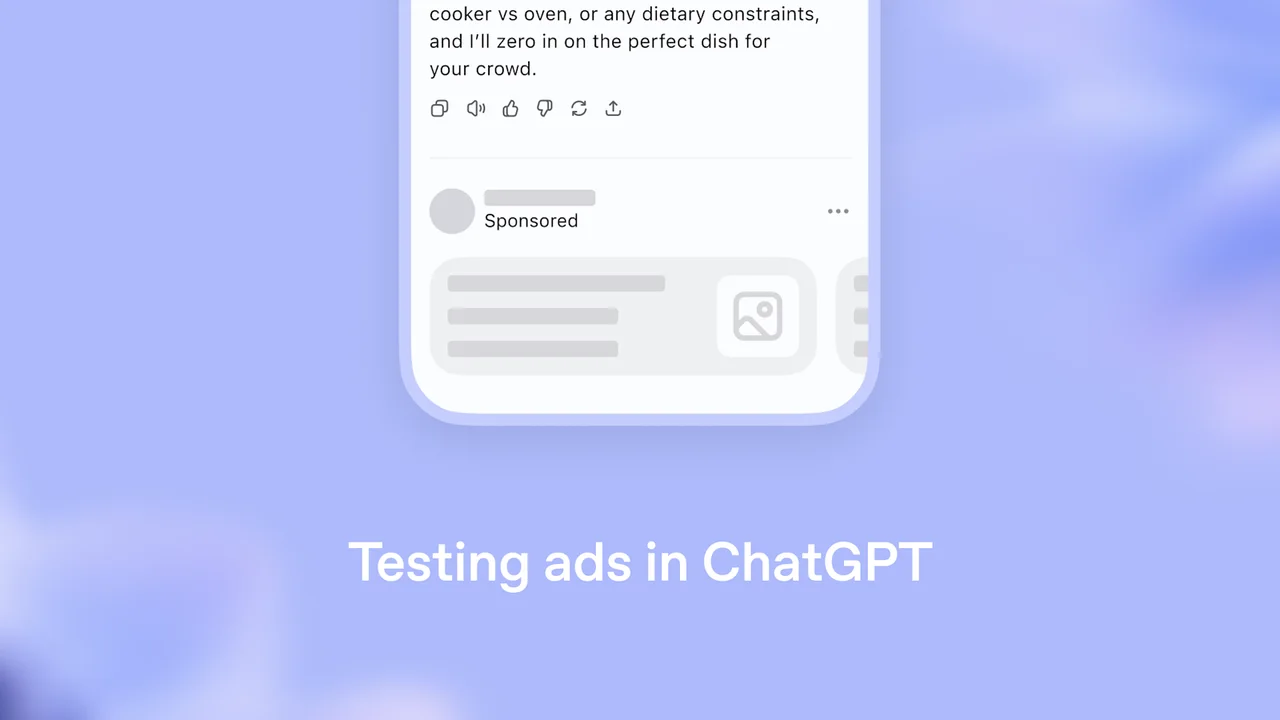
So the thing Sam Altman once called a last resort just got a self-serve dashboard. On July 22 OpenAI opened Advertise in ChatGPT, a place where any brand can build a campaign and point it at people mid-conversation. That's the news. Here's the part we actually care about: the ads only hit Free and Go users, they sit in a Sponsored block under the answer, and the old fifty-grand minimum is gone, so small shops can buy in now. We went looking for the clean version of the numbers and didn't find one. Sources disagree on the entry budget. They agree on the shape of it, though, and the shape is what changes your week.
The short answer
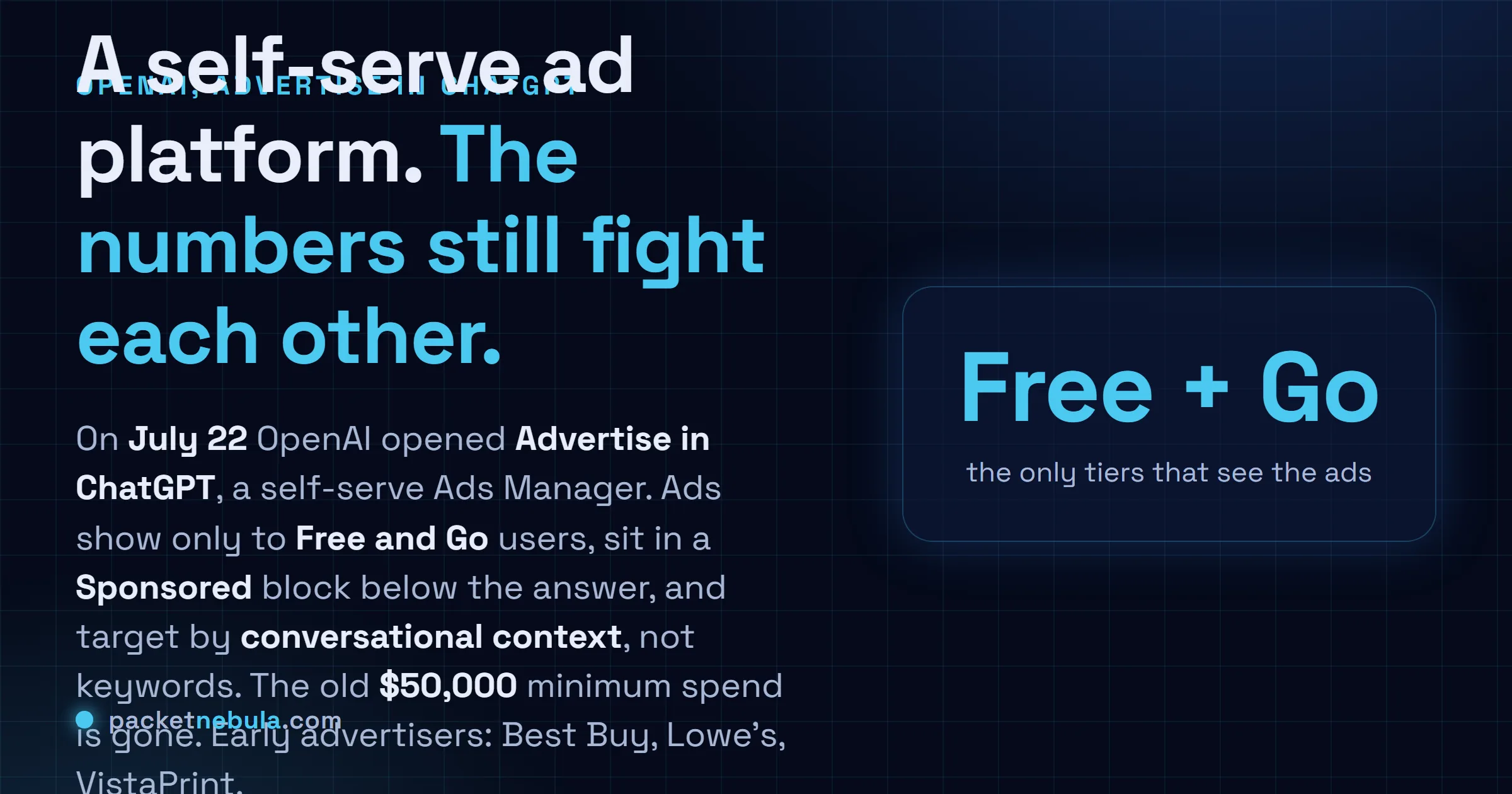
OpenAI opened Advertise in ChatGPT, a self-serve platform for buying ads that show up mid-conversation. They only reach Free and ChatGPT Go users, they live in a labeled Sponsored block under the answer, and they target by what you’re talking about rather than keywords. The old $50,000 floor is gone. The exact entry budget, though, depends which write-up you trust.
What OpenAI actually opened
Advertise in ChatGPT is a self-serve Ads Manager. You go in, build a campaign, set a budget, and choose who you want to reach. If you’ve ever touched Google or Meta’s ad tools, the concept is familiar. What’s new is where the ad lands and how it targets.
The targeting isn’t keywords. OpenAI pitches it as “conversational context,” which is a polite way of saying the ad reads the drift of what you’re asking. Someone researching a laptop upgrade in chat is a different signal than someone typing “best laptop” into a search box, and that’s the whole sales pitch. Best Buy, Lowe’s and VistaPrint ran early campaigns. A Best Buy exec talked up reaching customers in the actual research moment.
Worth saying plainly: this didn’t drop out of nowhere on July 22. OpenAI had been testing sponsored placements for months and ran a paid pilot first. July 22 is the day the doors opened to everyone, and the day the old $50,000 minimum spend went away. That removal is the real unlock. It’s what turns this from an enterprise experiment into something a small shop can buy.
Who sees it, and where it sits
Here’s the reassuring bit if you’re a heavy ChatGPT user. Ads only reach Free and ChatGPT Go accounts. Pay for Plus, Pro or Business and you see none of this. Under-18 accounts are out too.
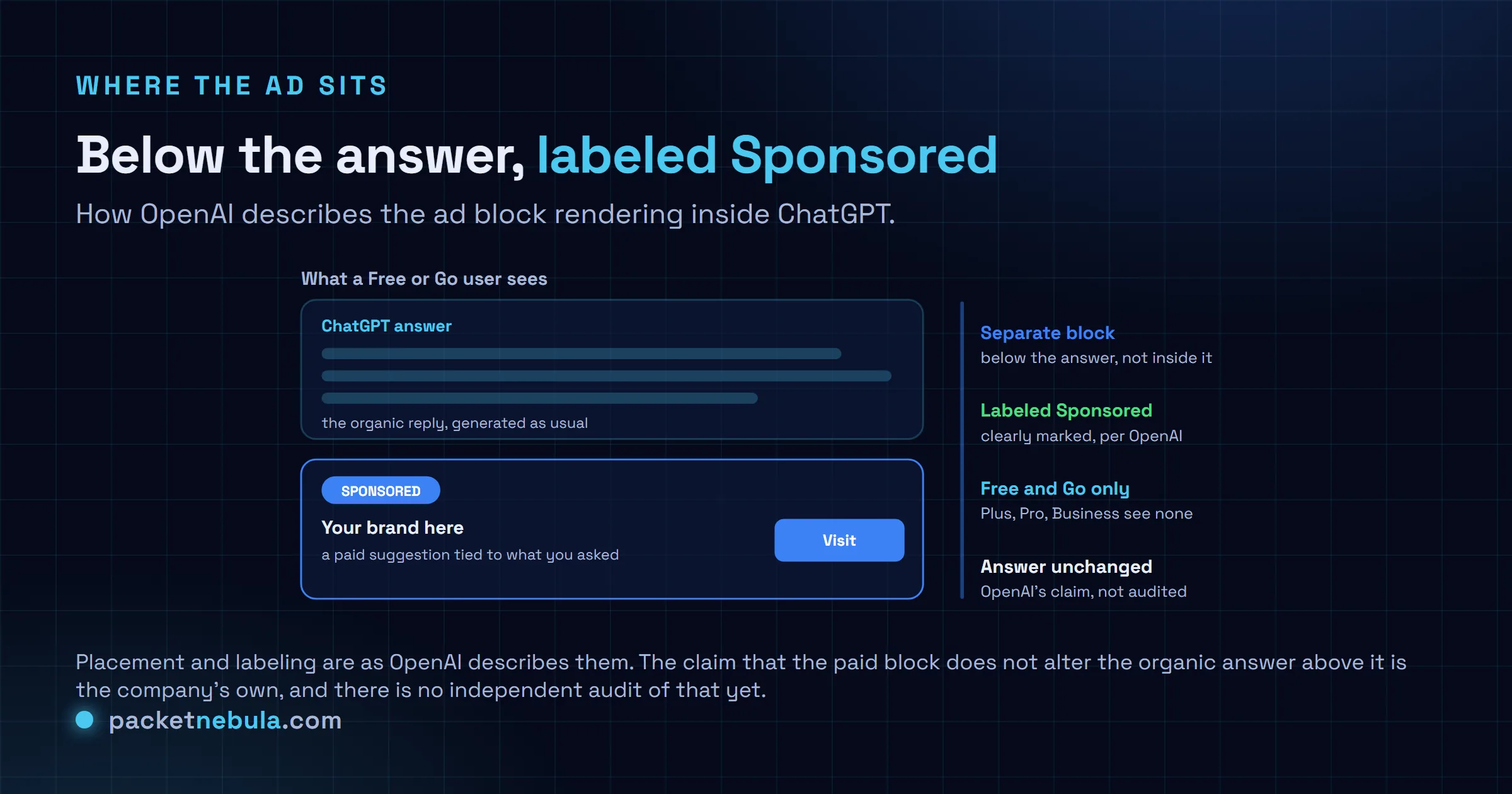
The format is a Sponsored block that sits below the answer, styled as its own card, clearly labeled. OpenAI’s line is that the ad doesn’t alter the organic answer it appears next to. I want to believe that, but it’s the company’s own word and nobody outside OpenAI has audited it. So we file it as a claim. The labeling and the separation are visible and real. The promise about answer integrity is a trust exercise for now.
The numbers nobody agrees on
This is where the coverage falls apart, and it’s the most useful thing we can tell you. Read four write-ups and you get four versions of the money.
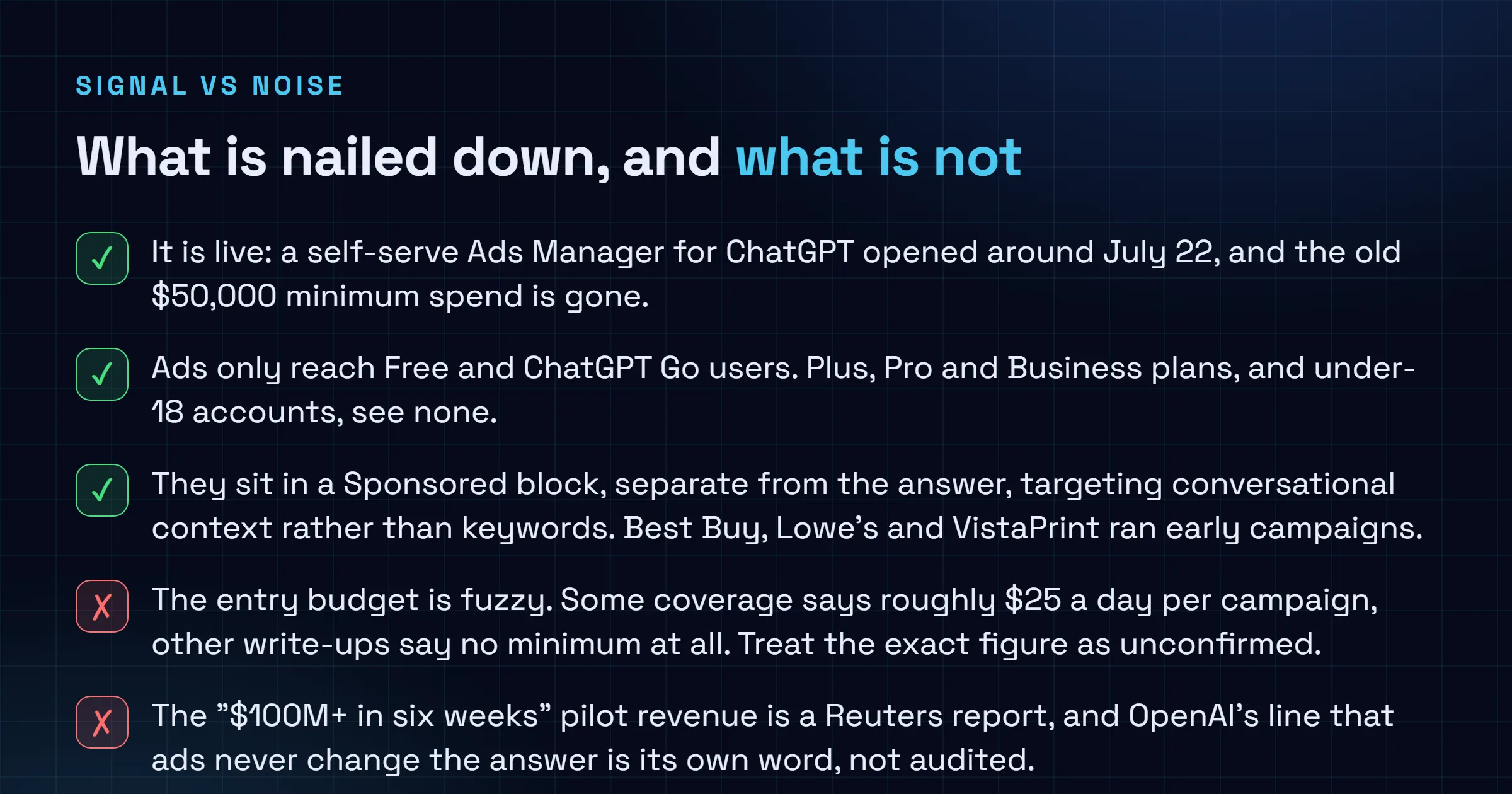
The $50,000 minimum being gone is consistent across sources. Past that, it splits. One camp says the entry point is roughly $25 a day per campaign. Another says there’s no minimum at all. Some coverage still quotes a $60 CPM from the pilot phase and a shift to cost-per-click bidding. We’re not going to pick a winner and print it as fact, because that’s exactly how a made-up number ends up quoted everywhere. If the exact rate matters for your budget, wait for OpenAI’s own rate card and treat the blog figures as noise until then.
Same with the eye-catching revenue line. You’ll see “$100 million-plus in six weeks” thrown around. That traces to a Reuters report on the US pilot, not an OpenAI disclosure, so it’s reporting, not a filing.
What it means for you
If you buy ads, the interesting change is the floor coming down. A channel that used to want $50,000 to talk to you now, in theory, doesn’t. That’s worth a small test if your customers are the type to research inside a chatbot. Early feedback we’ve seen is mixed, with at least one advertiser calling it expensive against plain search after two weeks. So test small, measure, don’t bet the quarter on it.
If you run websites for a living, the slower signal is the one to sit with. Search isn’t the only place buying intent lives anymore. When people ask ChatGPT what to buy and brands can pay to sit next to that answer, some share of the research that used to start on Google now starts in a chat window. It doesn’t break your SEO today. It’s a reminder that the map of where intent shows up keeps moving, which is part of why we keep arguing that owning your own fast, static pages beats renting attention on someone else’s surface.
And the human note. Back in 2024 Altman said “Ads plus AI is sort of uniquely unsettling to me,” and framed advertising as a last resort. Two years and a lot of compute bills later, the last resort has a self-serve dashboard. Make of that what you will. It’s the same company shipping the GPT-5.6 line, now funded partly by the thing its CEO said he’d only reach for if he had to.
Sources
The self-serve launch, plan exclusions and format as reported by OpenAI and rounded up in Build Fast with AI, with the self-serve Ads Manager details and the removal of the $50,000 minimum from EasyInsights. The Altman “last resort” quote and business context via Tuta. The budget figures conflict across these sources and are flagged as unconfirmed above; the six-week pilot revenue figure is a Reuters report, not an OpenAI disclosure.
Frequently asked questions
When did OpenAI launch ads in ChatGPT?
OpenAI opened its self-serve Advertise in ChatGPT platform around July 22, 2026, letting advertisers build campaigns without a large minimum. It was not a cold start. The company had been testing sponsored placements earlier in 2026 and ran a paid pilot before this. July 22 is when the self-serve Ads Manager opened up and the old $50,000 minimum spend went away.
Who sees ads in ChatGPT?
Only Free and ChatGPT Go users. Paid tiers, meaning Plus, Pro and Business, do not see ads, and accounts flagged as under 18 are excluded too. If you pay for ChatGPT, this rollout does not drop ads into your chats.
How are the ads shown?
They appear in a Sponsored block that sits below the model's answer, visually separated from it. OpenAI says the paid block does not change the organic answer above it. That is the company's own statement, and there is no independent audit of it yet, so treat it as a claim rather than a proven fact.
How much does it cost to advertise on ChatGPT?
This is the fuzzy part. The headline change is that the previous $50,000 minimum spend is gone, which opens the door to small businesses. Beyond that, coverage disagrees. Some reports cite roughly $25 a day per campaign, others say there is no minimum at all. Until OpenAI publishes clear rate-card details, treat any single figure as unconfirmed.
Does this change SEO or how I get traffic?
Not directly, not yet. Ads only show to Free and Go users and sit beside the answer, not inside it. But it is a signal worth watching. If people research purchases inside chat and brands can pay to appear there, that is another surface competing with search for the same intent. For now it is a marketing channel to test, not a reason to rebuild anything.


