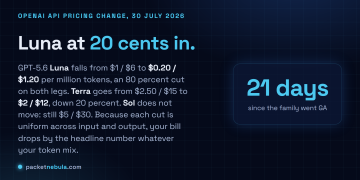





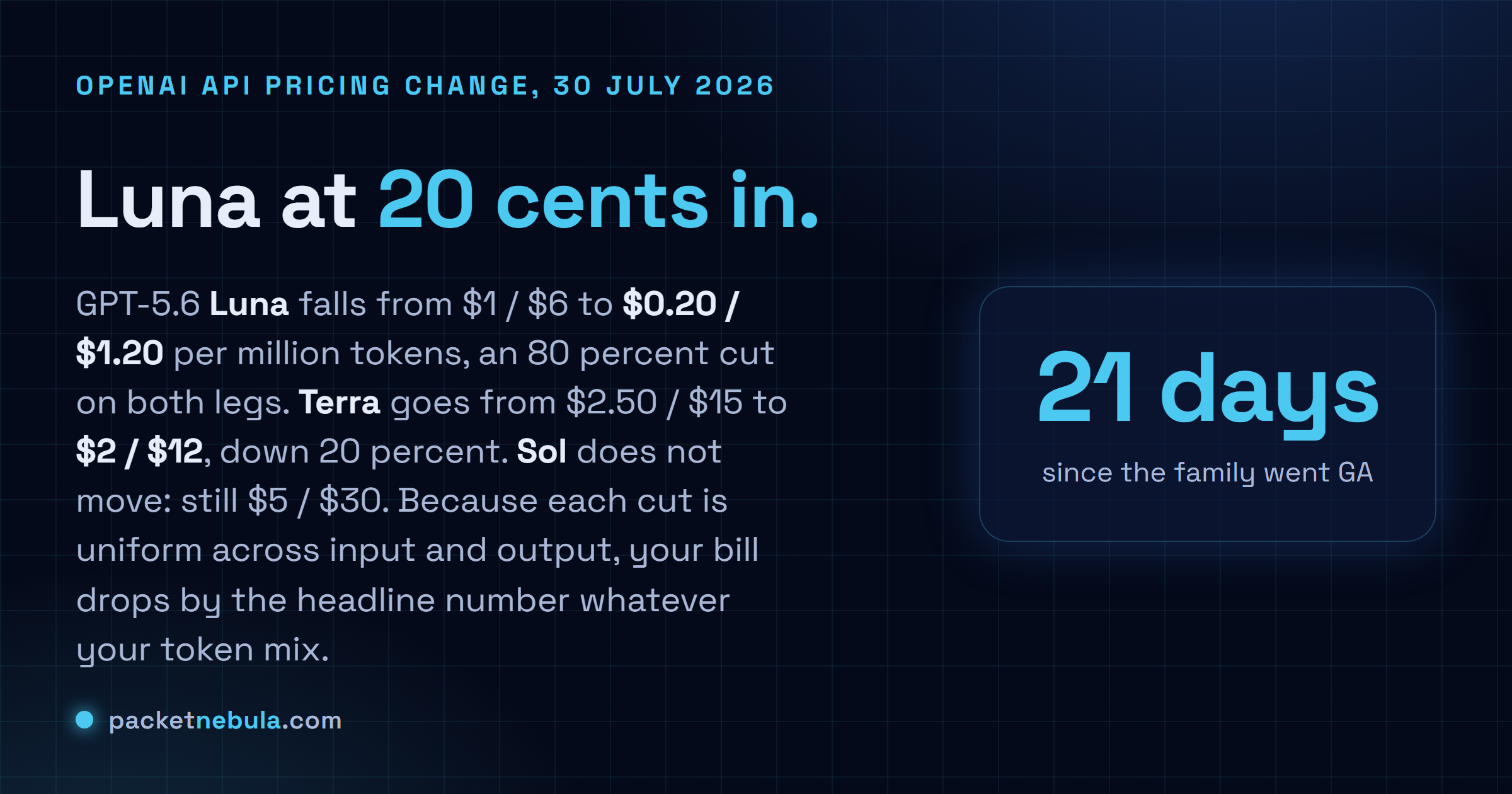
Somebody on your team benchmarked GPT-5.6 three weeks ago and picked a tier. That estimate is now wrong. On 30 July OpenAI cut the API price of GPT-5.6 Luna by 80 percent and Terra by 20 percent, and left Sol exactly where it was at $5 in and $30 out per million tokens. Luna is the one to stare at. A dollar and six dollars became twenty cents and $1.20, and the reduction is the same 80 percent on input as on output, so a bill drops by the headline number whatever your token mix looks like. Terra gets the tidier version, a flat fifth off both legs. The thing nobody put in a headline is what this does to the distance between the rungs. It used to be five times from the cheapest tier to the top one. It's twenty-five now.
The short answer
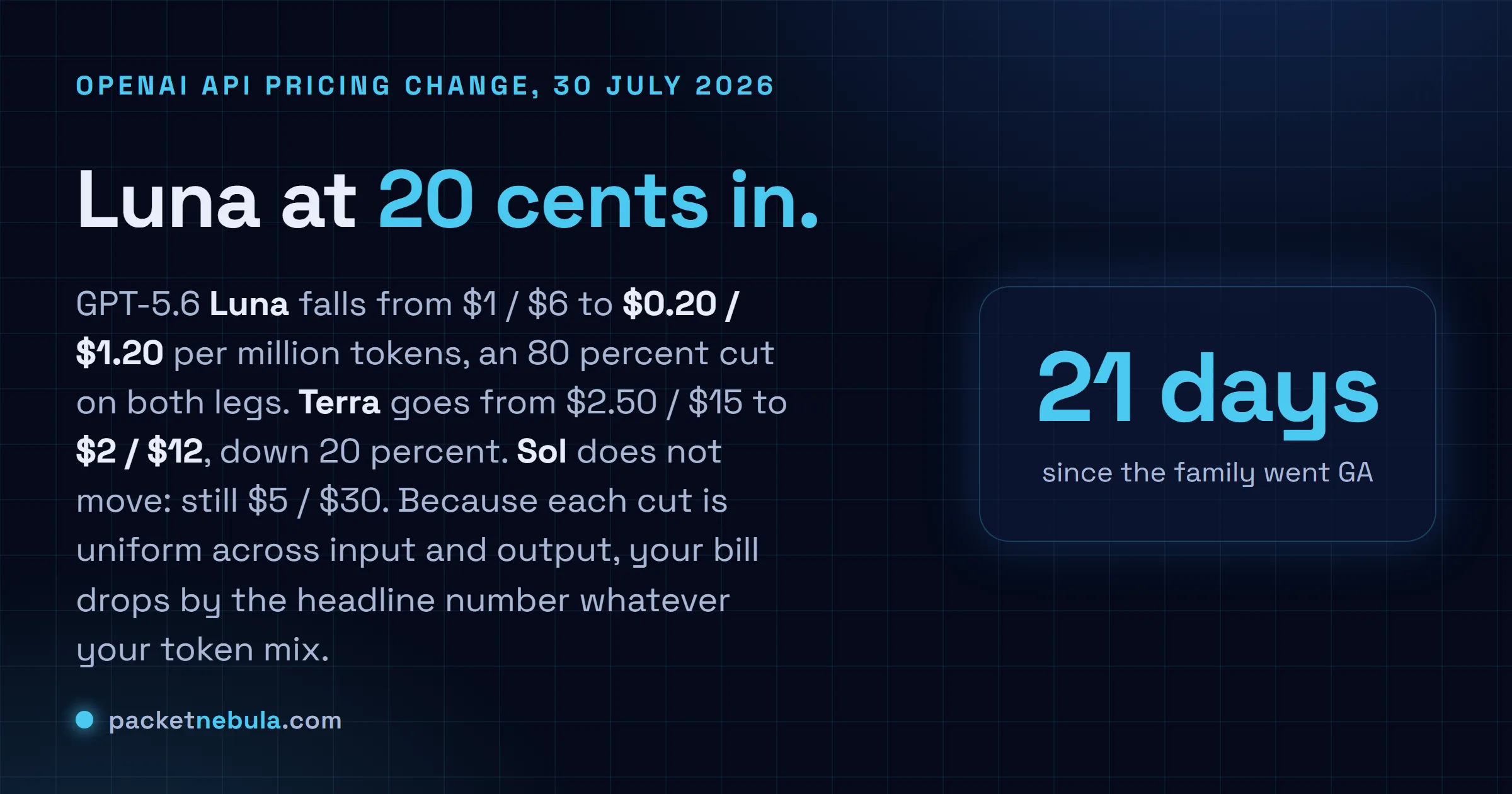
On 30 July 2026 OpenAI repriced the two lower GPT-5.6 tiers. Luna goes from $1 / $6 to $0.20 / $1.20 per million tokens, Terra from $2.50 / $15 to $2 / $12, and Sol holds at $5 / $30. Each cut applies equally to input and output, so no token mix changes the arithmetic. The consequence worth acting on is the widened spread between tiers, which makes routing decisions matter far more than they did at launch.
What actually changed
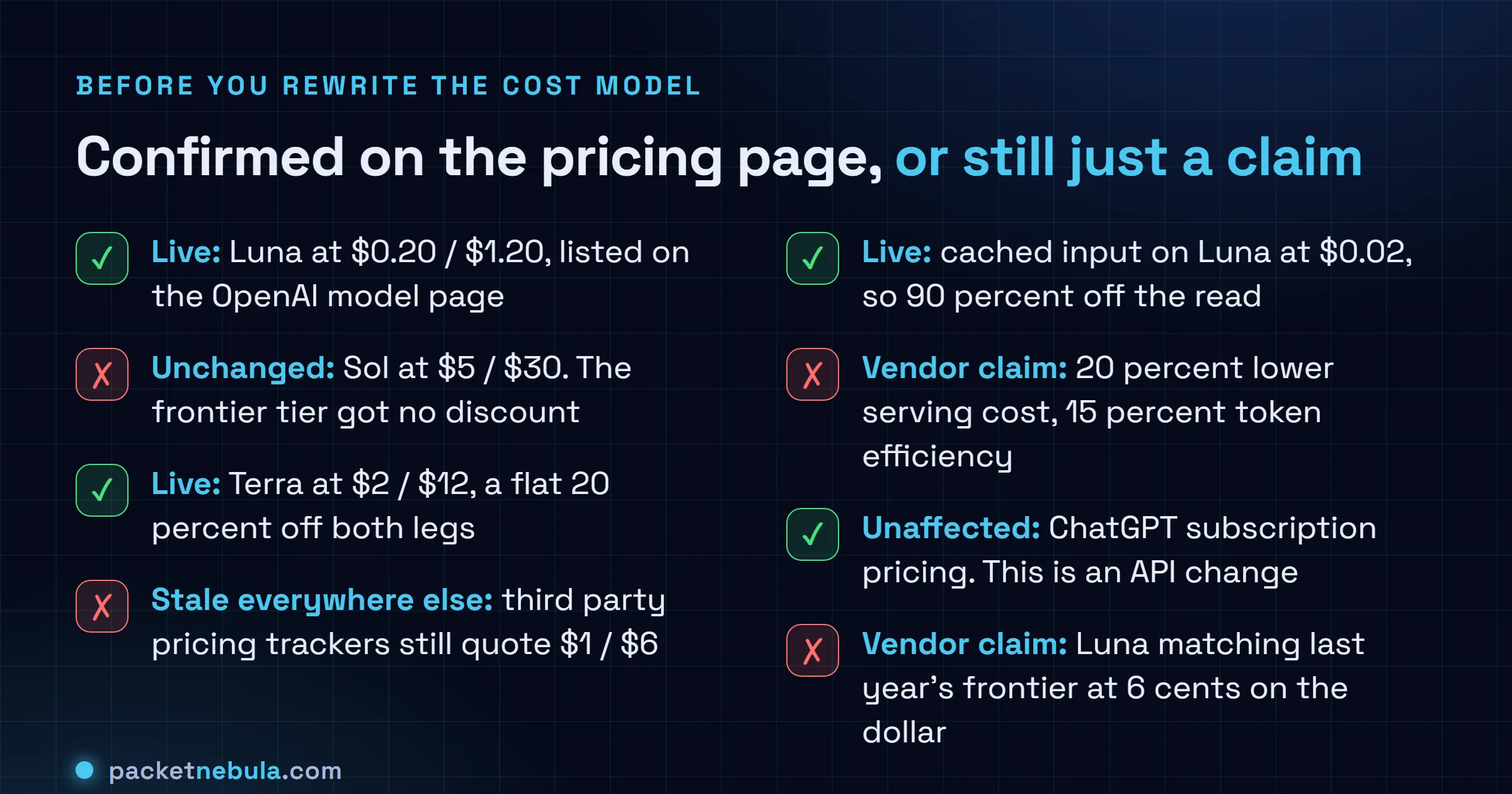
Three numbers, and they’re already live on the model pages. Luna: $0.20 per million input tokens, $1.20 per million output. Terra: $2 and $12. Sol: $5 and $30, same as it was on 9 July, same as GPT-5.5 charged before it.
The detail we’d flag first is that both cuts are uniform. Vendors love an asymmetric discount, usually a deep cut on input because input is cheap to serve and it makes the percentage look bigger than the saving. Not here. Luna’s input fell exactly 80 percent and so did its output. Terra fell exactly 20 percent on each. That means you don’t need to model your input-to-output ratio to know what happens to your invoice. It falls by the headline number. That’s rarer than it sounds, and it’s the reason this one is easy to act on.
Caching survives intact. Luna’s cached input reads at $0.02 per million on OpenAI’s own page, the usual 90 percent off, and the batch route still carries its own discount. So the floor under a well-cached high-volume workload just moved a long way down.
What didn’t change: Sol. If your agent loop runs on the frontier tier, congratulations, your bill on 31 July is identical to your bill on 29 July. We had a moment of thinking the headline applied to us before checking, and we suspect we won’t be the only ones.
The spread, not the discount
Here’s the part that actually reshapes architecture.
At general availability on 9 July, the ladder was gentle. Sol cost five times Luna on input and five times on output. We wrote at the time that Terra was the sensible default, and at $2.50 against $1 for Luna that was an easy call, because the quality difference bought more than the 2.5x price difference did.
Run the same division today. Sol against Luna is 25x on input and 25x on output. Terra against Luna is 10x. The tiers didn’t get closer together, they flew apart, and a routing mistake that used to cost you a small multiple now costs an order of magnitude.
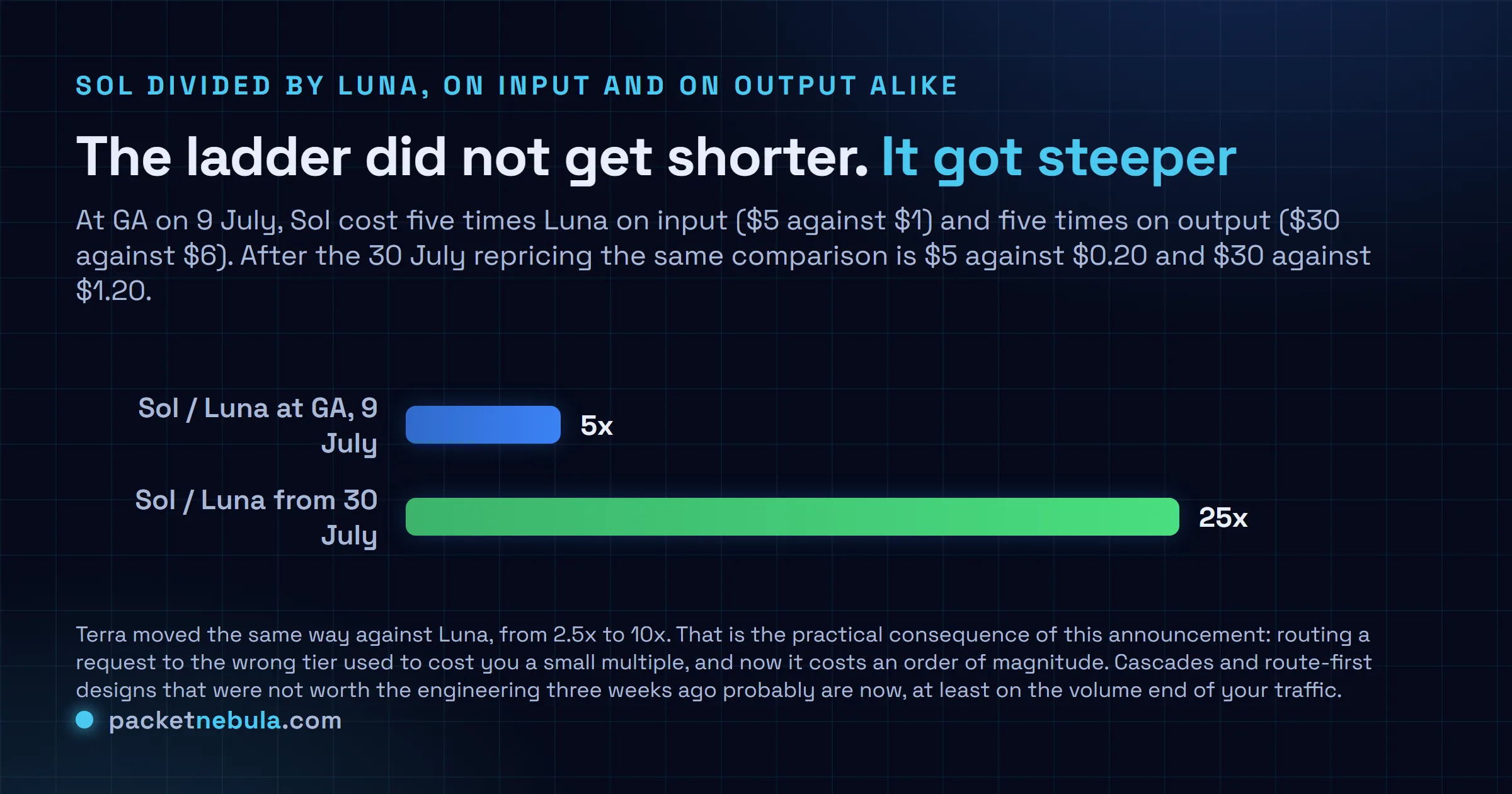
Which changes the calculus on cascades. A route-first design, where a cheap model handles the request and escalates only when it can’t, carries real engineering cost: a classifier, an escalation path, evaluation on both legs. At 2.5x savings that overhead rarely paid for itself and we mostly told people not to bother. At 10x it’s a different conversation, and on high-volume classification or extraction work it’s probably now the right answer.
Against a real bill
Say a modest production workload, 10 million input tokens and 2 million output tokens a day. Nothing exotic.
On Luna that used to be $10 plus $12, so $22 a day. Now it’s $2 plus $2.40, so $4.40. Over a month, roughly $660 becomes $132.
Terra on the same traffic was $25 plus $30, so $55 a day, and it’s now $20 plus $24, so $44. About $1,650 a month down to $1,320. Useful, not transformative.
Sol on that traffic is $50 plus $60, which is $110 a day, and it was $110 a day last week too.
So the honest summary: this is a volume play. If you’re spending real money at the bottom of the ladder, you just got a five-fold cut. If you’re spending real money at the top, you got a press release.
What we can verify, and what we can’t
The prices are checkable, and we checked them on the model pages rather than trusting the coverage. Worth doing yourself, because most third party pricing trackers were still quoting $1 / $6 for Luna hours after the announcement. Aggregator pages lag. Treat them as a starting point and confirm against the vendor.
The reasoning behind the cut is a different category of claim. OpenAI says it found roughly 20 percent lower end to end serving cost and better than 15 percent token generation efficiency, partly through work the model itself did on production code. Plausible, unaudited, and exactly the kind of number a company controls the definition of. Sam Altman has called costs “a huge issue” in recent remarks, which is at least a candid framing of why a discount lands three weeks into a launch.
The one to be most careful with: OpenAI’s claim that Luna matches models that were frontier-class a year ago at around six cents on the dollar per task, at nearly nine times the speed. Per task, not per token, which quietly folds in how many tokens the model spends thinking. It might well be true. It’s also unfalsifiable without their task set, so don’t put it in a budget.
Do you move
Not automatically. Nothing about any model’s quality changed on 30 July, only the invoice. Luna is exactly as good or as bad as it was when you last tested it, and if it flunked your accuracy bar in early July it still flunks it.
What changed is that the test is now worth rerunning, because the prize got five times bigger. Pull your evaluation set out, run Luna against it again, and see whether the tasks you rejected it for were genuinely beyond it or whether you rejected it on a cost-benefit calculation that no longer holds. That second category is where the money is. For the comparison against the previous generation, our GPT-5.6 against GPT-5.5 write-up still stands, with every price in it now stale for the bottom two tiers.
And a small note on planning. Two repricings inside a month, on a family that shipped in July, tells you the cost floor under this generation isn’t settled. We wouldn’t rebuild an architecture around a price that’s moved twice in three weeks. Build the routing layer so the tier is a config value, and let the next cut be somebody else’s migration.
Sources: the announcement and the rationale come from OpenAI’s own post, Advancing the price-performance frontier with GPT-5.6 (30 July 2026), with the live per-token rates and the $0.02 cached input figure taken from the GPT-5.6 Luna model page in the OpenAI API documentation. The old and new prices, the Fast mode rates and the general availability date are corroborated by Unite.AI. The serving cost and token efficiency figures, the Sam Altman quote and the enterprise spending context are reported by Yahoo Finance and CNBC.
What changed since
9 July 2026. OpenAI released GPT-5.6 to everyone after a US safety review, as three tiers rather than one model: Sol, Terra and Luna. The launch prices are the ones this price cut replaced.
30 July 2026. The cut described above.
Two later changes are worth knowing if you are picking a tier today. Sol reached ChatGPT before the API in August, and an Ultrafast preview appeared on 13 August running Sol at up to 750 tokens a second with no published price.
Frequently asked questions
How much does GPT-5.6 cost after the 30 July 2026 price cut?
Per million tokens: Luna is $0.20 input and $1.20 output, Terra is $2 input and $12 output, and Sol is unchanged at $5 input and $30 output. Cached input reads are 90 percent cheaper, which puts Luna cached input at $0.02 per million on OpenAI's own model page.
Which GPT-5.6 tiers got cheaper?
Only the two lower tiers. Luna fell 80 percent and Terra fell 20 percent, both uniformly across input and output tokens. Sol, the frontier tier, did not move at all, so anyone running most of their volume through Sol sees no change in their bill from this announcement.
Did the GPT-5.6 price cut change ChatGPT subscription prices?
No. This is an API pricing change, so it affects what you pay per token when you call the models yourself. ChatGPT consumer and business plan pricing was not part of the announcement.
Why did OpenAI cut GPT-5.6 prices three weeks after launch?
OpenAI attributes it to efficiency gains found after launch, citing roughly a 20 percent reduction in end to end serving cost and over 15 percent better token generation efficiency. The commercial backdrop is real too: reporting around the announcement points to enterprise buyers getting stricter about AI spend, and to pressure from cheap open weight models.
Should I switch from Terra to Luna now that Luna is 80 percent cheaper?
Only after you rerun your own evaluation. The price gap between Terra and Luna widened from 2.5x to 10x, which makes the test worth doing, but nothing about Luna's quality changed on 30 July. If Luna failed your accuracy bar three weeks ago, it still fails it, just more cheaply.