

So NVIDIA put a 102.4-terabit-per-second Ethernet switch on stage on July 21, and the number is doing a lot of heavy lifting. Here's the short answer: Spectrum-6 roughly doubles the per-chip bandwidth of the last generation, it's built for the Vera Rubin AI-factory platform, and its real headline isn't the terabits, it's co-packaged optics finally landing in a mainstream Ethernet switch. We went through NVIDIA's own numbers and the trade coverage, because a switch aimed at 100,000-GPU fabrics is not a switch for your rack, and the efficiency claims all carry quiet qualifiers. Worth pulling apart before anyone repeats the 102.4 on a slide.
The short answer
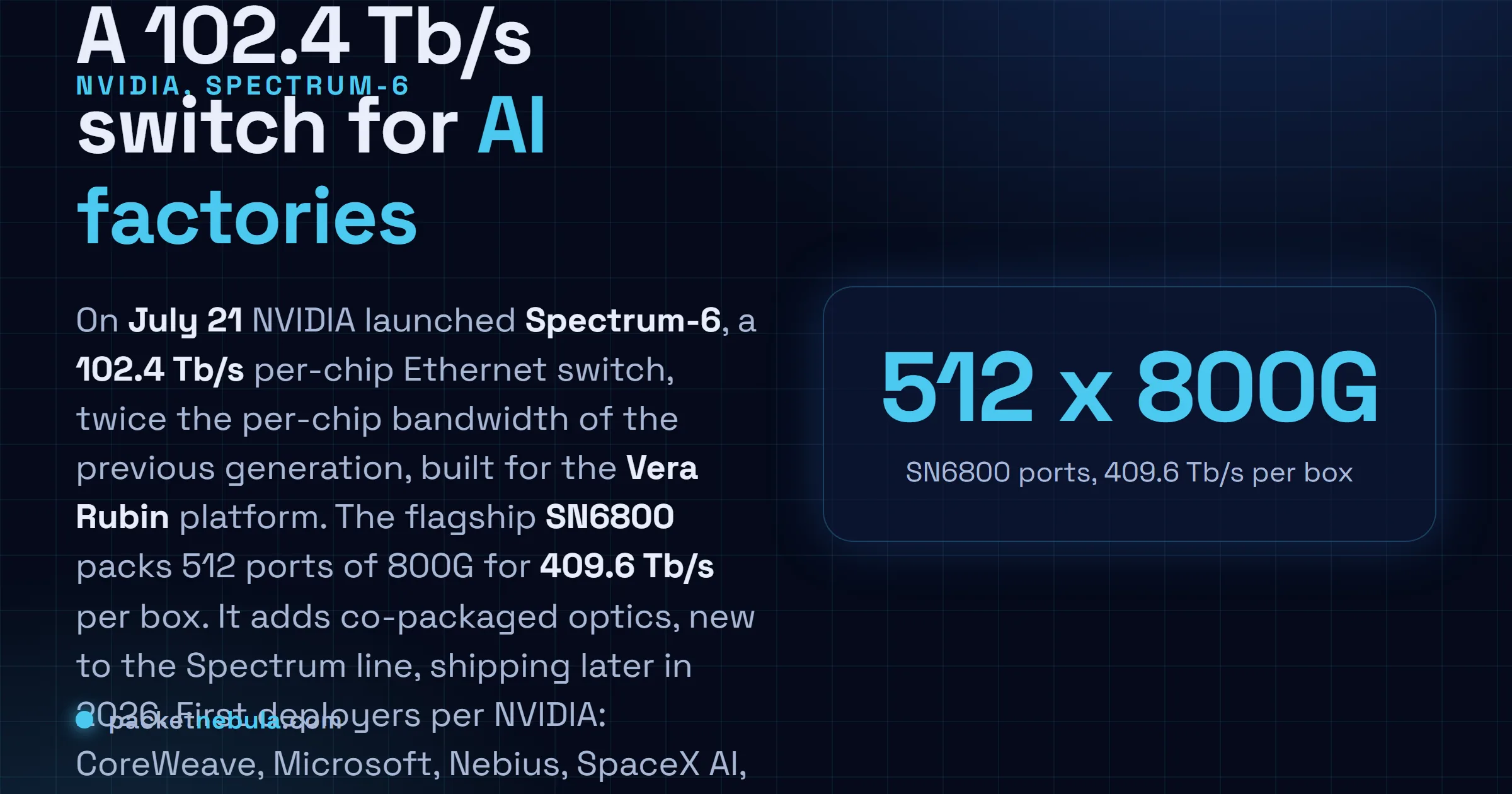
NVIDIA launched Spectrum-6 on July 21, a 102.4 Tb/s per-chip Ethernet switch for the Vera Rubin platform. It’s double the previous generation’s per-chip bandwidth, and the flagship SN6800 does 512 ports of 800G. The number everyone will quote is the terabits. The thing that actually matters is co-packaged optics arriving in a mainstream switch. Here’s how to read it without swallowing the marketing.
What NVIDIA actually announced
A switch got twice as fast. That’s the honest one-liner.
On July 21, NVIDIA introduced Spectrum-6, the next generation of its Spectrum-X Ethernet switching. The one number it leads with: 102.4 Tb/s per switch chip, which NVIDIA describes as twice the capacity of the previous generation. It gets there with 200G PAM4 SerDes, the electrical signaling that lets each lane run faster. The flagship box, the SN6800, lines up 512 ports of 800G for 409.6 Tb/s of switching in a single chassis. There’s a smaller sibling too, the SN6810, at 128 ports of 800G.
Image: NVIDIA (Spectrum-X Ethernet, the platform Spectrum-6 slots into)
This is the networking half of Vera Rubin, NVIDIA’s post-Blackwell platform. We wrote about what Vera Rubin actually is when Bristol Myers Squibb committed to a cluster, and the shape is the same here: the compute got the headlines, and the switch fabric that stitches those GPUs into one machine tends to get skipped. Spectrum-6 is that fabric.
The 102.4, read carefully
Here’s where people trip. 102.4 Tb/s is the aggregate of a single switch ASIC, not a port speed.
Per port, you’re getting 800G. The 102.4 is what one chip can move across all its ports at once. And the 409.6 Tb/s figure you’ll also see quoted is a different unit again: that’s a whole SN6800 box, multiple switch chips behind 512 ports. So if you line up “102.4” and “409.6” in the same sentence, you’re mixing per-chip and per-box. Not wrong, just two scales.
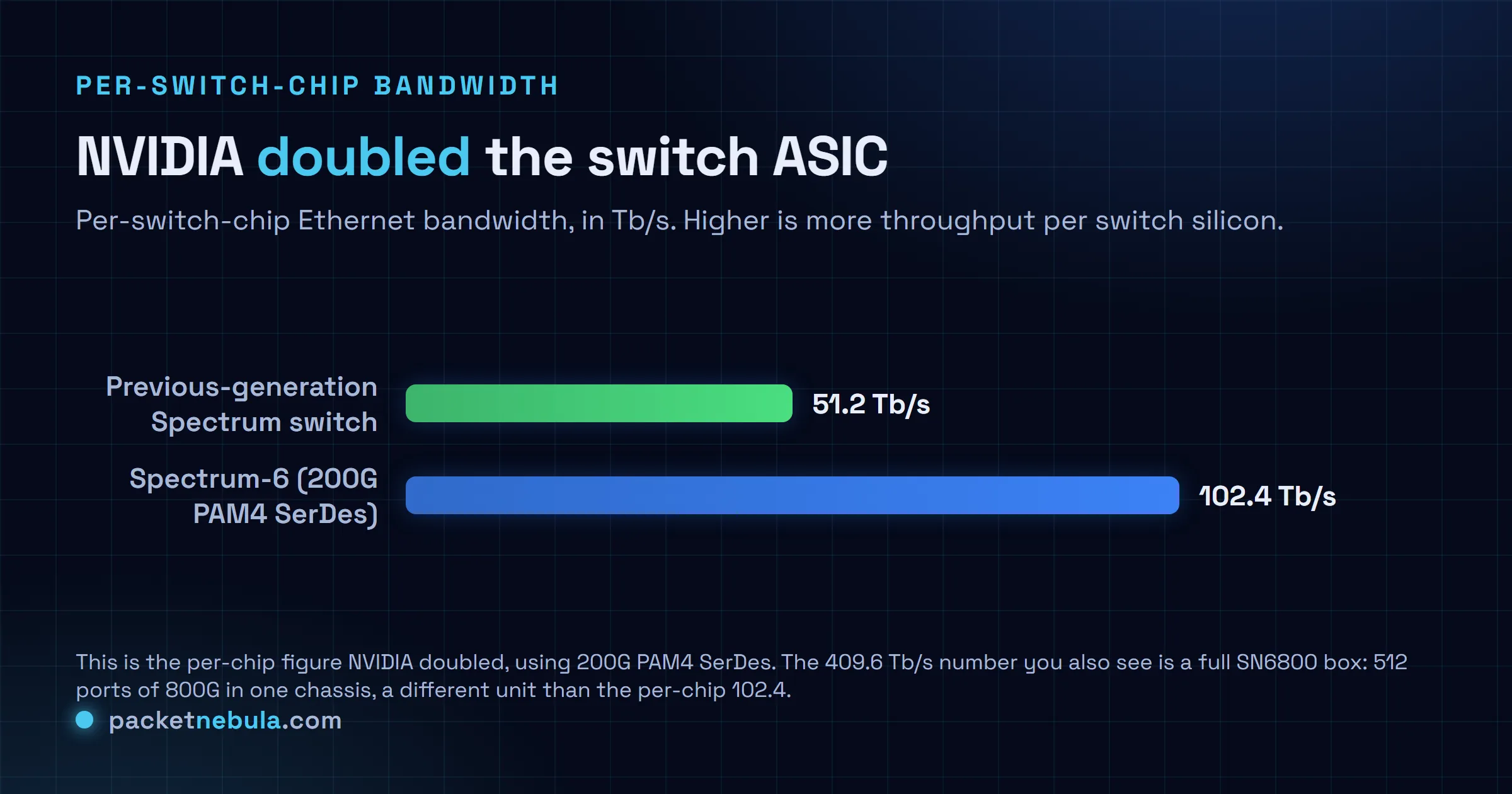
The doubling itself is real and it’s the boring, solid part of the announcement. Two generations of SerDes plus a bigger switch die genuinely gets you there. What I’d push back on is treating “2x bandwidth” as “2x anything you care about.” Fabric bandwidth is a ceiling, not a throughput guarantee. Whether your training run goes faster depends on collective patterns, congestion control, and about ten things that aren’t the switch.
The part that’s actually new: co-packaged optics
Strip the terabits away and here’s the real story. Spectrum-6 brings co-packaged optics, CPO, into NVIDIA’s mainstream Ethernet line.
Normally the bit that turns electrical signals into light lives in pluggable transceivers, the little modules you slot into the front of a switch. At gigascale, a fabric has hundreds of thousands of those, and every one is a part that can die, draw power, and generate heat. CPO moves the optics into the switch package itself. Fewer discrete pluggables, fewer failure points, less power per bit moved.
NVIDIA puts hard multipliers on this: up to 5x higher power efficiency, and 10x improvement in mean time between incidents by cutting the number of optical components that can fail. Those are believable in direction. They’re also NVIDIA’s own numbers, measured against “previous architectures,” and they attach to the photonics variant specifically, not the plain pluggable version. So take the shape of the claim, hold the exact multiplier at arm’s length.
Who this is for (probably not you)
Let’s be blunt about scale. The 95% network efficiency figure NVIDIA quotes is at deployments “exceeding 100,000 GPUs.”
That’s the tell. This is spine and super-spine switching for AI factories, the kind of build where the power budget itself is the constraint, not the enterprise top-of-rack most of us actually touch. The named first deployers make it obvious: CoreWeave, Microsoft, Nebius, SpaceX AI, Tesla. Those are hyperscale and neocloud operators wiring up GPU counts with a lot of zeros. If you run a normal data center, Spectrum-6 is beautifully overkill.
So what’s the takeaway for the rest of us? The direction, not the SKU. Co-packaged optics moving from demos into shipping switch products is the signal worth filing. It’s the kind of change that shows up in your world two or three years later, quietly, as the transceiver failures you used to babysit stop happening. For now, though, this is a switch for people building million-GPU machines. Read the CPO trend. Skip the purchase order.
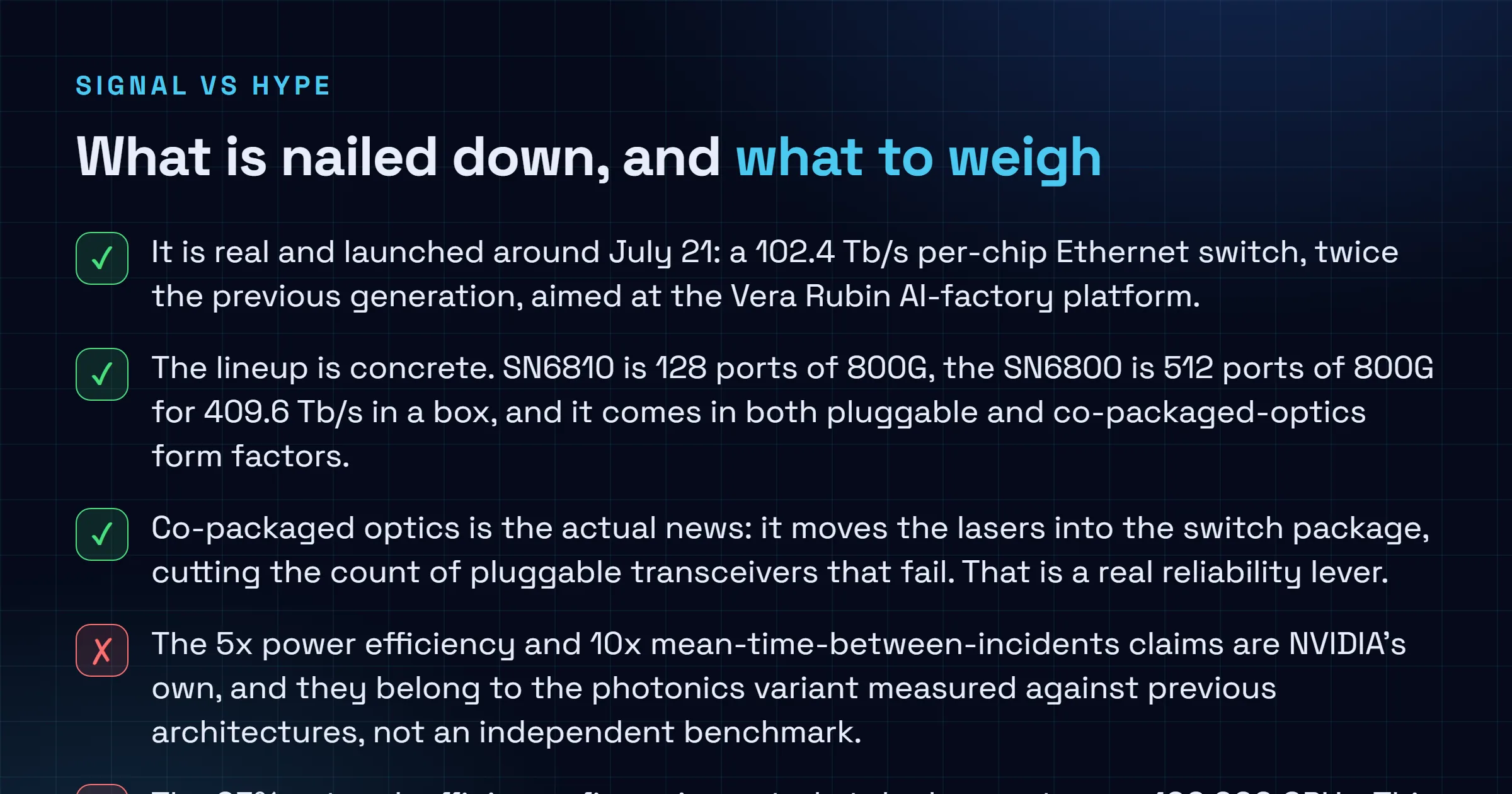
Sources: NVIDIA Blog, NVIDIA Technical Blog (Spectrum-X Photonics) and SDxCentral, July 2026. The 102.4 Tb/s per-chip bandwidth, the 200G PAM4 SerDes, the SN6810 (128x800G) and SN6800 (512x800G, 409.6 Tb/s) port counts, the co-packaged and pluggable optics form factors, and the up-to-5x power efficiency, 10x mean-time-between-incidents and 95%-at-100,000-GPU figures are attributed to NVIDIA and are vendor claims, not independently benchmarked. The named first deployers (CoreWeave, Microsoft, Nebius, SpaceX AI, Tesla) are as listed by NVIDIA.
Frequently asked questions
What is NVIDIA Spectrum-6?
It is NVIDIA's new Ethernet switch generation, announced July 21, 2026. Each switch chip pushes 102.4 Tb/s, about double the previous generation, using 200G PAM4 SerDes. It is the switching layer for the Vera Rubin AI-factory platform and part of the Spectrum-X line. The flagship SN6800 box carries 512 ports of 800G, for 409.6 Tb/s in one chassis.
What does the 102.4 Tb/s number actually mean?
It is the aggregate bandwidth of a single switch ASIC, not a per-port speed. Per-port you get 800G (or 200G with more ports). So 102.4 Tb/s is the total a chip can move across all its ports at once. The 409.6 Tb/s you also see is a full SN6800 box with four of those switch chips' worth of capacity behind 512 ports. Two different units, easy to conflate.
What are co-packaged optics and why do they matter?
Normally the optics that turn electrical signals into light sit in pluggable transceivers you slot into the front of the switch. Co-packaged optics, or CPO, move that conversion into the switch package itself. Fewer separate pluggables means fewer parts that can fail and less power burned per bit. NVIDIA says it is worth up to 5x power efficiency and 10x mean time between incidents, though those are its own figures for the photonics variant.
Is Spectrum-6 something I would buy for my data center?
Almost certainly not, unless you run a very large GPU cluster. This is spine and super-spine switching designed for AI factories in the tens of thousands of GPUs and up, where the 95% efficiency claim is quoted at over 100,000 GPUs. For a normal enterprise rack it is wildly oversized. The useful takeaway is the technology direction, CPO going mainstream, not a purchase order.
When does Spectrum-6 ship?
NVIDIA has named CoreWeave, Microsoft, Nebius, SpaceX AI and Tesla as among the first to deploy it. The co-packaged-optics versions are expected to ship later in 2026, with pluggable versions reaching early customers first. So it is real hardware with named takers, but broad availability is still ramping rather than something you can order today.


