
So the biggest AI copyright fight just ended with a cheque, not a verdict. On July 20 a federal judge in San Francisco signed off on Anthropic's settlement with authors: 1.5 billion dollars, about 3,000 dollars per book. That's the news, and it's the largest copyright recovery anyone can point to. We went in expecting the ruling to answer the one question every builder actually has, whether training a model on copyrighted text is legal. It doesn't. Here's the bit the headline number buries: this settles how Anthropic got the books, not whether the training itself was fair use. Your Claude keys don't change today. The precedent you were waiting for still isn't here.
The short answer
A San Francisco judge signed off on Anthropic’s settlement with authors: the largest copyright recovery on record. It pays out for pirated books used in training. It does not decide whether training on copyrighted text is fair use, because settling meant that question never reached appeal. Nothing about your Claude access or API pricing moves.
What the judge actually approved
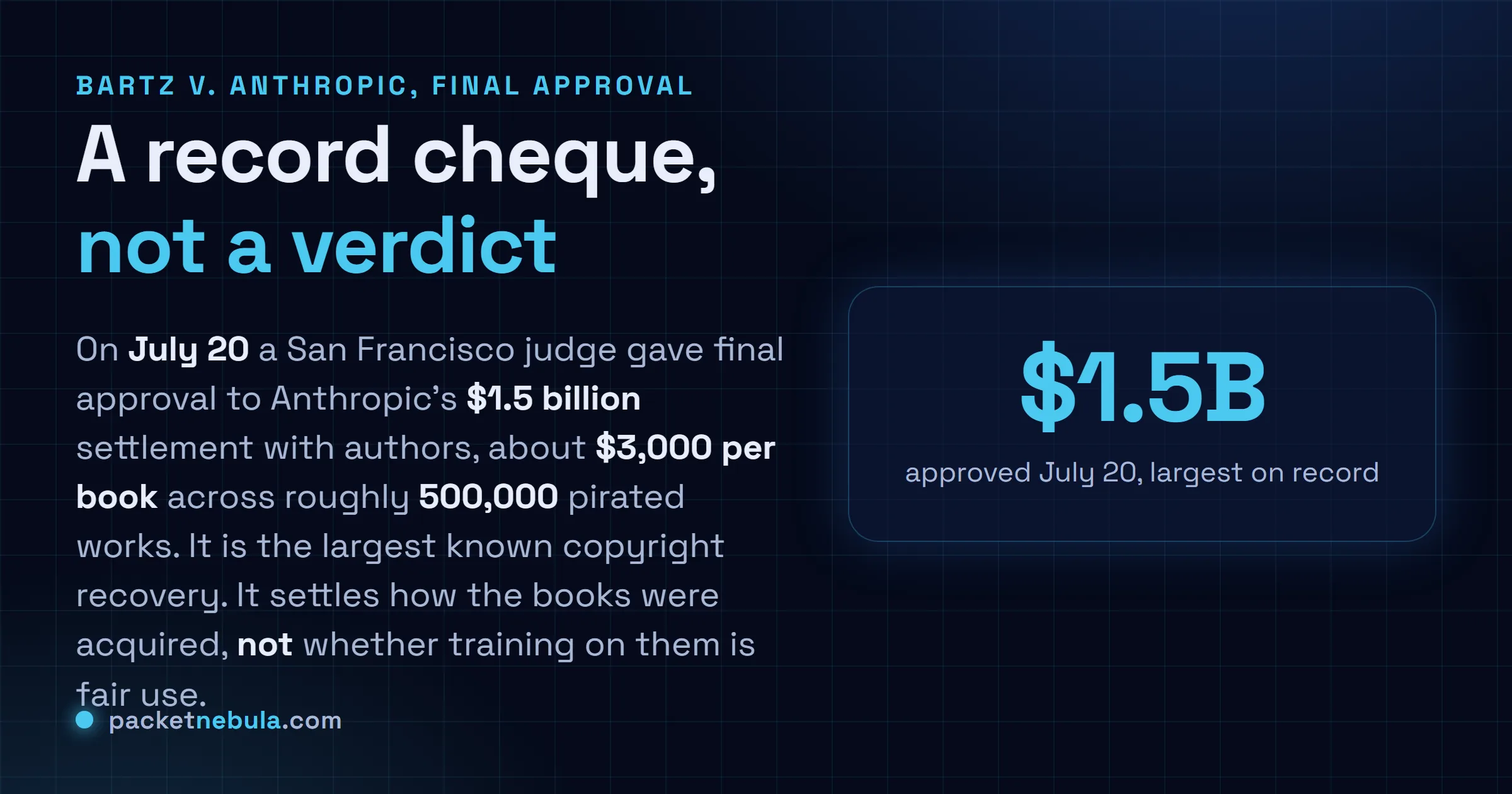
On July 20, Judge Araceli Martinez-Olguin gave final approval to the class settlement in Bartz v. Anthropic, in the U.S. District Court for the Northern District of California. The plaintiffs are authors, led by thriller novelist Andrea Bartz, who sued in 2024. Preliminary approval came from Judge William Alsup back in September 2025. Some authors objected that 1.5 billion dollars was too low. The judge disagreed and signed anyway.
The scope is narrow, and that narrowness is the whole story. The settlement covers pirated books. Per the filings, Anthropic pulled them from LibGen in June 2021 and from PiLiMi in July 2022. To claim, a book needed an ISBN or ASIN and a timely Copyright Office registration. About 500,000 works qualified, and roughly 91 percent had been claimed by rights holders when the judge signed.
Plaintiff counsel Justin Nelson called it “the largest known copyright recovery in history.” That’s almost certainly right. It’s also the first of the big AI training-data cases to actually settle, while the ones against Google, Meta, OpenAI and a stack of news outlets grind on.
The question it doesn’t answer
Here’s what we kept waiting to read, and never did.
Is it legal to train a model on copyrighted text? This ruling doesn’t say. It can’t. A settlement is two parties agreeing to stop fighting, not a court deciding who was right.
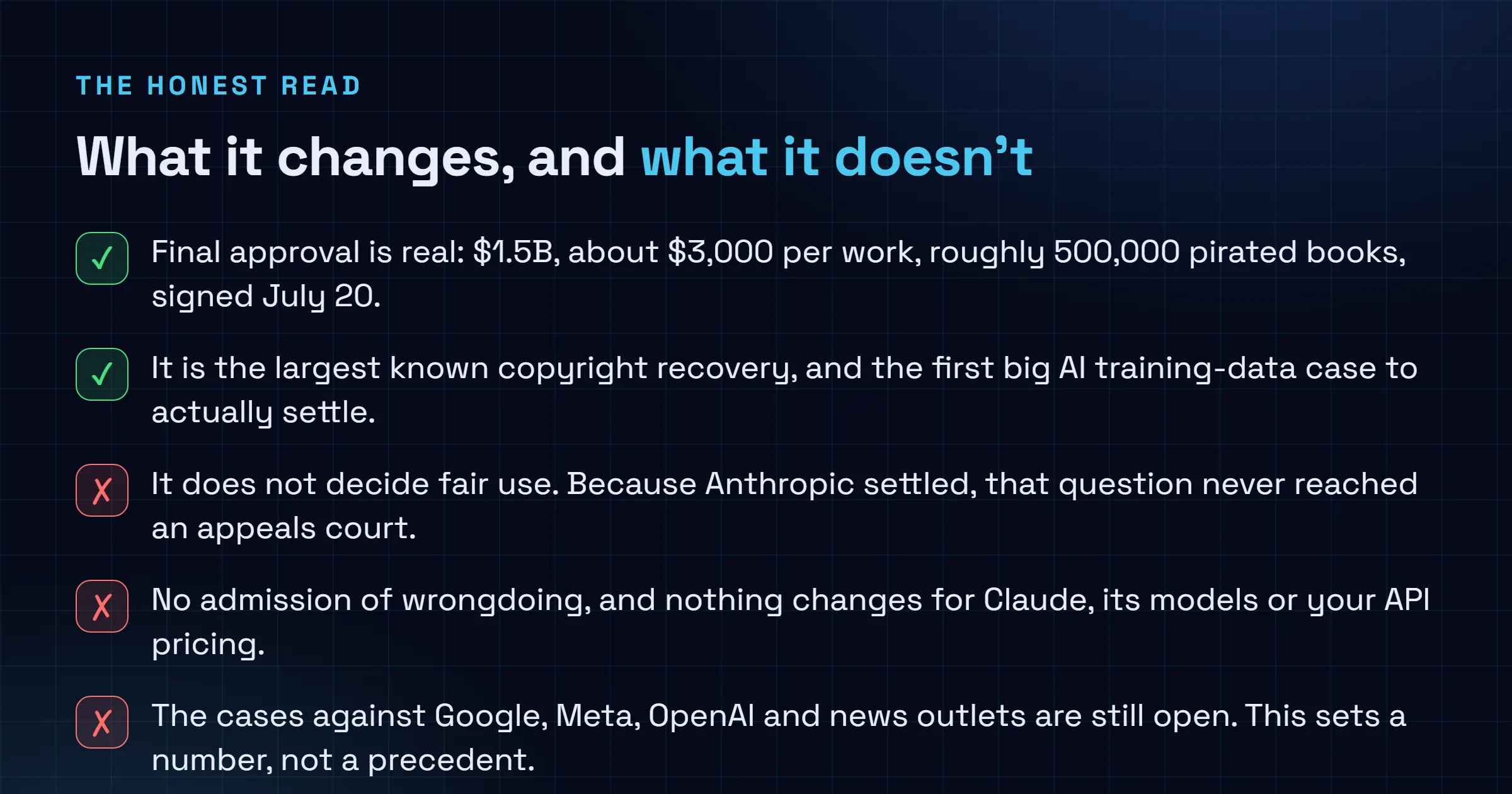
Worse, the one piece of case law that pointed anywhere got neutralised. Judge Alsup had ruled earlier that training on books Anthropic bought legally counted as fair use. That finding applied to this case. Because Anthropic then settled rather than let it run, the fair-use question never went up to an appeals court, where a ruling would actually bind other judges. So the strongest signal we had just lost its teeth. The piracy got a price tag. The core legal question is exactly as open as it was a year ago.
If you were hoping this ruling would tell you whether the data behind your favourite model is on solid ground, it doesn’t. Nobody’s is, yet.
What changes for you
Today? Nothing you have to act on. No Claude model disappears. No API endpoint shifts. Your token bill is whatever it was yesterday. If you ship on Anthropic, this is a headline, not a task.
The real signal is slower and more useful. A 1.5 billion dollar cheque for scraping pirated books is the clearest number yet on what training-data provenance can cost. That’s why the labs suddenly talk about licensed corpora and data deals. Not because a court forced them, but because the bill for not bothering just became public and enormous. When you’re weighing a model for something you’ll ship and support for years, “where did the training data come from” stopped being a philosophical question. It’s a line item now.
Why it still matters
Not because your workflow breaks. It doesn’t. It matters because it sets the number.
Every other AI copyright case now has a reference point on the table: pirated training data can run to roughly 3,000 dollars a book and nine zeros in aggregate. That reshapes how every lab budgets for data, and it hands the plaintiffs in the pending cases a very large exhibit. Anthropic, for its part, admits nothing about fair use and moves on. The precedent that would actually settle this for everyone is still somewhere up the road, in a case that doesn’t end with a cheque.
For a longer look at where the legal fights around big AI companies are heading, we walked through the Apple v. OpenAI trade secrets suit, which is a different flavour of the same theme: the courtroom drama rarely changes your keys, but it always tells you where the money and the risk are moving.
Sources
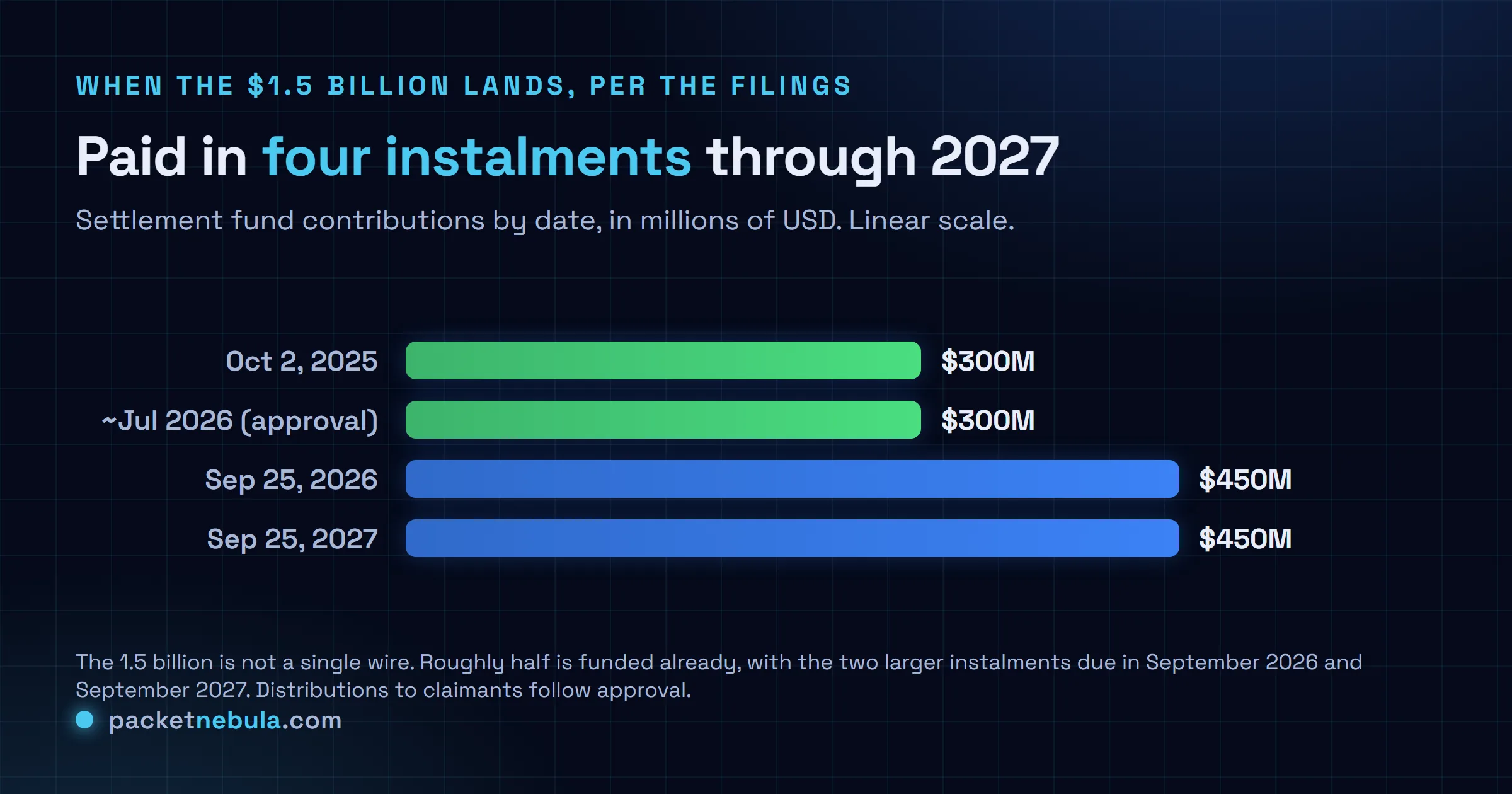
Final approval and the ruling details as reported by TechCrunch and Fortune, with settlement terms, claim rules and the instalment schedule from the Authors Guild. The 1.5 billion dollar figure, the roughly 3,000 dollars per work and the “largest known copyright recovery” quote are as stated in those reports; the fair-use question remains unresolved because the settlement was never appealed.
Frequently asked questions
What did the judge approve on July 20, 2026?
U.S. District Judge Araceli Martinez-Olguin, in San Francisco, granted final approval to the class settlement in Bartz v. Anthropic. Anthropic pays 1.5 billion dollars, roughly 3,000 dollars per work, to rights holders of about 500,000 pirated books used in training. It follows preliminary approval by Judge William Alsup in September 2025, and the judge rejected objections that the amount was too small.
Does this decide whether AI training on copyrighted books is legal?
No, and that is the important part. The settlement resolves how Anthropic acquired the books, which was by downloading pirated copies from LibGen and PiLiMi. It does not set binding precedent on fair use. Judge Alsup had earlier found that training on legally bought books was fair use, but because Anthropic settled, that question never reached an appeals court. So there is still no higher-court ruling either way.
Does the settlement change anything for Claude or the Anthropic API?
Not operationally. No model is pulled, no endpoint changes, no price moves because of this ruling. If you build on Claude, there is nothing to do this week. The impact is legal and financial, not technical.
Who gets paid, and how much?
Rights holders of the roughly 500,000 covered works get at least 3,000 dollars per title before fees, potentially more depending on valid claims and interest. Trade and university-press titles split 50/50 between author and publisher by default; self-published and rights-reverted authors take the full amount. About 91 percent of covered works had been claimed at the time of final approval.
Does Anthropic admit wrongdoing?
No. Like most settlements, this one carries no admission of liability on the fair-use or training questions. Anthropic's deputy general counsel said the company was pleased that more than 91 percent of covered authors and publishers had claimed their share.


