




Somebody finally put a public price on a humanoid robot company, and it came in at 61 billion yuan. Unitree priced its Shanghai STAR Market listing on 6 August at 150.80 yuan a share, raising roughly 6.1 billion yuan at a valuation near 9 billion dollars, which makes it the first humanoid maker anyone can mark to market. Then you open the prospectus and the number worth staring at isn't the valuation. It's 73.6 percent, the share of 2025 humanoid revenue that came from research and education buyers. Universities and labs. Not factories. Unitree shipped more than 5,500 humanoids last year, more than any company on earth, and the portion that went into named industrial work like intelligent manufacturing or logistics delivery came to 15.702 million yuan. That gap is the story.
The short answer
Unitree priced its Shanghai STAR Market IPO on 6 August at 150.80 yuan a share, raising about 6.1 billion yuan at a 61 billion yuan valuation. It is the first mainland listed humanoid maker and it is profitable, with 1.71 billion yuan of 2025 revenue and a 60.13 percent gross margin. The prospectus also shows that research and education buyers drove 73.6 percent of humanoid revenue, and that Q1 2026 profit halved while revenue grew 68.5 percent.
 Image: Unitree
What actually got priced
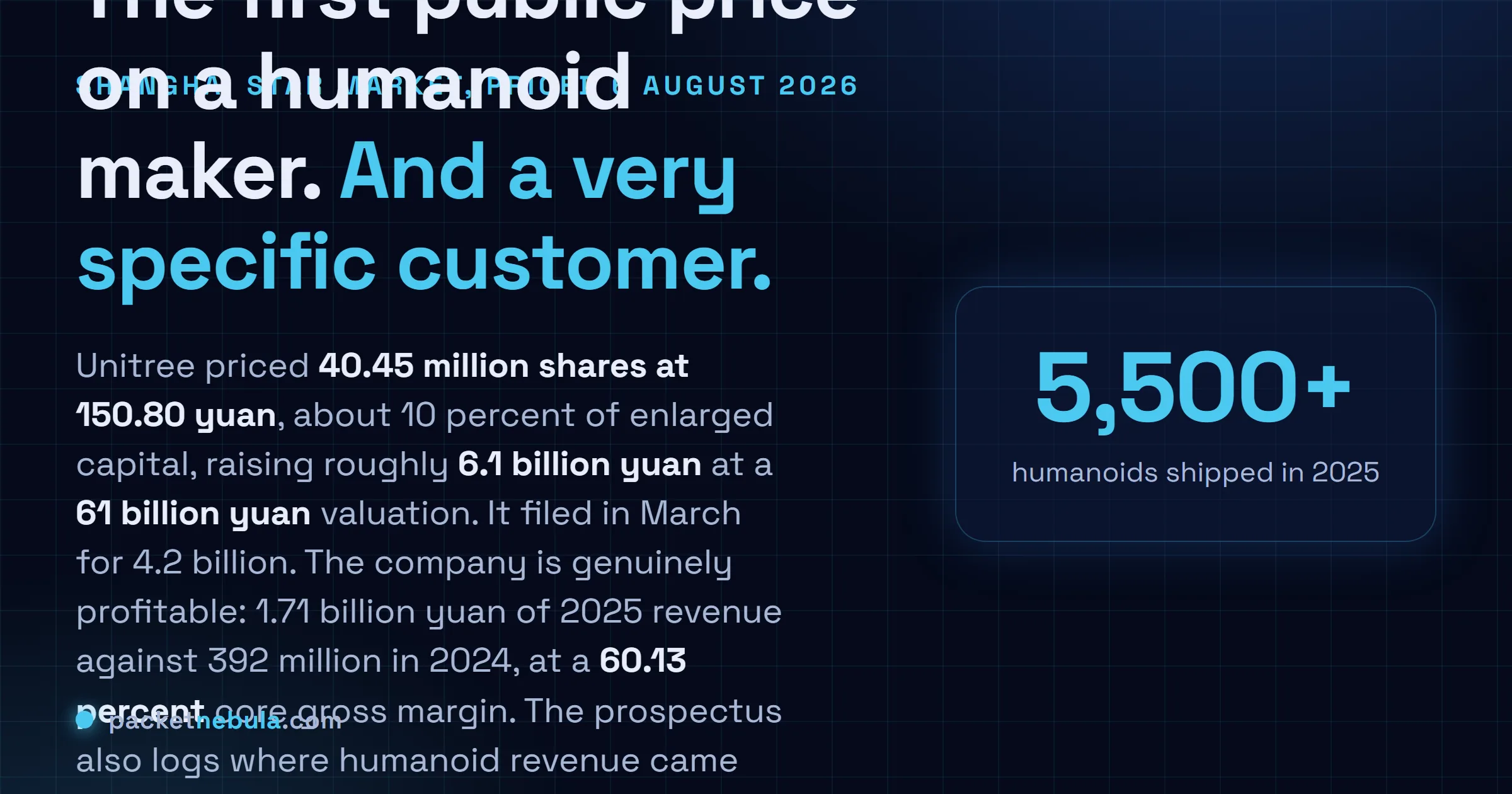
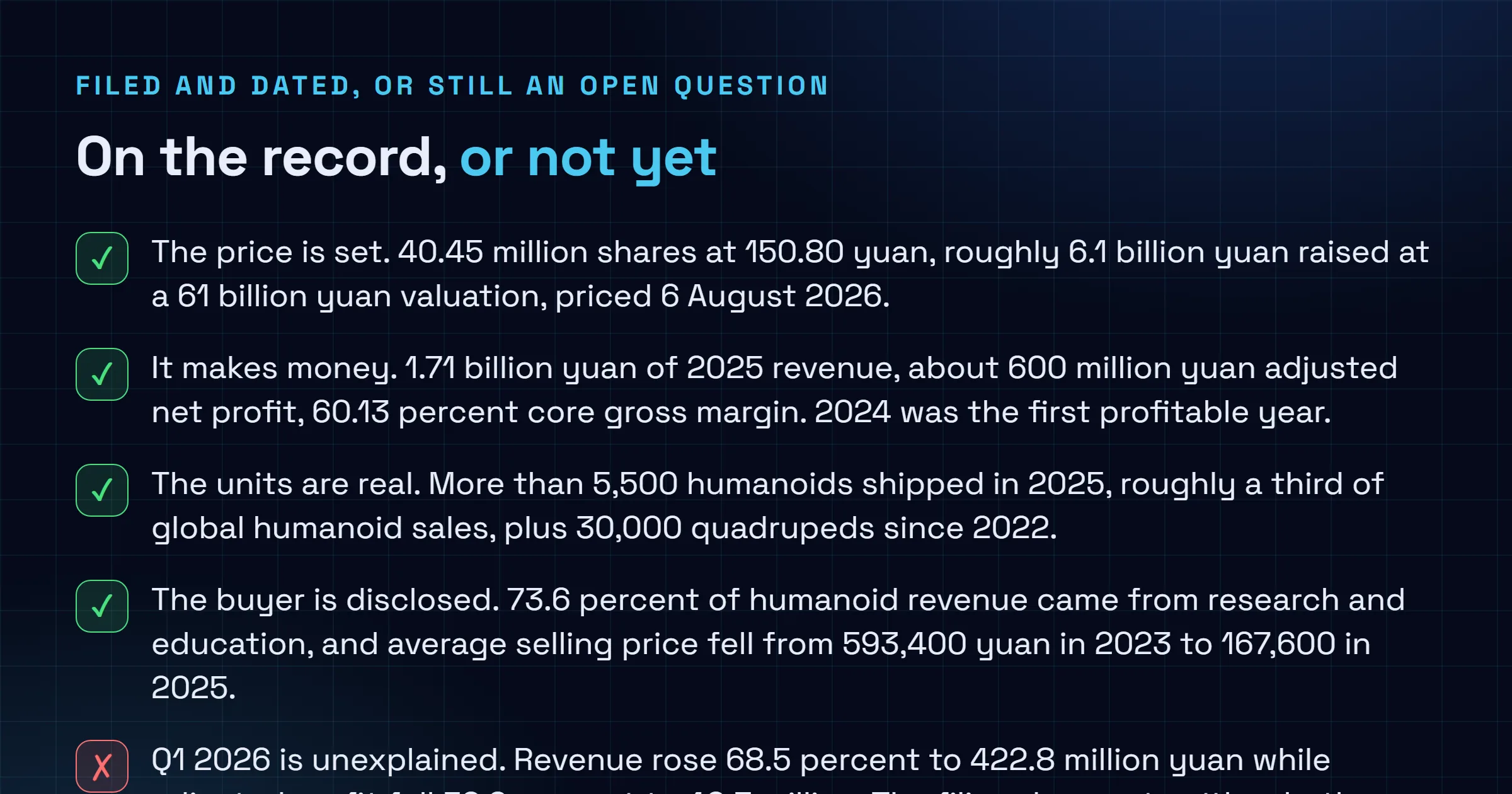
Hangzhou based Yushu Technology, which everyone calls Unitree, priced 40.45 million shares at 150.80 yuan on 6 August. That’s about 10 percent of enlarged share capital, roughly 6.1 billion yuan raised, and a company valued near 61 billion yuan. Call it 9.04 billion dollars.
The interesting comparison isn’t with Tesla or anyone else. It’s with Unitree’s own filing. When it went to the Shanghai Stock Exchange on 20 March it was after 4.2 billion yuan. It priced at nearly half again that. Subscriptions open 10 August, money due on the 12th, and DeepSeek is on the strategic investor list, which is a nicely circular detail for anyone tracking who funds whom in Chinese AI right now.
The cap table was already crowded before this. Meituan holds about 9.6 percent, HongShan around 7.1, Matrix Partners China 5.5, with Tencent, Alibaba, Xiaomi, ByteDance, BYD and Geely all somewhere on the register. Founder Wang Xingxing controls roughly a third.
And unlike most of this sector, the accounts aren’t a blank. Revenue hit 1.71 billion yuan in 2025 against 392 million in 2024. Adjusted net profit came in near 600 million. Gross margin on core businesses, 60.13 percent. 2024 was the first profitable year and 2025 was the year it stopped being marginal.
The number nobody put in the headline
Here’s what we kept coming back to. Unitree shipped more than 5,500 humanoids in 2025, roughly a third of global humanoid sales, which makes it the largest humanoid robot maker in the world by units. Humanoids went from 1.9 percent of core revenue in 2023 to 51.5 percent in 2025.
So who bought them?
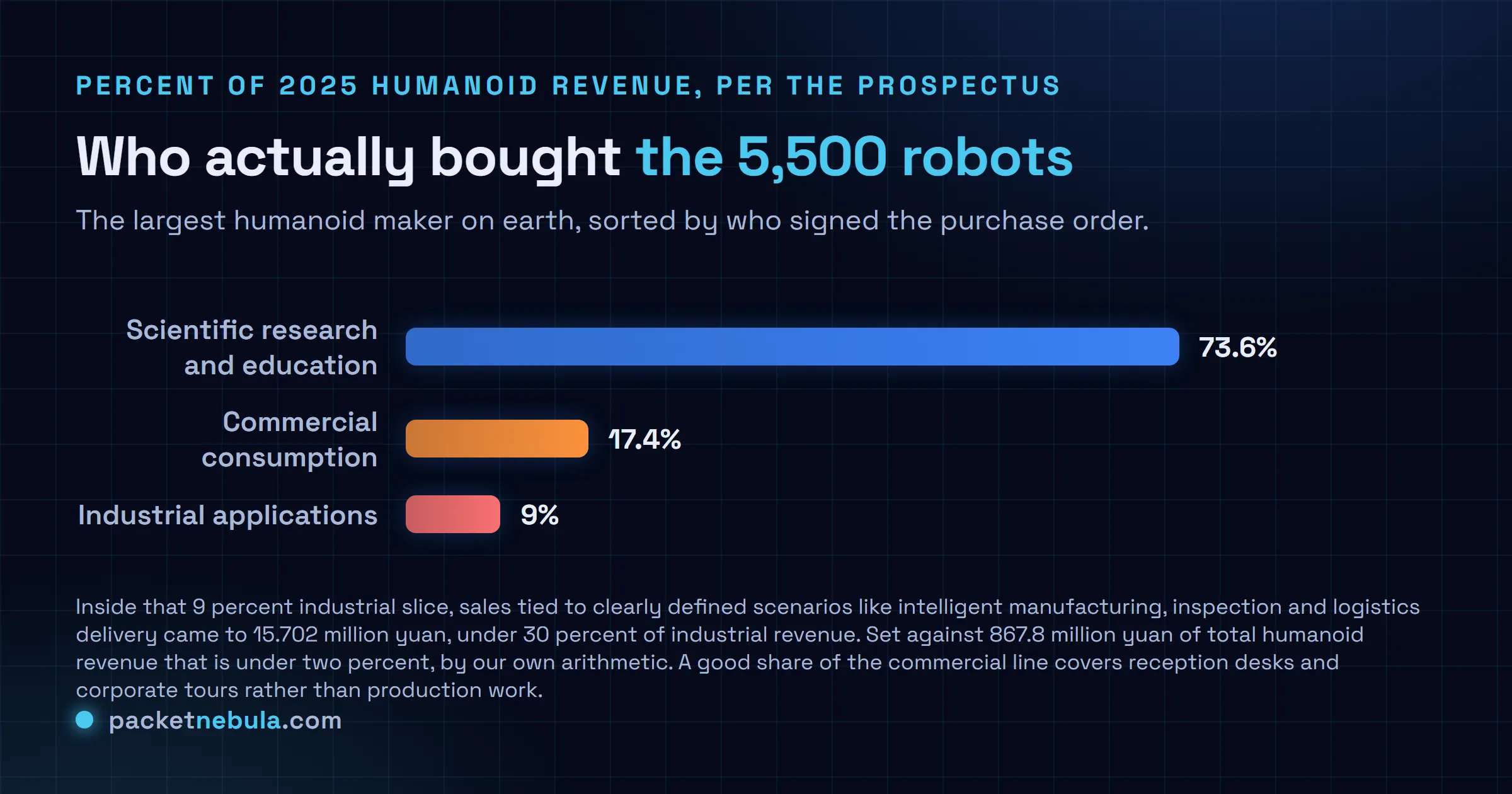
Research and education: 73.6 percent of humanoid revenue. Commercial consumption: 17.39 percent. Industrial applications: 9 percent. And inside that 9 percent, the sales tied to clearly defined work like intelligent manufacturing or logistics delivery added up to 15.702 million yuan.
Against 867.8 million yuan of humanoid revenue, that’s under two percent by our own arithmetic. The world’s biggest humanoid company sold about fifteen and a half million yuan worth of robots into jobs that look like actual jobs.
We want to be fair about what this does and doesn’t mean. Selling to universities is a real business, and a very good one here: humanoid gross margin is 62.91 percent, which is roughly three times what Tesla or Xiaomi earn on a car. Labs have grant money, they buy at list, and they don’t push for volume discounts the way an industrial buyer would. Unitree found a customer who pays well. Nothing wrong with that.
But it isn’t the story the sector has been telling investors. The pitch for humanoids has always been labour replacement at scale, and the largest shipper in the world is currently running a very profitable scientific instrument business. Even a chunk of that 17.39 percent commercial slice goes to reception desks and corporate tours, per the same filing.
Where the margin is heading
The price of a Unitree humanoid has collapsed on purpose. Average selling price went from 593,400 yuan in 2023 to 167,600 yuan in 2025, about 25,000 dollars. That’s vertical integration doing its work, since Unitree makes its own high torque motors, actuators and reducers, with over 90 percent of components sourced domestically. It’s also a deliberate walk down market toward the buyer who now pays the bills.
Then there’s Q1 2026, which is the line we’d want explained before subscribing. Revenue up 68.5 percent to 422.8 million yuan. Adjusted profit down 52.6 percent to 40.3 million. Growth intact, profitability cut in half.
There are boring explanations for that. IPO costs, a hiring push, a five year plan that calls for 75,000 humanoids and 115,000 quadrupeds a year and needs plant built before it needs orders. Unitree runs 480 employees with 175 in R&D, which is small for that ambition. Honestly, I’d read the Q1 dip as investment rather than decay. I might be wrong, and the filing doesn’t settle it either way.
The geopolitical line is short but real: US sales were 13.3 percent of 2025 revenue, and the filing flags tariff and export control exposure on both the selling side and the roughly 20 percent of the supply chain that gets imported.
What it changes for you
If you’re anywhere near buying, specifying or competing with a humanoid, this listing hands you something the field has never had: a public multiple attached to filed accounts. Roughly 36 times trailing revenue, on our maths. Every private humanoid valuation until now has been a funding round negotiated in the dark. Now there’s a daily print to argue against.
It also gives you a reference for what “shipping” means. Tesla still hasn’t shown Optimus V3 and publishes essentially no specs, while Unitree just disclosed its unit count, its ASP and its buyer mix in a regulated filing. That’s the contrast worth holding onto. Humanoid’s HMND 01 sits somewhere in between with published pilots but private numbers.
And it lines up with what the software side keeps showing. When DeepMind published Gemini Robotics 2’s own success rates last week, picking an object off the floor logged at 45.7 percent. A robot that succeeds at a household task under half the time is a superb research platform and a poor warehouse hire. Unitree’s revenue mix is that benchmark table expressed in yuan.
Buy the shares or don’t, we have no view worth acting on. Just don’t read “world’s largest humanoid maker” as “humanoids are working.” The filing says something more specific than that.
Sources: the IPO pricing, share count, valuation, subscription dates and Q1 2026 figures come from Reuters’ report on Unitree pricing its Shanghai IPO (6 August 2026), with the raise total corroborated by Bloomberg and CNBC. The March filing target, the 5,500 unit shipments, the average selling price decline and the research and education share are from Rest of World’s report on the prospectus. The buyer mix percentages, the 15.702 million yuan industrial figure and the 62.91 percent humanoid gross margin are from 36Kr’s breakdown of the same filing. Shareholder percentages, component sourcing and the five year production plan come from KraneShares’ IPO guide. The revenue multiple is our own calculation from the priced valuation and 2025 revenue, not a figure either company or exchange published.
Frequently asked questions
How much is Unitree worth after the IPO?
Unitree priced its STAR Market offering at 150.80 yuan per share on 6 August 2026, which values the company at roughly 61 billion yuan, about 9.04 billion dollars. It is selling 40.45 million shares, around 10 percent of enlarged share capital, to raise about 6.1 billion yuan or 904 million dollars. That is well above the 4.2 billion yuan the company targeted when it filed with the Shanghai Stock Exchange on 20 March 2026. Subscriptions open on 10 August with payment due 12 August.
Is Unitree actually profitable?
Yes, which genuinely sets it apart in this field. Revenue reached 1.71 billion yuan in 2025, up from 392 million in 2024, with adjusted net profit of about 600 million yuan and a gross margin of 60.13 percent on core businesses. 2024 was its first profitable year. The wrinkle is Q1 2026: revenue grew 68.5 percent to 422.8 million yuan while adjusted profit fell 52.6 percent to 40.3 million yuan. Growth is still there. The margin behind it is thinning.
Who is actually buying Unitree humanoid robots?
Per the prospectus, 73.6 percent of humanoid revenue in 2025 came from scientific research and education, 17.39 percent from commercial consumption, and 9 percent from industrial applications. Inside that industrial slice, sales tied to clearly defined scenarios such as intelligent manufacturing, inspection and logistics delivery totalled 15.702 million yuan, under 30 percent of industrial revenue. So the buyer is overwhelmingly a lab with a budget, and a good share of the commercial purchases are for reception desks and corporate tours rather than production work.
Why did the price of a Unitree humanoid drop so much?
The average selling price of a Unitree humanoid fell from 593,400 yuan in 2023 to 167,600 yuan in 2025, roughly 25,000 dollars. That is partly cost engineering and vertical integration, since Unitree builds its own motors, actuators and reducers and sources over 90 percent of components domestically, and partly a deliberate move down market to reach the education buyers who now dominate the revenue. Gross margin on humanoids still came in at 62.91 percent, so the cuts have not gutted the economics.
Does this IPO price set a benchmark for other humanoid companies?
It sets the first one anyone can argue with, which matters more than the number itself. Private humanoid valuations have been set in funding rounds with no published revenue behind them. Unitree now has a daily share price attached to a filed set of accounts, so anyone valuing a robot maker has a public multiple to reason from, around 36 times trailing revenue on our arithmetic. Whether that multiple holds after the 10 August subscription window is a different question, and we would not guess at it.