

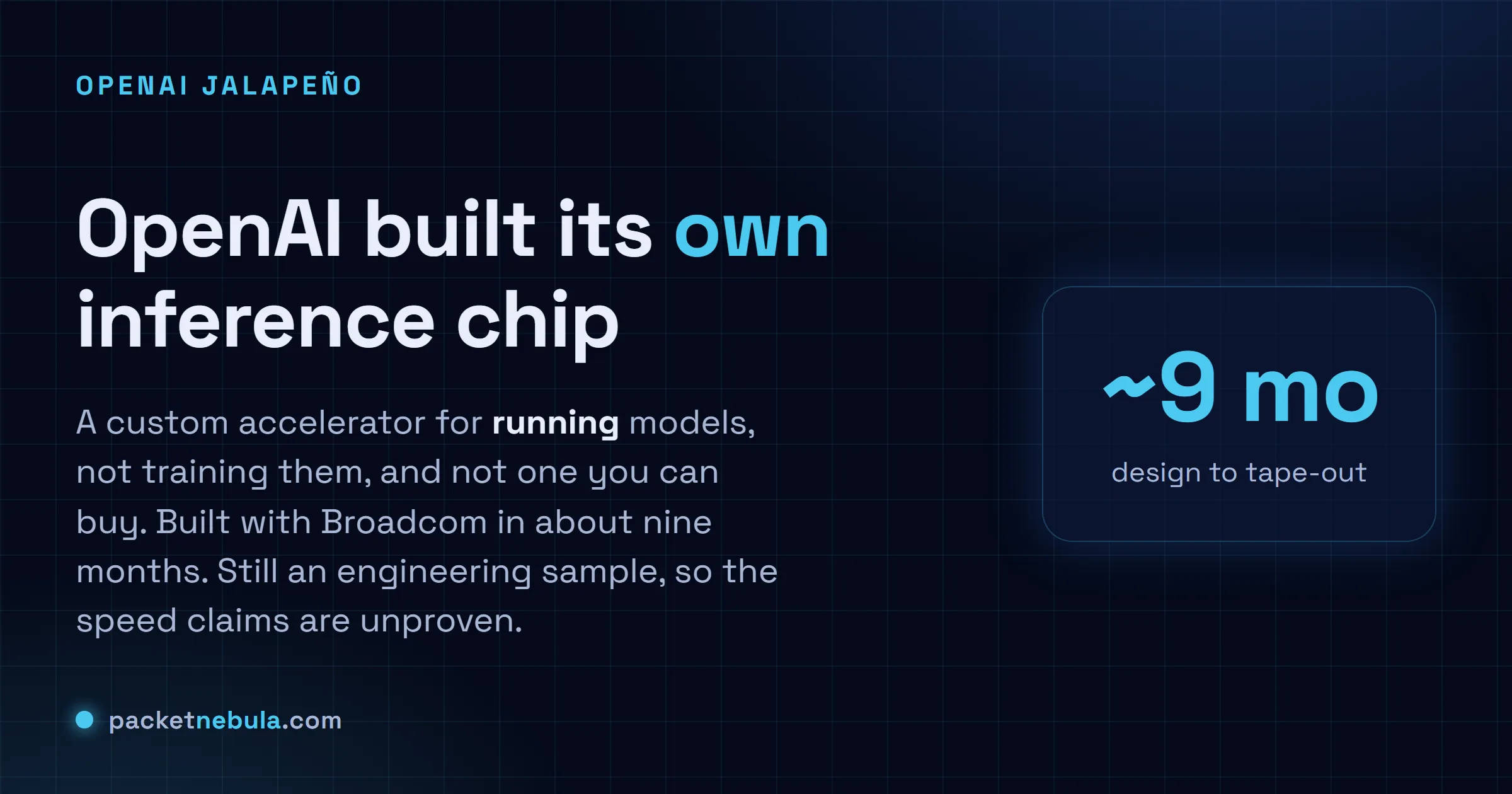
Sam Altman got handed a chip on a stage, and the AI hardware race picked up a new character. On June 24, OpenAI and Broadcom unveiled Jalapeño, OpenAI's first custom silicon, and here's the one-line version we'd give a colleague: it's an inference accelerator, the chip that runs a trained model on every request, not the GPU that trains it. OpenAI designed it around how its own models serve traffic, Broadcom handled the silicon, Celestica the systems. Design to tape-out in about nine months. It isn't for sale, it's still an engineering sample, and deployment is targeted for the end of 2026. So the real question isn't whether it's impressive. It's whether any of it reaches your desk.
The short answer
OpenAI announced Jalapeño, its first custom chip. It is an inference accelerator, built for running models rather than training them, and you cannot buy one. The near-term effect on your work is basically nothing. The slow-burn effect, if the numbers hold, is cheaper inference for OpenAI, which can leak into steadier API pricing and less exposure to Nvidia shortages.
What OpenAI actually shipped
Not a product. A prototype with a name. OpenAI and Broadcom put Jalapeño on stage on June 24, and the parts worth writing down are narrow. It’s OpenAI’s first custom accelerator, what the companies call an Intelligence Processor, and it’s a single massive ASIC (Tom’s Hardware pegged it as reticle-sized, meaning about as big as a chip can physically get). Broadcom did the silicon implementation and networking. Celestica handles boards and racks. OpenAI did the architecture, because it wanted a chip shaped around how its own serving stack behaves rather than a general-purpose part it then bends to fit.
The timeline is the flashy bit. OpenAI says Jalapeño went from first design to tape-out in roughly nine months, which it calls possibly the fastest ASIC cycle ever pulled off in high-end semiconductors. That’s their framing, and tape-out is not the same as a shipping product, so file it under impressive but unverified. Engineering samples are running real workloads in the lab at production target frequency and power, including a coding model OpenAI names as GPT-5.3-Codex-Spark. Live traffic? Not yet. Deployment is aimed at the end of 2026.
Inference, not training, is the whole point
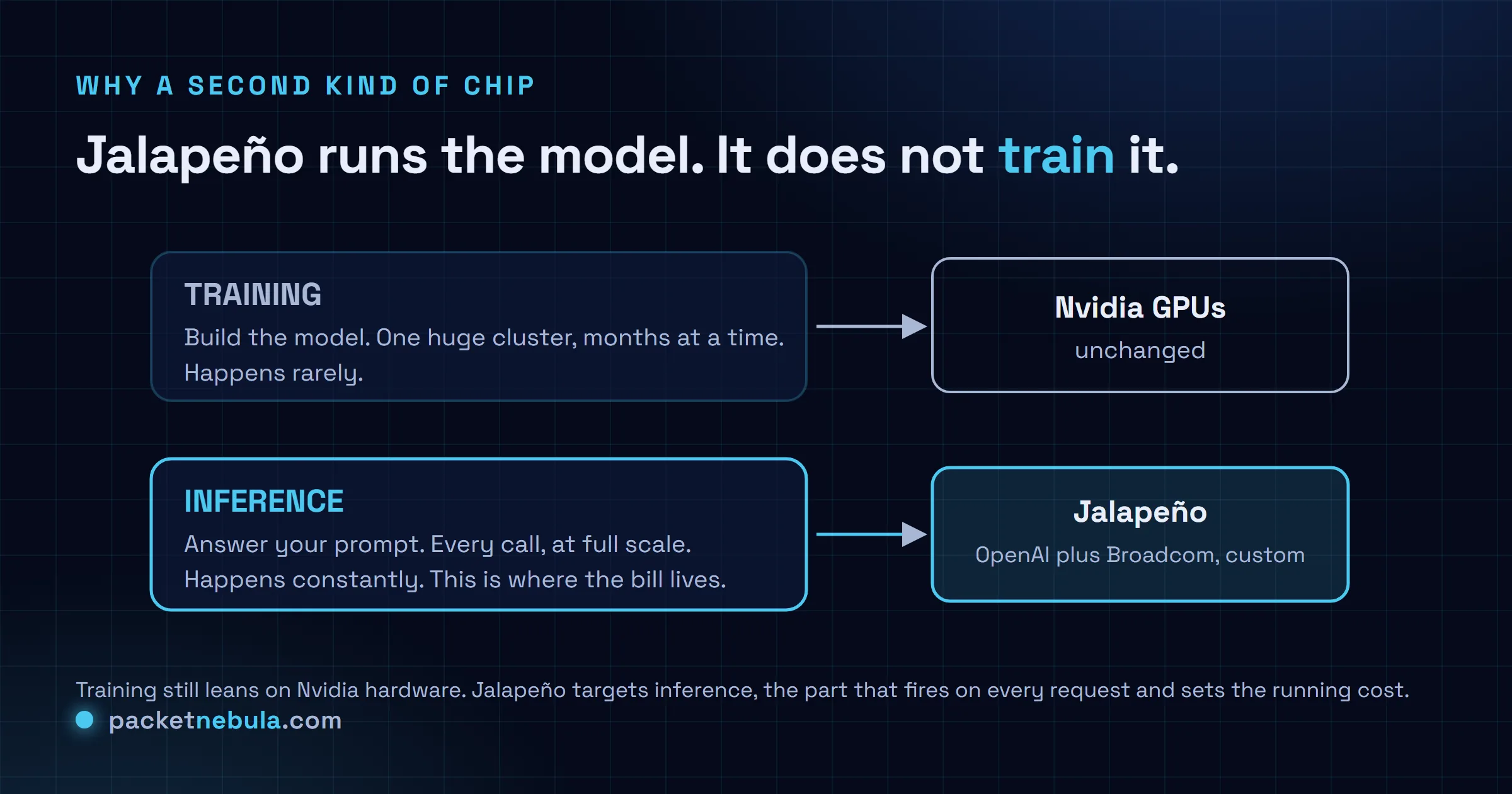
Here’s the distinction that makes sense of the news. Training a model is the one-time, brutal job: months on a giant cluster to produce the weights. That still runs on Nvidia, and OpenAI hasn’t suggested otherwise. Inference is the other job, the model answering you, and it fires on every single request. At OpenAI’s scale that’s the meter that never stops spinning. Jalapeño is a blank-slate design for that second job, and OpenAI was blunt about the goal: lower operating cost when running interactive models like the coding ones people hammer all day.
The one number OpenAI put out is performance per watt, which it says early testing shows is substantially better than current state-of-the-art. Read that carefully. It’s a lab reading on a sample, OpenAI is still measuring, and there is no independent benchmark. So we’d treat it as a direction of travel, not a spec you can bank on. Efficiency per watt is the honest thing to chase for inference, mind you, because at data-center scale the power bill is a big slice of what a token costs to serve.
Does it change your day? Mostly no
Let’s be honest about the reach of this. You can’t buy a Jalapeño, you can’t rent one, and it doesn’t touch the quality of the models you already call. Same GPT models, different metal underneath. If you were hoping OpenAI shipped hardware you could drop into a homelab, this isn’t that, and nothing on the roadmap says it will be.
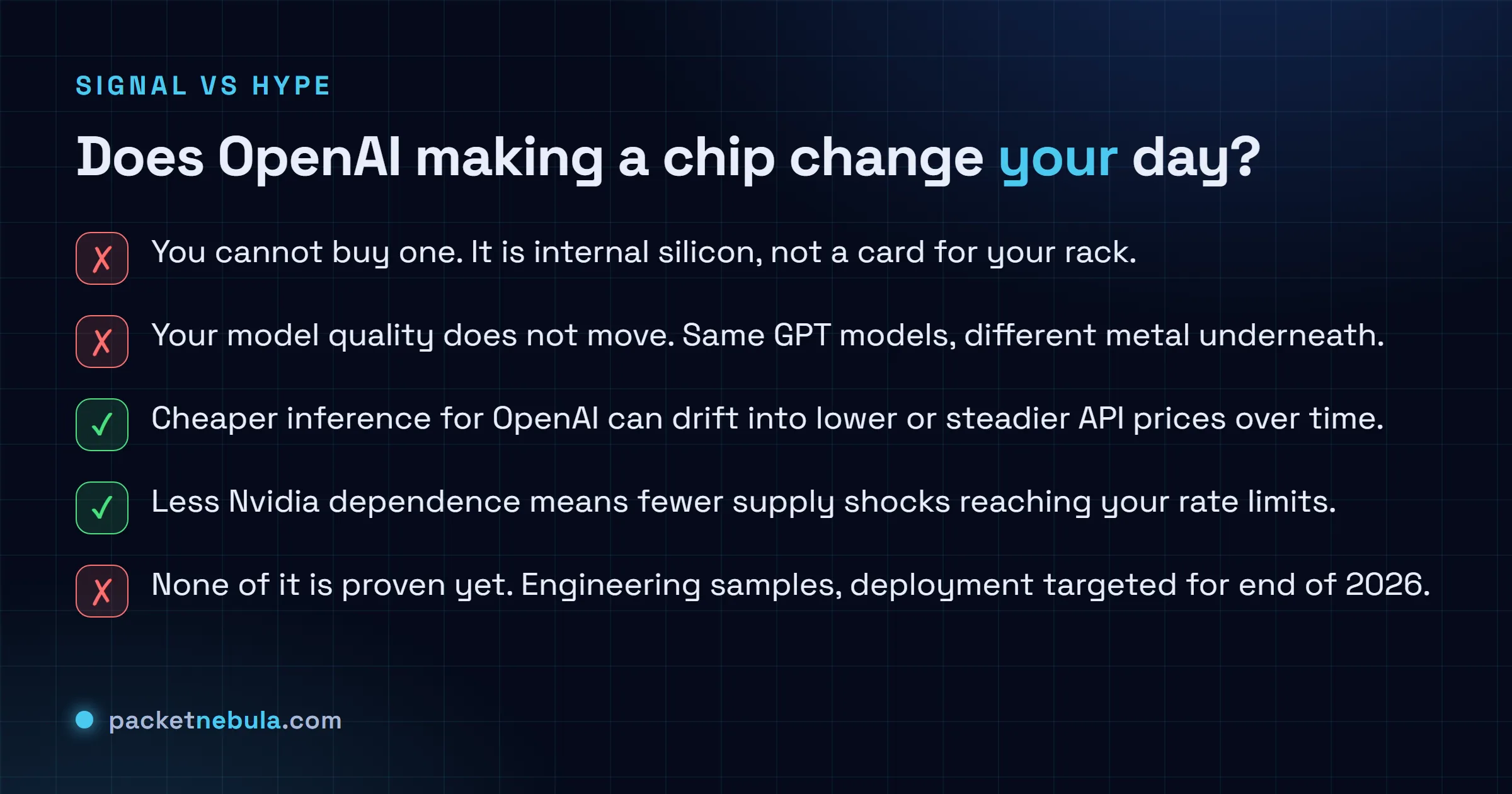
Where it could matter, slowly, is your invoice and your uptime. If OpenAI serves its own models more cheaply, that pressure can show up as steadier or lower API prices over time, the same way custom silicon at the other big clouds has. And a company less hostage to Nvidia allocation is a company whose rate limits wobble less when GPUs get scarce. Both are real, both are indirect, and both are a 2027 story at the earliest. If you’re picking a model today, the GPT-5.6 versus GPT-5.5 tradeoff matters far more than the chip underneath, and if you want to understand why inference cost is the number that quietly runs your bill, our Fable 5 effort-level breakdown walks through exactly where the money goes.
The honest read
Jalapeño is a strategy move dressed as a chip launch. OpenAI wants to own more of its own stack and lean on Nvidia less, and building custom inference silicon is how the hyperscalers have chipped at that for years. Real story. Just not a product story, and not yours to use. So don’t re-architect anything around it, don’t read the performance-per-watt line as gospel, and don’t expect a Jalapeño instance to appear in a console. Watch the API price sheet over the next year. That’s where this either shows up or it doesn’t.
Sources: OpenAI and Broadcom’s official Jalapeño announcement and Broadcom’s press release; reporting and context via TechCrunch and Tom’s Hardware, June 2026. Performance figures here are OpenAI’s own lab claims on engineering samples and are not independently verified.
Frequently asked questions
What is OpenAI's Jalapeño chip?
Jalapeño is OpenAI's first custom chip, an inference accelerator it calls an Intelligence Processor. OpenAI designed it from scratch for running large language models, with Broadcom on the silicon and Celestica on the systems. It is built for inference, meaning it runs already-trained models to answer requests, and it is not aimed at training.
Can I buy a Jalapeño chip?
No. It is internal silicon for OpenAI's own data centers, not a card you can put in a server or a cloud instance you can rent. There is no consumer or enterprise product, and OpenAI has not announced one.
When will Jalapeño be deployed?
OpenAI is targeting initial deployment by the end of 2026, expanding after that as the first step in a multi-generation compute platform with Broadcom. Right now the chip is at the engineering-sample stage, running workloads in the lab rather than serving live traffic.
Does Jalapeño replace Nvidia GPUs?
Not for training. OpenAI still relies on Nvidia hardware for the heavy work of training models. Jalapeño targets inference, the part that runs constantly once a model ships, so the goal is to reduce dependence on Nvidia for serving rather than to swap it out everywhere.
How was Jalapeño built so fast?
OpenAI says the chip went from initial design to manufacturing tape-out in roughly nine months, which it describes as possibly the fastest ASIC development cycle achieved in advanced semiconductors. That claim is OpenAI's own, and final performance is still being measured, so treat the speed and efficiency numbers as unproven for now.


