




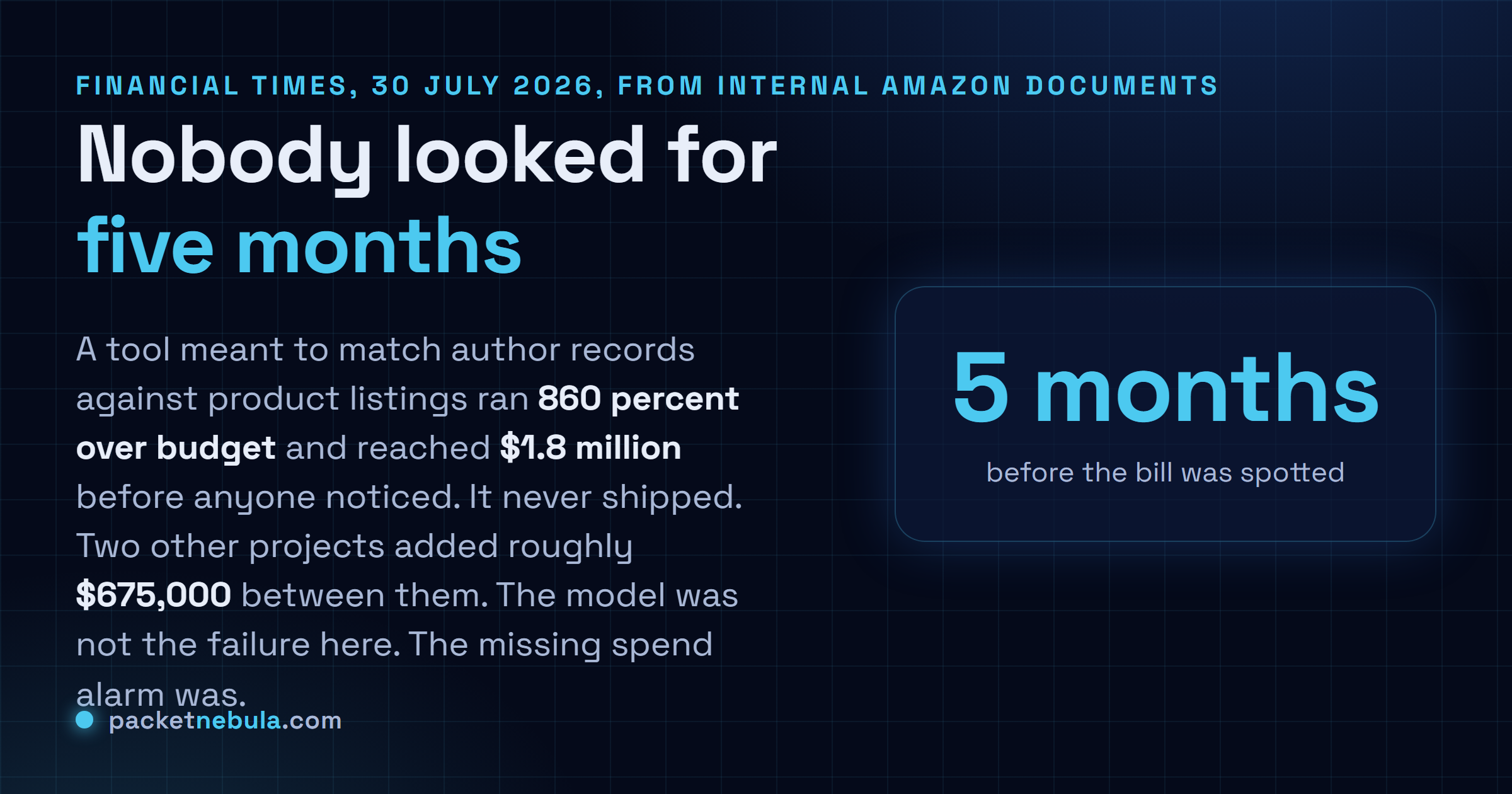
Somewhere in Amazon's catalogue, a tool was quietly matching author records against product listings. It ran for five months. It never launched, and it burned about $1.8 million in Claude Sonnet tokens, which the Financial Times reported on 30 July from internal documents as an 860 percent overrun. Two smaller projects pushed the unplanned total to roughly $2.5 million. The number isn't really the story, though. Amazon is guiding to something near $200 billion of capital spending this year, so $1.8 million is a rounding error inside a rounding error. Five months is the story. A cloud bill that size used to come with an alarm bolted to it, and this one didn't.
The short answer
The Financial Times reported on 30 July 2026 that an Amazon tool using Claude Sonnet to match author records against product listings ran to $1.8 million before detection, and never launched. Two other projects added roughly $675,000. The failure worth studying isn’t the model choice. It’s that a metered bill ran for five months with nothing watching it.
What was actually reported
The Financial Times had the documents first, on 30 July. Everyone else has been working from that, us included, so it’s worth being precise about what came from the leak and what didn’t.
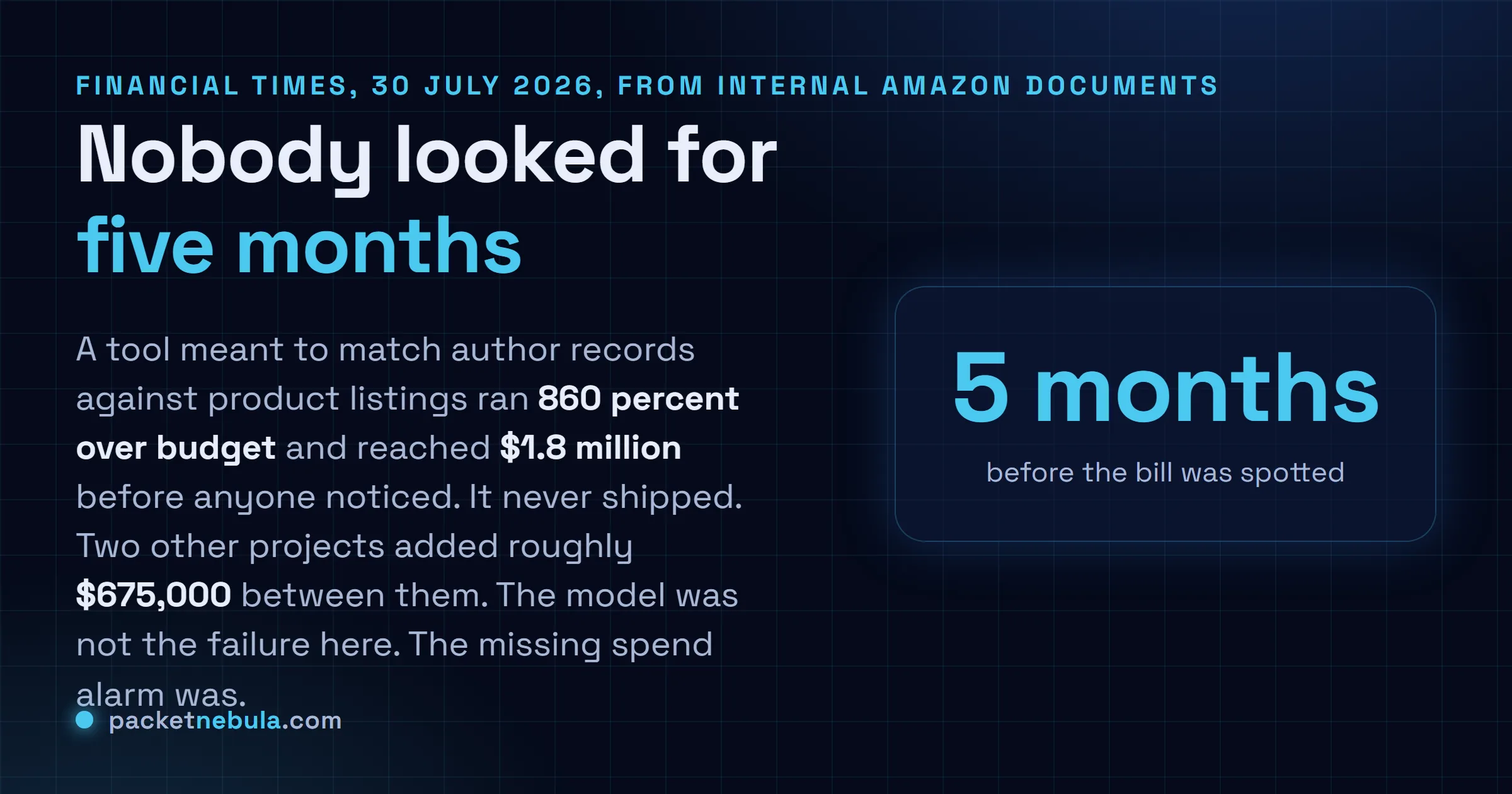
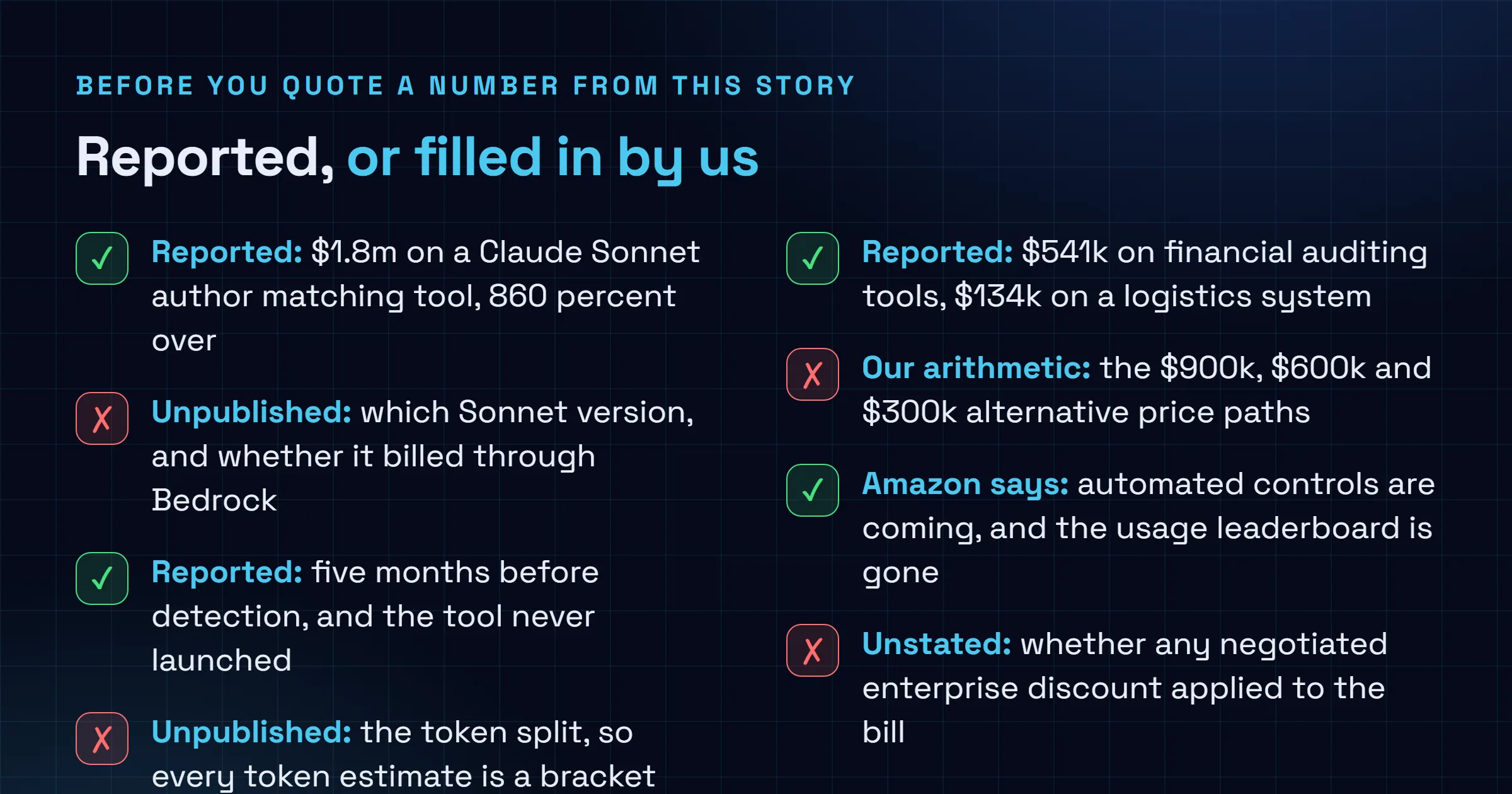
Confirmed in the reporting: a tool built to cross-reference author information with product listings on Amazon’s store, running on Anthropic’s Claude Sonnet, reaching roughly $1.8 million at 860 percent over its budget. Five months before anyone spotted it. The deployment failed. Senior engineers brought it to a staff meeting on Tuesday 28 July, where it landed alongside two smaller cases, about $541,000 on financial auditing tooling and about $134,000 on a system meant to speed up deliveries. That last one got caught inside a couple of weeks, which tells you the detection problem isn’t uniform.
Not in the reporting: which Sonnet version ran, whether the billing went through Bedrock or the first-party API, what discount Amazon has negotiated, and the input to output token split. Every token number below is a bracket for that reason.
Amazon’s statement is the one you’d write in its position. As with any new technology, we’re experimenting, learning and improving how we use it. The company also pointed out that this touched a small number of teams inside a corporate workforce around 300,000, which is fair and also slightly beside the point.
The number that should worry you
$1.8 million of Sonnet is a lot of tokens.
At the standard list price of $3 per million input tokens, that’s 600 billion input tokens. Flip it and assume every dollar went to output at $15 per million, and you still land at 120 billion. Reality sits somewhere between, and for a matching job it sits near the top: you send a product listing and an author record in, you get back a short verdict. Heavy in, light out.
By Anthropic’s own rule of thumb of roughly 0.75 words per token, 600 billion tokens is on the order of 450 billion words. For deciding whether a name on a book matches a name in a database.
Honestly, I keep getting stuck on that. Not because a model can’t do the job, it obviously can, but because somewhere in there is a loop that ran and reran without anyone reading the meter. Five months is two quarters. It’s long enough for a budget review to have happened and missed it.
The levers were sitting right there
Here’s what stings. Anthropic publishes all of this on one page.
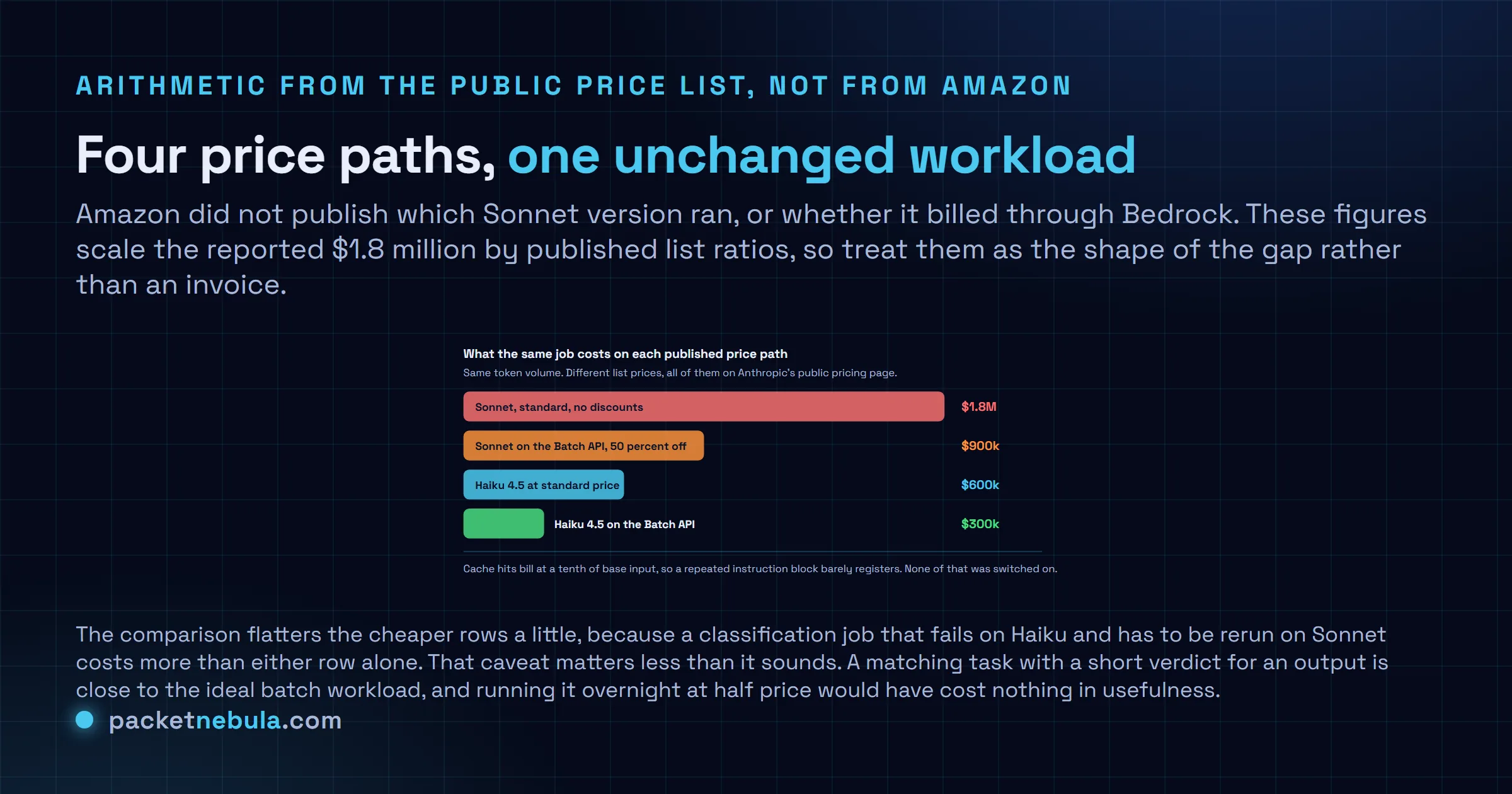
The Batch API takes 50 percent off input and output both, for work that doesn’t need an answer this second. An offline catalogue reconciliation is close to the platonic ideal of that workload. Nobody is waiting. Run it overnight, pay half.
Prompt caching bills a cache hit at a tenth of the base input rate. A job that sends the same instruction block and the same schema on every single call is paying full freight for identical bytes, over and over, unless someone sets a cache breakpoint.
And Haiku 4.5 costs $1 and $5 per million tokens against Sonnet’s standard $3 and $15. Exactly a third. For name matching, a smaller model with a tight prompt is often the right call anyway, and the ones it can’t resolve get escalated.
Stack Batch on Haiku and you’re at $0.50 per million input, one sixth of Sonnet’s standard rate. The same workload lands near $300,000 instead of $1.8 million.
That comparison is a little generous to the cheap rows, and I should say so. If Haiku fails on a chunk of records and you rerun those on Sonnet, you’ve paid twice. Fine. Even granting that, the gap between what this cost and what it should have cost is most of an order of magnitude.
What this means if you run an LLM in production
The model tier is the least interesting decision here.
Software has always had cost bugs. An infinite retry loop against a database costs you some CPU and a page. The same bug against a token-metered endpoint costs you money at a rate nothing in your stack is designed to notice, and one Amazon engineer put it exactly that way: bugs that used to be near free became catastrophically expensive once the AI was doing the work.
So the guardrail worth building isn’t a cheaper model. It’s a circuit breaker. A hard per-project spend ceiling that stops calls rather than emailing someone. A daily anomaly check on token volume, not on dollars, since dollars lag. Budget alarms that fire to the team that owns the job instead of to a finance mailbox nobody reads. Amazon says it’s building the automated version of this now, which is a sensible thing to build and an odd thing not to have had.
There’s a second lesson buried in the same story, and it’s about incentives. Amazon has scrapped an internal leaderboard that ranked employees by AI usage. Staff had been gaming it, which anyone could have predicted, and back in May the company had already dealt with people inflating token counts on its internal Kiro platform to climb the board. If you measure adoption by consumption, you will get consumption. You just won’t get adoption.
We wrote about the same shape of problem when an agent swarm ran up $1,339 rebuilding SQLite, and about the cost side of model selection in our breakdown of what each Claude effort level costs. Different scales, same missing meter.
The part nobody at Amazon said out loud
The executive quote doing the rounds is the honest one: it’s hard to figure out how much anything related to AI actually costs.
That’s true, and it’s not a complaint about pricing pages. Token consumption depends on prompt length, on retries, on how chatty a model is when it’s uncertain, on whether your context window is full of things the model didn’t need. None of that is knowable from a design doc. You find it out by running the thing.
Which is precisely why the ceiling has to exist before the first run, not after the first invoice. I might be wrong about how much of this is Amazon-specific, given the company is spending at a scale where $1.8 million genuinely can hide. At a normal company it would have shown up on the first monthly bill and someone would have shouted. That’s not a comfort, though. It just means most teams get caught faster, not that they’ve built anything better.
Sources
Original reporting by the Financial Times, 30 July 2026, from internal Amazon documents. Secondary coverage and quotes via Tom’s Hardware, The Next Web and Oninvest. All per-token prices, the Batch API discount and the cache hit multiplier come from Anthropic’s published pricing documentation. The alternative cost figures are our own arithmetic on those published rates.
Frequently asked questions
How much did Amazon spend on the failed Claude project?
About $1.8 million, on a tool that matched author information against product listings in Amazon's store. The Financial Times reported the figure on 30 July 2026 from internal documents, describing it as 860 percent over the project's budget. The deployment failed and the tool was never launched. Two other efforts overran as well, a financial auditing tool by roughly $541,000 and a delivery logistics system by about $134,000, taking the unplanned total to around $2.5 million.
How did the overspend go unnoticed for five months?
Amazon has not published the mechanism, and that is the interesting gap. What the reporting does say is that senior engineers raised it at a staff meeting on 28 July, and that one executive put the underlying problem plainly: it is hard to figure out how much anything related to AI actually costs. Token billing turns a piece of software into a metered utility, so a loop that used to waste CPU cycles now writes a line on an invoice, and nothing about a normal deployment pipeline watches that line.
What would the same job have cost with cost controls on?
Considerably less, using nothing more exotic than the published price list. The Batch API takes 50 percent off both input and output, so the same volume lands near $900,000. Haiku 4.5 at $1 and $5 per million tokens is a third of Sonnet's standard $3 and $15, so about $600,000. Run Haiku through Batch and it is roughly $300,000. Prompt cache hits bill at a tenth of base input on top of that. These are our ratios applied to the reported figure, not Amazon's accounting.
How many tokens is $1.8 million of Claude Sonnet?
Somewhere between 120 billion and 600 billion, and the split has not been published. At Sonnet's standard $3 per million input tokens, $1.8 million buys 600 billion input tokens. If every dollar had gone to output at $15 per million, it would still be 120 billion. A matching task sends far more in than it gets back, so the real figure sits toward the top of that bracket. By Anthropic's own rough conversion of about 0.75 words per token, 600 billion tokens is on the order of 450 billion words.
What is Amazon changing after this?
Two things have been reported. The company is building automated guardrails that cap project spending before it reaches an invoice, and it has scrapped an internal leaderboard that ranked staff by AI usage, which employees had been gaming. That leaderboard had already produced a problem of its own back in May, when people inflated token usage on the internal Kiro platform to climb it. Amazon's public line is that it is experimenting, learning and improving how it uses the technology.