
• Latest
  • Trending
  • All
Answer card: Qwen3.8-Max is not open source today; it is API only, the weights are promised next week on Hugging Face and ModelScope, and no licence has been named.

Qwen 3.8 Max: is it open source? Not yet

3 September 2026
Answer card stating that OpenAI published its research acceleration measurements on 6 September 2026, that as of mid August 2026 its research organisation logged 3.1 agent workdays of coding agent runtime for every workday of human labour normalised to a standard eight hour day, and that OpenAI states this should not be read as a 3.1 times productivity gain because it measures runtime rather than delivered output.

OpenAI’s 3.1 agent-workdays per human day is not a 3.1x gain

7 September 2026
Answer card stating that Mullvad announced on 3 September 2026 that it is shutting down its public encrypted domain name system servers on 2 November 2026 and sponsoring the Quad9 Foundation instead, with 194.242.2.2 and its five sibling addresses all going away, and virtual private network customers unaffected.

Mullvad’s DNS servers go dark on 2 November, and Quad9 blocks no ads

5 September 2026
OpenAI announcement image for GPT-6 Astra, a spiral galaxy of white, blue and amber points of light curling around a bright core on a near black star field.

GPT-6 Astra lists at $10 and $50, 2.5x what GPT-5.6 Sol costs

6 September 2026
Google's official announcement image for the release, reading Introducing Gemini 3.8 Flash and 3.8 Flash Cyber in black type over a pale blue background with a blurred white chevron and the four colour Gemini spark below.

Gemini 3.8 Flash keeps the price and the 1 January cliff

3 September 2026
Answer card stating that Anthropic announced Enterprise Frontier Safeguards on 1 September 2026, that activity data used for misuse monitoring moves into cloud storage the customer controls under the customer own encryption keys, that Anthropic charges nothing for the feature while the cloud provider bills storage and egress, and that the phased rollout starts later in autumn 2026 with interim zero data retention on Fable 5 and Fable 5.1 for eligible customers.

Anthropic moves retention into your own cloud, for 30 days

3 September 2026
Official Google diagram of a client connection in three numbered steps: a DNS lookup with a query and an address, a TLS ClientHello and ServerHello, then a content exchange with a website. A callout on the DNS step reads 25% of global web traffic is now protected by encrypted DNS, and a callout beside an Android phone on the ClientHello step reads Android 17 supports ECH GREASE by default.

Android 17 hides the SNI, not your DNS or destination

3 September 2026
Still frame from the Claude Fable 5.1 launch video showing model-designed protein binders in orange docked against twelve grey target proteins, rendered as ESMFold2 structure predictions.

Claude Fable 5.1 breaks forced tool use, cuts cache 75%

1 September 2026
Answer card stating that on 31 August 2026 the European Commission designated ChatGPT a Very Large Online Search Engine under the Digital Services Act, the first conversational AI service classified that way, because it answers user prompts and queries including by searching the web, with OpenAI having declared roughly 159.1 million average monthly users in the European Union for ChatGPT search.

The EU now calls ChatGPT a very large search engine

3 September 2026
Answer card stating that on 31 August 2026 the Department of War added OpenAI ChatGPT Mil and Starshield AI Grok for Government to the GenAI.mil portal alongside Google Gemini, all three accredited at Impact Level 5 for Controlled Unclassified Information, with 1.7 million unique users onboarded out of roughly 3 million eligible personnel, and ChatGPT Mil currently serving GPT-5.4 Terra with GPT-5.6 Terra said to be rolling out.

ChatGPT Mil and Grok reached IL5 on GenAI.mil

3 September 2026
Answer card stating that Anthropic opened a research preview of the Model Hardware Standard on 27 August 2026, standardising the driver layer between an operating system and a laboratory instrument with read and write primitives plus discovery and safety limits, reachable through MCP as well as a command line and code files, with no public specification published.

Anthropic’s Model Hardware Standard is gated, and sits under MCP

3 September 2026
Official Cohere key art for the Parse 5 launch: the Cohere mark and the wordmark Parse with a superscript 5 in white, centred on a soft out of focus gradient of deep blue, violet and amber curves.

Cohere Parse 5 is $1.50 per 1,000 pages, on three of five dimensions

3 September 2026
Title card from the OpenAI announcement video: a man sits on a blue sofa in a loft with tall windows and potted plants, a laptop open on the coffee table in front of him, with the words WebMCP in ChatGPT in large white type across the lower left.

WebMCP in ChatGPT needs GPT-5.6 Sol or Terra

3 September 2026
  • About
  • Contact
  • Privacy
  • Legal
Monday, September 7, 2026
  • Login
Packet Nebula
  • Home
  • Articles
    • Security
    • Network
    • Dev
    • Sysadmin
    • SEO
    • Email & DNS
  • Tools
    • Network tools: free, fast, no signup
    • Security tools: free, fast, no signup
    • Developer tools: free, fast, no signup
    • Sysadmin tools: free, fast, no signup
    • SEO tools: free, fast, no signup
    • Email & DNS tools: free, fast, no signup
  • Download
  • About
No Result
View All Result
Packet Nebula
No Result
View All Result
Home Dev

Qwen 3.8 Max: is it open source? Not yet

by stephane
3 September 2026
in Dev
0
Answer card: Qwen3.8-Max is not open source today; it is API only, the weights are promised next week on Hugging Face and ModelScope, and no licence has been named.
491
SHARES
1.4k
VIEWS
Share on FacebookShare on Twitter

Half the headlines this week call Qwen3.8-Max an open source model. Right now it isn't one, and the gap matters if you were planning around it. Alibaba announced the model on August 3, made it available through its hosted API, and promised the weights on Hugging Face and ModelScope next week. Promised. Nothing to download today. And when they do land, open weights still isn't the same thing as open source, because the licence decides what you may actually do, and Alibaba hasn't named one. So here is the honest state of play: what shipped, what didn't, what the licence question really means for you, and whether a 2.4 trillion parameter model is something you could realistically run even after the download button appears.

The short answer

Qwen3.8-Max isn’t open source right now. It’s a hosted model you reach through an API, with weights promised for next week on Hugging Face and ModelScope. Even after they land, the licence decides whether you can really use them, and Alibaba hasn’t published one. Worth watching. Not worth planning on yet.
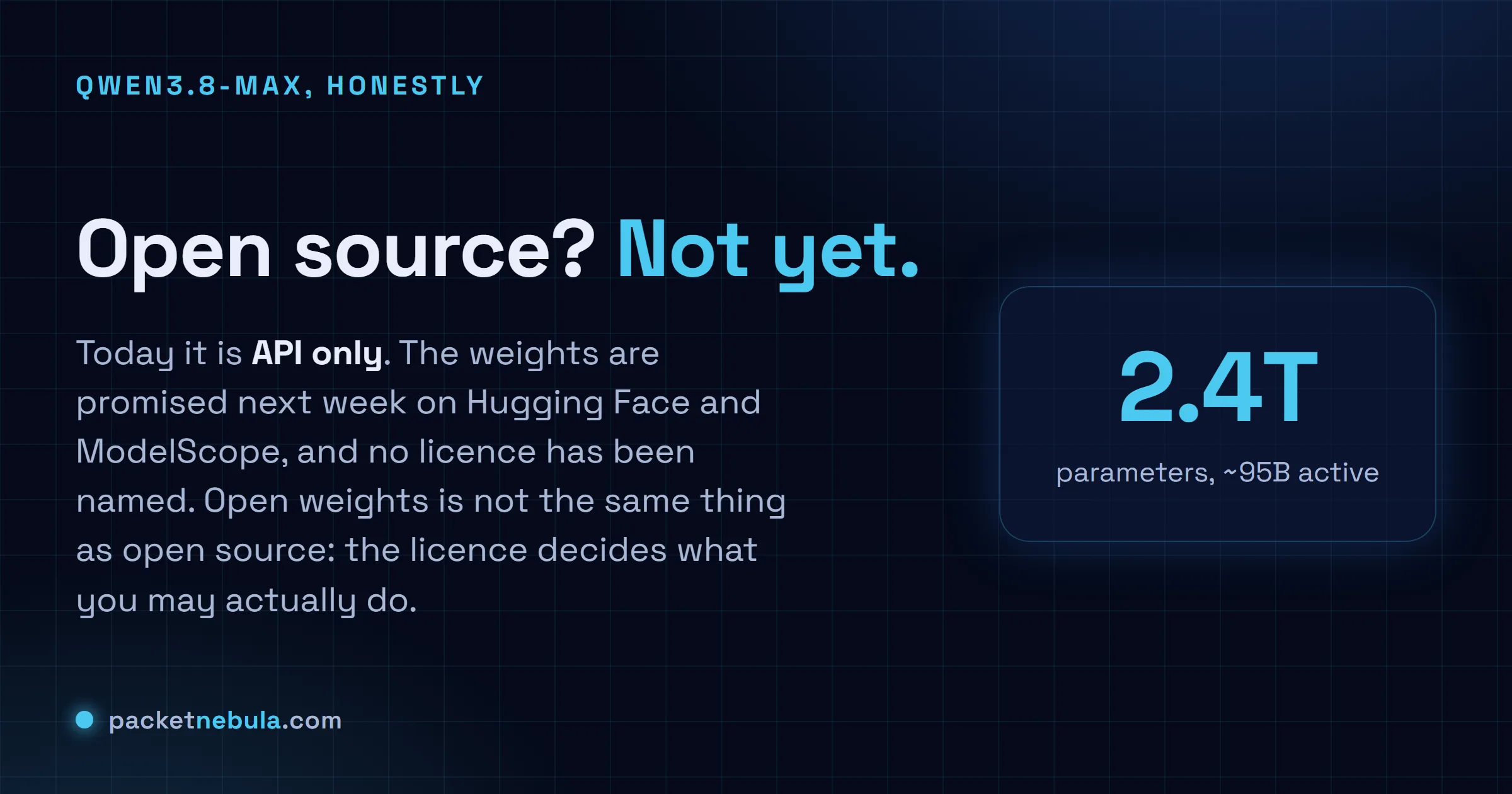
API onlytoday
next weekweights promised
no licencenamed yet
Answer card: Qwen3.8-Max is API only today, weights promised next week on Hugging Face and ModelScope, and no licence has been named.
The honest answer to the question in the headline: not yet, and the licence is the part nobody has seen.

What Alibaba actually announced

On August 3 Alibaba put out Qwen3.8-Max, and the specs explain the noise. It’s a mixture of experts model with 2.4 trillion total parameters, reported at around 95 billion active per token, a 1 million token context window (991K of usable input, a little less with thinking on) and up to 131K tokens of output. Reasoning chains can run to 262K tokens, which tells you what it’s built for: long agentic jobs, autonomous coding, research that doesn’t finish in one pass.

You can use it today through QwenCloud, and the API is OpenAI and DashScope compatible, so wiring it into existing code is a config change rather than a project. Pricing is $2 in and $6 out per million tokens, with cached input reads down at $0.25. Same headline rate as Grok 4.5, a fraction of what the Western flagships charge.

What you cannot do today is download it. Alibaba said the weights ship next week on Hugging Face and ModelScope, and framed it as a return to the open strategy after keeping several recent flagships closed. It would be the first Max-class Qwen ever opened. That’s genuinely a big deal. It’s also, right now, a sentence in an announcement.

Open weights is not open source

This is the part the headlines flatten, and it’s worth being precise about, because the two phrases give you very different rights.

Open weights means you can download the model file and run it. That’s it. Open source, in the sense the term normally carries, implies a licence that lets you use, modify and redistribute freely, including commercially. Model weights routinely ship under custom licences that look open at a glance and carry real conditions underneath: revenue thresholds above which you need a separate deal, use restrictions, limits on redistribution, clauses about training other models on the outputs.

We’ve seen both ends of that spectrum recently. GLM-5.2 shipped under MIT, about as permissive as it gets, and that licence is a large part of why we recommended it as the open option against API-only rivals. Other releases have arrived with paperwork that quietly rules out the exact use case you had in mind.

Alibaba hasn’t named a licence for Qwen3.8-Max. Until it does, the correct posture is interest, not planning. If you’re building something commercial that depends on self-hosting these weights, that decision can’t be made yet, however loudly a headline says open source.
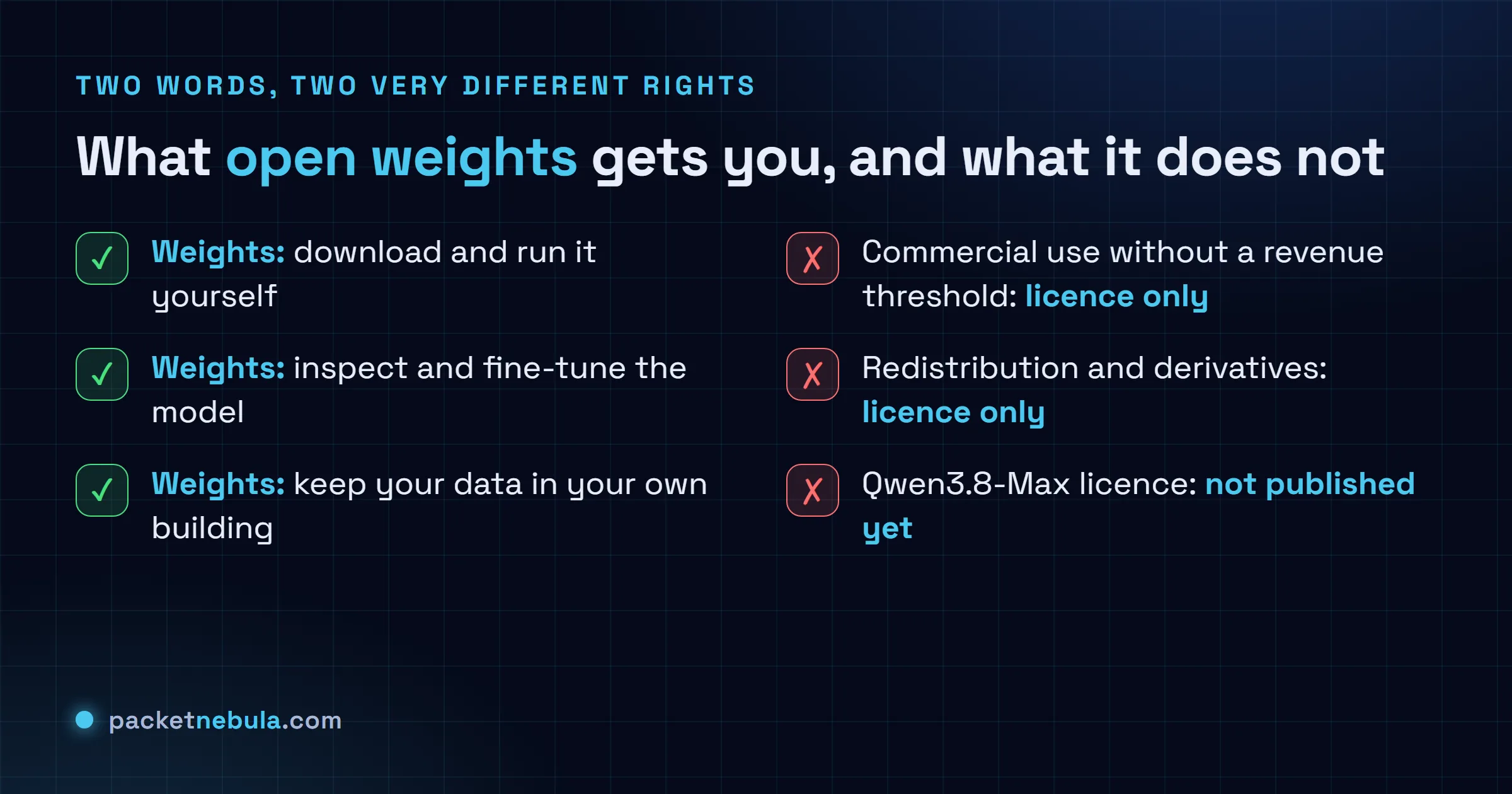
Checklist comparing what open weights gives you (download, self-host, inspect) against what only a permissive licence gives you (commercial use, redistribution, fine-tuning without limits), with the Qwen 3.8 Max status unknown.
Two different things wearing the same word. The licence is the line between them.

Even with the weights, could you run it?

Say the download lands next week under a licence you like. There’s a second question people skip, and for most readers it’s the one that decides everything.

A 2.4 trillion parameter model isn’t a laptop project. Even with a mixture of experts design that only activates a fraction of the network per token, and even heavily quantized, you’re looking at server-class memory measured in hundreds of gigabytes. This is self-hostable in the sense that a company with real GPUs can serve it privately. It’s not self-hostable in the sense that you can pull a model with Ollama and run it offline, which is what most people mean when they get excited about open weights.

So the open drop matters, a lot, but for a specific audience: providers who’ll serve it cheaply, labs who’ll fine-tune it, companies with data that can’t leave the building. If you wanted a Qwen on your own machine, the smaller open models in the family remain the answer, and always were.
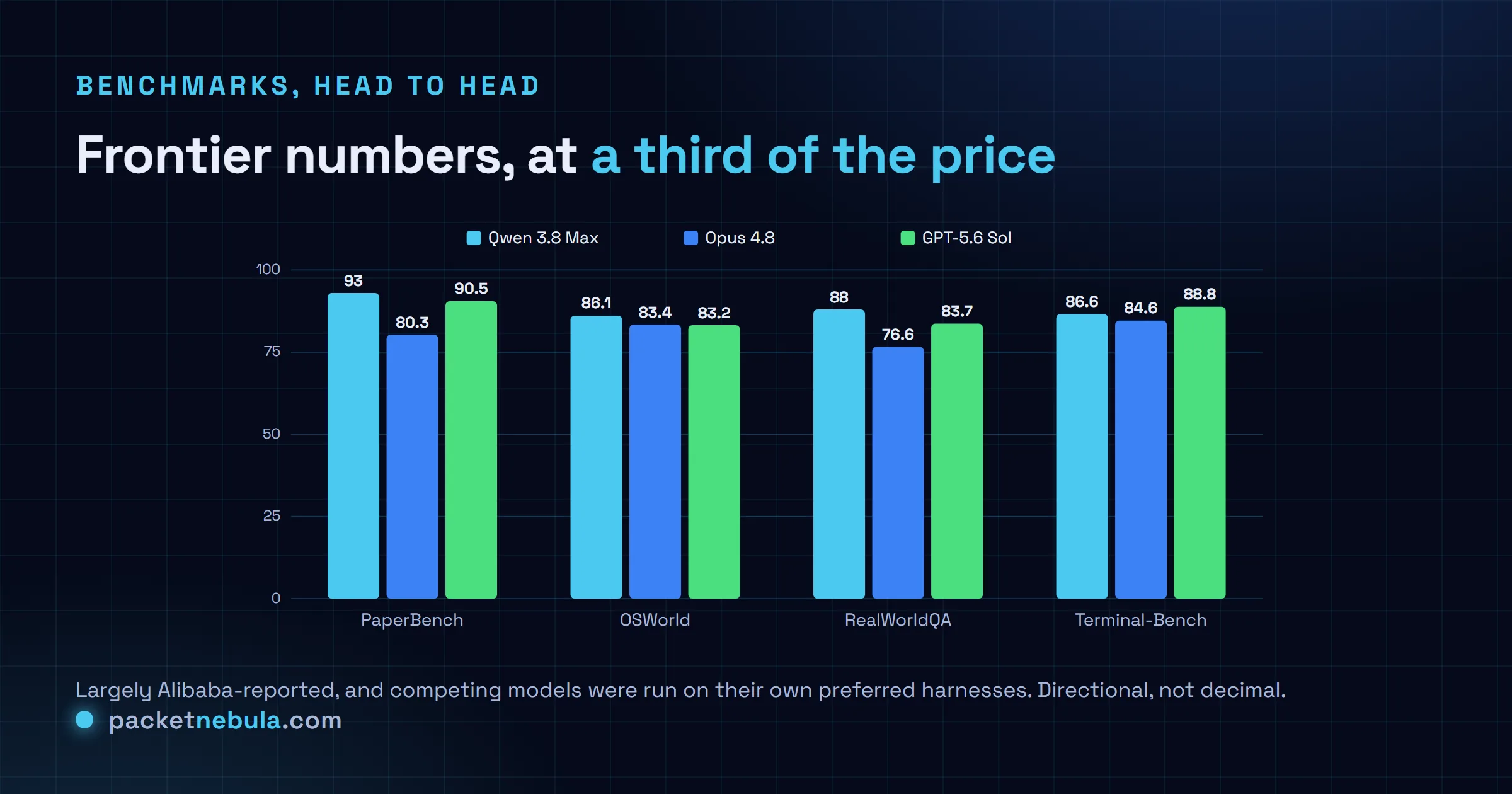
Grouped bar chart of Qwen 3.8 Max against Claude Opus 4.8 and GPT-5.6 Sol on PaperBench, OSWorld-Verified, RealWorldQA and Terminal-Bench 2.1.
Strong numbers, mostly Alibaba-reported. Read the direction, not the decimals.

The benchmarks, and how much to trust them

The scores are real and they’re good. On PaperBench it posts 93.0 against Claude Opus 4.8’s 80.3 and GPT-5.6 Sol’s 90.5. On OSWorld-Verified, the computer-use test, 86.1 against 83.4 and 83.2. On RealWorldQA it’s 88.0 against Opus at 76.6. Terminal-Bench 2.1 puts it at 86.6, ahead of Opus 4.8’s 84.6 and behind GPT-5.6 Sol at 88.8. Its own predecessor got left behind entirely on FrontierSWE, 40.7 up to 73.5.

Now the honest caveat, which the write-ups include and the headlines drop: most of the competing models were evaluated on their own preferred harnesses, and some of the Qwen in-house benchmarks are new. Cross-lab comparisons like these are directional. The direction says a Chinese lab is shipping frontier-class multimodal and agentic performance at a third of the Western price. That conclusion survives a generous error bar. The individual decimals don’t need to.

What to watch next week

Three things, in order of how much they’d change your plans.

The licence first. MIT or Apache and this is a genuinely significant open release, the first Max-class model anyone can self-host. A custom licence with commercial thresholds and it’s a research artifact with good PR. Second, the model card: real activated-parameter numbers, training details, and eval methodology you can check rather than take on faith. Third, whether the drop actually happens next week, because promised weights have slipped before, at every lab.

Until then, Qwen3.8-Max is an interesting, cheap, capable hosted model with an open future that hasn’t arrived. Use the API if the price and the vision scores fit your work. Just don’t build the self-hosting plan yet, and be a little suspicious of any headline that already put the words open source in the past tense.

Sources: Alibaba’s Qwen3.8-Max announcement of August 3 2026, with specs, pricing and benchmark tables collated by MarkTechPost and Developers Digest. Benchmark figures are largely Alibaba-reported and were not run on a common harness; the open-weights date, licence and model card were unpublished at the time of writing.

What changed since

19 July 2026. Qwen3.8-Max-Preview went up with a 2.4T parameter claim and open weights promised soon. Nothing runnable, and the promise was a post rather than a licence.

4 August 2026. The state described above: API only, weights promised, no licence named.

15 August 2026. The picture split in two, and this is the part that dates the answer above. The small model, Qwen3.8-27B, shipped under Apache 2.0 with a vision encoder. The 2.4T flagship weights came out text only, under a custom licence rather than a permissive one. So "is Qwen 3.8 open source" now depends entirely on which model you mean, and we pulled that apart in Qwen3.8-27B ships Apache 2.0 with vision, the 2.4T doesn’t.

Frequently asked questions

Is Qwen 3.8 Max open source?

Not today. As of August 4, 2026 the model runs through Alibaba's hosted API only. The weights are promised for next week on Hugging Face and ModelScope, which would make it open weight, and open weight is not automatically open source: that depends on a licence Alibaba has not published yet.

When are the Qwen 3.8 Max weights released?

Alibaba said next week, counting from the August 3 announcement, on Hugging Face and ModelScope. No exact date has been given, and no model card has appeared. It would be the first Max-class Qwen model the company has ever opened, so the drop is worth watching rather than assuming.

What licence will Qwen 3.8 Max use?

Unannounced, and it is the detail that decides everything. GLM-5.2 shipped under MIT, which lets you use it commercially with almost no strings. Plenty of other model weights ship under custom licences with revenue caps, use restrictions or no redistribution. Until Alibaba names one, treat any commercial plan built on these weights as provisional.

Can I run Qwen 3.8 Max locally?

Realistically, no, not on your own machine. It is a 2.4 trillion parameter mixture of experts, reported at about 95 billion active parameters per token, so even quantized you are looking at server-class memory rather than a desktop GPU. Open weights here means self-hostable on serious infrastructure, not something you pull with Ollama on a laptop.

How much does Qwen 3.8 Max cost?

Through the API it is $2 per million input tokens and $6 per million output, with cached input reads as low as $0.25 per million. That is the same headline rate as Grok 4.5 and a fraction of the Western flagships, which is a large part of why the model is getting attention.

Tags: aialibaballmnewsopen-weightsqwen
Share196Tweet123
stephane

stephane

  • Trending
  • Comments
  • Latest
The Agentic Coding section of the official Hy4 preview benchmark appendix published by Tencent, a table comparing Hy3 and Hy4 preview against DeepSeek V4 Pro 0813, Qwen 3.8 Max, GLM 5.3, Kimi K3, GPT 5.6 Sol and Claude Opus 5 across SWE-bench Multilingual, SWE-bench Pro, DeepSWE, three SWE Atlas tasks, SWE-Marathon, Terminal-Bench 2.1, NL2Repo-Bench, CyberGym, ProgramBench, PostTrainBench and Harbor-Index.

Tencent’s 770B Hy4 tops one benchmark row in 46

3 September 2026
Answer card: Proton Lumo 2.0 is private by policy, not by locality. Saved history is locked so even Proton cannot read it, but the prompt is decrypted on a Proton EU server to answer it, then forgotten.

Proton Lumo 2.0 review: how private is it, really?

3 September 2026
Answer card: Apple released iOS 26.6 and iPadOS 26.6 on 27 July 2026 with a release note covering bug fixes, security updates and an optimized Spotlight index to prepare for iOS 27, the index the rebuilt Siri reads for personal context.

iOS 26.6 is out: the Spotlight index it quietly builds

27 July 2026
Answer card: JWTs are not encrypted, anyone can read them; the signature proves who issued the token, not who may read it.

Are JWTs encrypted? No, and the difference will bite you

0
Answer card: a random 8 character password falls in under 2 hours offline, while 16 random characters hold for 1.4 trillion years at the same speed.

How long does it take to crack a password in 2026?

0
Answer card: three DNS records decide if your mail lands or bounces; SPF lists allowed senders, DKIM signs messages, DMARC sets the failure policy.

SPF, DKIM and DMARC explained: the records your email needs

0
Answer card stating that OpenAI published its research acceleration measurements on 6 September 2026, that as of mid August 2026 its research organisation logged 3.1 agent workdays of coding agent runtime for every workday of human labour normalised to a standard eight hour day, and that OpenAI states this should not be read as a 3.1 times productivity gain because it measures runtime rather than delivered output.

OpenAI’s 3.1 agent-workdays per human day is not a 3.1x gain

7 September 2026
Answer card stating that Mullvad announced on 3 September 2026 that it is shutting down its public encrypted domain name system servers on 2 November 2026 and sponsoring the Quad9 Foundation instead, with 194.242.2.2 and its five sibling addresses all going away, and virtual private network customers unaffected.

Mullvad’s DNS servers go dark on 2 November, and Quad9 blocks no ads

5 September 2026
OpenAI announcement image for GPT-6 Astra, a spiral galaxy of white, blue and amber points of light curling around a bright core on a near black star field.

GPT-6 Astra lists at $10 and $50, 2.5x what GPT-5.6 Sol costs

6 September 2026
  • About
  • Contact
  • Privacy
  • Legal

Copyright © 2026 Stephane Cardon.

Welcome Back!

Login to your account below

Forgotten Password?

Retrieve your password

Please enter your username or email address to reset your password.

Log In
No Result
View All Result
  • Home
  • Articles
    • Security
    • Network
    • Dev
    • Sysadmin
    • SEO
    • Email & DNS
  • Tools
    • Network tools: free, fast, no signup
    • Security tools: free, fast, no signup
    • Developer tools: free, fast, no signup
    • Sysadmin tools: free, fast, no signup
    • SEO tools: free, fast, no signup
    • Email & DNS tools: free, fast, no signup
  • Download
  • About

Copyright © 2026 Stephane Cardon.