
• Latest
  • Trending
  • All
Answer card: DeepSeek-V4-Flash-0731 replaced the April preview weights behind the same deepseek-v4-flash endpoint on 31 July 2026, keeping the same 284B parameter architecture with 13B active and the same $0.14 and $0.28 per million token pricing, while Terminal Bench 2.1 rose from 61.8 to 82.7.

DeepSeek V4-Flash-0731: same API, new model

12 September 2026
Answer card stating that Qwen3.8-Omni-Flash launched on 17 September 2026 as an API only model on Alibaba Cloud Model Studio, taking text, images, audio and video in a 1M token context and returning text only, priced at 0.15 dollars per million input tokens for every modality and 0.47 dollars per million output tokens in the international regions, with no open weights published and the Qwen-Live Harness GitHub repository returning 404.

Qwen3.8-Omni-Flash bills audio at $0.15 and ships no weights

18 September 2026
Answer card stating that on 15 September 2026 AWS said it is unable to restore access to resources and data hosted exclusively in the Middle East Bahrain region me-south-1 and in the mec1-az2 zone of the UAE region, because the damage spanned multiple Availability Zones and exceeded what multi-AZ services are designed to withstand.

AWS can’t restore me-south-1, six months after the drone strikes

17 September 2026
Answer card stating that Google released Gemini 3.8 Live and Gemini 3.8 Live Extended Thinking on 15 September 2026 at 3 dollars per million audio input tokens and 12 dollars out, that the thinking model requires asynchronous tools, and that Artificial Analysis scores it 82.6 on its Speech to Speech Quality Index.

Gemini 3.8 Live Extended Thinking rejects any tool that blocks

16 September 2026
Answer card summarising the Atria Dawn Preview release: 744B GLM-5.2 base, MIT licence, 1.5 TB BF16 and 756 GB FP8 checkpoints, 256K context, top on five of sixteen benchmark rows and trailing on SWE-bench Pro.

Atria Dawn Preview is 744B under MIT, and the BF16 weighs 1.5 TB

15 September 2026
Answer card stating that OpenAI released the Agents API in public beta on 10 September 2026 with no separate fee, billed through model tokens, tool calls and hosted sandbox time, with a choice of OpenAI hosted, self hosted or partner sandboxes, US only data residency and no Zero Data Retention support.

OpenAI’s Agents API has no fee, no ZDR and a one hour sandbox clock

14 September 2026
Answer card: Sakana Fugu Max at $2 and $6 per million tokens, Fugu Ultra v2 unchanged at $5 and $30, and Sakana saying Ultra v2 scores without Fable 5 or GPT-6 Astra in its pool.

Fugu Max costs $2 and $6 while Fugu Ultra v2 runs without Fable 5

13 September 2026
Answer card stating that DeepSeek released DeepSeek-V4.1-Flash on 10 September 2026 as a 552 billion parameter mixture of experts model with a new causal encoder decoder architecture that activates 8 billion parameters on input and 16 billion on output, with native vision, a one million token context and MIT licensed weights, that the API model name is now deepseek-flash at 0.15 dollars per million input tokens and 0.60 dollars per million output tokens off peak, and that DeepSeek announced V4 Pro would be routed to V4.1-Flash from 14 September and reversed that on 11 September.

DeepSeek V4.1-Flash arrived, and the V4 Pro retirement lasted a day

12 September 2026
Answer card stating that Cognition released SWE-2 on 10 September 2026, a coding model post-trained from Kimi K3, scoring 50.0 percent on FrontierCode 1.1 Main against 50.9 percent for Claude Fable 5.1 and 27.3 percent on Terminal-Bench 4 against 55.8 percent, available only inside Devin.

SWE-2 trails Fable 5.1 by one point, and by 28 on Terminal-Bench 4

11 September 2026
Answer card for Meta Muse, free to 100 million tokens a week then $20 a month, launched 8 September 2026 for United States adults only, running in a dedicated per user virtual machine.

Does Meta Muse do enough to earn your inbox and a card on file?

9 September 2026
Answer card stating that the public download pages for the VMware Virtual Disk Development Kit on developer.broadcom.com began returning 404 errors on 25 August 2026 with no announcement or deprecation notice, that Broadcom support tells customers the kit is no longer available for use or download, and that release lines 7.0.3.1, 8.x and 9.x are all affected.

Broadcom pulled VDDK 8.0 and 9.0, and the 404 is the only notice

8 September 2026
Answer card stating that OpenAI published its research acceleration measurements on 6 September 2026, that as of mid August 2026 its research organisation logged 3.1 agent workdays of coding agent runtime for every workday of human labour normalised to a standard eight hour day, and that OpenAI states this should not be read as a 3.1 times productivity gain because it measures runtime rather than delivered output.

OpenAI’s 3.1 agent-workdays per human day is not a 3.1x gain

7 September 2026
Answer card stating that Mullvad announced on 3 September 2026 that it is shutting down its public encrypted domain name system servers on 2 November 2026 and sponsoring the Quad9 Foundation instead, with 194.242.2.2 and its five sibling addresses all going away, and virtual private network customers unaffected.

Mullvad’s DNS servers go dark on 2 November, and Quad9 blocks no ads

5 September 2026
  • About
  • Contact
  • Privacy
  • Legal
Friday, September 18, 2026
  • Login
Packet Nebula
  • Home
  • Articles
    • Security
    • Network
    • Dev
    • Sysadmin
    • SEO
    • Email & DNS
  • Tools
    • Network tools: free, fast, no signup
    • Security tools: free, fast, no signup
    • Developer tools: free, fast, no signup
    • Sysadmin tools: free, fast, no signup
    • SEO tools: free, fast, no signup
    • Email & DNS tools: free, fast, no signup
  • Download
  • About
No Result
View All Result
Packet Nebula
No Result
View All Result
Home Dev

DeepSeek V4-Flash-0731: same API, new model

by stephane
12 September 2026
in Dev
0
Answer card: DeepSeek-V4-Flash-0731 replaced the April preview weights behind the same deepseek-v4-flash endpoint on 31 July 2026, keeping the same 284B parameter architecture with 13B active and the same $0.14 and $0.28 per million token pricing, while Terminal Bench 2.1 rose from 61.8 to 82.7.
493
SHARES
1.4k
VIEWS
Share on FacebookShare on Twitter

Your DeepSeek bill didn't change last Friday. The model did. On 31 July DeepSeek shipped DeepSeek-V4-Flash-0731 onto the same deepseek-v4-flash endpoint you were already calling, at the same price, with the same 284B parameters and 13B firing per token, and the weights underneath turned into something that scores 82.7 on Terminal Bench 2.1 where the April preview managed 61.8. Those are DeepSeek's own numbers, and we'll get to how much weight they carry. The practical bit first: nothing in your code has to change, which is the whole problem. If you keep an eval suite from the spring, it now describes a model you aren't talking to any more.

The short answer

DeepSeek-V4-Flash-0731 supersedes the April preview on the same model name, the same endpoint and the same price, with no architecture change at all. The benchmark jumps are large and they’re all post-training. They also come from a harness DeepSeek hasn’t released, at the most expensive effort setting, so read them as a direction rather than a measurement.
31 Julweights swapped in place
82.7Terminal Bench 2.1, was 61.8
$0.14per 1M input, unchanged
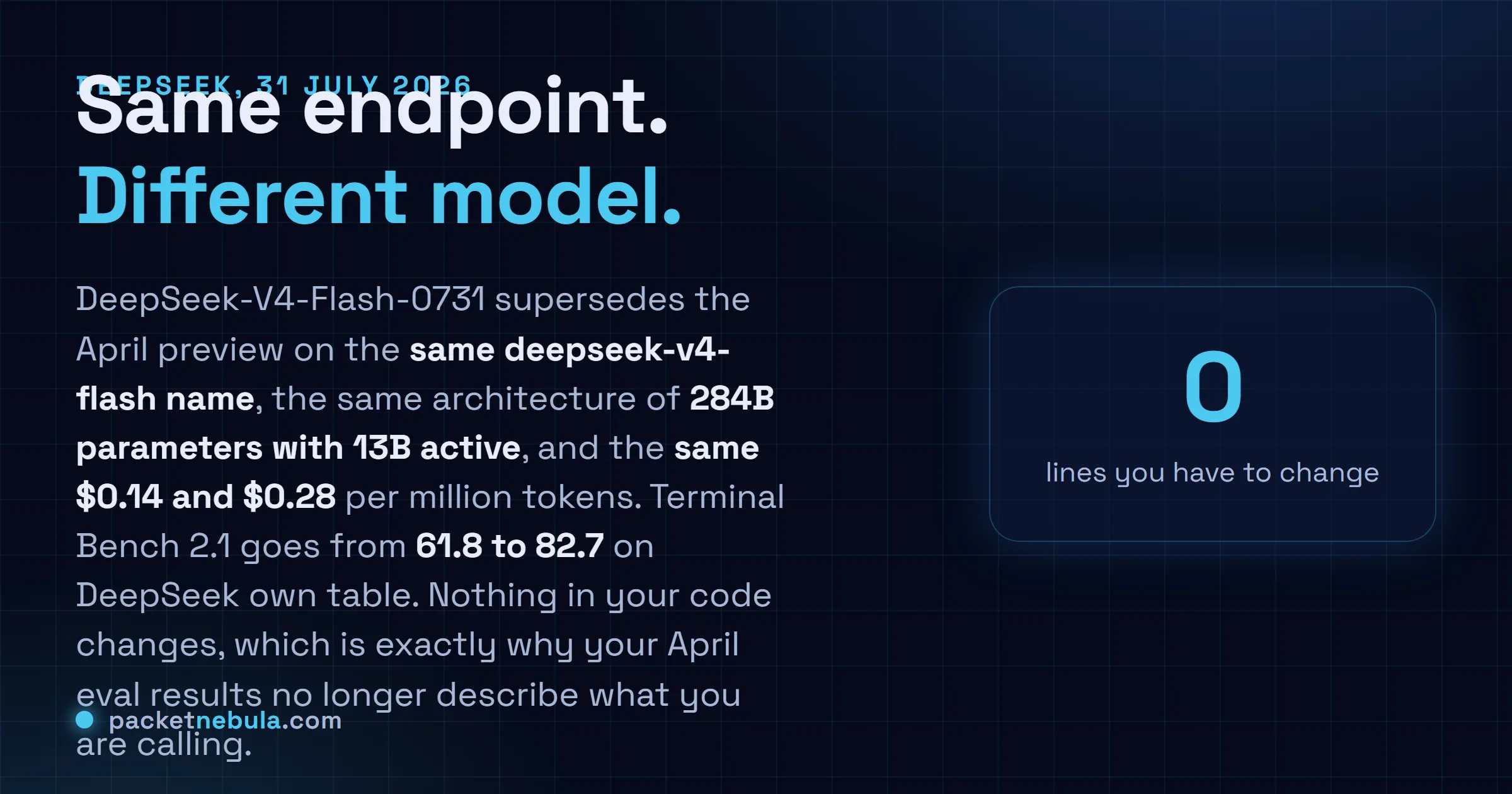
Answer card: DeepSeek-V4-Flash-0731 replaced the April preview behind the same deepseek-v4-flash endpoint on 31 July 2026, with the same 284B parameter architecture, 13B active per token, and the same $0.14 and $0.28 per million token pricing, while Terminal Bench 2.1 rose from 61.8 to 82.7.
Zero lines to change is a feature until you remember what your evals were measuring.

What actually shipped

DeepSeek published DeepSeek-V4-Flash-0731 on Hugging Face on 31 July, under the MIT licence, ungated. The model card calls it the official release of DeepSeek-V4-Flash, superseding the preview, with what it describes as substantially enhanced agentic capabilities.

The company was unusually blunt about the scope on X:

DeepSeek-V4-Flash-0731 keeps the exact same model architecture and size as the preview version. Today’s upgrade applies ONLY to the DeepSeek-V4-Flash API. The DeepSeek-V4-Pro API and App/Web models remain unchanged for now. The official release of DeepSeek-V4-Pro is coming ASAP!

That’s @deepseek_ai on X, 31 July 2026, emoji stripped.

So: a mixture of experts with 284B parameters and 13B firing per token, 256 routed experts per layer with six active, a 1M token window. The Hugging Face card lists 304B total, which is the same base model plus the DSpark speculative decoding module riding along in the checkpoint. Both numbers are floating around the coverage and both are right about different things.

Two API changes came with it. deepseek-v4-flash now speaks the Responses API format natively and has been adapted for Codex. And reasoning_effort takes three levels, low, high and max.
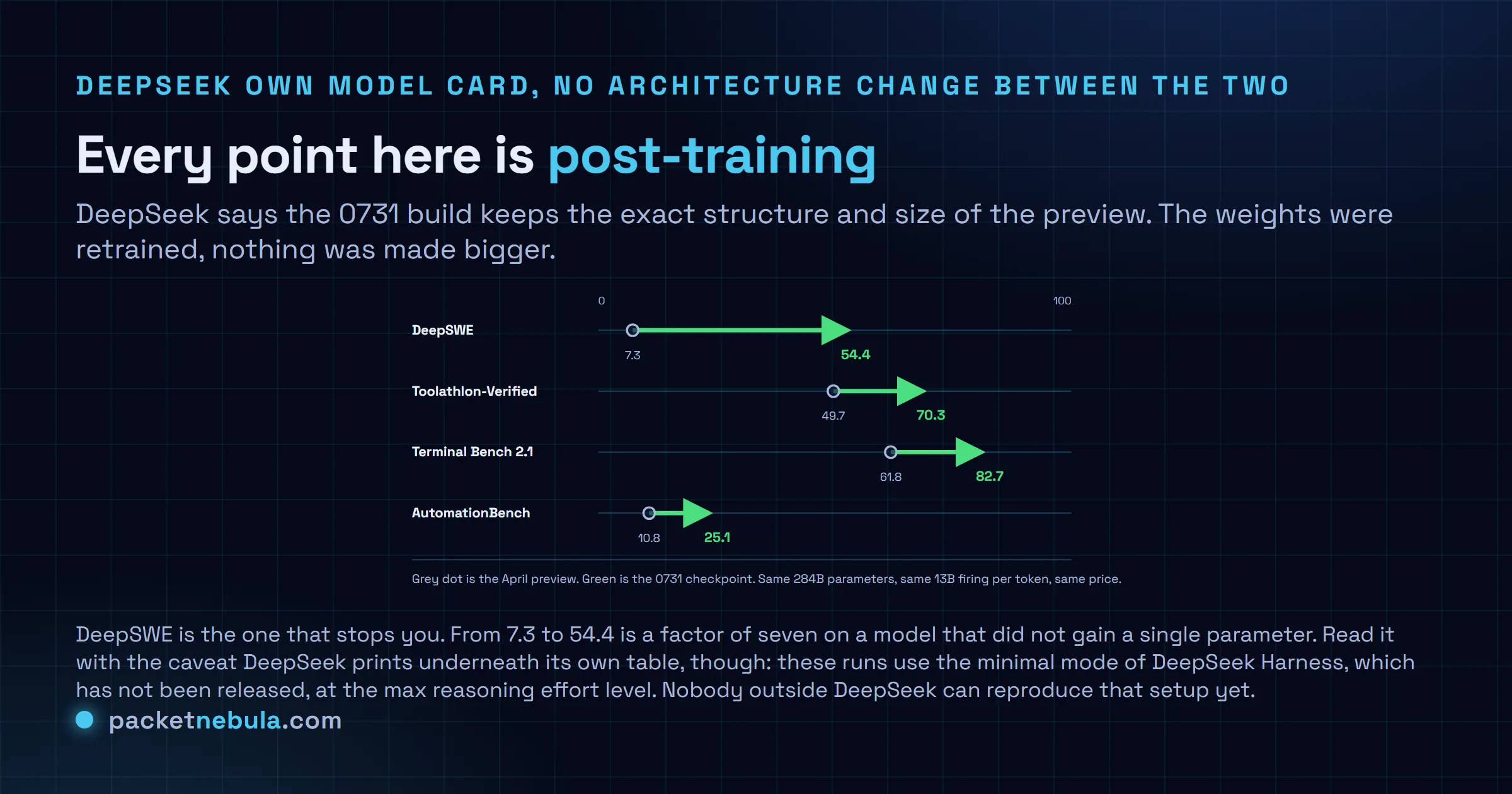
Diagram comparing the DeepSeek V4-Flash April preview against the 0731 checkpoint on four benchmarks published by DeepSeek: DeepSWE 7.3 to 54.4, Toolathlon-Verified 49.7 to 70.3, Terminal Bench 2.1 61.8 to 82.7, and AutomationBench 10.8 to 25.1, with both builds sharing the same 284B parameter architecture.
Same parameters, same active count, same price. Only the training run is different.

The caveat DeepSeek printed itself

DeepSWE going from 7.3 to 54.4 is the number everyone quoted, and honestly it’s the one that made us go and read the footnotes.

They’re right there under the table. For the code agent tasks, the model was evaluated with the minimal mode of DeepSeek Harness, which the card marks as still to be released, at the max reasoning effort level with temperature 1.0 and top_p 0.95. Two of the nine benchmarks, DSBench-FullStack and DSBench-Hard, are DeepSeek’s own internal test sets.

None of that is dishonest. It’s disclosed, in the same paragraph, which is more than a lot of launch posts manage. But it does mean nobody outside DeepSeek can reproduce a single row today, and it means the headline scores were produced at the setting that burns the most tokens. A 7x jump on a preview that scored 7.3 also tells you the preview was badly broken at agent work, which is a slightly less exciting way to frame the same fact.

The one independent read we found comes from Artificial Analysis, which puts it at 50 on its Intelligence Index and ranks it third of 101 open weights models. Different methodology, same rough conclusion.

Where it lands against everything else

We pulled the Terminal Bench 2.1 figures we’ve collected across launches into one place. Every score below is self-reported by whoever shipped the model, on its own harness, so read the ordering loosely.
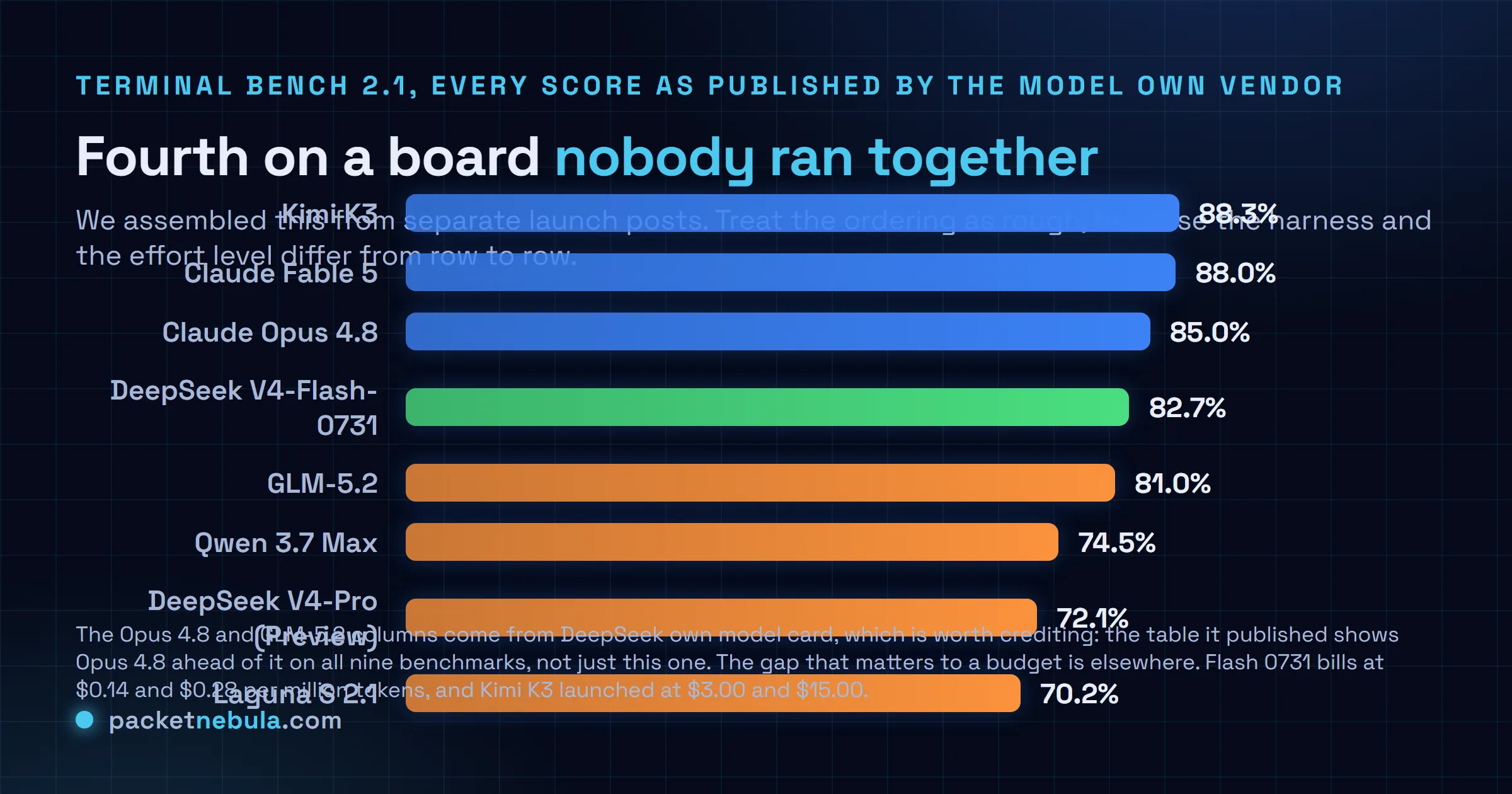
Comparison chart of self-reported Terminal Bench 2.1 scores: Kimi K3 at 88.3 percent, Claude Fable 5 at 88.0, Claude Opus 4.8 at 85.0, DeepSeek V4-Flash-0731 at 82.7, GLM-5.2 at 81.0, Qwen 3.7 Max at 74.5, DeepSeek V4-Pro Preview at 72.1 and Laguna S 2.1 at 70.2.
Assembled from separate launch posts. Nobody ran these together.

Credit where it’s due: the Opus 4.8 and GLM-5.2 columns come from DeepSeek’s own card, and Opus 4.8 beats it on all nine rows. Publishing a table you lose is not the norm.

The interesting comparison isn’t the score anyway. Kimi K3 sits five points ahead at $3.00 and $15.00 per million tokens. Flash 0731 is at $0.14 and $0.28. You can argue about whether five points of benchmark is worth anything, but you can’t really argue with twenty times the input price.

The price, and the cache

Unchanged from the preview. $0.0028 per million tokens on a cache hit, $0.14 on a miss, $0.28 for output.

Divide those first two and you get exactly 50. A cache hit costs a fiftieth of a cache miss, and a hundredth of an output token.

Put it on a workload. Say an agent loop pushing 10 million input tokens and 2 million output tokens a day. Cold, that’s $1.40 plus $0.56, so $1.96. Now assume a stable system prompt and tool schema, which is what an agent loop actually looks like, and let 90 percent of that input hit cache: $0.14 for the misses, about $0.03 for the hits, $0.56 for output. Roughly $0.73.

That’s our arithmetic on published rates, not a DeepSeek claim. It’s also a 63 percent cut for setting a cache breakpoint properly, which is a better return than most model swaps.

One thing DeepSeek doesn’t publish: the token cost of each effort level. The scores above were run at max. Whatever max costs you in thinking tokens, that bill lands on the output line at $0.28. Effort control is a genuine lever here, and it’s one Laguna S 2.1 shipped without.

Running it yourself

MIT, ungated, weights on Hugging Face. DeepSeek gives you a vLLM invocation that serves the model on a single node of four GB300s, and an SGLang recipe alongside it.

DSpark is the nice detail. The speculative decoding draft module lives in the same checkpoint as the target weights, so you turn it on with one flag instead of standing up a second model. In vLLM that’s --speculative-config '{"method":"dspark","num_speculative_tokens":7}', and in SGLang it’s --speculative-algorithm DSPARK with no separate draft path.

Worth saying out loud: four GB300s is not a homelab. This is open weights in the licensing sense, not the run-it-on-your-desk sense.
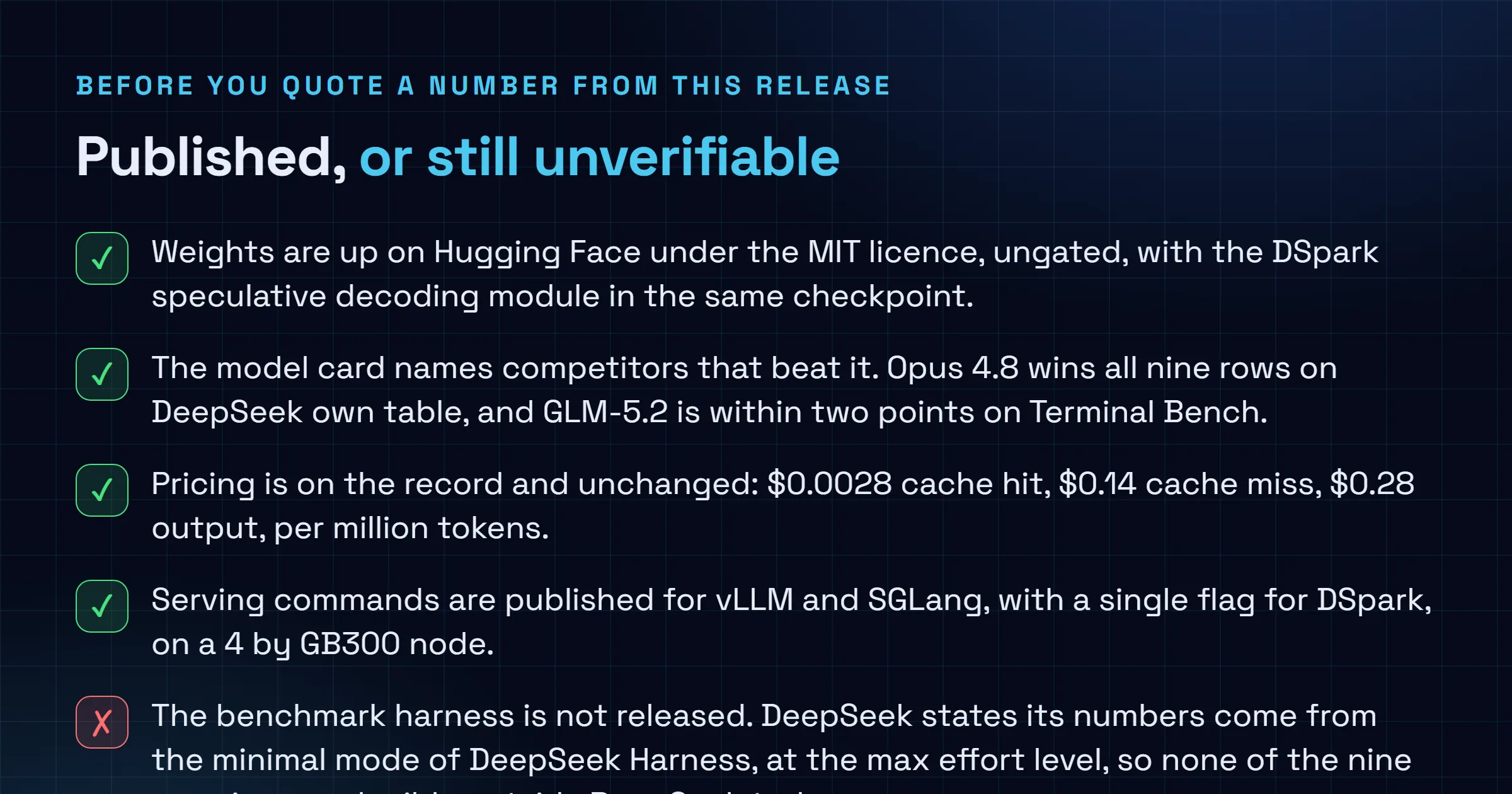
Checklist separating what DeepSeek published about V4-Flash-0731, including MIT weights, pricing and serving commands, from what remains unverifiable, including the unreleased evaluation harness, two internal benchmarks, and per effort level token costs.
Four things you can check today. Four you can't.

What we’d do this week

Re-run your evals. That’s it, mostly.

If you’re on deepseek-v4-flash in production, you got a different model on Friday whether you wanted one or not, and any regression tests you passed in April are now stale. Probably in your favour. Probably.

Then look at your cache hit rate before you look at anything else. The model got better for free. The 50x gap between a hit and a miss is the part still sitting on the table.

And if you’re still calling the old aliases, that’s a separate deadline you’ve already missed. We wrote up the deepseek-chat cutover when it landed.

What changed since

12 September 2026. This model is retired. On 10 September DeepSeek shipped DeepSeek-V4.1-Flash on a new encoder-decoder architecture and moved the API to a new name, deepseek-flash. The deepseek-v4-flash name still resolves, but DeepSeek describes the routing as temporary, so anything still calling it has been talking to the new model since 10 September without an opt-in. The prices above are history too. The flat $0.14 and $0.28 gave way to peak and off-peak billing on 16 August ($0.22 in and $0.66 out off-peak, double at peak), and V4.1-Flash now lists at $0.15 and $0.60 off-peak. The 0731 weights stay on Hugging Face under MIT if you need the exact build you benchmarked. We’ve written up what V4.1-Flash changes for your bill and your model names separately.

Sources

The benchmark table, the architecture description, the licence and both serving commands come from the DeepSeek-V4-Flash-0731 model card on Hugging Face, published 31 July 2026, including the footnote about DeepSeek Harness and the two internal DSBench sets. The scope of the upgrade and the note about V4-Pro are from DeepSeek on X. Pricing and the Responses API and Codex changes via MarkTechPost and Simon Willison. The independent index score and open weights ranking are from Artificial Analysis. The daily cost figures and the fifty times cache ratio are our own arithmetic on the published rates.

Frequently asked questions

What changed in DeepSeek-V4-Flash-0731?

The weights, and only the weights. DeepSeek states that the 0731 build keeps the exact same architecture and size as the April preview, so the gains come entirely from a reworked post-training pipeline aimed at coding, agents and tool use. On DeepSeek's published table, Terminal Bench 2.1 goes from 61.8 to 82.7, DeepSWE from 7.3 to 54.4 and Toolathlon-Verified from 49.7 to 70.3. The API also gained native support for the Responses API format and an adaptation for Codex.

Do I need to change my code?

No, and that is the part worth pausing on. The model name deepseek-v4-flash, the endpoint, the latency profile and the price are all unchanged, so anything already pointed at it picked up the new build automatically on 31 July 2026. There is no opt-in and no version pin in the API name. If you benchmarked the preview and wrote down the results, re-run that suite, because the thing answering your calls is not the thing you measured.

How much does DeepSeek-V4-Flash-0731 cost?

Per million tokens: $0.0028 on a cache hit, $0.14 on a cache miss, and $0.28 for output. That cache hit rate is exactly one fiftieth of a cache miss, which matters more than it sounds for an agent loop that resends the same system prompt and tool schema on every turn. A workload sending 10 million input and 2 million output tokens a day costs about $1.96 with no caching, and roughly $0.73 if 90 percent of the input hits cache. That last figure is our arithmetic on the published rates, not a DeepSeek quote.

Is DeepSeek-V4-Flash-0731 better than V4-Pro?

On the nine benchmarks DeepSeek published, yes, and by a clear margin despite a far smaller activated parameter count. Flash 0731 beats V4-Pro (Preview) on every row, 82.7 against 72.1 on Terminal Bench 2.1 and 54.4 against 12.8 on DeepSWE. The catch is that the comparison is against the Pro preview, not a released Pro. DeepSeek said on 31 July that the V4-Pro API and the app and web models are unchanged for now, with the official Pro release coming later.

Can I run DeepSeek-V4-Flash-0731 locally?

The weights are on Hugging Face under the MIT licence and ungated, so yes if you have the hardware. DeepSeek publishes a vLLM command that serves it on a single node of four GB300s, plus an SGLang recipe. The DSpark speculative decoding module ships inside the same checkpoint, so you enable it with one flag rather than loading a separate draft model. For the high and max reasoning effort levels DeepSeek recommends allowing up to 384K tokens of output.

Tags: aiapideepseekdev-toolsllmnewsopen-weights
Share197Tweet123
stephane

stephane

  • Trending
  • Comments
  • Latest
Answer card: Proton Lumo 2.0 is private by policy, not by locality. Saved history is locked so even Proton cannot read it, but the prompt is decrypted on a Proton EU server to answer it, then forgotten.

Proton Lumo 2.0 review: how private is it, really?

3 September 2026
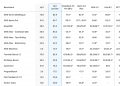
The Agentic Coding section of the official Hy4 preview benchmark appendix published by Tencent, a table comparing Hy3 and Hy4 preview against DeepSeek V4 Pro 0813, Qwen 3.8 Max, GLM 5.3, Kimi K3, GPT 5.6 Sol and Claude Opus 5 across SWE-bench Multilingual, SWE-bench Pro, DeepSWE, three SWE Atlas tasks, SWE-Marathon, Terminal-Bench 2.1, NL2Repo-Bench, CyberGym, ProgramBench, PostTrainBench and Harbor-Index.

Tencent’s 770B Hy4 tops one benchmark row in 46

3 September 2026
Answer card: Qwen 3.7 Max is API-only and cannot run locally yet; the open Qwen models (Qwen 3.6 27B, qwen3:8b to 32b) run offline via Ollama.

Qwen 3.7 local: what you can actually run offline

22 June 2026
Answer card: JWTs are not encrypted, anyone can read them; the signature proves who issued the token, not who may read it.

Are JWTs encrypted? No, and the difference will bite you

0
Answer card: a random 8 character password falls in under 2 hours offline, while 16 random characters hold for 1.4 trillion years at the same speed.

How long does it take to crack a password in 2026?

0
Answer card: three DNS records decide if your mail lands or bounces; SPF lists allowed senders, DKIM signs messages, DMARC sets the failure policy.

SPF, DKIM and DMARC explained: the records your email needs

0
Answer card stating that Qwen3.8-Omni-Flash launched on 17 September 2026 as an API only model on Alibaba Cloud Model Studio, taking text, images, audio and video in a 1M token context and returning text only, priced at 0.15 dollars per million input tokens for every modality and 0.47 dollars per million output tokens in the international regions, with no open weights published and the Qwen-Live Harness GitHub repository returning 404.

Qwen3.8-Omni-Flash bills audio at $0.15 and ships no weights

18 September 2026
Answer card stating that on 15 September 2026 AWS said it is unable to restore access to resources and data hosted exclusively in the Middle East Bahrain region me-south-1 and in the mec1-az2 zone of the UAE region, because the damage spanned multiple Availability Zones and exceeded what multi-AZ services are designed to withstand.

AWS can’t restore me-south-1, six months after the drone strikes

17 September 2026
Answer card stating that Google released Gemini 3.8 Live and Gemini 3.8 Live Extended Thinking on 15 September 2026 at 3 dollars per million audio input tokens and 12 dollars out, that the thinking model requires asynchronous tools, and that Artificial Analysis scores it 82.6 on its Speech to Speech Quality Index.

Gemini 3.8 Live Extended Thinking rejects any tool that blocks

16 September 2026
  • About
  • Contact
  • Privacy
  • Legal

Copyright © 2026 Stephane Cardon.

Welcome Back!

Login to your account below

Forgotten Password?

Retrieve your password

Please enter your username or email address to reset your password.

Log In
No Result
View All Result
  • Home
  • Articles
    • Security
    • Network
    • Dev
    • Sysadmin
    • SEO
    • Email & DNS
  • Tools
    • Network tools: free, fast, no signup
    • Security tools: free, fast, no signup
    • Developer tools: free, fast, no signup
    • Sysadmin tools: free, fast, no signup
    • SEO tools: free, fast, no signup
    • Email & DNS tools: free, fast, no signup
  • Download
  • About

Copyright © 2026 Stephane Cardon.