
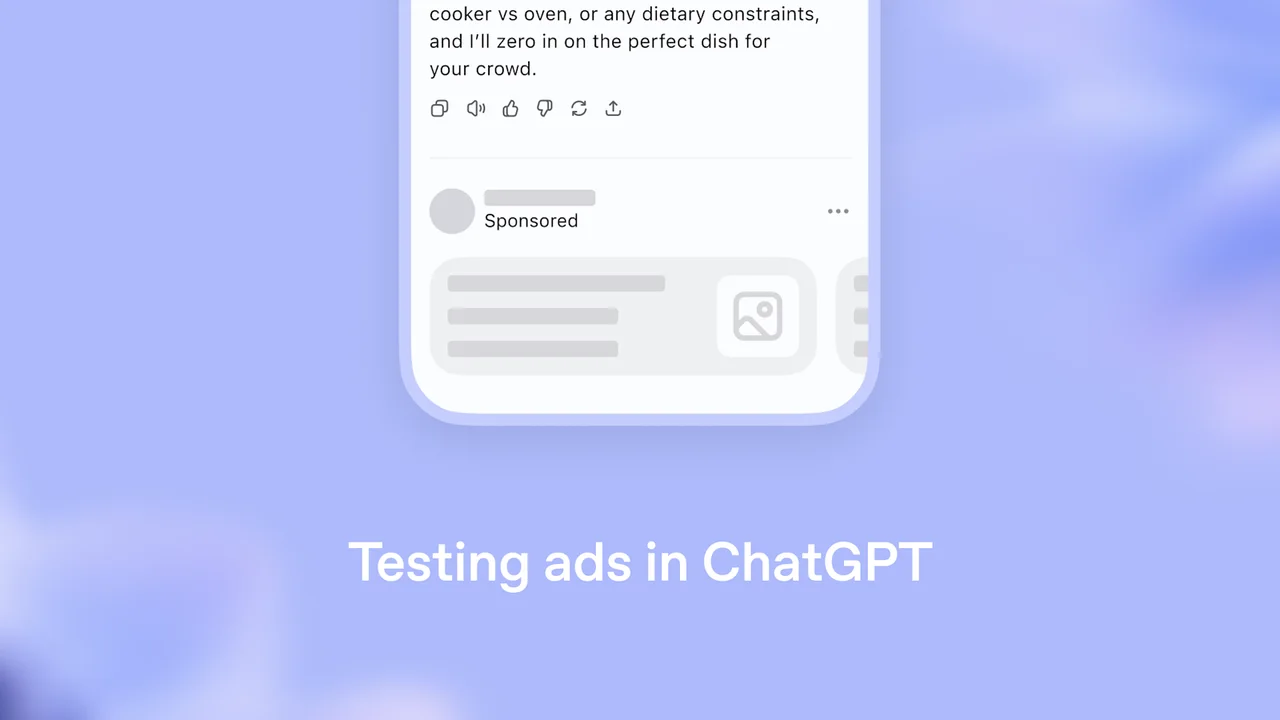
• Latest
  • Trending
  • All
Answer card: on July 22, 2026 OpenAI opened a self-serve Ads Manager for ChatGPT, with ads shown only to Free and Go users in a Sponsored block below the answer, targeting conversational context, and the old $50,000 minimum spend removed.

ChatGPT ads are live: OpenAI’s self-serve Ads Manager

22 July 2026
Answer card stating that OpenAI published its research acceleration measurements on 6 September 2026, that as of mid August 2026 its research organisation logged 3.1 agent workdays of coding agent runtime for every workday of human labour normalised to a standard eight hour day, and that OpenAI states this should not be read as a 3.1 times productivity gain because it measures runtime rather than delivered output.

OpenAI’s 3.1 agent-workdays per human day is not a 3.1x gain

7 September 2026
Answer card stating that Mullvad announced on 3 September 2026 that it is shutting down its public encrypted domain name system servers on 2 November 2026 and sponsoring the Quad9 Foundation instead, with 194.242.2.2 and its five sibling addresses all going away, and virtual private network customers unaffected.

Mullvad’s DNS servers go dark on 2 November, and Quad9 blocks no ads

5 September 2026
OpenAI announcement image for GPT-6 Astra, a spiral galaxy of white, blue and amber points of light curling around a bright core on a near black star field.

GPT-6 Astra lists at $10 and $50, 2.5x what GPT-5.6 Sol costs

6 September 2026
Google's official announcement image for the release, reading Introducing Gemini 3.8 Flash and 3.8 Flash Cyber in black type over a pale blue background with a blurred white chevron and the four colour Gemini spark below.

Gemini 3.8 Flash keeps the price and the 1 January cliff

3 September 2026
Answer card stating that Anthropic announced Enterprise Frontier Safeguards on 1 September 2026, that activity data used for misuse monitoring moves into cloud storage the customer controls under the customer own encryption keys, that Anthropic charges nothing for the feature while the cloud provider bills storage and egress, and that the phased rollout starts later in autumn 2026 with interim zero data retention on Fable 5 and Fable 5.1 for eligible customers.

Anthropic moves retention into your own cloud, for 30 days

3 September 2026
Official Google diagram of a client connection in three numbered steps: a DNS lookup with a query and an address, a TLS ClientHello and ServerHello, then a content exchange with a website. A callout on the DNS step reads 25% of global web traffic is now protected by encrypted DNS, and a callout beside an Android phone on the ClientHello step reads Android 17 supports ECH GREASE by default.

Android 17 hides the SNI, not your DNS or destination

3 September 2026
Still frame from the Claude Fable 5.1 launch video showing model-designed protein binders in orange docked against twelve grey target proteins, rendered as ESMFold2 structure predictions.

Claude Fable 5.1 breaks forced tool use, cuts cache 75%

1 September 2026
Answer card stating that on 31 August 2026 the European Commission designated ChatGPT a Very Large Online Search Engine under the Digital Services Act, the first conversational AI service classified that way, because it answers user prompts and queries including by searching the web, with OpenAI having declared roughly 159.1 million average monthly users in the European Union for ChatGPT search.

The EU now calls ChatGPT a very large search engine

3 September 2026
Answer card stating that on 31 August 2026 the Department of War added OpenAI ChatGPT Mil and Starshield AI Grok for Government to the GenAI.mil portal alongside Google Gemini, all three accredited at Impact Level 5 for Controlled Unclassified Information, with 1.7 million unique users onboarded out of roughly 3 million eligible personnel, and ChatGPT Mil currently serving GPT-5.4 Terra with GPT-5.6 Terra said to be rolling out.

ChatGPT Mil and Grok reached IL5 on GenAI.mil

3 September 2026
Answer card stating that Anthropic opened a research preview of the Model Hardware Standard on 27 August 2026, standardising the driver layer between an operating system and a laboratory instrument with read and write primitives plus discovery and safety limits, reachable through MCP as well as a command line and code files, with no public specification published.

Anthropic’s Model Hardware Standard is gated, and sits under MCP

3 September 2026
Official Cohere key art for the Parse 5 launch: the Cohere mark and the wordmark Parse with a superscript 5 in white, centred on a soft out of focus gradient of deep blue, violet and amber curves.

Cohere Parse 5 is $1.50 per 1,000 pages, on three of five dimensions

3 September 2026
Title card from the OpenAI announcement video: a man sits on a blue sofa in a loft with tall windows and potted plants, a laptop open on the coffee table in front of him, with the words WebMCP in ChatGPT in large white type across the lower left.

WebMCP in ChatGPT needs GPT-5.6 Sol or Terra

3 September 2026
  • About
  • Contact
  • Privacy
  • Legal
Tuesday, September 8, 2026
  • Login
Packet Nebula
  • Home
  • Articles
    • Security
    • Network
    • Dev
    • Sysadmin
    • SEO
    • Email & DNS
  • Tools
    • Network tools: free, fast, no signup
    • Security tools: free, fast, no signup
    • Developer tools: free, fast, no signup
    • Sysadmin tools: free, fast, no signup
    • SEO tools: free, fast, no signup
    • Email & DNS tools: free, fast, no signup
  • Download
  • About
No Result
View All Result
Packet Nebula
No Result
View All Result
Home Dev

ChatGPT ads are live: OpenAI’s self-serve Ads Manager

by stephane
22 July 2026
in Dev
0
Answer card: on July 22, 2026 OpenAI opened a self-serve Ads Manager for ChatGPT, with ads shown only to Free and Go users in a Sponsored block below the answer, targeting conversational context, and the old $50,000 minimum spend removed.
491
SHARES
1.4k
VIEWS
Share on FacebookShare on Twitter

So the thing Sam Altman once called a last resort just got a self-serve dashboard. On July 22 OpenAI opened Advertise in ChatGPT, a place where any brand can build a campaign and point it at people mid-conversation. That's the news. Here's the part we actually care about: the ads only hit Free and Go users, they sit in a Sponsored block under the answer, and the old fifty-grand minimum is gone, so small shops can buy in now. We went looking for the clean version of the numbers and didn't find one. Sources disagree on the entry budget. They agree on the shape of it, though, and the shape is what changes your week.

The short answer

OpenAI opened Advertise in ChatGPT, a self-serve platform for buying ads that show up mid-conversation. They only reach Free and ChatGPT Go users, they live in a labeled Sponsored block under the answer, and they target by what you’re talking about rather than keywords. The old $50,000 floor is gone. The exact entry budget, though, depends which write-up you trust.
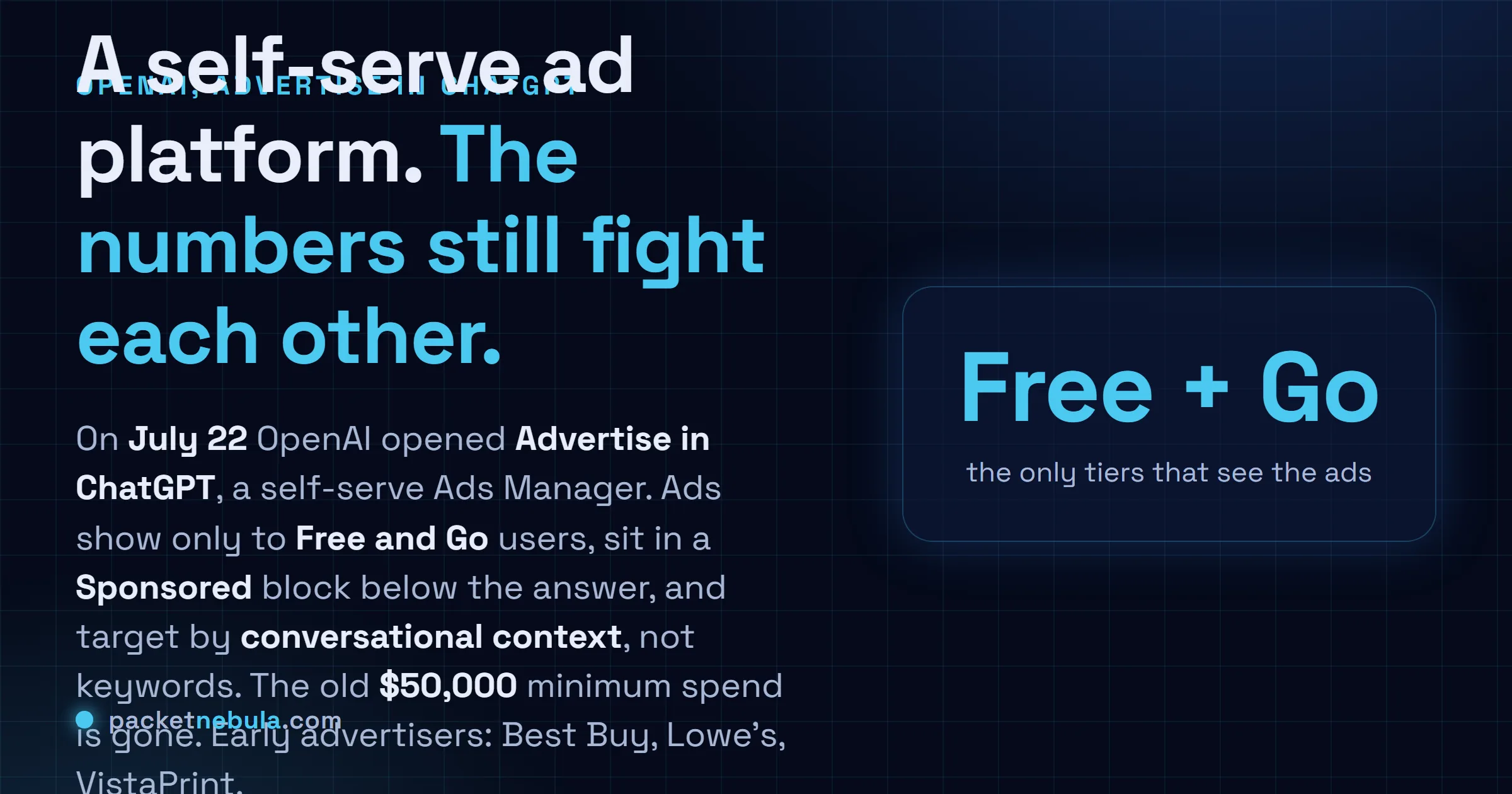
July 22self-serve Ads Manager opened
Free + Gothe only tiers that see ads
$50k goneold minimum spend removed
Answer card: on July 22, 2026 OpenAI opened a self-serve Ads Manager for ChatGPT, ads shown only to Free and Go users in a Sponsored block below the answer, targeting conversational context, with the old $50,000 minimum spend removed.
The one-card version. A real platform, wrapped in numbers that don't line up.

What OpenAI actually opened

Advertise in ChatGPT is a self-serve Ads Manager. You go in, build a campaign, set a budget, and choose who you want to reach. If you’ve ever touched Google or Meta’s ad tools, the concept is familiar. What’s new is where the ad lands and how it targets.

The targeting isn’t keywords. OpenAI pitches it as “conversational context,” which is a polite way of saying the ad reads the drift of what you’re asking. Someone researching a laptop upgrade in chat is a different signal than someone typing “best laptop” into a search box, and that’s the whole sales pitch. Best Buy, Lowe’s and VistaPrint ran early campaigns. A Best Buy exec talked up reaching customers in the actual research moment.

Worth saying plainly: this didn’t drop out of nowhere on July 22. OpenAI had been testing sponsored placements for months and ran a paid pilot first. July 22 is the day the doors opened to everyone, and the day the old $50,000 minimum spend went away. That removal is the real unlock. It’s what turns this from an enterprise experiment into something a small shop can buy.

Who sees it, and where it sits

Here’s the reassuring bit if you’re a heavy ChatGPT user. Ads only reach Free and ChatGPT Go accounts. Pay for Plus, Pro or Business and you see none of this. Under-18 accounts are out too.
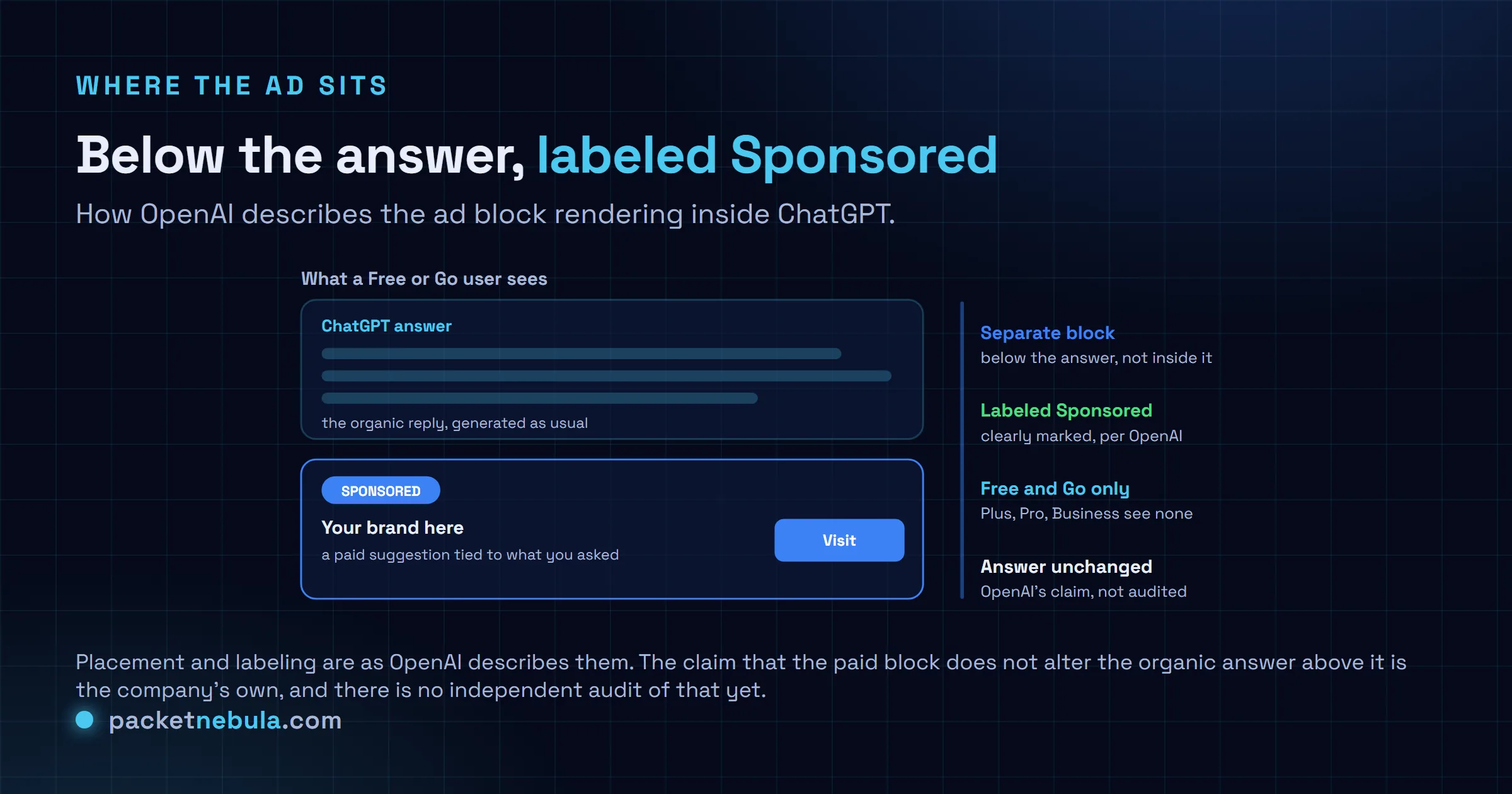
Diagram of a ChatGPT screen for a Free or Go user: the organic answer card on top, then a separate Sponsored ad block below it with a brand placeholder and a Visit button, with annotations noting it is a separate block, labeled Sponsored, shown to Free and Go only, with the answer unchanged per OpenAI.
The ad is its own block under the reply, tagged Sponsored. OpenAI says it doesn't touch the answer above. That claim is unaudited.

The format is a Sponsored block that sits below the answer, styled as its own card, clearly labeled. OpenAI’s line is that the ad doesn’t alter the organic answer it appears next to. I want to believe that, honestly, but it’s the company’s own word and nobody outside OpenAI has audited it. So we file it as a claim. The labeling and the separation are visible and real. The promise about answer integrity is a trust exercise for now.

The numbers nobody agrees on

This is where the coverage falls apart, and it’s the most useful thing we can tell you. Read four write-ups and you get four versions of the money.
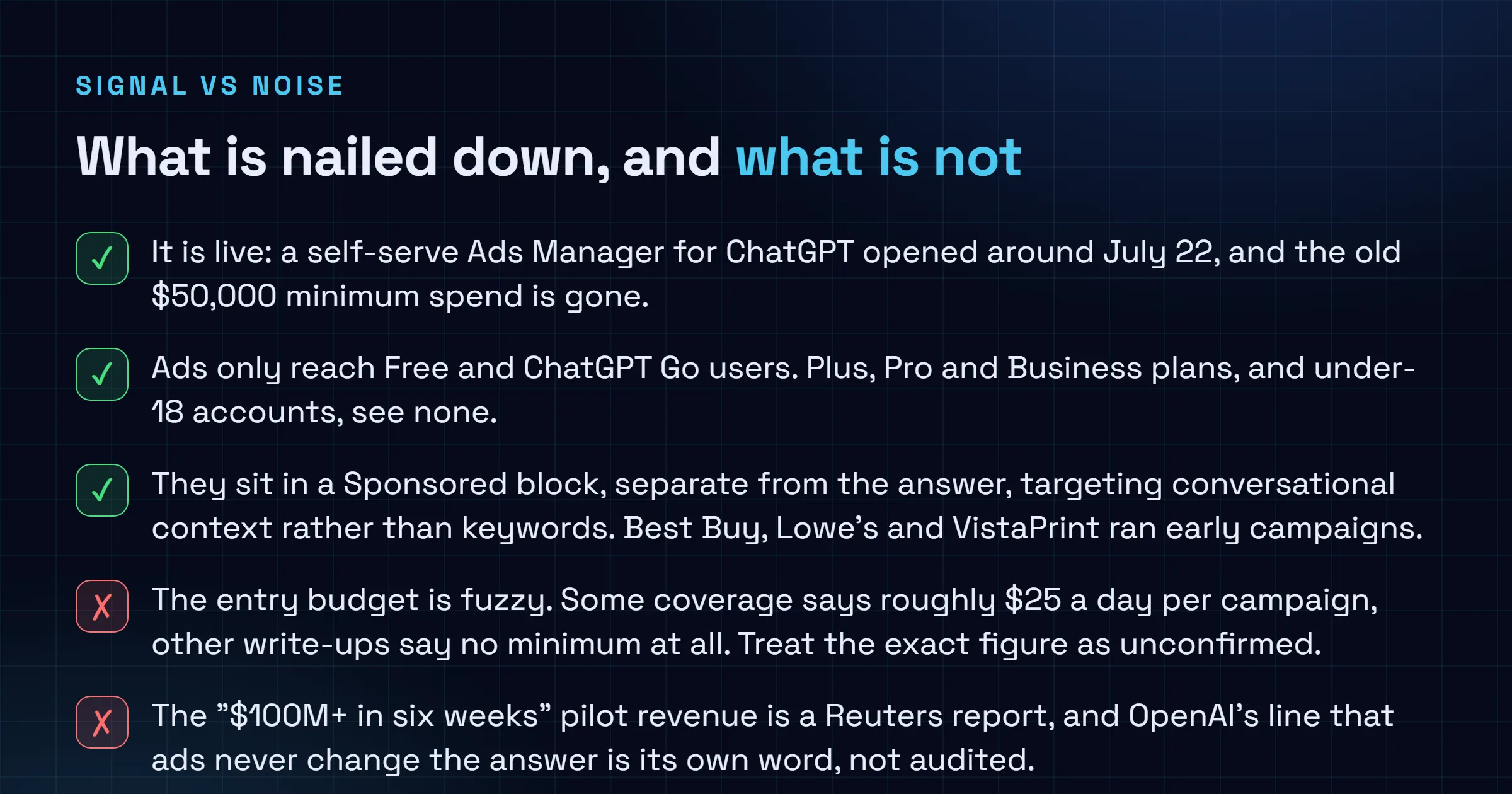
Checklist of what is confirmed versus fuzzy about ChatGPT ads: confirmed that it is live and the $50,000 minimum is gone, confirmed only Free and Go users see ads, confirmed the Sponsored block sits separate from the answer with early advertisers Best Buy Lowe's and VistaPrint; fuzzy that the entry budget is around $25 a day or has no minimum, and that the $100M pilot revenue is a Reuters report while the no-answer-change claim is unaudited.
Split the facts by how solid they are. The platform is confirmed. Half the numbers around it are not.

The $50,000 minimum being gone is consistent across sources. Past that, it splits. One camp says the entry point is roughly $25 a day per campaign. Another says there’s no minimum at all. Some coverage still quotes a $60 CPM from the pilot phase and a shift to cost-per-click bidding. We’re not going to pick a winner and print it as fact, because that’s exactly how a made-up number ends up quoted everywhere. If the exact rate matters for your budget, wait for OpenAI’s own rate card and treat the blog figures as noise until then.

Same with the eye-catching revenue line. You’ll see “$100 million-plus in six weeks” thrown around. That traces to a Reuters report on the US pilot, not an OpenAI disclosure, so it’s reporting, not a filing.

What it means for you

If you buy ads, the interesting change is the floor coming down. A channel that used to want $50,000 to talk to you now, in theory, doesn’t. That’s worth a small test if your customers are the type to research inside a chatbot. Early feedback we’ve seen is mixed, with at least one advertiser calling it expensive against plain search after two weeks. So test small, measure, don’t bet the quarter on it.

If you run websites for a living, the slower signal is the one to sit with. Search isn’t the only place buying intent lives anymore. When people ask ChatGPT what to buy and brands can pay to sit next to that answer, some share of the research that used to start on Google now starts in a chat window. It doesn’t break your SEO today. It’s a reminder that the map of where intent shows up keeps moving, which is part of why we keep arguing that owning your own fast, static pages beats renting attention on someone else’s surface.

And the human note. Back in 2024 Altman said “Ads plus AI is sort of uniquely unsettling to me,” and framed advertising as a last resort. Two years and a lot of compute bills later, the last resort has a self-serve dashboard. Make of that what you will. It’s the same company shipping the GPT-5.6 line, now funded partly by the thing its CEO said he’d only reach for if he had to.

Sources

The self-serve launch, plan exclusions and format as reported by OpenAI and rounded up in Build Fast with AI, with the self-serve Ads Manager details and the removal of the $50,000 minimum from EasyInsights. The Altman “last resort” quote and business context via Tuta. The budget figures conflict across these sources and are flagged as unconfirmed above; the six-week pilot revenue figure is a Reuters report, not an OpenAI disclosure.

Frequently asked questions

When did OpenAI launch ads in ChatGPT?

OpenAI opened its self-serve Advertise in ChatGPT platform around July 22, 2026, letting advertisers build campaigns without a large minimum. It was not a cold start. The company had been testing sponsored placements earlier in 2026 and ran a paid pilot before this. July 22 is when the self-serve Ads Manager opened up and the old $50,000 minimum spend went away.

Who sees ads in ChatGPT?

Only Free and ChatGPT Go users. Paid tiers, meaning Plus, Pro and Business, do not see ads, and accounts flagged as under 18 are excluded too. If you pay for ChatGPT, this rollout does not drop ads into your chats.

How are the ads shown?

They appear in a Sponsored block that sits below the model's answer, visually separated from it. OpenAI says the paid block does not change the organic answer above it. That is the company's own statement, and there is no independent audit of it yet, so treat it as a claim rather than a proven fact.

How much does it cost to advertise on ChatGPT?

This is the fuzzy part. The headline change is that the previous $50,000 minimum spend is gone, which opens the door to small businesses. Beyond that, coverage disagrees. Some reports cite roughly $25 a day per campaign, others say there is no minimum at all. Until OpenAI publishes clear rate-card details, treat any single figure as unconfirmed.

Does this change SEO or how I get traffic?

Not directly, not yet. Ads only show to Free and Go users and sit beside the answer, not inside it. But it is a signal worth watching. If people research purchases inside chat and brands can pay to appear there, that is another surface competing with search for the same intent. For now it is a marketing channel to test, not a reason to rebuild anything.

Tags: adsaibig-techchatgptnewsopenai
Share196Tweet123
stephane

stephane

  • Trending
  • Comments
  • Latest
The Agentic Coding section of the official Hy4 preview benchmark appendix published by Tencent, a table comparing Hy3 and Hy4 preview against DeepSeek V4 Pro 0813, Qwen 3.8 Max, GLM 5.3, Kimi K3, GPT 5.6 Sol and Claude Opus 5 across SWE-bench Multilingual, SWE-bench Pro, DeepSWE, three SWE Atlas tasks, SWE-Marathon, Terminal-Bench 2.1, NL2Repo-Bench, CyberGym, ProgramBench, PostTrainBench and Harbor-Index.

Tencent’s 770B Hy4 tops one benchmark row in 46

3 September 2026
Answer card: Proton Lumo 2.0 is private by policy, not by locality. Saved history is locked so even Proton cannot read it, but the prompt is decrypted on a Proton EU server to answer it, then forgotten.

Proton Lumo 2.0 review: how private is it, really?

3 September 2026
Answer card: Apple released iOS 26.6 and iPadOS 26.6 on 27 July 2026 with a release note covering bug fixes, security updates and an optimized Spotlight index to prepare for iOS 27, the index the rebuilt Siri reads for personal context.

iOS 26.6 is out: the Spotlight index it quietly builds

27 July 2026
Answer card: JWTs are not encrypted, anyone can read them; the signature proves who issued the token, not who may read it.

Are JWTs encrypted? No, and the difference will bite you

0
Answer card: a random 8 character password falls in under 2 hours offline, while 16 random characters hold for 1.4 trillion years at the same speed.

How long does it take to crack a password in 2026?

0
Answer card: three DNS records decide if your mail lands or bounces; SPF lists allowed senders, DKIM signs messages, DMARC sets the failure policy.

SPF, DKIM and DMARC explained: the records your email needs

0
Answer card stating that OpenAI published its research acceleration measurements on 6 September 2026, that as of mid August 2026 its research organisation logged 3.1 agent workdays of coding agent runtime for every workday of human labour normalised to a standard eight hour day, and that OpenAI states this should not be read as a 3.1 times productivity gain because it measures runtime rather than delivered output.

OpenAI’s 3.1 agent-workdays per human day is not a 3.1x gain

7 September 2026
Answer card stating that Mullvad announced on 3 September 2026 that it is shutting down its public encrypted domain name system servers on 2 November 2026 and sponsoring the Quad9 Foundation instead, with 194.242.2.2 and its five sibling addresses all going away, and virtual private network customers unaffected.

Mullvad’s DNS servers go dark on 2 November, and Quad9 blocks no ads

5 September 2026
OpenAI announcement image for GPT-6 Astra, a spiral galaxy of white, blue and amber points of light curling around a bright core on a near black star field.

GPT-6 Astra lists at $10 and $50, 2.5x what GPT-5.6 Sol costs

6 September 2026
  • About
  • Contact
  • Privacy
  • Legal

Copyright © 2026 Stephane Cardon.

Welcome Back!

Login to your account below

Forgotten Password?

Retrieve your password

Please enter your username or email address to reset your password.

Log In
No Result
View All Result
  • Home
  • Articles
    • Security
    • Network
    • Dev
    • Sysadmin
    • SEO
    • Email & DNS
  • Tools
    • Network tools: free, fast, no signup
    • Security tools: free, fast, no signup
    • Developer tools: free, fast, no signup
    • Sysadmin tools: free, fast, no signup
    • SEO tools: free, fast, no signup
    • Email & DNS tools: free, fast, no signup
  • Download
  • About

Copyright © 2026 Stephane Cardon.