




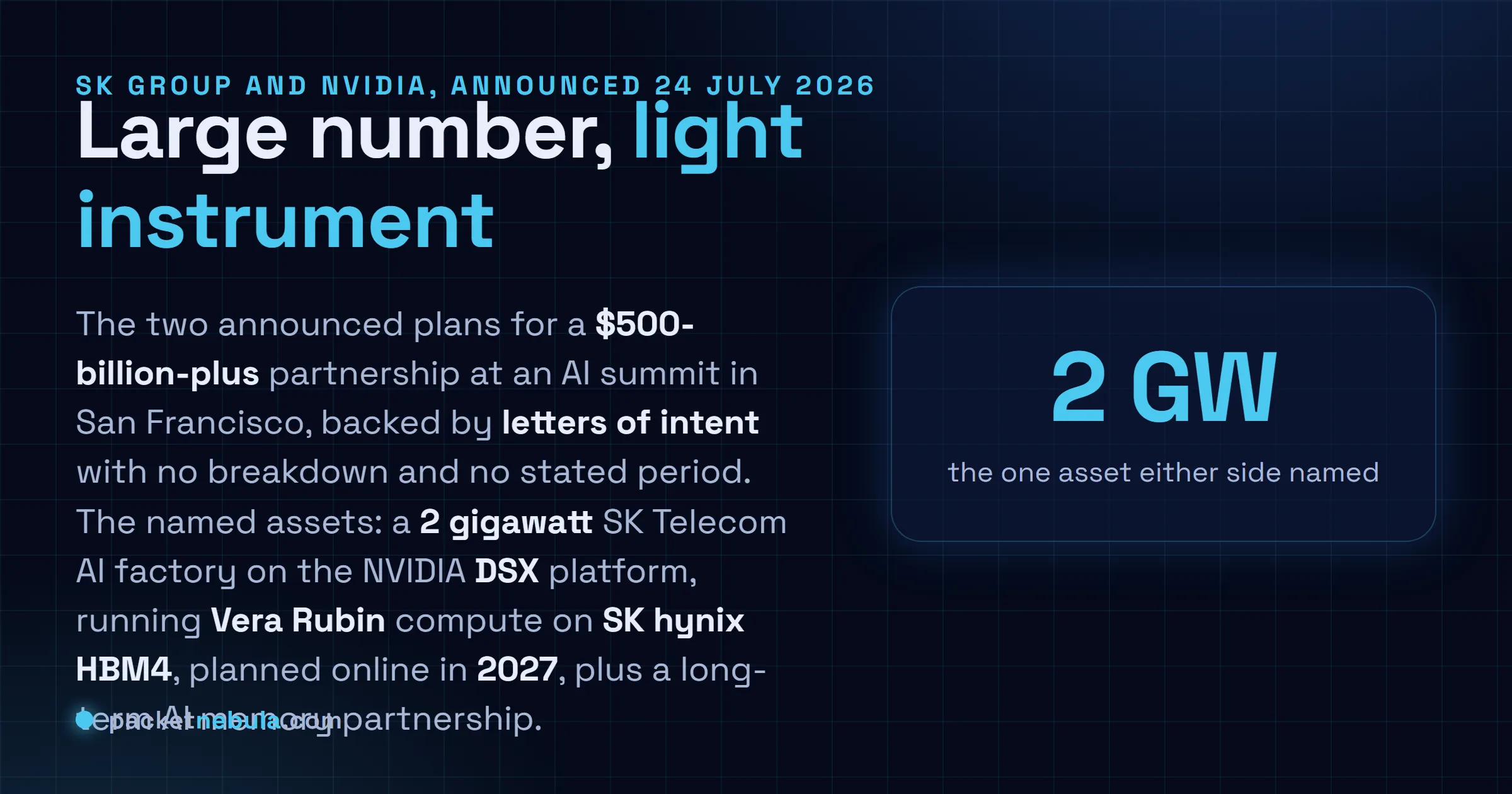
Three deals landed in one afternoon at a San Francisco hotel, and the biggest number came with the least paperwork. On July 24 SK Group and NVIDIA announced plans for a $500-billion-plus partnership, which reads like the largest thing anyone signed all year until you check the instrument: letters of intent. No breakdown, no period, no purchase order. What is actually named is a 2 gigawatt AI factory that SK Telecom will build on NVIDIA's DSX platform, running Vera Rubin compute on SK hynix HBM4 memory, planned online in 2027. The other half is a long-term memory partnership. That second half is the part that reaches your invoice, and almost nobody led with it.
The short answer
SK Group and NVIDIA announced a $500-billion-plus partnership on July 24 in San Francisco. The paperwork behind it is letters of intent, with no breakdown and no stated period. What is concrete: a 2 gigawatt SK Telecom AI factory on the DSX platform with Vera Rubin and SK hynix HBM4, planned for 2027, plus a long-term memory partnership. Compare that with the smallest deal announced the same day, which came with written closing conditions attached.
What was actually signed
Letters of intent. That is the phrase both companies used, and it is the whole story of how to read the rest.
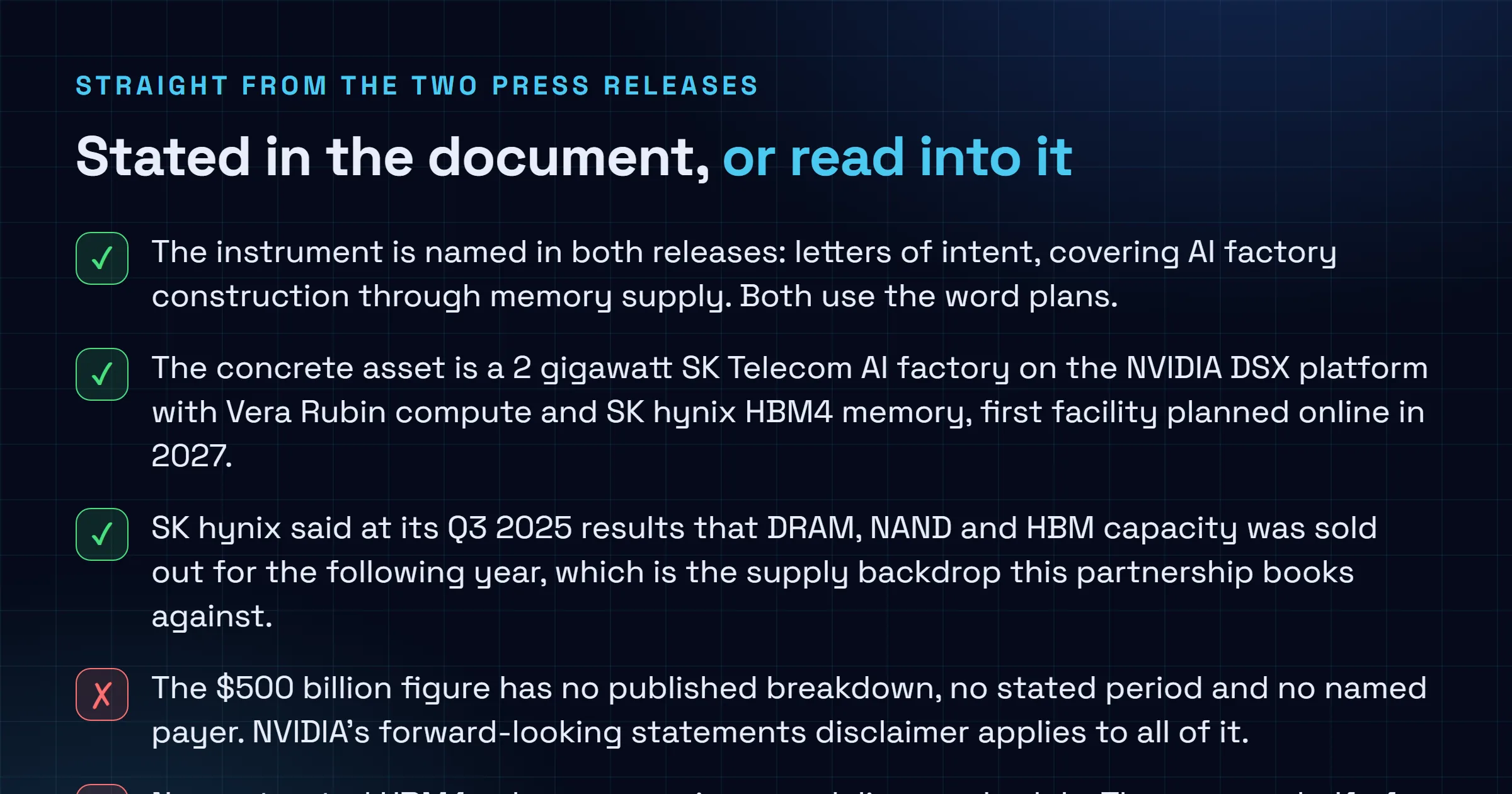
NVIDIA’s release says the two announced “plans for a $500-billion-plus comprehensive partnership” and that letters of intent were signed covering AI factory construction through memory supply. SK hynix put out its own version the next day with the same language. Nothing in either document breaks the figure into parts, attaches it to a period, or names a payer. NVIDIA’s forward-looking statements disclaimer sits at the bottom doing its usual job.
Two things are genuinely named. SK Telecom will build a 2 gigawatt AI factory on NVIDIA’s DSX platform with Vera Rubin accelerated computing and SK hynix HBM4 memory, with the first facility planned online in 2027. And SK hynix enters a long-term AI memory partnership with NVIDIA to codevelop next-generation memory, described as covering everything from large language model training to agentic and physical AI.
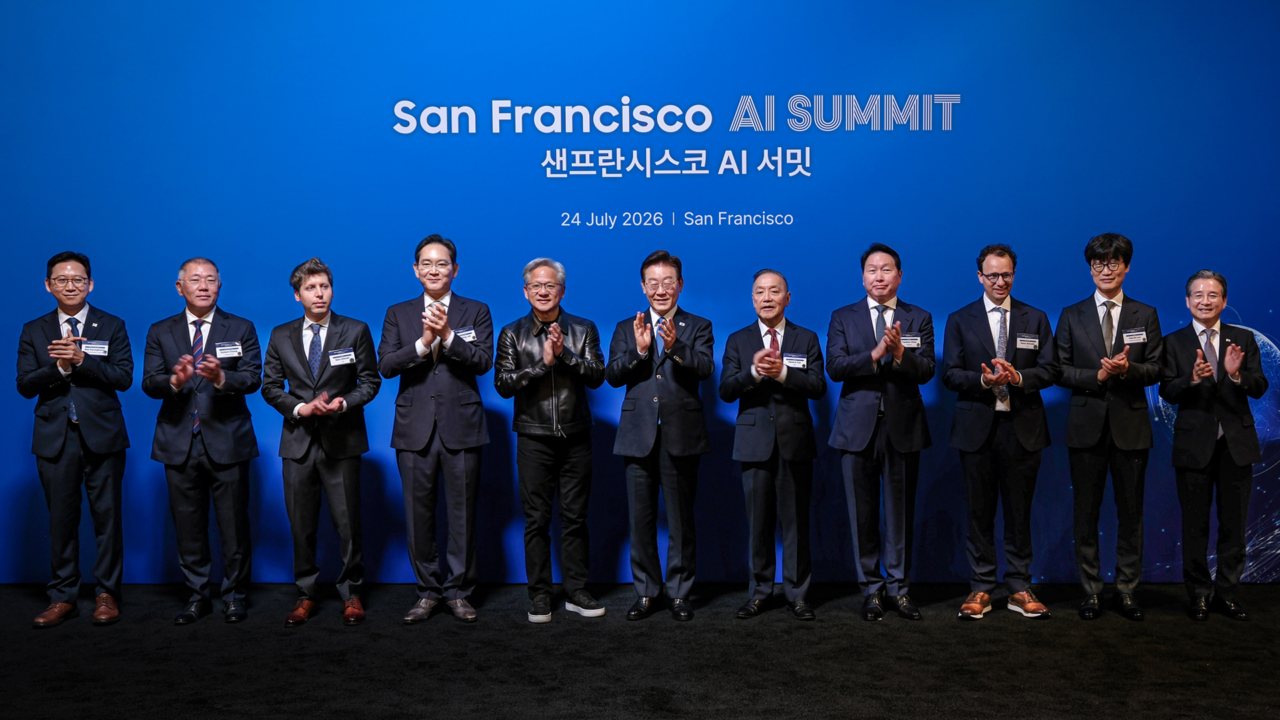 Image: NVIDIA
That photo is the actual context. This was a summit hosted by South Korean president Lee Jae Myung, and SK was one signature among several. Samsung and Broadcom signed a memorandum of understanding reported at more than $200 billion across HBM4 supply, two-nanometre foundry and advanced packaging, running five years to 2030. NAVER, NVIDIA and Brookfield announced a $10 billion package. Coverage tallied roughly $950 billion of announcements across the day.
The smallest number is the only one with conditions
Here is where it gets interesting, and honestly it took reading all three releases side by side to notice.
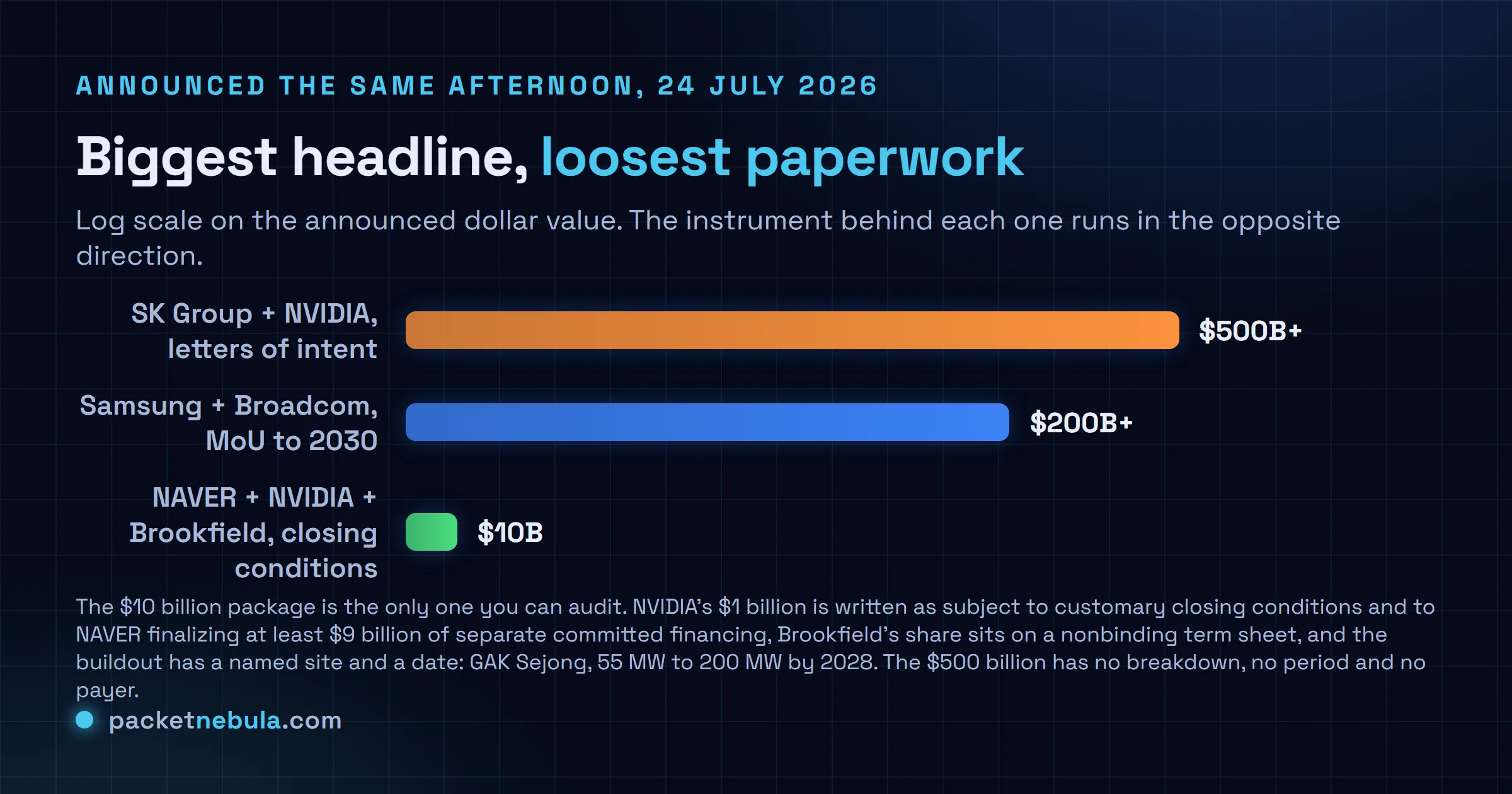
The NAVER deal is the small one, and it is the only one where you can see the machinery. NVIDIA is putting in $1 billion, explicitly “subject to customary closing conditions and NAVER finalizing at least $9 billion of committed financing for the project”. Brookfield’s share, up to $9 billion, sits on a nonbinding term sheet. The buildout is specific: the GAK Sejong data centre goes from the 55 megawatts announced in June to 200 megawatts by 2028, roughly 100,000 GPUs on Vera Rubin.
So the deal with the smallest headline is the one carrying a written financing condition, a named site and a date. The $500 billion has none of those.
Now, some arithmetic that nobody in either release does. NAVER discloses 200 MW against a $10 billion envelope, which is $50 million per megawatt. Run SK’s 2 GW at that same disclosed rate and you land near $100 billion. The headline is five times larger. Which tells you the $500 billion is not the factory. It is an umbrella over memory fabs, future capacity, service revenue and whatever else the two sides expect to transact over years they did not specify.
Maybe that is fair enough. SK is a conglomerate and memory fabs cost a fortune, so an umbrella number is not automatically a fiction. But a number you cannot decompose is a direction, not a commitment. I would rather have the $10 billion with the closing condition.
The half that reaches your invoice
Skip the gigawatts for a second. The memory partnership is the part with a shorter path to your budget.
SK hynix already told everyone how tight this is. At its Q3 2025 results, the head of DRAM marketing said flatly that the company had sold out its DRAM, NAND and HBM capacity for the following year. Customers had booked the slots. A long-term supply partnership with NVIDIA books more of that output further ahead, and Seoul Economic Daily reported on July 26 that SK is extending HBM4 supply to Microsoft as well. No contracted volumes or prices have been published by anyone, so treat the specifics as unknown.
The direction is not really in doubt though. Everyone shipping an accelerator is queueing at the same handful of suppliers. When AMD put 31 TB of HBM4 in a Helios rack it was drawing on the same constrained pool that NVIDIA is now locking up years in advance. That pressure has been leaking into ordinary DDR5 pricing for months.
Practical version: if you are specifying servers or workstations for the next 18 months, treat memory as a rising line item rather than a flat one. I might be wrong about the magnitude. About the direction, less so.
Two gigawatts, in units you can picture
NVIDIA gave us a usable ratio without meaning to. Its NAVER announcement pairs roughly 100,000 GPUs with a 200 megawatt buildout, so about 2 kW per accelerator once cooling and facility overhead are in. Apply that to SK’s 2 GW and you get something on the order of a million accelerators in one site. That extrapolation is ours, not NVIDIA’s, and the real ratio will drift with rack density and cooling design. Still, it puts the announcement in a bracket.
For power, the comparison that matters is regulatory. New York started gating new data centers above 50 MW, and this is forty of those in a single campus. Silicon has not been the binding constraint on these builds for a while. Grid interconnect and local politics are, which is exactly why the 2027 date deserves the same scepticism as the dollar figure.
What to watch instead of the number
The conversion. Letters of intent become contracts or they quietly do not, and that transition is the only signal worth setting an alert on. After that: a named construction site with a grid interconnect, and an HBM4 delivery schedule with volumes on it.
Meanwhile nothing about your 2026 procurement changed this week. First SK facility is 2027, NAVER’s 200 MW is 2028. Announcements at a summit do not add a single rack to the market this year, which is a boring thing to say about a $500 billion headline, and it happens to be the accurate one.
Sources: NVIDIA newsroom, July 24 2026, SK hynix newsroom, July 25 2026, the NAVER, NVIDIA and Brookfield release, NVIDIA’s summit blog post, CNBC on Samsung and Broadcom and Notebookcheck on SK hynix sold-out capacity. The letters of intent wording, the $500-billion-plus figure, the 2 GW SK Telecom factory and its 2027 date come from the NVIDIA and SK hynix releases. NVIDIA’s $1 billion, Brookfield’s up to $9 billion nonbinding term sheet, the $9 billion closing condition, the 55 to 200 megawatt expansion and the 2028 date are quoted from the NAVER release, and the roughly 100,000 GPU figure from NVIDIA’s summit blog. The Samsung and Broadcom terms and the roughly $950 billion daily tally are as reported in press coverage, not primary documents. The $50 million per megawatt rate and the 2 kW per GPU ratio are our own arithmetic on those published figures. The image is NVIDIA’s own summit photograph.
Frequently asked questions
What did SK Group and NVIDIA actually announce?
Plans for a partnership worth more than $500 billion, announced July 24, 2026 at an AI summit in San Francisco. The companies say they signed letters of intent. The named assets are a 2 gigawatt AI factory that SK Telecom will build using the NVIDIA DSX platform and Vera Rubin accelerated computing with SK hynix HBM4 memory, planned to come online in 2027, and a long-term AI memory partnership between SK hynix and NVIDIA.
Is the $500 billion a signed contract?
No. Both press releases describe letters of intent and use the word plans. Neither NVIDIA nor SK published a breakdown of the figure or the period it covers, and NVIDIA's release carries the usual forward-looking statements disclaimer. Treat it as a stated direction rather than money that has moved.
How big is 2 gigawatts in practical terms?
Very. New York now gates new data centers above 50 megawatts, so a single 2 GW site is about forty times that threshold. For accelerator counts, NVIDIA's own NAVER announcement pairs roughly 100,000 GPUs with a 200 MW buildout, which works out to about 2 kW per GPU once cooling and facility overhead are counted. Apply that same ratio and 2 GW lands on the order of a million accelerators. That extrapolation is ours, not NVIDIA's.
What does this change for HBM4 and memory prices?
It extends a squeeze that was already on. SK hynix said at its Q3 2025 results that it had sold out DRAM, NAND and HBM capacity for the following year, and a long-term supply partnership with NVIDIA books more of that output ahead. Nobody has published contracted volumes or prices, so the honest read is directional: if you are specifying servers or workstations over the next 18 months, budget memory as a rising line item.
When does any of this affect what I can buy?
Not in 2026. The first SK facility is planned for 2027 and NAVER's 200 MW expansion targets 2028. Nothing announced at this summit adds capacity to the market this year, and the letters of intent have to convert into contracts before construction schedules mean anything.