




Picture a factory floor in Fremont where the last Model S rolled off in early May, now filling up with tooling for a machine nobody outside Tesla has laid eyes on. That's the Optimus V3 situation as of this week: the production lines are going in, and the robot has still never been revealed. Tesla told shareholders on 22 July that first-generation Optimus lines are being installed, with production anticipated in 2026. The same call set no unveiling date, gave no unit target, and disclosed no dimensions. Musk spent most of his Optimus minutes lowering expectations instead, calling it the hardest product Tesla has ever tried to scale, with no existing supply chain behind it. So the spec sheets you're finding in search results? Somebody made those up.
The short answer
Tesla is installing Optimus production lines at Fremont for a robot it has never shown. The Q2 call on 22 July confirmed the tooling and set no reveal date, no unit target and no specs. First units go to internal training data collection, not customers. Every detailed V3 spec sheet online recycles Gen 2 numbers or invents them.
What Tesla actually said
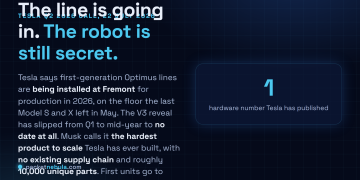
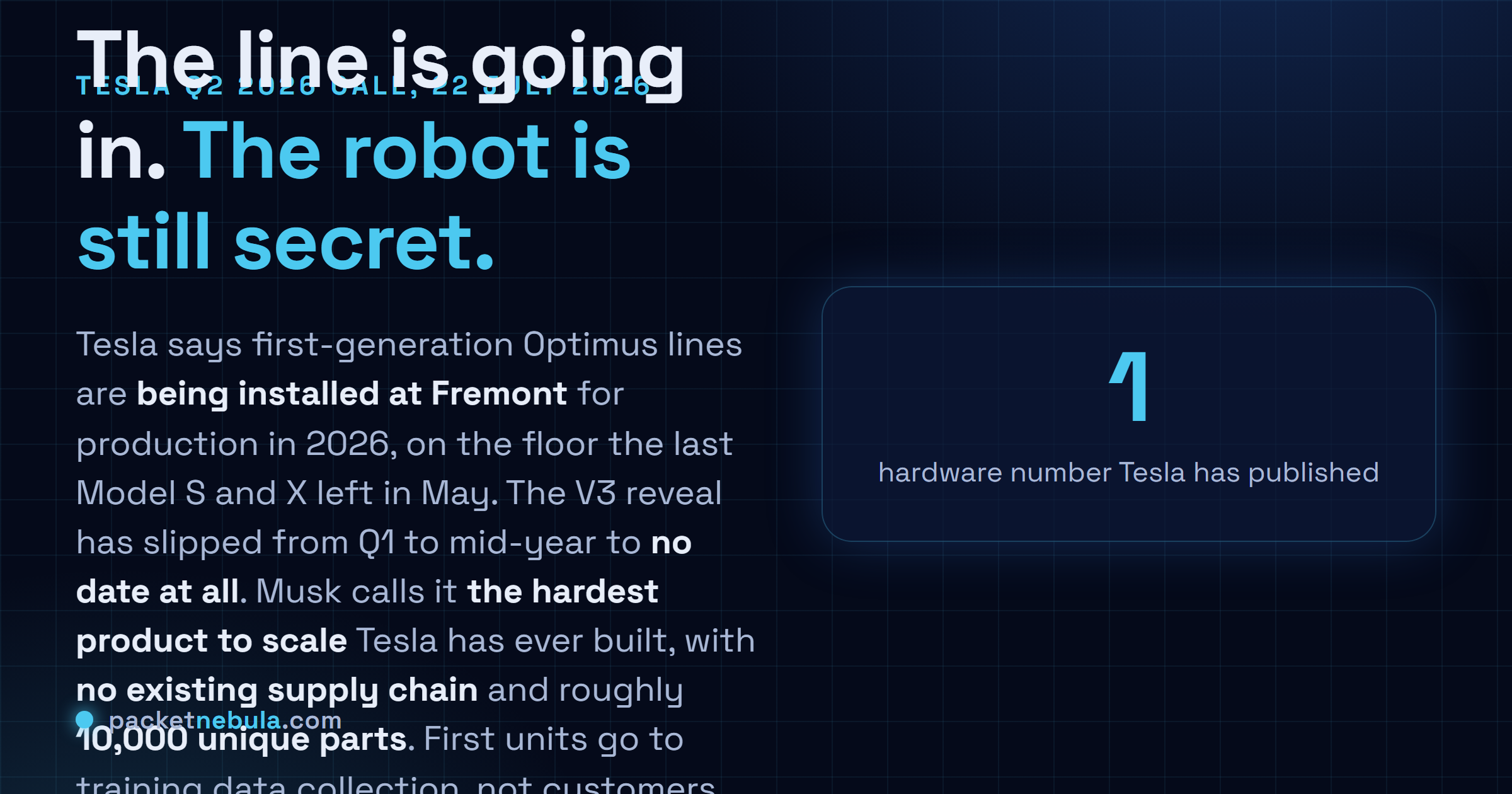
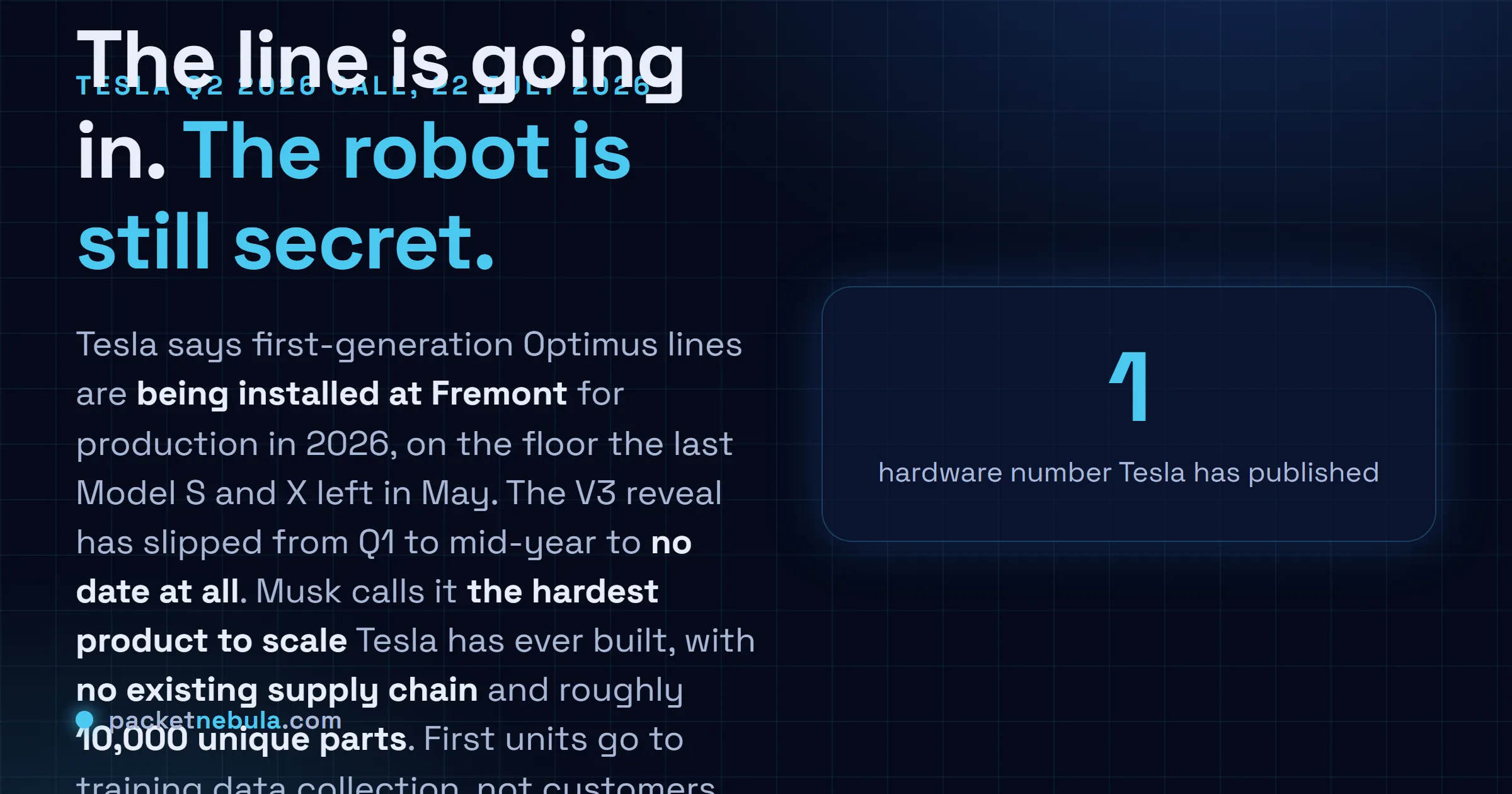
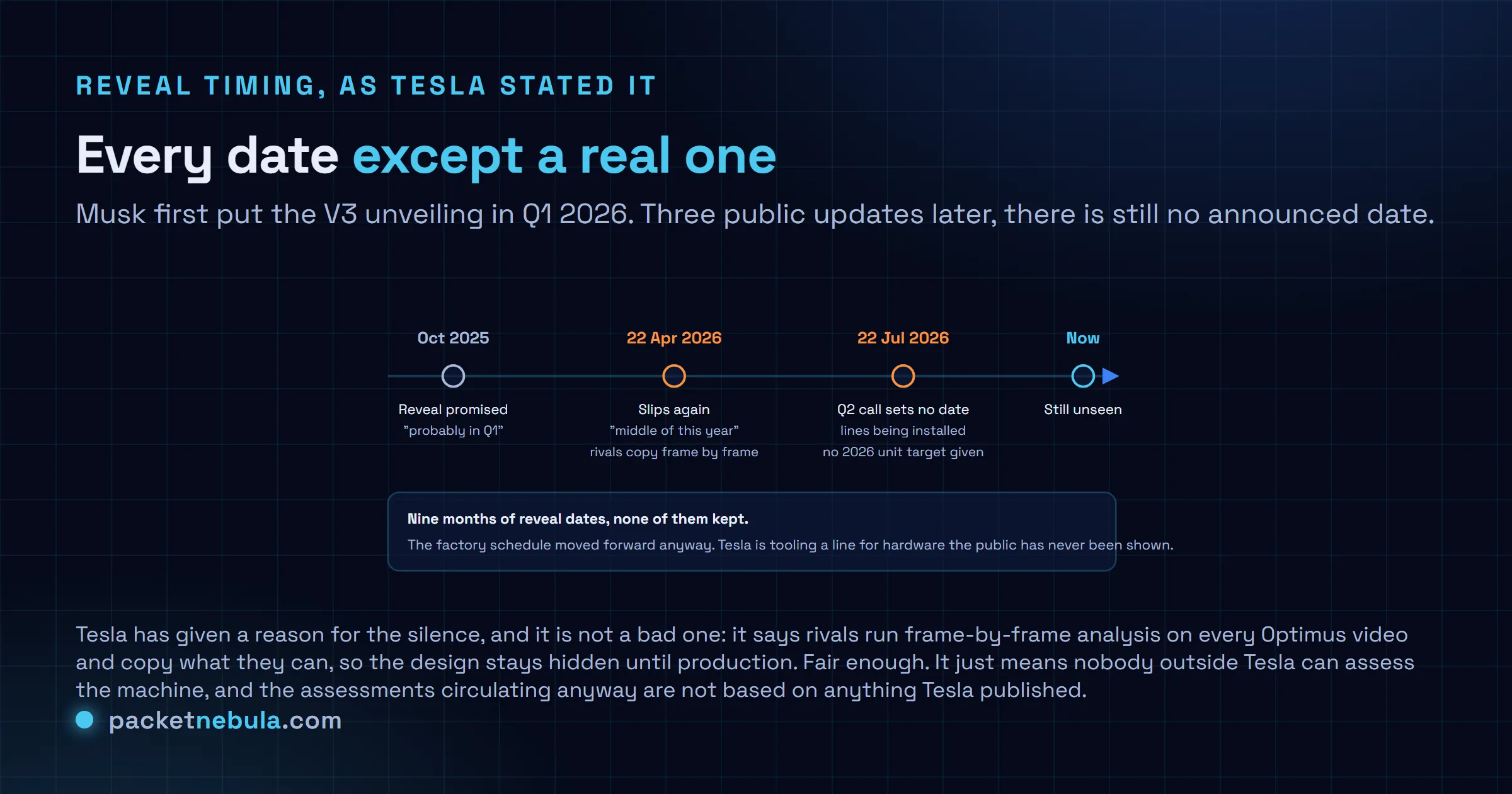
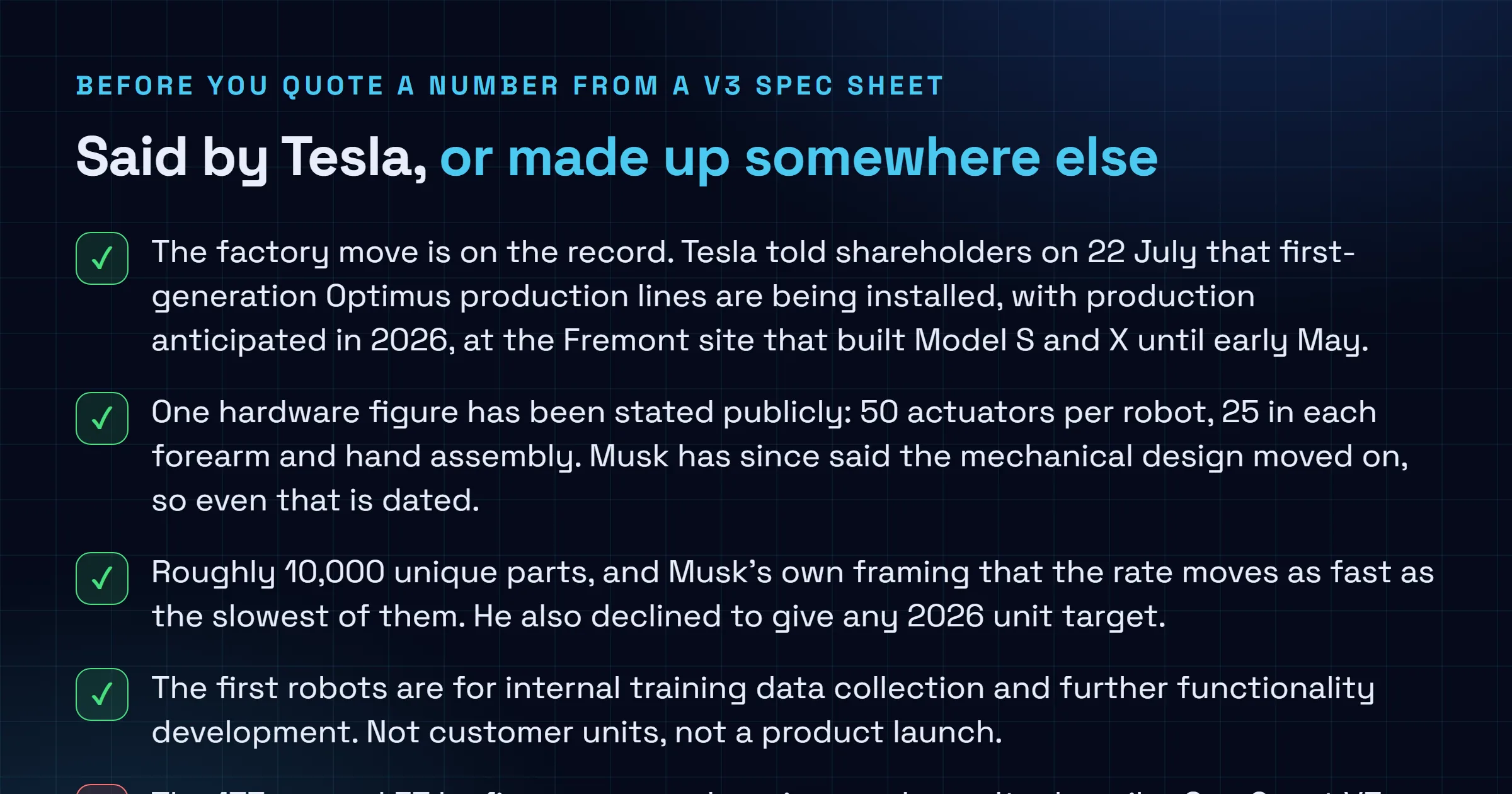
The Q2 2026 call ran on 22 July, and the Optimus section was shorter on news than anyone expected. Tesla’s own line: first-generation production lines for Optimus are being installed, in anticipation of production in 2026. That’s the concrete part. It sits on the Fremont floor that built Model S and X until early May, which is a real conversion of a real building, not a slide.
Everything after that was Musk managing expectations downward. He called it the hardest product to scale in manufacturing Tesla has ever made, because everything on the robot is new. He said there’s no existing supply chain for it. Back in April he’d put it more bluntly: the rate moves as fast as the least lucky, slowest, dumbest part in the entire ten thousand. And he declined to name a 2026 unit target, which is a notable retreat from January 2025, when he floated roughly 10,000 robots for that year and Tesla built none.
The forward-looking bits were about generations that don’t exist yet. Optimus 4 will be more vertically integrated, he said. AI5 will go into Optimus eventually. Fine, but that’s roadmap talk about a successor to a robot we haven’t met.
The reveal that keeps not happening
Musk originally said Tesla would unveil V3 “probably in Q1” 2026. April came and the answer became “probably middle of this year.” July came, and the Q2 call simply didn’t address it.
Tesla has offered a reason, and honestly it’s the most credible part of the whole story. The company says rivals run frame-by-frame analysis whenever it releases footage and copy whatever they can lift, so the design stays under wraps until production is actually running. Anyone who has watched the humanoid field this year knows the concern isn’t imaginary. Designs converge fast.
But secrecy has a cost that Tesla doesn’t pay and you do. Nobody outside the company can assess this machine. Not its reach, not its payload, not its duty cycle, not what it costs to keep running for a shift. Those are the numbers that decide whether a humanoid is a tool or a demo, and for V3 they’re all blank.
Every V3 spec sheet is made up
This is the part worth being loud about, because the search results are genuinely polluted.
Tesla has published exactly one hardware number for this robot: 50 actuators per unit, 25 in each forearm and hand assembly. That’s it. And Musk has since said the mechanical design moved on from that description, so even the one number is stale. Add “roughly 10,000 unique parts” if you’re feeling generous about what counts as a spec.
Now look at what’s circulating. A height of 173 cm and a weight of 57 kg, quoted confidently across dozens of pages. Those are Gen 2 figures, relabelled. A $30,000 price, which Tesla has never announced for any version. An IP68 ingress rating, a 20 km/h walking speed, 22 degrees of freedom per hand. No Tesla source exists for any of them. And a persistent claim that mass production began back in January, which contradicts Tesla’s own July statement that the lines are still being installed.
I find this more interesting than annoying, actually. It’s a clean example of what happens when search demand for a number vastly exceeds the supply of the number. The gap fills itself, the filler gets scraped, the scrape gets cited, and eighteen months later a fabricated height is treated as a fact. We ran into the same pattern with Etched’s Sohu projections, where 2024 figures for a discontinued design still get quoted as current.
What it changes for you
If you’re evaluating humanoids for actual work this year, the practical answer is that Optimus isn’t evaluable. You can’t run a comparison against a robot with no published payload. Tesla itself said the first units go to training data collection and further functionality development, which is internal language for “we’re still learning what it can do.”
Compare that with what a shippable pitch looks like. Humanoid’s HMND 01 Alpha publishes its height, its degrees of freedom, its payload and the plants where it ran pilots, and you can argue with those numbers precisely because they exist. Same on the software side, where Mistral’s Robostral Navigate put a benchmark score on the table for people to poke at. Disclosure invites criticism. That’s the trade Tesla has decided not to make.
Timing note, since it’s this week: IEEE Humanoids 2026 runs 28 to 31 July in Santa Clara, with “Humanoids and the Future of Work” as the special topic for its 25th edition. Tesla’s factory sits a short drive north. One of those two things will produce published, reviewable numbers about humanoid labour, and it won’t be the factory.
My read, and I might be wrong here: the Fremont conversion is the real signal and the missing reveal is noise. Converting an S and X line is expensive and hard to reverse, so somebody at Tesla believes in the schedule. The silence probably says more about competitive paranoia than about the robot being in trouble. Just don’t let anyone sell you a spec sheet in the meantime.
Sources: the production line installation, the scaling remarks and the Optimus 4 and AI5 comments come from Tesla’s Q2 2026 earnings call on 22 July 2026. The reveal slipping to “middle of this year”, the late July or August production start, the roughly 10,000 unique components and the frame-by-frame copying rationale come from Electrek’s report on the Fremont Model S and X line conversion (22 April 2026). The audit of circulating V3 specifications, including the recycled Gen 2 dimensions and the unsourced price, is documented in RoboZaps’ Optimus Gen 3 status page. Conference dates are from the IEEE Robotics and Automation Society listing for Humanoids 2026. No Optimus V3 dimensions, price or performance figures are asserted here, because Tesla has published none.
Frequently asked questions
Has Tesla revealed Optimus V3?
No. As of late July 2026 the third-generation Optimus has not been shown publicly. Musk first said the unveiling would come "probably in Q1" 2026, then pushed it to "probably middle of this year" on the April earnings call, and the 22 July Q2 call set no new date. Tesla has said it is holding the design back because competitors analyse its robot videos frame by frame, so it plans to keep V3 hidden until production is under way.
When does Optimus production actually start?
Tesla told shareholders on 22 July 2026 that first-generation Optimus production lines are being installed at Fremont, with production anticipated during 2026. On the April call Musk pointed at late July or August for the start, roughly four months after the last Model S and X came off that line in early May. He also warned output would be slow and gave no unit target for the year, so treat "production starts" as a line switching on rather than robots shipping.
What are the confirmed Optimus V3 specs?
Almost nothing. The one hardware figure Tesla has stated publicly is 50 actuators per robot, 25 in each forearm and hand assembly, and Musk has since said the mechanical design changed after that. Tesla has also described roughly 10,000 unique parts. No official height, weight, payload, battery, speed or ingress rating exists for V3. Anything more detailed than that is coming from somewhere other than Tesla.
Is the $30,000 Optimus price real?
It is not a Tesla number. No price has been announced for Optimus V3, there is no order page and no configurator. Musk has talked in the past about eventual low unit costs at volume, which is a manufacturing ambition rather than a price. The first robots off the Fremont line are earmarked for internal training data collection and functionality development, not for sale, so a consumer price would be premature anyway.
Why do so many sites list detailed Optimus V3 specifications?
Because the demand for those numbers exists and the supply does not, so the gap gets filled. The commonly quoted 173 cm and 57 kg figures are Gen 2 numbers reused under a V3 heading. Other details making the rounds, an IP68 rating, a 20 km/h walking speed, 22 degrees of freedom per hand, have no Tesla source behind them. If a spec sheet does not cite a Tesla filing, video or executive statement, assume it was assembled from older material and guesswork.