




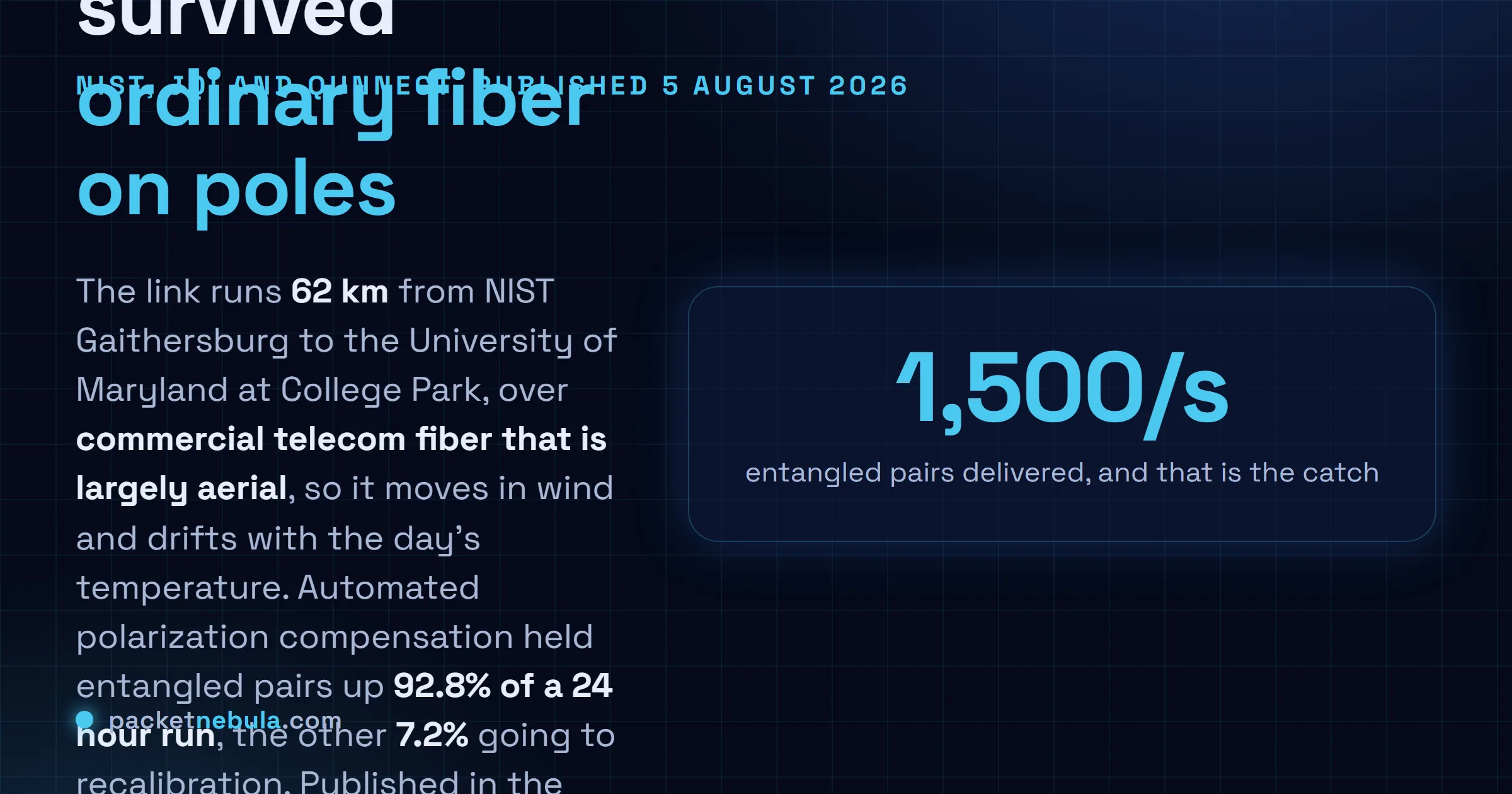
Somewhere between Gaithersburg and College Park there's a strand of ordinary telecom fiber hanging off utility poles, doing what fiber on poles does: swaying in wind, stretching in the afternoon sun, taking the occasional bird. NIST ran entangled photons down it for 24 hours and kept the entanglement alive 92.8% of the time. That's the result, published 5 August 2026 with the Joint Quantum Institute and a New York outfit called Qunnect. Not a distance record. A robustness one, and honestly the more useful kind. The number that keeps our feet on the ground is the throughput: about 1,500 entangled pairs per second, across 62 kilometres.
The short answer
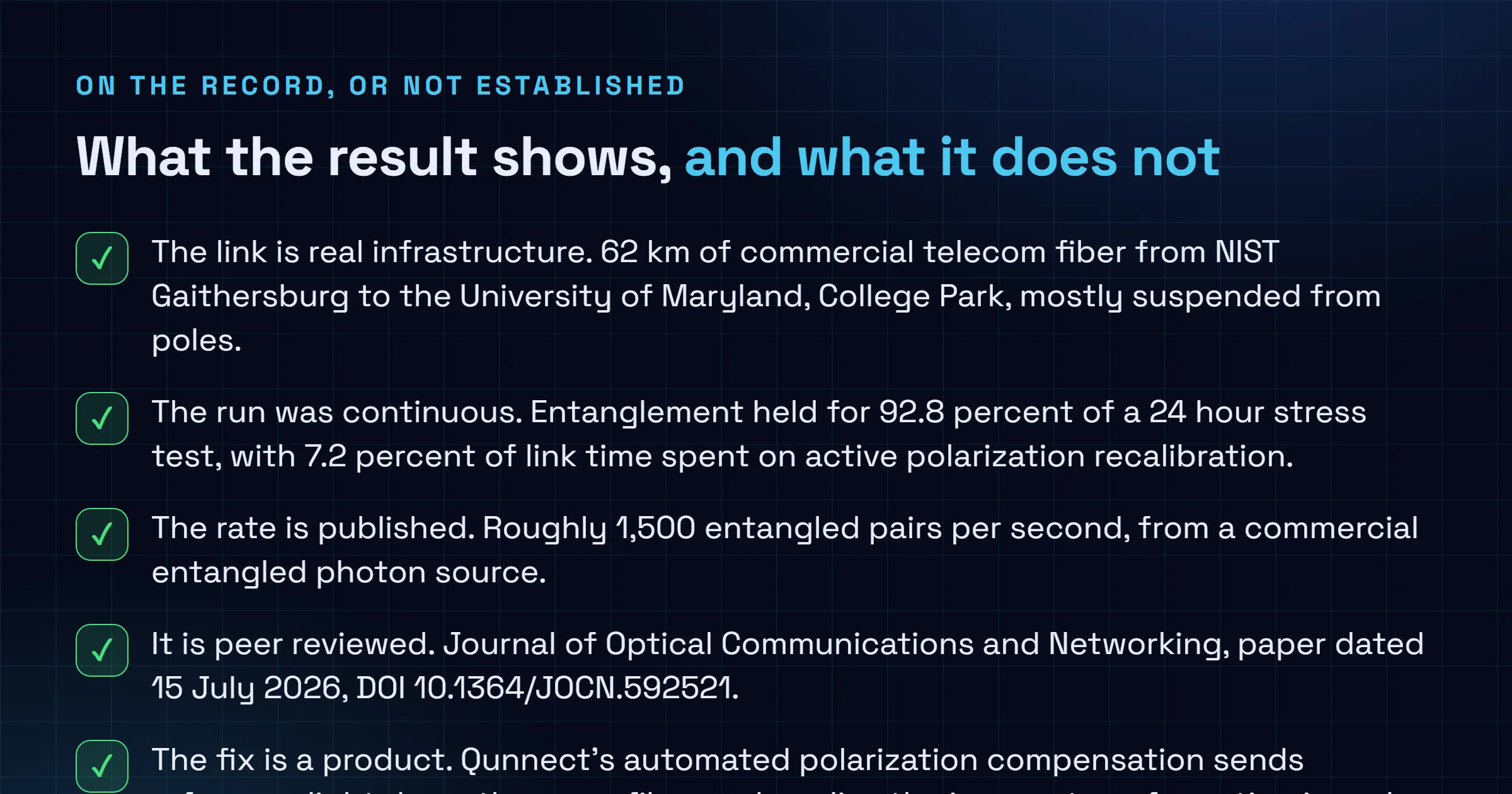
NIST, the Joint Quantum Institute at UMD and Qunnect distributed entangled photon pairs across 62 km of live telecom fiber between Gaithersburg and College Park, most of it hanging from utility poles. Automated polarization compensation kept entanglement up for 92.8% of a continuous 24 hour test, with 7.2% of link time spent recalibrating. Published 5 August 2026, from a paper dated 15 July in the Journal of Optical Communications and Networking. The distance is unremarkable. The conditions are the point, and the 1,500 pairs per second are the reason nobody should be redesigning a network around this yet.
The bad fiber is the whole experiment
Every entanglement-over-fiber headline you’ve read for a decade came with an asterisk, and the asterisk was usually the fiber. Spooled in a lab. Buried in a trench. Dark, dedicated, thermally boring.
This one wasn’t.
The link runs from NIST’s Gaithersburg campus to the University of Maryland at College Park, and it’s commercial telecom fiber that spends most of its 62 kilometres in the air. Which means it does everything fiber in the air does. It sways. It expands through the afternoon and contracts overnight. Trucks go past and it shivers. All of that twists the fiber’s birefringence around, and since the entanglement here lives in photon polarization, twisting the fiber scrambles the thing you’re trying to preserve.
Yicheng Shi, the lead author, called it about as bad a connection as you can possibly have. He also said the quiet part: “We put this to an extreme test in an environment that’s really noisy. Amazingly, it still worked.”
I like that he sounded surprised.
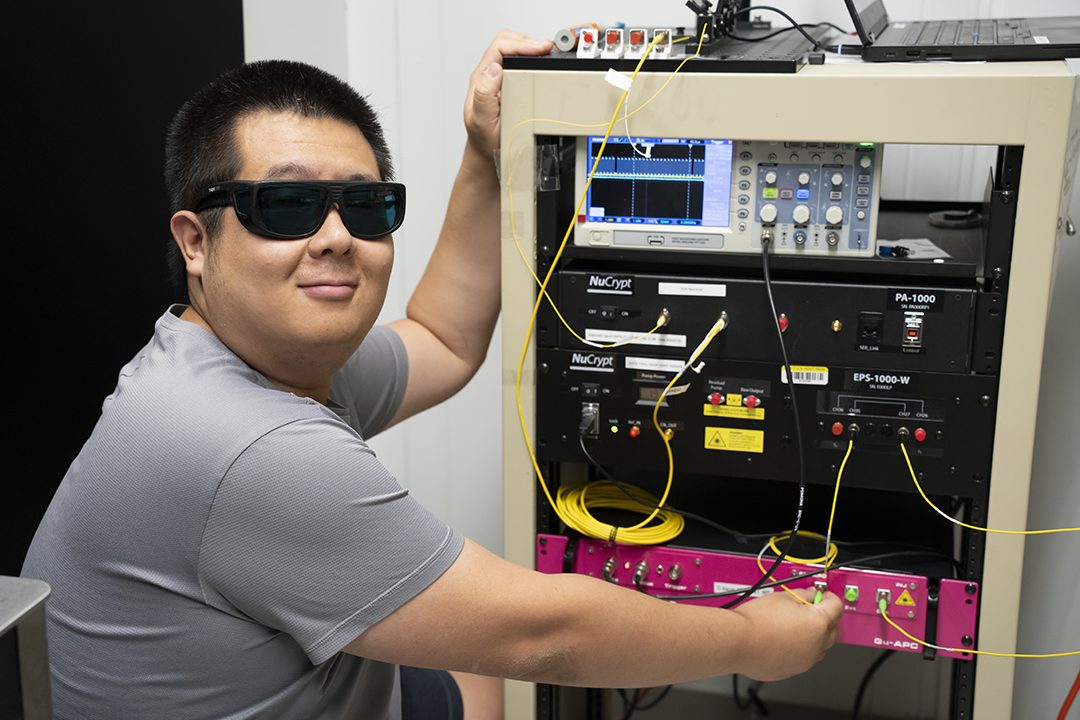
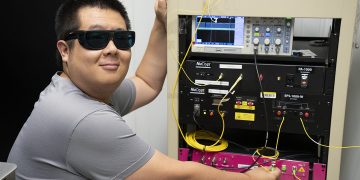
Image: NIST
What held it up
Qunnect’s automated polarization compensation, doing a fairly old trick very fast.
Classical reference light goes down the same fiber as the quantum channel. It comes out transformed, the hardware reads how it was transformed, and it applies the inverse to the quantum path before the drift has moved on. A tracking loop, essentially, chasing a fiber that will not sit still.
The number that makes this honest is 7.2%. That’s how much of the 24 hour window went to recalibration rather than to carrying entangled pairs, and it’s the direct complement of the 92.8% everyone is quoting. Nobody hid it, NIST published both halves, and we’d rather see a result stated that way than as a clean uptime figure with the overhead tucked into a footnote.
Quantum Computing Report puts a CHSH parameter of S = 2.45 ± 0.08 on the run, and says the link stayed above the classical bound for more than 20 consecutive hours. We didn’t find that figure in NIST’s own release, so treat it as the outlet’s reading of the paper rather than a press-office number.
Now the part that should cool you down
1,500 entangled pairs per second.
That’s the delivery rate, and it’s a hard ceiling on everything you might want to build on top. Put it next to any link in your own rack. A 10 Gbps wavelength carries ten billion bits every second. This carries fifteen hundred correlated photon pairs, and a key derived from them would be some fraction of that after sifting and error correction, assuming you were running a key exchange protocol at all. Which they weren’t. This is entanglement distribution, full stop. No key rate is published because no keys were being made.
So when the write-ups say the trial validates metropolitan quantum networks and QKD channels over existing fiber, hold that at arm’s length. What it validates is the physical layer surviving a genuinely hostile span. That’s a real and expensive assumption to have tested, because the alternative was trenching dedicated fiber across a metro area and nobody was going to pay for that. But surviving the medium and being useful at rate are different milestones, and this is the first one.
There’s no repeater here either. Entanglement went end to end across a single span, so the reach is still whatever fiber loss allows, and the loss budget itself doesn’t appear in the public material. No wavelength, no dB figure, no state fidelity that we could find outside the paywall. Which makes it hard to judge how much headroom is left before the pair rate falls off a cliff.
If you run a network, here’s your action item
There isn’t one. That’s fine.
Nothing about your metro rings changes this quarter, or next year. What changes is the shape of the eventual pitch: when someone eventually sells you a quantum link, the sentence “we can run it on your existing aerial plant” now has a peer-reviewed result behind it instead of a hope. Worth knowing before that conversation, not before your next maintenance window.
The thing that actually has a calendar on it is still the classical one. ML-DSA shipped first in the post-quantum TLS stack, and Cloudflare turned on ML-DSA-44 to origins with OpenSSL 3.5, which is software you can deploy on a Tuesday. Entangled photons on utility poles are a lovely result. They are not a migration plan, and I’d be a little wary of anyone who presents them as one.
Sources
- NIST, “‘Spooky’ Particles Transit DC Suburbs, a Step Toward a Quantum Network”, 5 August 2026, for the 62 km distance, the aerial commercial fiber, the 1,500 pairs per second, the 92.8% and 7.2% split, the journal reference and the Yicheng Shi quotes. Photograph credit NIST.
- Journal of Optical Communications and Networking, Vol. 18 Issue 8, DOI 10.1364/JOCN.592521, the peer-reviewed paper behind the announcement, dated 15 July 2026.
- Quantum Computing Report, for the CHSH value of S = 2.45 ± 0.08, the 20 hour figure above the classical bound and the description of Qunnect’s multiplexed reference-light compensation.
- The Quantum Insider, for the comparison with the 2022 European 248 km buried-fiber result and the commercial entangled photon source.
Frequently asked questions
What did NIST actually demonstrate?
Entanglement distribution over 62 kilometres of deployed commercial telecom fiber running from NIST's Gaithersburg campus to the University of Maryland in College Park. The point isn't the distance. It's that the fiber is mostly aerial, strung from utility poles, so it moves in wind and its birefringence drifts with temperature all day. The team held entangled pairs across it for 92.8% of a continuous 24 hour run at roughly 1,500 pairs per second, using automated polarization compensation built by Qunnect. The work appeared in the Journal of Optical Communications and Networking, paper dated 15 July 2026, DOI 10.1364/JOCN.592521.
Is 62 km a record?
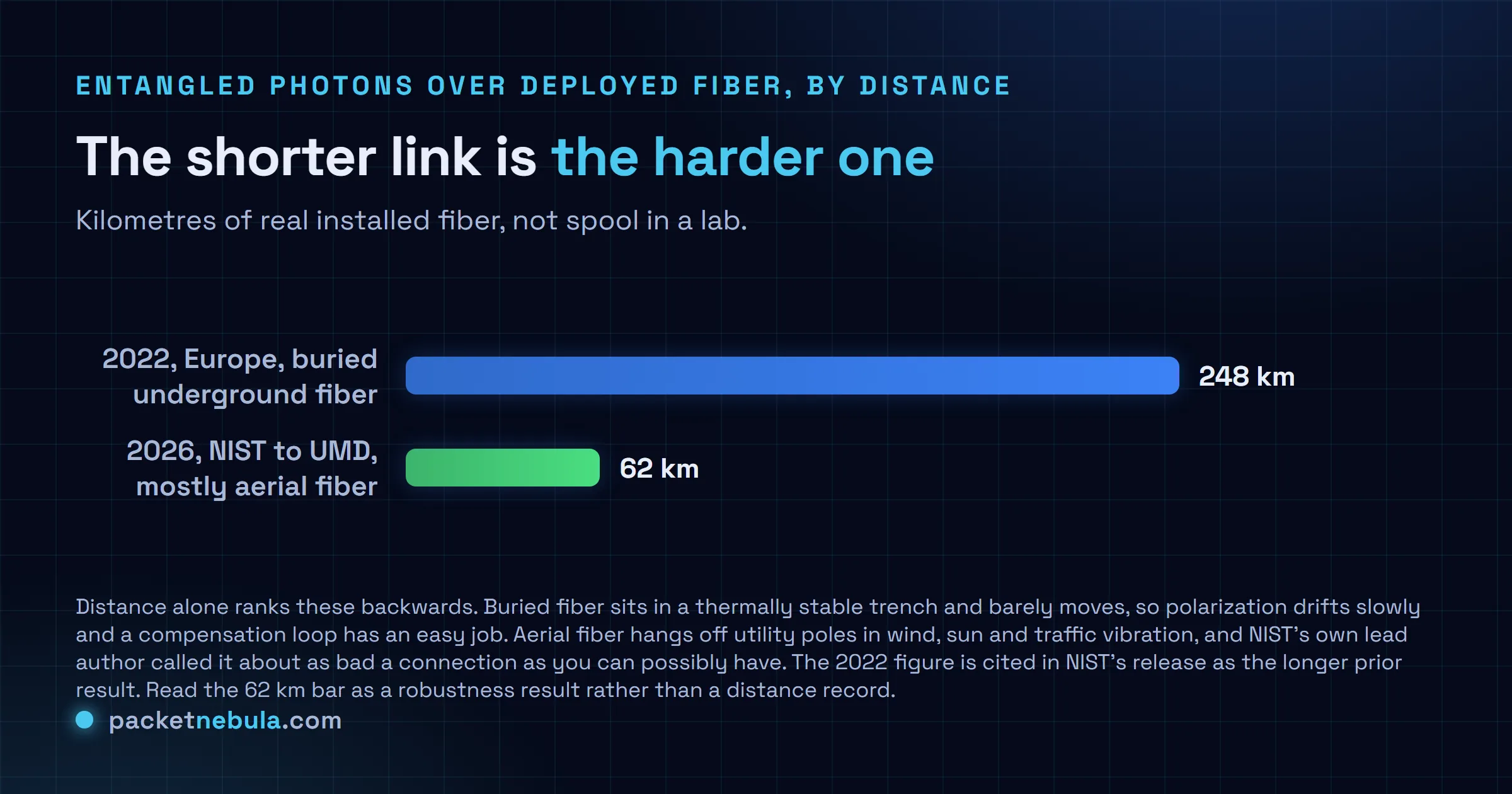
No, and NIST doesn't claim it is. Its own release points at a 2022 European demonstration that reached 248 kilometres, four times further. That one ran through buried fiber, which sits in a trench at a near constant temperature and hardly moves. The comparison is the story: the shorter link here was by far the nastier environment. Lead author Yicheng Shi described it as about as bad a connection as you can possibly have, and framed the whole experiment as a stress test.
Does this mean quantum key distribution is coming to my metro network?
Not on these numbers. 1,500 entangled pairs per second is the ceiling on everything downstream, and after sifting and error correction a key rate is some fraction of that. Compare it to a link you already run: a 10 Gbps wave moves ten billion bits a second. The demonstration also distributed entanglement, it did not run a key exchange protocol or publish a key rate. What it does establish is that the physical layer works on the fiber you already have, which is the expensive assumption everyone was making.
Should this change my post-quantum crypto plans?
No. Nothing at all. The migration to ML-KEM and ML-DSA is a software problem with a real calendar attached, and it runs over the classical internet whatever the quantum networking people manage next. QKD and post-quantum cryptography solve overlapping problems by completely different means, and only one of them ships in OpenSSL today. If you were hoping this buys you time on the PQC work, it doesn't.
What is polarization compensation doing here?
Holding the experiment together. The entanglement is encoded in photon polarization, and any real fiber rotates polarization as it flexes and warms. On buried fiber that drift is slow enough to ignore for a while. On aerial fiber it isn't. Qunnect's devices send classical reference light down the same fiber, measure how the fiber transformed it, then apply the inverse transformation to the quantum channel in real time. That correction loop cost 7.2% of the link's time over the 24 hour run, which is the honest price of the 92.8% figure.