
Open Qwen Chat this morning and there's a new image model waiting, Qwen-Image-3.0, with a demo reel of dense infographics and UI mockups that mostly hold together. So what actually shipped? A hosted model you can prompt right now, live in Qwen Chat since July 21, and a set of loud capability claims: text legible down to 10 pixels, in-image rendering across 12 languages, whole charts built from live data. What did not ship is the part that lets you trust any of it. No open weights. No benchmark score. No model card, no technical report. That's a real break from how Qwen shipped the last two versions, and it's the whole story here. We went to separate the model you can use today from the numbers you're being asked to take on faith.
The short answer
Alibaba launched Qwen-Image-3.0 on July 21, hosted in Qwen Chat. It claims in-image text legible down to 10 pixels, rendering in 12 languages and 20+ fonts, and full infographics built from live data. What’s missing is telling: no downloadable weights, no benchmark score, no model card. The last two versions shipped all of that. Here’s the line between what you can use and what you’re asked to believe.
What actually shipped
A model you can generate with. That’s the solid part. As of July 21, Qwen-Image-3.0 is reachable through Qwen Chat, so if you’ve got an account you can throw prompts at it this afternoon. Alibaba frames it as the third generation of its image line, and the pitch is specific: this isn’t for pretty wallpapers, it’s meant to output images you’d actually use as a tool. Knowledge diagrams. UI interfaces. Charts with real labels.
The headline feature is text that survives being small. Qwen says the model renders in-image text legibly down to about 10 pixels, across 12 languages and more than 20 fonts. If you’ve ever asked an image model for a poster and watched it spell the title wrong, you know why that matters. It also claims it can pull live data off the internet and lay it into a graphic, a weather card being the example everyone’s passing around.
And the instruction window grew. Qwen-Image 2.0 took prompts of roughly 1,000 tokens. 3.0 takes up to 4,500. That’s not a rounding tweak.
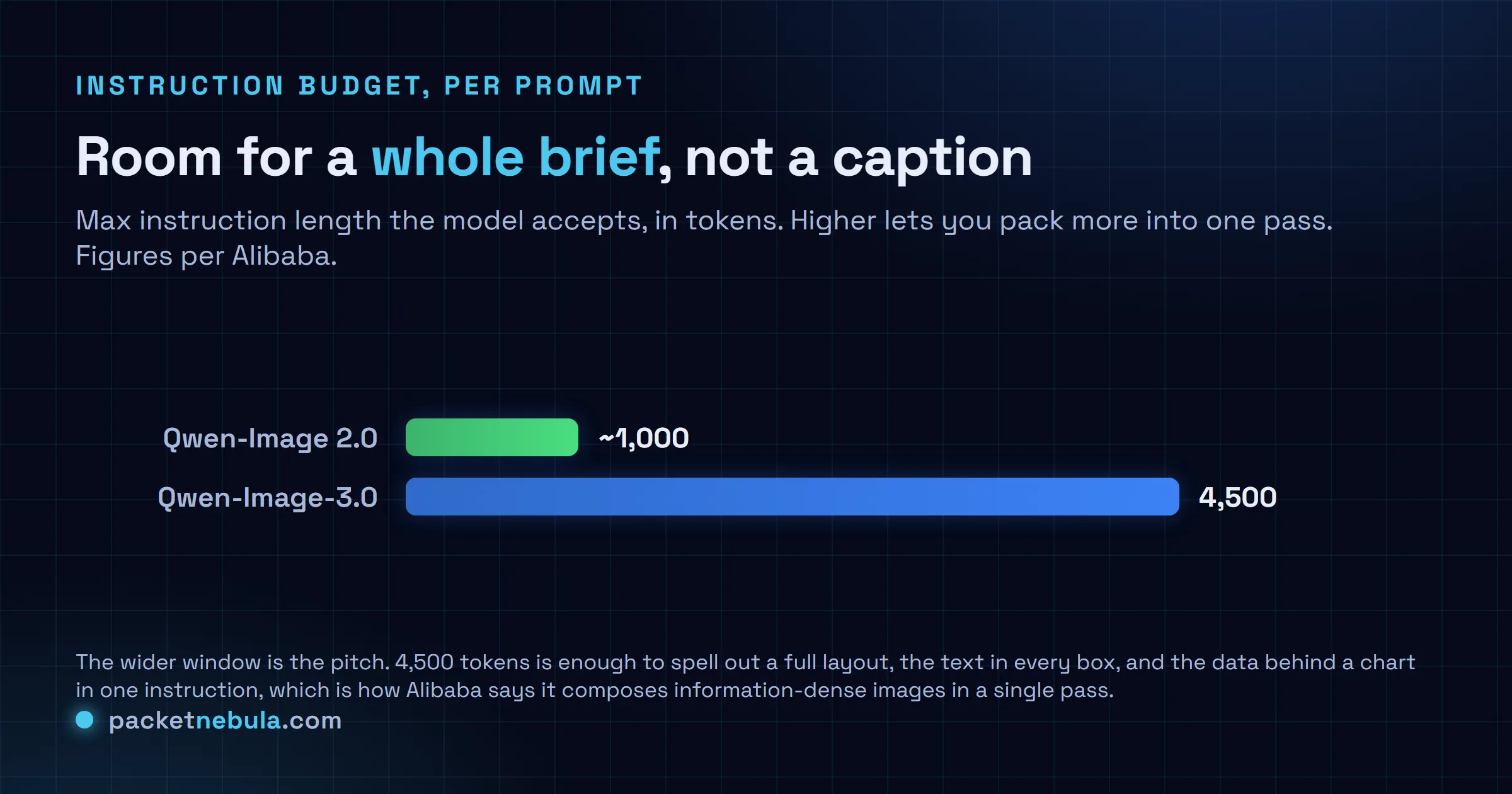
More room per prompt is the mechanism behind the “information-dense in a single pass” claim. You can describe the layout, the text in each box, and the data behind a chart all at once, instead of generating and patching. That’s the part I’d want to test first, because dense composition is exactly where image models tend to fall apart.
The receipts that didn’t come
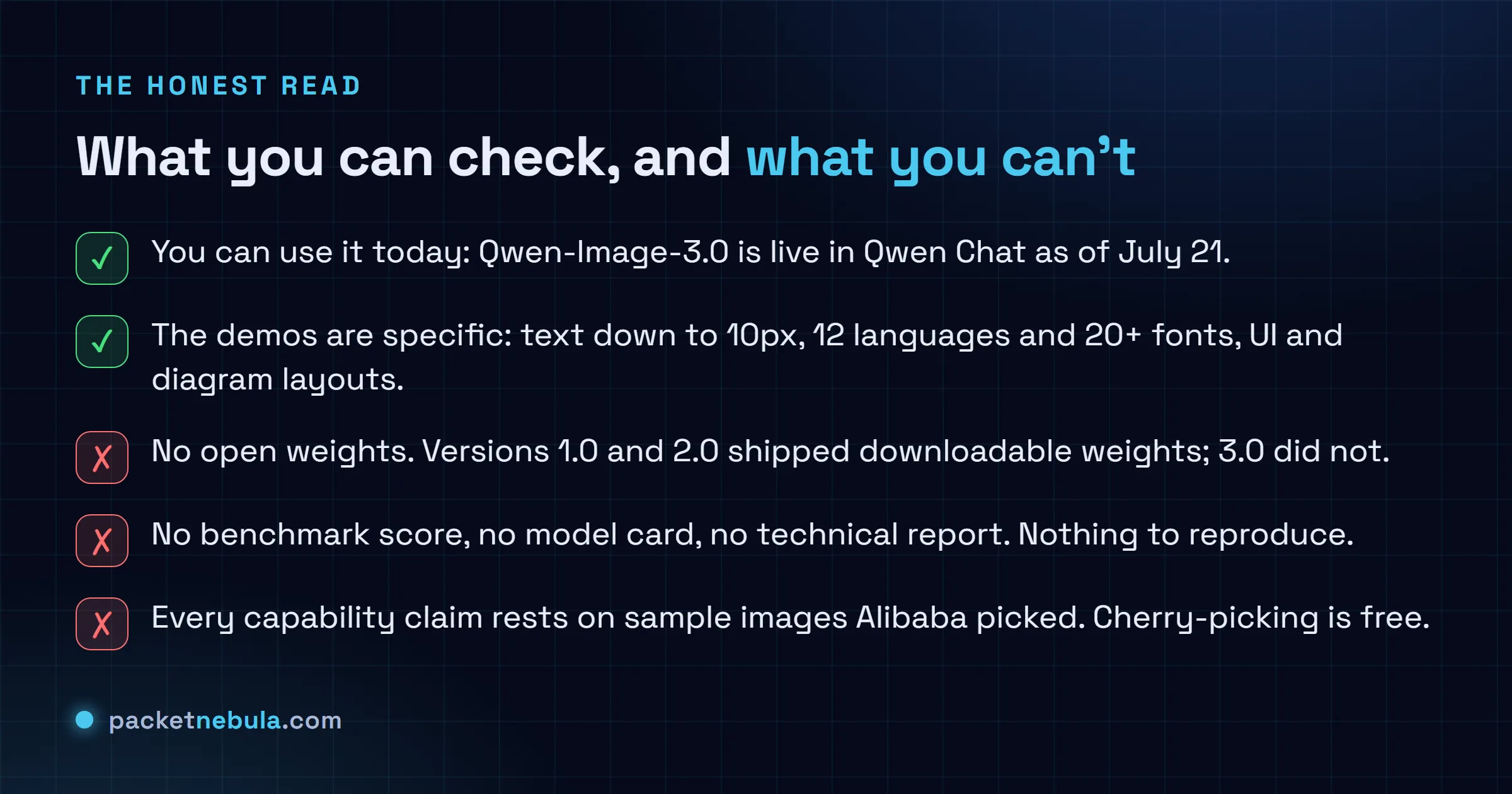
Here’s where we slow down. Everything above is Alibaba’s description of Alibaba’s model, illustrated with images Alibaba picked. There is no benchmark score. No model card. No technical report. Nothing a third party can pull up and rerun.
That’s not the bar we’re inventing. It’s the bar Qwen set itself. Qwen-Image 1.0 landed in August 2025 with open weights under an Apache 2.0 license and a proper writeup. Version 2.0 came with a technical report too, and Alibaba even ranked Qwen-Image 2.0 Pro fifth on its own Qwen-Image-Bench. Modest, but a number. For 3.0 there isn’t even a self-reported score. The launch is a blog post and a gallery.
And the weights stayed home. This is the bigger shift. The whole reason a lot of us paid attention to Qwen-Image in the first place is that it was open: you could pull it down and run it on your own box. 3.0 is hosted-only. No files on Hugging Face, no license posted. So the one thing that made the line special, self-hosting, is exactly what’s absent from the version with the biggest claims.
We’ve seen this shape twice this month
If this pattern feels familiar, it should. Alibaba ran nearly the same play with its language side a couple of days ago: Qwen3.8’s preview went live with a giant parameter claim and open weights “soon”, none of it backed by a card or a benchmark. Same lab, same week, same move. Announce the impressive thing, ship the hosted preview, keep the weights and the numbers back.
Which is worth holding next to the other big image drop this month. ByteDance’s Seedream 5.0 Pro also pushed in-image text and a headline feature, but it shipped with an actual per-image price and a concrete workflow you could poke at. I’m not saying Seedream is better. I’m saying you can weigh it. With Qwen-Image-3.0 right now, you mostly can’t.
The honest read
I’m genuinely interested in this model, and I’m not going to repeat its demo reel as proof. Both are true at once.
Use it. Really, go generate with it in Qwen Chat and see if the tiny-text and diagram claims hold on your own prompts, because your prompts are the only test that counts. Just don’t wire it into anything on the strength of a gallery, and don’t quote “10 pixels, 12 languages” as a measured fact when it’s a caption under a picture. If you need open image weights you can actually run, the older Qwen-Image releases and Seedream are still where the receipts are. When the weights, a model card, or one reproducible benchmark shows up for 3.0, that’s when the claims become facts. Not before.
Sources: Qwen (qwen.ai), the official Qwen-Image-3.0 announcement of July 21, 2026, for the capability claims (10px text, 12 languages and 20+ fonts, UI and diagram generation, live-data graphics) and hosted availability in Qwen Chat. Unite.AI and Phemex News for the July 21 date, the 4,500-token instruction limit versus about 1,000 for Qwen-Image 2.0, the absence of open weights, benchmarks, a model card and a license, and the context that Qwen-Image 1.0 shipped Apache 2.0 open weights in August 2025 and Qwen-Image 2.0 Pro ranked fifth on Alibaba’s own Qwen-Image-Bench. All capability figures are as claimed by Alibaba and are not independently reproduced.
Update, 7 October 2026. The FAQ says Qwen-Image 2.0 shipped open weights. No 2.0 repository exists in the Qwen organisation on Hugging Face. The release with weights is 2.1.
Frequently asked questions
Is Qwen-Image-3.0 released?
Yes, but only as a hosted model. On July 21, 2026, Alibaba made Qwen-Image-3.0 available through Qwen Chat, so you can generate with it today. It has not released downloadable weights, unlike Qwen-Image 1.0 and 2.0, which both shipped open weights. So you can use it, you just cannot run it yourself.
Can I download the Qwen-Image-3.0 weights?
Not as of July 21. Qwen-Image 1.0 shipped in August 2025 under a permissive Apache 2.0 license, and 2.0 followed with a technical report. Version 3.0 launched with none of that: no weights on Hugging Face, no license posted. If you need open image-generation weights you can self-host today, the older Qwen-Image releases are still the honest pick.
What can Qwen-Image-3.0 actually do?
Alibaba says it renders in-image text legibly down to about 10 pixels, across 12 languages and more than 20 fonts, and that it can compose knowledge diagrams, UI mockups and data-driven graphics like weather cards in a single pass. Instructions can run up to 4,500 tokens. All of that comes from example images the company published, not from an independent test.
Are there benchmarks for Qwen-Image-3.0?
No. There is no benchmark score, no model card and no technical report. For contrast, Alibaba ranked Qwen-Image 2.0 Pro fifth on its own Qwen-Image-Bench at that launch. For 3.0 there is not even a self-reported number, so every quality claim rests on the samples Alibaba chose to show.
How is it different from Seedream 5.0 Pro?
Both are July image models with strong in-image text. Seedream 5.0 Pro leans on splitting a render into editable layers, and it shipped with a per-image price. Qwen-Image-3.0 leans on dense information design, diagrams and UIs, and it shipped hosted-only with no weights and no numbers. Different bets, and one of them you can measure.


