
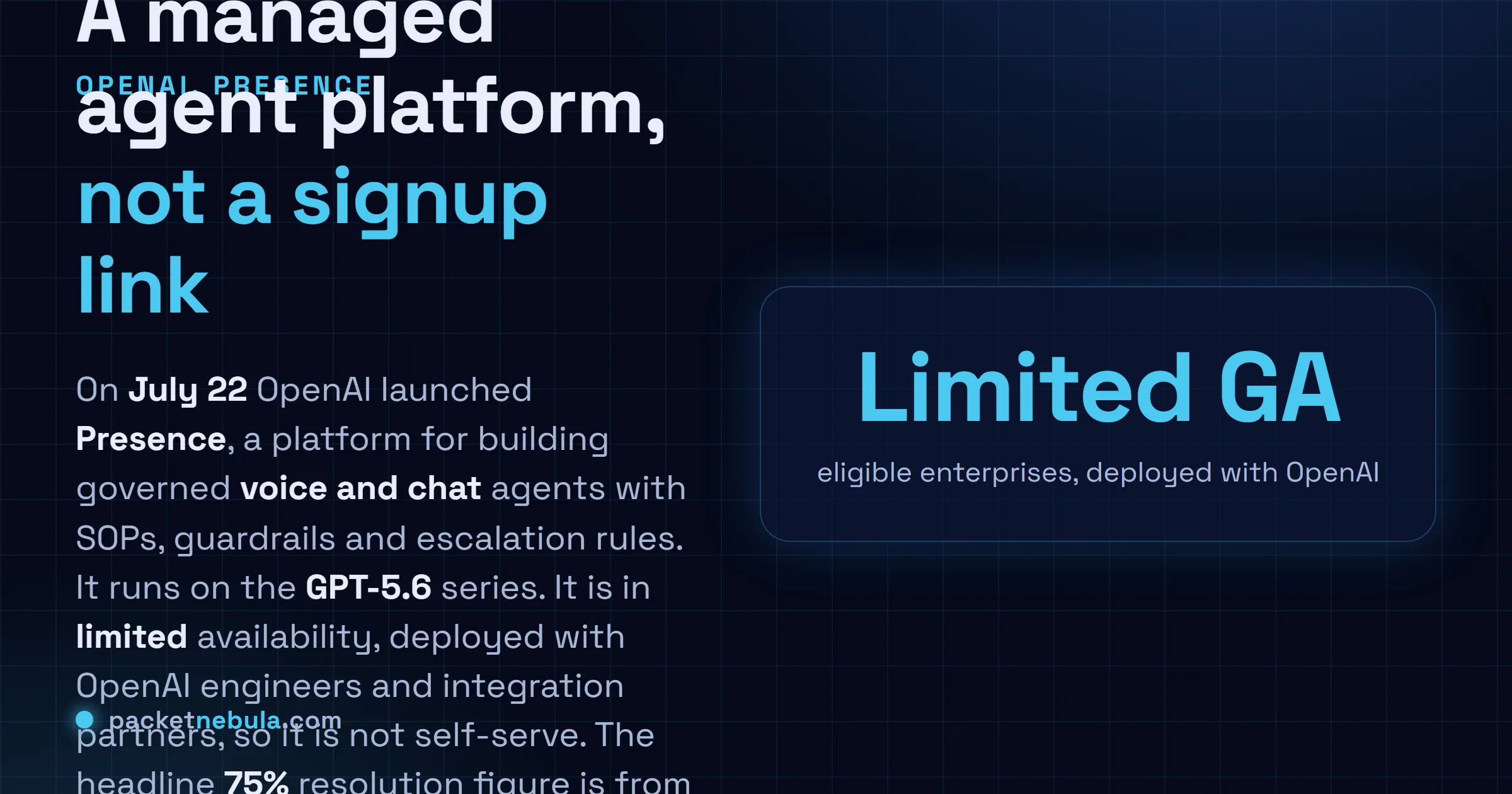
Someone calls a support line, gets a real answer, and never talks to a person. That's the pitch OpenAI put a product name on this week. On July 22 it launched Presence, a managed platform for building AI agents that handle voice and chat with company rules, guardrails and escalation baked in. Here's what we actually care about: it runs on the GPT-5.6 series, it is in limited availability deployed hand in hand with OpenAI's own engineers, and the eye-catching 75% resolution number comes from OpenAI running the thing on its own support line. So it's real, and it's narrower than the headline sounds.
The short answer
OpenAI launched Presence, a managed platform for building voice and chat agents with company rules, guardrails and escalation wired in. It runs on GPT-5.6, it is in limited availability and deployed alongside OpenAI’s own engineers, and the headline 75% resolution number comes from OpenAI running it on its own support line. Real product, narrower reach than the number suggests.
What OpenAI actually shipped
For a while the OpenAI story was raw model access. You got an API, you got a model, and you built the agent, the rules and the monitoring on top yourself. Presence flips that. It’s a managed system for standing up an agent that answers questions, resolves issues, touches company systems, takes approved actions, and hands off to a person when it should.
The framing OpenAI uses is worth repeating because it’s the whole design. Each deployment starts with a specific job. The agent gets a standard operating procedure, plus only the data and the system access that job needs, nothing more. Guardrails block the risky moves. A simulation tool throws edge cases at those guardrails before anything goes live. And once it’s running, a Codex-powered loop (Codex runs on GPT-5.6) watches the output and suggests changes.
That last part is the actual pitch. It isn’t “here’s a chatbot.” It’s “here’s an agent that gets tuned over time, with the tuning half-automated.” Whether that holds up outside OpenAI’s own walls is the open question, and we’ll get to it.
How they fence it in
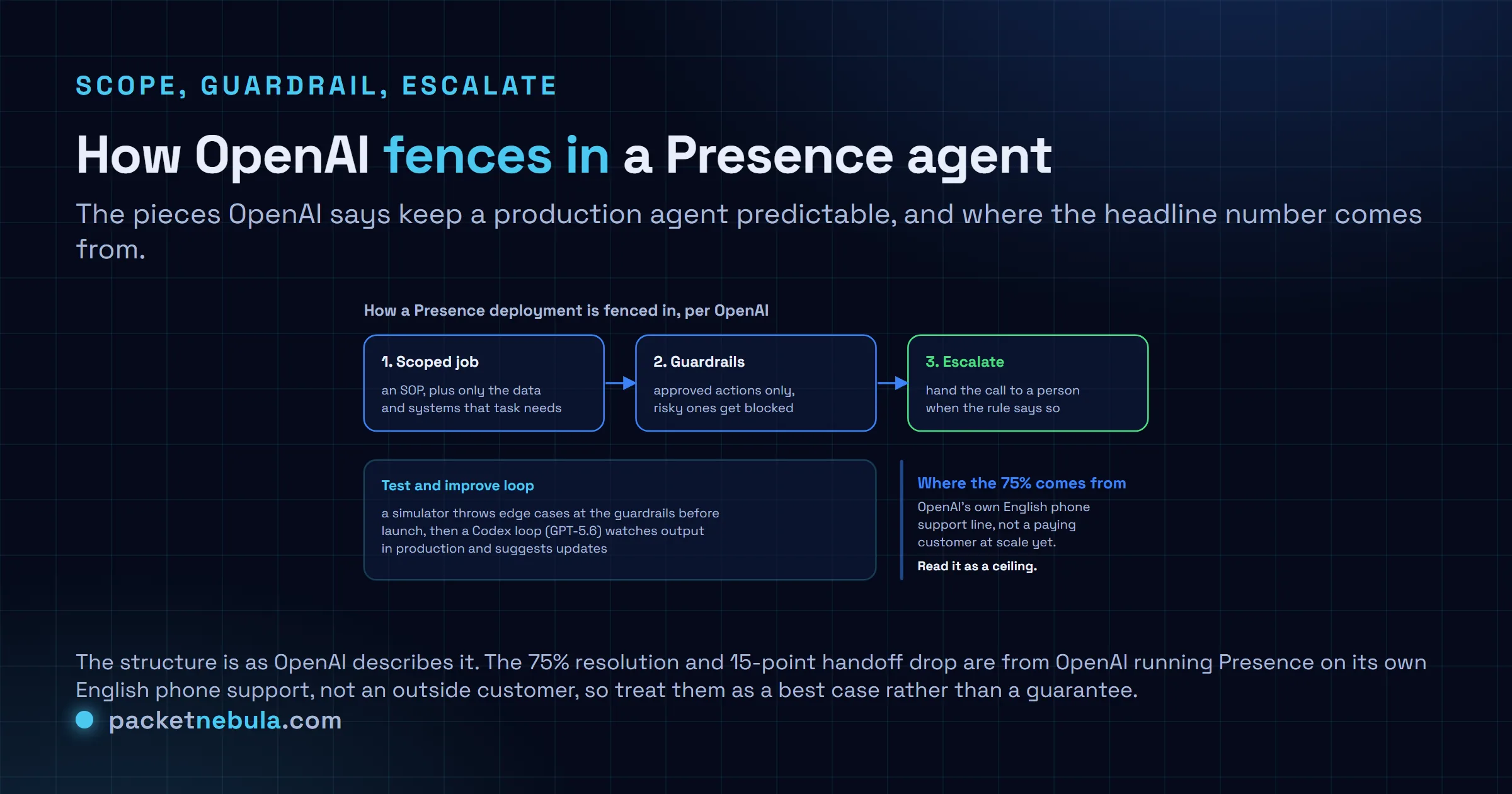
Nothing here is exotic on its own. Scoping an agent’s permissions, adding escalation, testing against simulated calls, monitoring in production: contact-center teams have wanted all of it for years. What’s new is one vendor selling the whole stack as a product, with the model maker’s own engineers doing the integration.
And that’s the catch buried in “available.” Presence is in a limited general availability program for eligible enterprise customers, and it ships with OpenAI Forward Deployed Engineers and selected systems integration partners. Translation: you don’t sign up. You get onboarded. This is a deployed engagement, closer to a consulting-plus-software arrangement than a dashboard you spin up on a Tuesday. If you were hoping to test-drive it this week, that’s not the shape of it.
The number everyone will quote
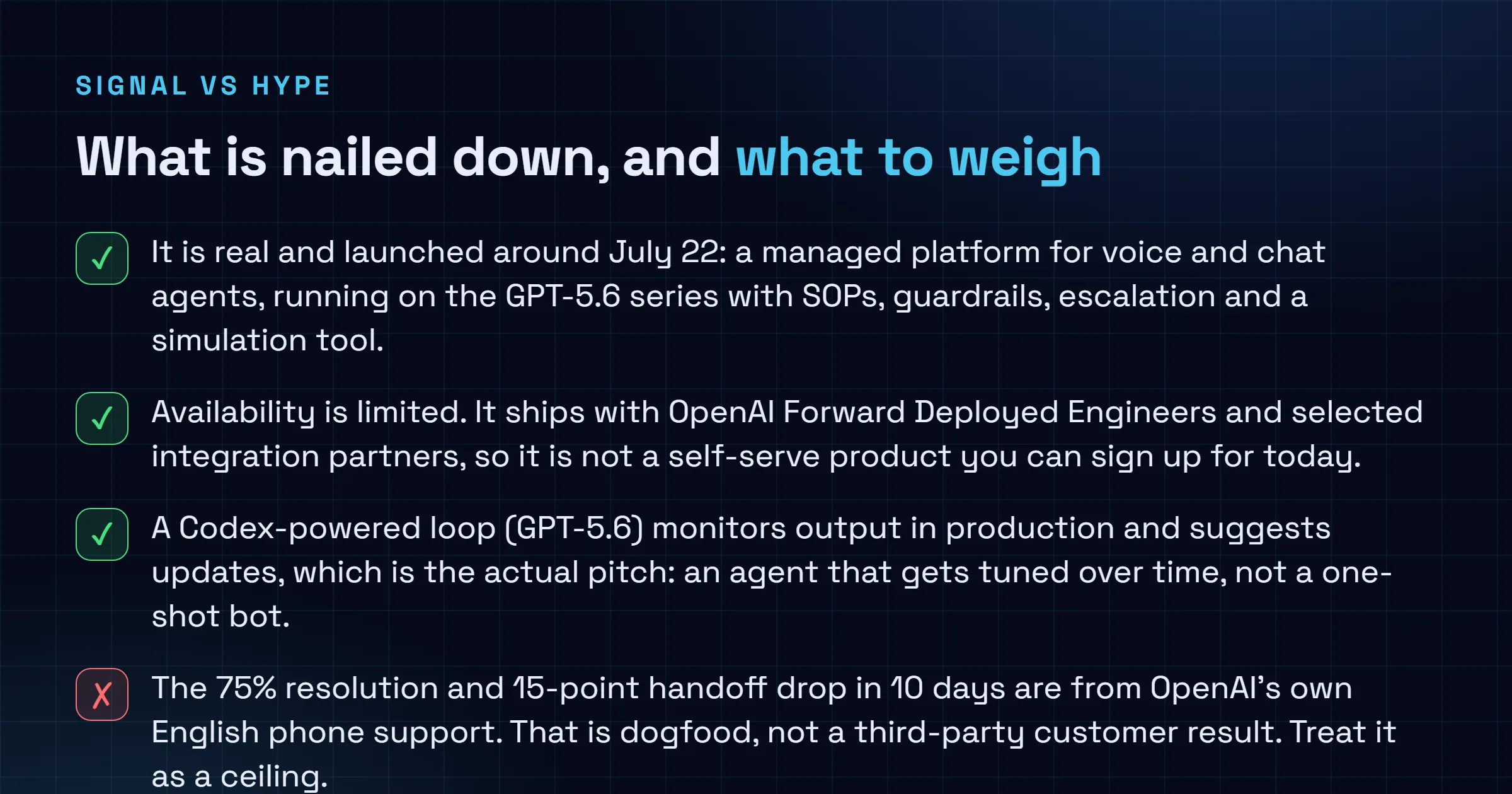
You’re going to see “resolves 75% of inbound issues without human assistance” everywhere. Here’s the honest reading. That figure is from OpenAI’s own English-language phone support, powered by Presence. OpenAI also says the improvement loop cut human handoffs by 15 percentage points over 10 days, and that the agent matched help-desk reps on response quality within a few weeks of going live.
Those are good numbers. They’re also OpenAI dogfooding its own product on its own traffic. That’s not nothing, running it on your own support desk is a real commitment and a fair proof point. But it isn’t a paying customer hitting 75% on messy, multilingual, regulated traffic. It’s a ceiling under favorable conditions, and the write-ups that drop the word “OpenAI’s own” turn a dogfood metric into an industry benchmark. Don’t let them.
As for outside adoption, the named names are all early. OpenAI points to BBVA looking at AI voice support for banking in Mexico, SoftBank testing Japanese-language conversations, and Australian insurer IAG assessing claims support during demand spikes. Every one of those is framed as exploring or testing. Real logos, sure. Proof it works at scale in those settings, not yet.
What it means for you
If you were already going to build agents on OpenAI’s voice and realtime tooling, Presence is the built-versus-bought decision landing on your desk. Buy it, and OpenAI’s engineers wire the guardrails and the escalation and you get the improvement loop for free. Build it, and you keep control of every piece and you own the maintenance. There’s no universally right answer. It comes down to whether you’d rather own the plumbing or rent the whole thing, and how comfortable you are handing a model vendor deep access to your systems.
The strategic read is bigger than one product. This is OpenAI moving up the stack, from selling the model that powers your agent to selling the agent itself, delivered and tuned. It’s the same GPT-5.6 line, the one that shipped as Sol, Terra and Luna, now wrapped in a managed service with people attached. That’s a different business than an API, and it puts OpenAI square in the lane the contact-center software vendors thought was theirs.
For most teams reading this, the move today is small: watch it, don’t rebuild around it. It’s limited, it’s deployed by hand, and the flattering numbers are self-reported. When an outside customer publishes real resolution rates on their own traffic, that’s the data point worth changing plans over. Until then, it’s a well-built agent platform with OpenAI’s thumb on the scale of its own demo.
Sources
The launch, the deployment model and the guardrail structure as reported by SiliconANGLE and IT Brief Asia, with the 75% resolution and 15-point handoff figures, the governance framing and the named customers (BBVA, SoftBank, IAG) via CX Today. The 75% and 15-point numbers are OpenAI’s own, measured on OpenAI’s English-language support line, and are flagged as dogfood above; the named customers are described as exploring or testing, not proven deployments, and no public pricing has been disclosed.
Frequently asked questions
What is OpenAI Presence?
Presence is a managed platform OpenAI launched around July 22, 2026 for building and running AI agents that handle customer support, sales and internal tasks over voice and chat. Instead of raw model access, you get a system to scope what an agent can see and do, set guardrails and escalation rules, test it against simulated edge cases, and keep tuning it in production. It runs on the GPT-5.6 series.
Can I sign up for OpenAI Presence today?
Not on your own. It is in a limited general availability program for eligible enterprise customers, and it ships with OpenAI Forward Deployed Engineers and selected systems integration partners who connect it to your systems and write the guardrails. So it is a deployed engagement, not a self-serve dashboard you can spin up in an afternoon.
What does the 75% resolution figure actually mean?
It means OpenAI runs Presence on its own English-language phone support, and there the agent resolves roughly 75% of inbound issues without a human. OpenAI also says its improvement loop cut human handoffs by 15 percentage points over 10 days. Those are OpenAI dogfooding its own product on its own traffic, not results from an outside customer, so read them as a best case rather than what you will get.
Which companies are using Presence?
OpenAI named BBVA looking at AI voice support for banking in Mexico, SoftBank testing Japanese-language customer conversations, and Australian insurer IAG assessing agents for claims support during demand spikes. All of these are framed as exploring or testing, not proven at-scale deployments. No public pricing has been shared.
How is this different from the Realtime API?
The Realtime API and similar building blocks give you the model and the plumbing, and you assemble the agent, the policies and the monitoring yourself. Presence sits a layer up: it is the whole managed system, guardrails, simulation, escalation and a Codex-powered improvement loop, delivered with OpenAI engineers. It is the buy-the-platform option versus build-it-on-the-API.


