
Your voice agent hangs for a beat after the caller stops talking, and that beat is where the call feels robotic. On July 6, OpenAI pushed two new Realtime API models, gpt-realtime-2.1 and gpt-realtime-2.1-mini, and the headline we'd give a colleague is short: same voice stack, lower p95 latency (OpenAI says at least 25%, from better caching), and a mini model that now reasons with a configurable effort dial. It's an API update, not a new ChatGPT voice. So the real question is whether the numbers change how you'd build a phone agent, and which of the two you actually call.
The short answer
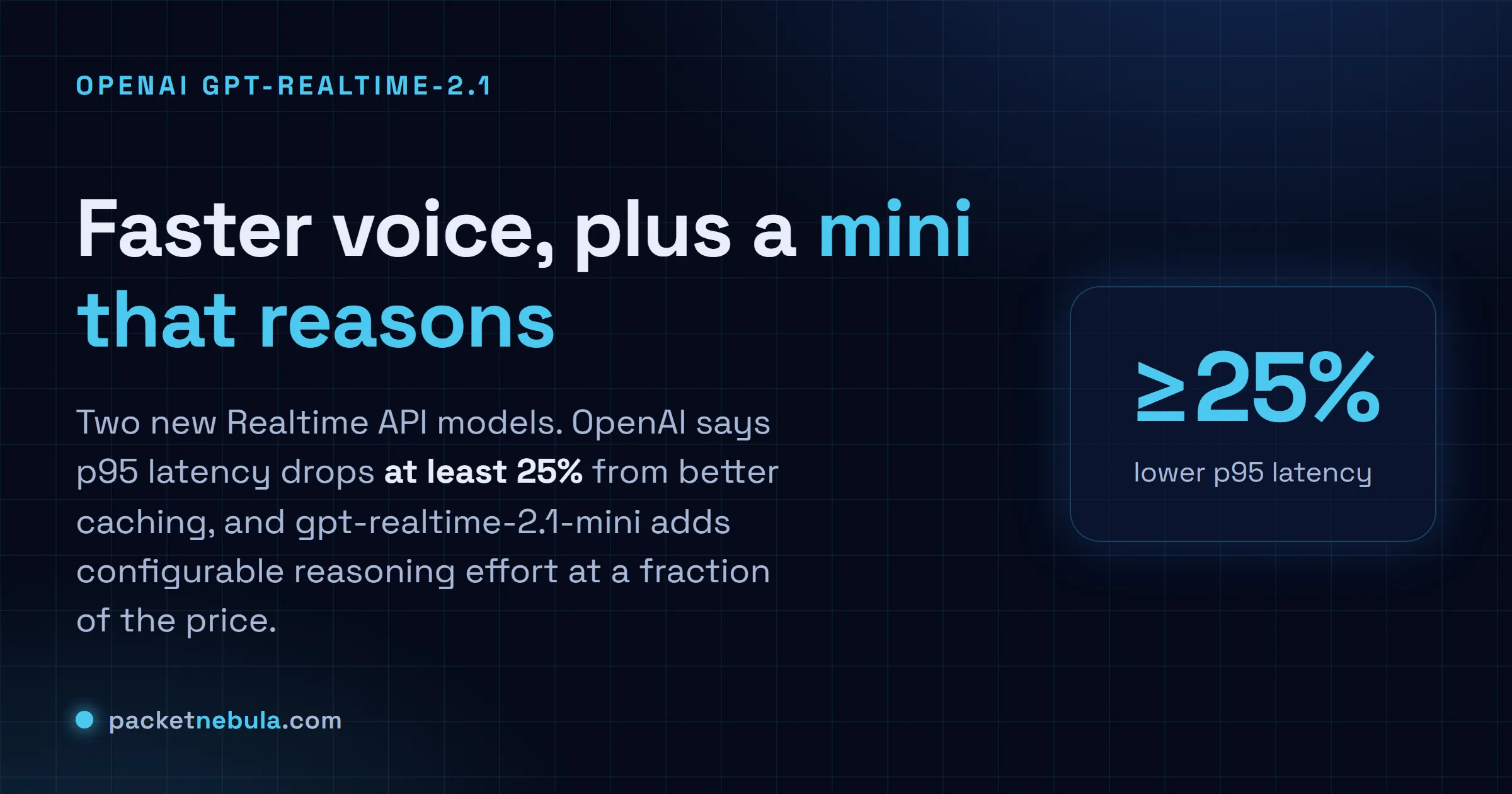
OpenAI shipped gpt-realtime-2.1 and gpt-realtime-2.1-mini for the Realtime API. The full model gets cleaner interruption and noise handling and better alphanumeric recognition. The mini now reasons with a configurable effort dial, at the same price as before. Latency drops at least 25% on OpenAI’s own p95 numbers, from caching. Net for you: a real, measurable upgrade for voice agents, but verify the latency claim on your own traffic.
What OpenAI actually shipped
Two model strings, not a new product. On July 6, OpenAI added gpt-realtime-2.1 and gpt-realtime-2.1-mini to the Realtime API, the speech-to-speech interface that powers phone agents, live support bots, and anything where a person talks and the model talks back in near real time. If you already run gpt-realtime-2, this is the next snapshot, and swapping to it is a model-string change you can A/B test.
The full model, gpt-realtime-2.1, is the incremental-but-useful kind of update. OpenAI calls out three fixes over gpt-realtime-2: better alphanumeric recognition, better silence and noise handling, and better interruption behaviour. That first one sounds dull and isn’t. If your agent takes order numbers, postcodes, card digits or booking references over the phone, garbled alphanumerics are the bug that quietly tanks your completion rate. We’ve watched a demo bot hear “B as in boy” and write “P”. So a cleaner read on codes is worth more than it looks on the changelog.
The mini grew a brain
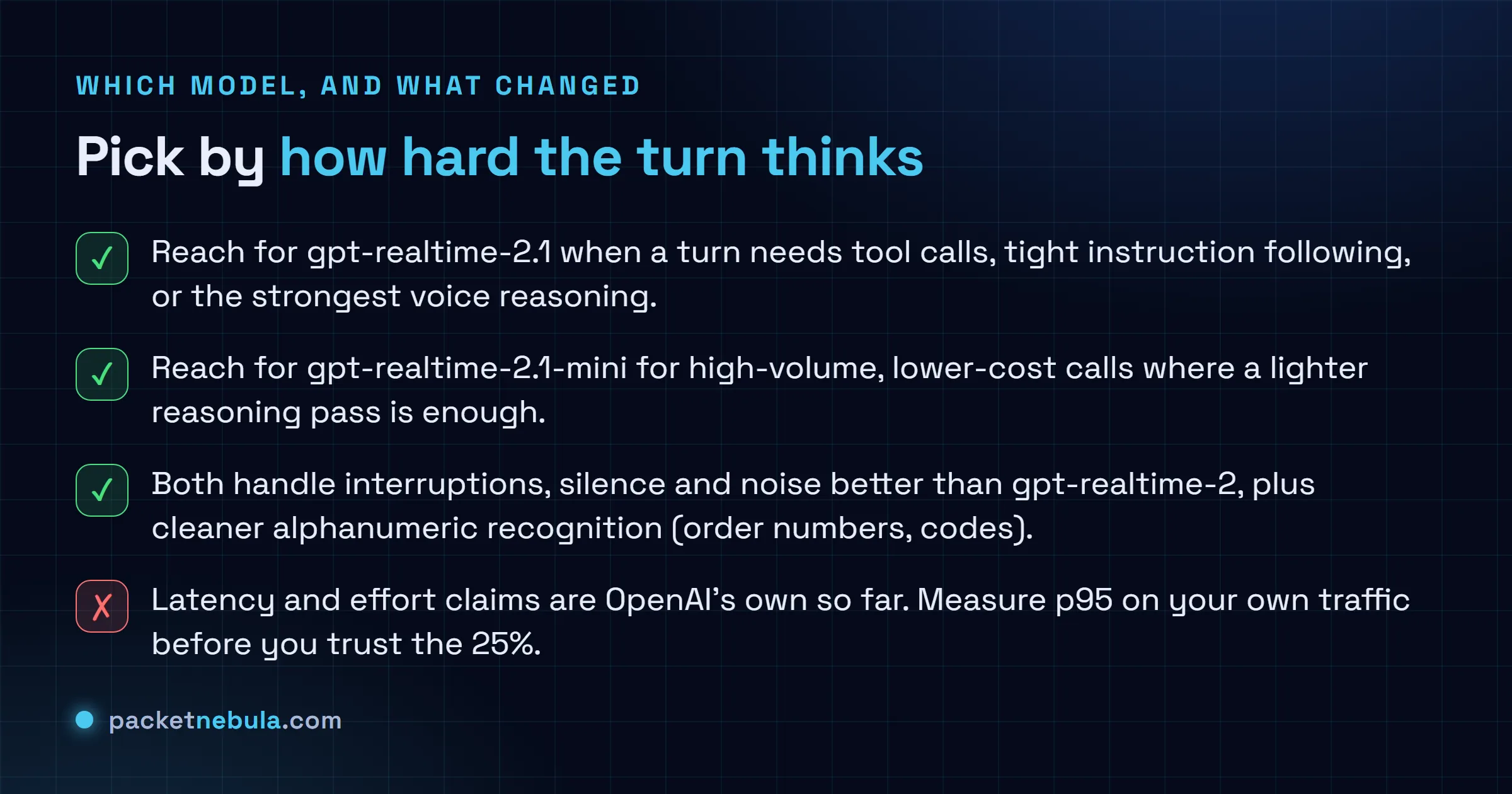
Here’s the part that’s genuinely new. gpt-realtime-2.1-mini isn’t just a smaller, cheaper voice model any more. It’s a mini reasoning model, with configurable reasoning effort, the same kind of low-to-high effort dial you’ve seen on the text side. Per OpenAI, the mini ships at the same price as the earlier gpt-realtime-mini. So the reasoning upgrade is, in effect, free.
Why does that matter for a voice build? Because voice agents live or die on the turn that needs a little thought. “Cancel my Tuesday appointment and rebook me after 3pm” is a turn where a purely reflexive model fumbles and a reasoning pass saves the call. Before, you’d reach for the full model for those, and eat the cost on every turn including the trivial ones. Now the mini can think a bit when it has to, and you keep the full model for the genuinely hard workflows: dense tool chains, strict instruction following, the stuff where a wrong step is expensive.
I think the effort dial on the mini is the more interesting release than the latency line everyone’s quoting. Latency is a one-time win. A cheap model that can reason on demand changes how you architect the whole agent.
The price gap is the whole design decision
Audio output is what a talking agent burns most, and that’s where the two models split hard. The full model is $64 per million audio output tokens. The mini is $20. Input tells the same story: $32 versus $10 for audio, $4 versus $0.60 for text. At phone-agent volume, that difference isn’t a rounding error, it’s your margin.
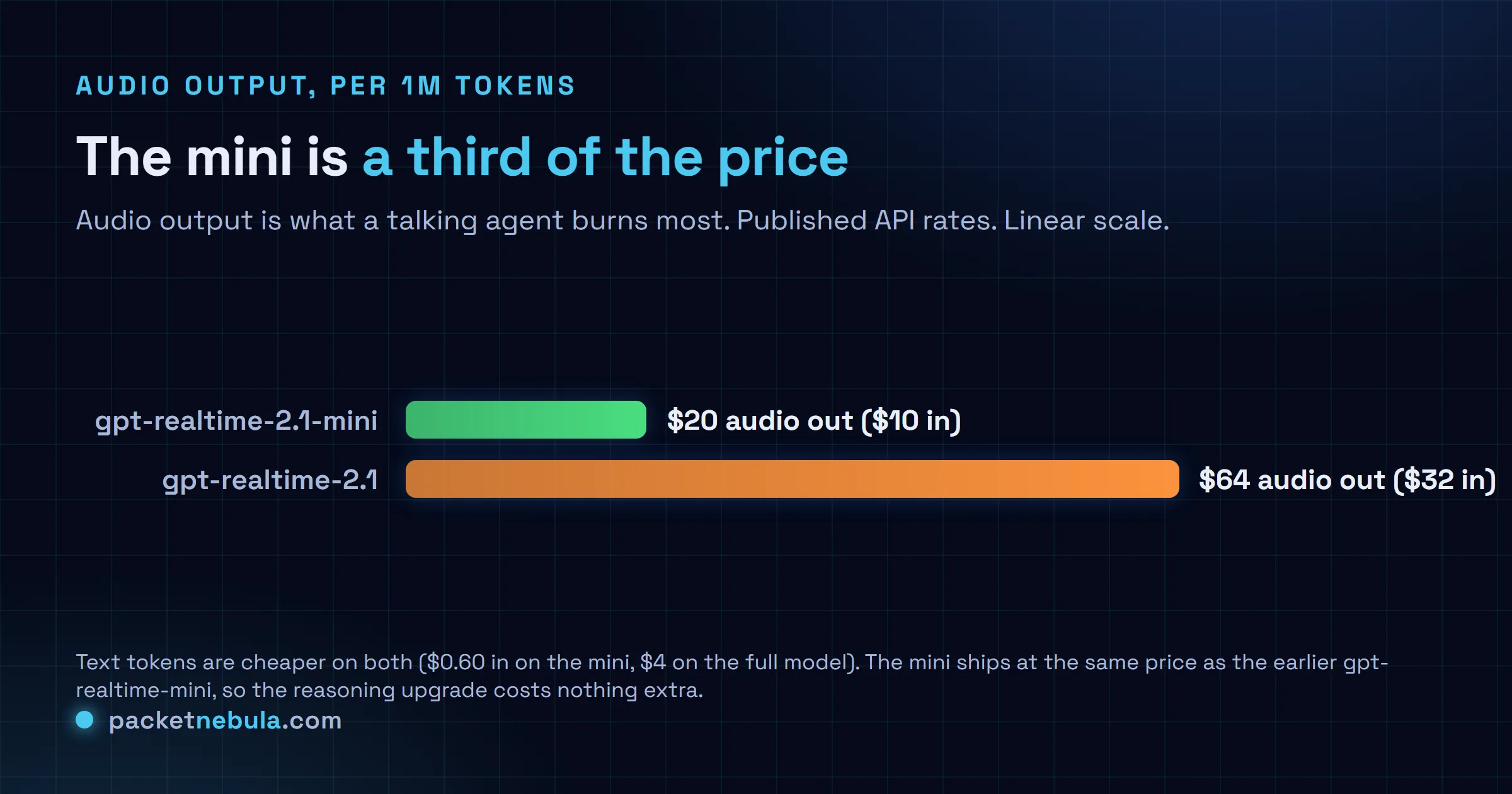
So the build pattern writes itself. Default your turns to the mini. Route the hard ones, or the ones that trip its reasoning, up to gpt-realtime-2.1. If you’ve sized inference cost on the text side before, this is the same story in a different medium: the model rate is fixed, but which model you call on each turn is the dial that sets the bill. Our Fable 5 effort-level breakdown walks through exactly how a reasoning dial turns into real money, and it applies cleanly here.
About that 25% latency claim
The number OpenAI put front and centre is p95 latency down at least 25% across the Realtime voice models, and the cause it gives is improved caching. Read that the way you’d read any vendor’s own benchmark. It’s a p95, which is the right percentile to care about for voice (the tail is what a caller feels), and it’s plausible that better caching of session context shaves the slow turns. But it’s OpenAI measuring OpenAI, on unstated traffic. Your prompts, your tool latency, your audio setup all move the real number.
So do the boring thing. Log p95 on your current gpt-realtime-2 build, switch the model string, and log it again on the same traffic. If you get anywhere near 25%, lovely. If you don’t, you’ve lost nothing but a config change. We wouldn’t re-architect a call flow on a press-release number, and neither should you.
If you’re weighing this against a bigger model decision rather than a voice one, the GPT-5.6 versus GPT-5.5 tradeoff is the one that moves your bill more than a Realtime snapshot does.
The honest read
gpt-realtime-2.1 is a solid, unglamorous upgrade: faster on the tail, cleaner on codes and interruptions, worth the model-string swap once you’ve verified the latency on your own traffic. The mini is the quiet headline. A voice model at a third of the price that can now reason on demand changes the default answer to “which model do I call,” and it costs nothing extra to try. Build for the mini, escalate to the full model when a turn earns it, and measure p95 yourself instead of trusting the 25%. That’s the whole play.
Sources: OpenAI’s official Realtime models announcement on the OpenAI Developer Community (July 6, 2026), with reporting and pricing via MarkTechPost and The Next Web. Latency and effort figures are OpenAI’s own measurements; verify p95 on your own traffic before relying on them.
Frequently asked questions
What is gpt-realtime-2.1?
It is OpenAI's updated speech-to-speech model on the Realtime API, released on July 6, 2026. It succeeds gpt-realtime-2 with better alphanumeric recognition, silence and noise handling, and interruption behaviour, and OpenAI reports p95 latency down at least 25% across the Realtime voice models from improved caching. It is aimed at production voice agents that need tool use and tight instruction following.
How is gpt-realtime-2.1-mini different?
The mini is a smaller, cheaper Realtime model that now supports configurable reasoning effort, so you can trade a bit of latency for a stronger reasoning pass per turn. OpenAI ships it at the same price as the earlier gpt-realtime-mini, so the reasoning upgrade does not cost extra. Reach for it on high-volume calls where you do not need the full model's strongest reasoning or heaviest tool use.
How much does gpt-realtime-2.1 cost?
At the published Realtime API rates, gpt-realtime-2.1 is $4 per million text input tokens, $32 per million audio input, and $64 per million audio output. The mini is far cheaper at $0.60 text input, $10 audio input, and $20 audio output per million tokens. Cached input is heavily discounted on both, which is part of where the latency win comes from.
Is the 25% latency improvement guaranteed?
No. The at-least-25% p95 figure is OpenAI's own measurement across the Realtime voice models, driven by caching, and your result depends on your prompts, tools, and traffic shape. Treat it as a strong signal, not a spec, and measure p95 on your own agent before and after switching.
How do I switch to the new models?
Point your Realtime API session at the gpt-realtime-2.1 or gpt-realtime-2.1-mini model identifier instead of gpt-realtime-2. Both are available to test in the OpenAI Playground first. Nothing else in the Realtime flow changes, so it is a model-string swap you can A/B against your current build.


