

So you open Claude and the model picker has a new top line: Opus 5. Anthropic shipped it on July 24, its fourth model in under two months, and the honest headline for anyone paying a bill is the price. It's five dollars per million tokens in, twenty-five out, exactly what Opus 4.8 cost. Same number, new flagship. Anthropic's own framing is 'frontier intelligence at half the cost of Fable 5', which holds on paper because Fable 5 runs ten and fifty. We went in to sort the two things that actually change your day from the benchmark superlatives you're being handed, because most of those numbers come off benchmarks Anthropic named itself.
The short answer
Anthropic shipped Claude Opus 5 on July 24, its fourth model in under two months. The price is unchanged from Opus 4.8, five and twenty-five, which Anthropic pitches as half the cost of Fable 5. The real news for anyone building on it isn’t the benchmark superlatives (those are Anthropic’s own scoreboard). It’s that thinking is on by default now, and disabling it at high effort levels is a breaking change.
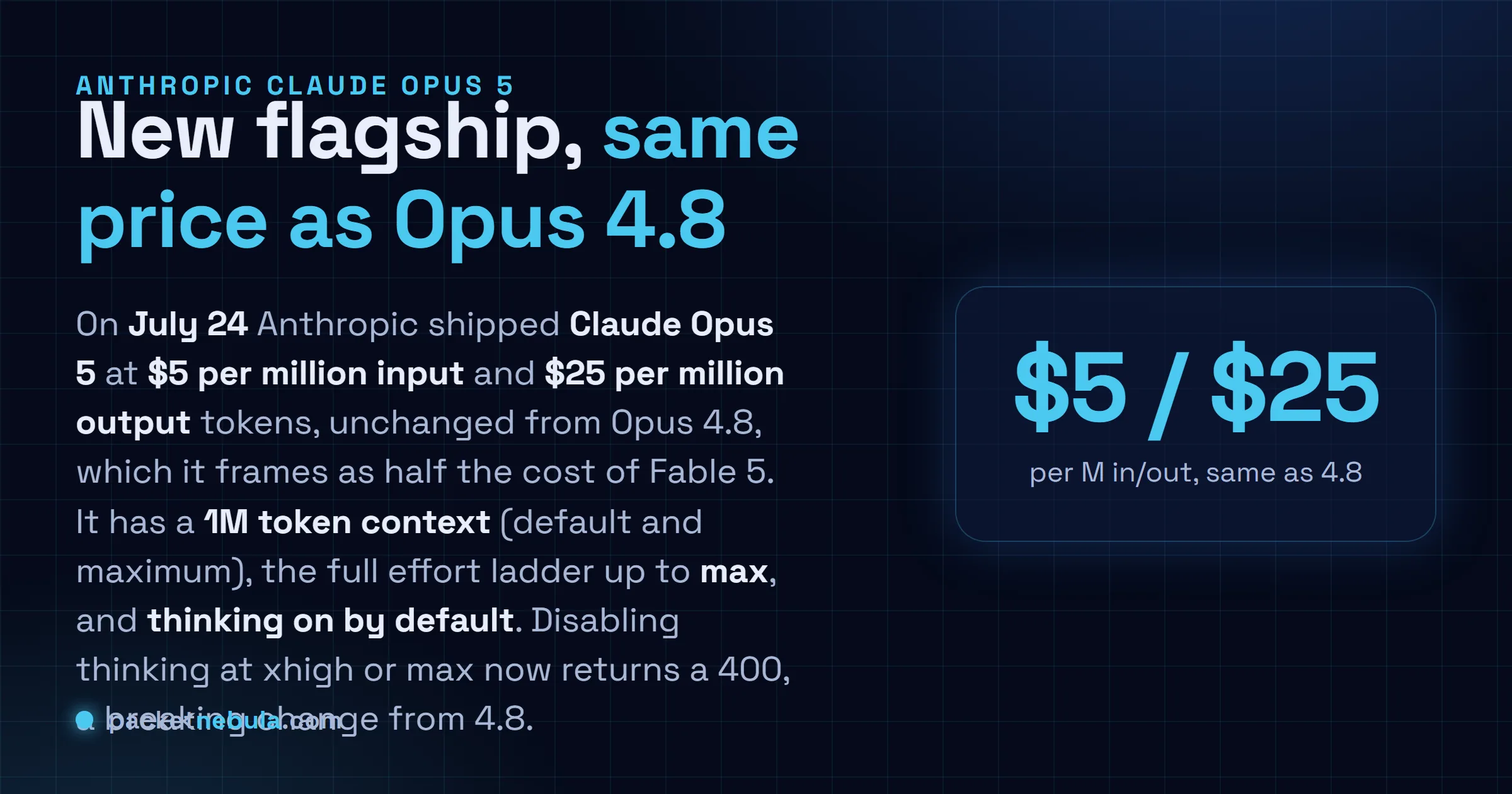
The price didn’t move, and that’s the story
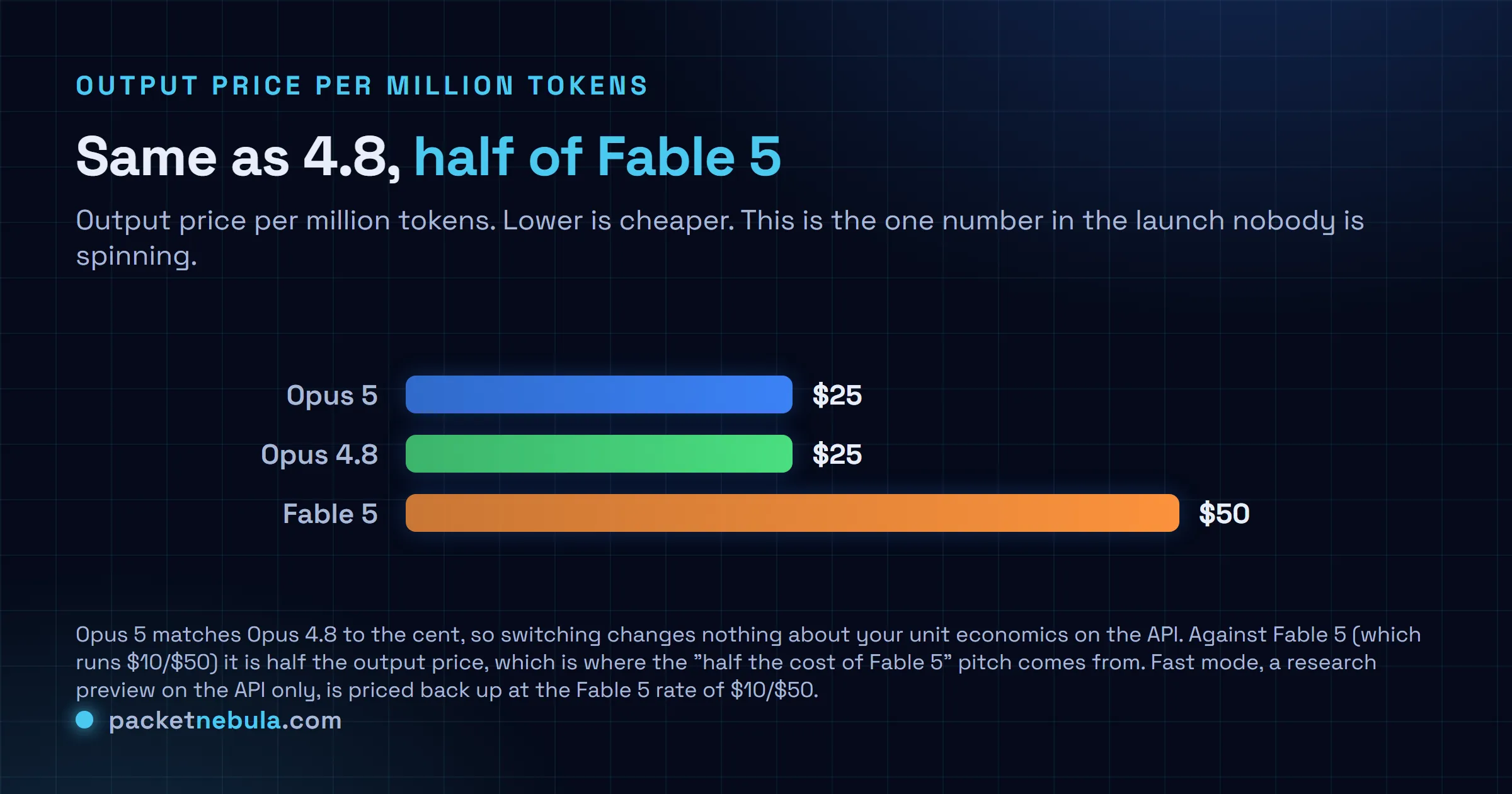
Here’s the thing the launch charts bury. Opus 5 costs exactly what Opus 4.8 did: five dollars per million input tokens, twenty-five per million output. Not a cent cheaper, not a cent more. So on the API, nothing about your unit economics changes when you switch. What changes is that you get a stronger model at the rate you were already paying.
The “half the cost of Fable 5” line is real, it’s just measured against a different model. Fable 5 runs ten and fifty. So Opus 5 lands Fable-class capability, by Anthropic’s telling, at Opus money. If you’re on Claude Max, Opus 5 is already your default, and it’s the strongest option on Pro. There’s also a Fast mode, a research preview on the Claude API only, and that one is priced back up at the Fable 5 rate of ten and fifty for the extra speed.
 Image: Anthropic
The two changes that actually bite
Read the release notes and past the marketing, two things will trip up existing code.
First, thinking is on by default. On Opus 4.8, a plain request ran without thinking unless you set it to adaptive. On Opus 5, that same request thinks, and the model decides how much on each turn. Sounds harmless. It isn’t, because max_tokens is a hard cap on total output, thinking plus the visible answer both. So a workload that ran clean on 4.8 with a tight max_tokens can now truncate, or quietly cost more, until you raise the ceiling. Go re-check it before you ship.
Second, and this one’s a genuine breaking change: you can only disable thinking at effort high or below. Send thinking: {"type": "disabled"} with effort xhigh or max and you get a 400 error, full stop. On 4.8 those two settings were independent. If any of your calls disable thinking at the top effort levels, they’ll start failing the moment you swap the model ID.
One more, softer. Opus 5 verifies its own work without being told to. Anthropic’s own guidance is to remove the “add a final verification step” or “use a subagent to verify” instructions you carried over from older models, because they cause it to over-verify. Weird advice to give about your own model, but it’s in the docs.
The benchmarks are Anthropic’s own scoreboard
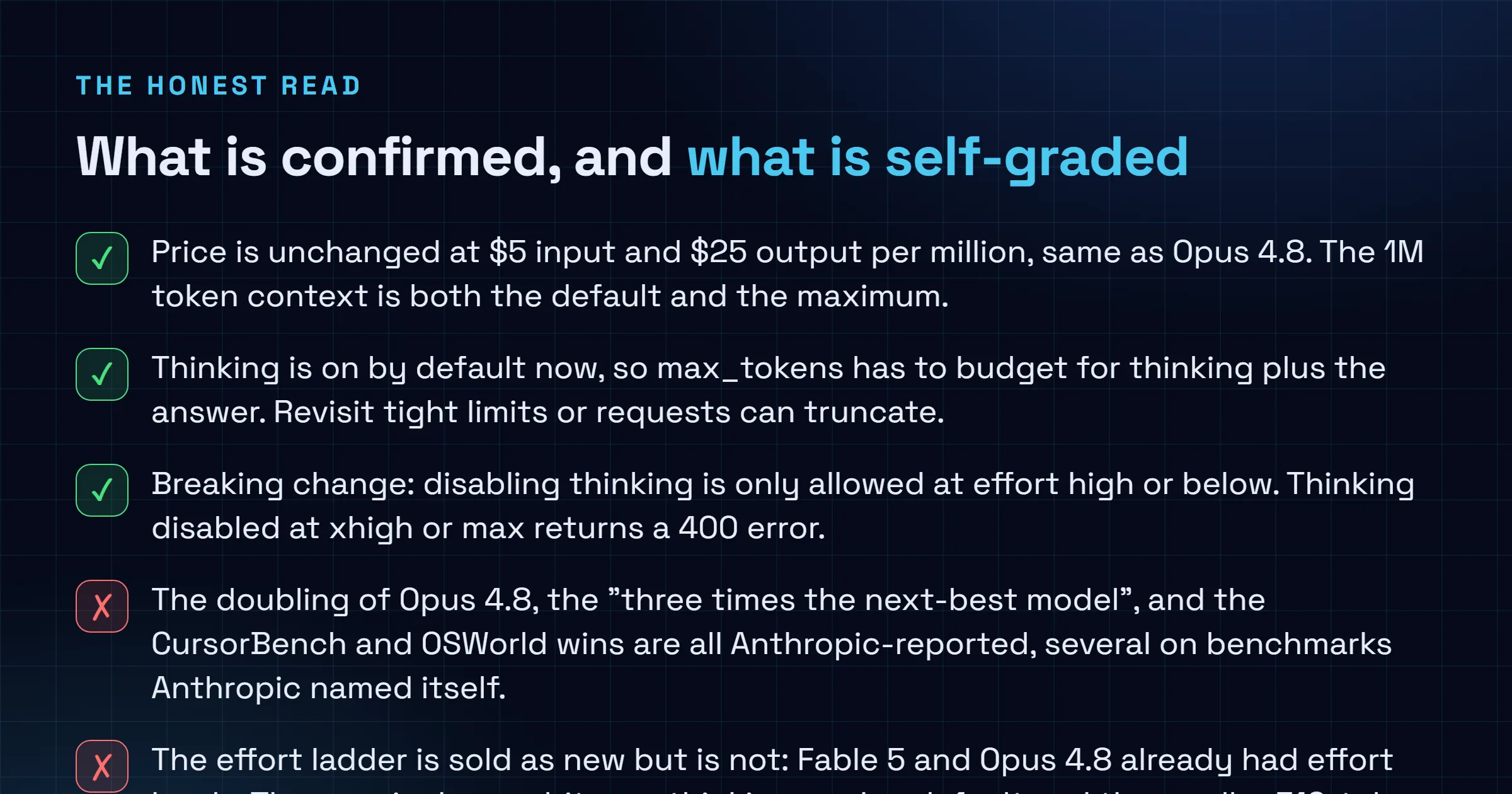
Now the part everyone’s reposting. Opus 5 “more than doubles” Opus 4.8 on Frontier-Bench v0.1. It scores three times the next-best model on ARC-AGI 3, about one and a half times on Zapier AutomationBench, sits within half a percent of Fable 5 on CursorBench 3.2, and clears Fable 5 on OSWorld 2.0. Impressive on the slide. Here’s the catch: those are Anthropic’s numbers, and several of those benchmarks are ones Anthropic named and built. Frontier-Bench, CursorBench, AutomationBench. The chemistry and protein gains over 4.8, ten and seven points, are Anthropic’s measurements too.
None of that means the model’s weak. It probably isn’t. But “three times the next-best model” on your own scoreboard is a vendor claim, not a fact, and I’d wait for someone outside the building to run it before I quoted the multiplier as gospel. The effort ladder gets sold as new too, low through max, and it mostly isn’t. Fable 5 and Opus 4.8 already had effort levels. What’s actually new here is thinking-on-by-default and the smaller 512-token cache minimum, down from 1,024.
Safety, in one paragraph
Anthropic calls Opus 5 its most aligned Opus to date, with the lowest misalignment score of its recent models and stronger cyber guardrails than 4.8. It also says the model stays behind Mythos 5 on exploit-development capability, which is the kind of specific, slightly awkward admission that reads as honest. All of it is Anthropic’s own audit, so file it under “reassuring, and self-graded.”
The honest read
If you’re on Claude Max, this is a shrug in the best way: Opus 5 is already your default, it costs you nothing extra, so just use it. The only homework is two lines of it. Re-check your max_tokens, because thinking is on now and eats into that budget. And grep your code for any call that disables thinking at xhigh or max, because those will 400 the day you flip the model ID.
Everything else, the doubling, the three-times-next-best, the frontier-this and frontier-that, is Anthropic grading its own paper, and the paper looks good. Just don’t repeat the multipliers as measured until an outside benchmark says so. If you want the background on how effort levels actually price out, our writeup on Fable 5 effort levels and cost still holds for Opus 5’s ladder, and the Sonnet 5 versus Opus 4.8 piece is the baseline this new flagship is measured against. For where Opus 5 sits in the plans, our note on Fable 5 going permanent covers the Max and Pro details that carry over.
Sources: Anthropic Claude Platform docs, What’s new in Claude Opus 5 for the pricing (5 and 25 dollars per million, unchanged from Opus 4.8; Fast mode at 10 and 50), the 1M token context (default and maximum), 128k max output, thinking on by default, the full effort ladder including max, the disable-thinking-requires-effort-high breaking change, the 512-token prompt cache minimum, self-verification behavior, and availability (claude-opus-5 on the API, Bedrock, Vertex and Microsoft Foundry). Anthropic news, Claude Opus 5 for the capability claims and the benchmark figures (Frontier-Bench v0.1, CursorBench 3.2, ARC-AGI 3, Zapier AutomationBench, OSWorld 2.0, and the organic chemistry and protein gains over Opus 4.8), all Anthropic-reported. Fortune for the July 24 launch, the cost-versus-capability framing, and the note that this is Anthropic’s fourth model in under two months. Every capability and benchmark figure is as reported by Anthropic and is not independently reproduced.
Frequently asked questions
How much does Claude Opus 5 cost?
Five dollars per million input tokens and twenty-five per million output, the same as Claude Opus 4.8. Anthropic frames that as half the cost of Fable 5, which runs ten and fifty. Fast mode, a research preview on the Claude API only, is priced at the Fable 5 rate of ten and fifty.
What is genuinely new versus Opus 4.8?
Two things bite in your code. Thinking is on by default now, where Opus 4.8 ran without it unless you asked, so your max_tokens has to budget for thinking plus the answer. And disabling thinking is only allowed at effort high or below, so thinking disabled with xhigh or max returns a 400 error. Opus 5 also verifies its own work, so drop the verify-step instructions you carried over.
What is the context window?
One million tokens, and that is both the default and the maximum. There is no smaller context variant. Max output is 128k tokens. The prompt cache minimum also dropped to 512 tokens, down from 1,024 on Opus 4.8, so shorter prompts can now be cached with no code change.
Are the benchmark numbers independent?
No. Frontier-Bench v0.1, CursorBench 3.2, ARC-AGI 3, Zapier AutomationBench and OSWorld 2.0 are all reported by Anthropic, and several are benchmarks Anthropic named itself. The chemistry and protein gains over Opus 4.8 are Anthropic figures too. Treat them as vendor claims until an outside run lands.
Where can I use Claude Opus 5?
The Claude API as claude-opus-5, plus Amazon Bedrock, Google Cloud Vertex and Microsoft Foundry. It is the default model on Claude Max and the strongest option on Claude Pro, and it runs in Claude.ai, Claude Code and Claude Cowork. Opus 4.8 stays available on all of them.


