
A small cloud in Singapore quotes you GPU hours at a price that makes your finance person smile. Then the quote goes quiet, and nobody explains why. Here's a decent guess: Nvidia has more than halved the number of Asian companies it will sell AI chips to, after running them through a white list most of them failed. The Financial Times reported it Monday. The vetting covers Singapore, Malaysia and Japan, and the small GPU rental outfits took it worst. No price change has been announced anywhere. So if you rent from a big cloud in Frankfurt or Virginia, this is just news you can read and forget. If your cheap capacity comes from a regional provider, though, the company you rent from may have quietly lost its slot.
The short answer
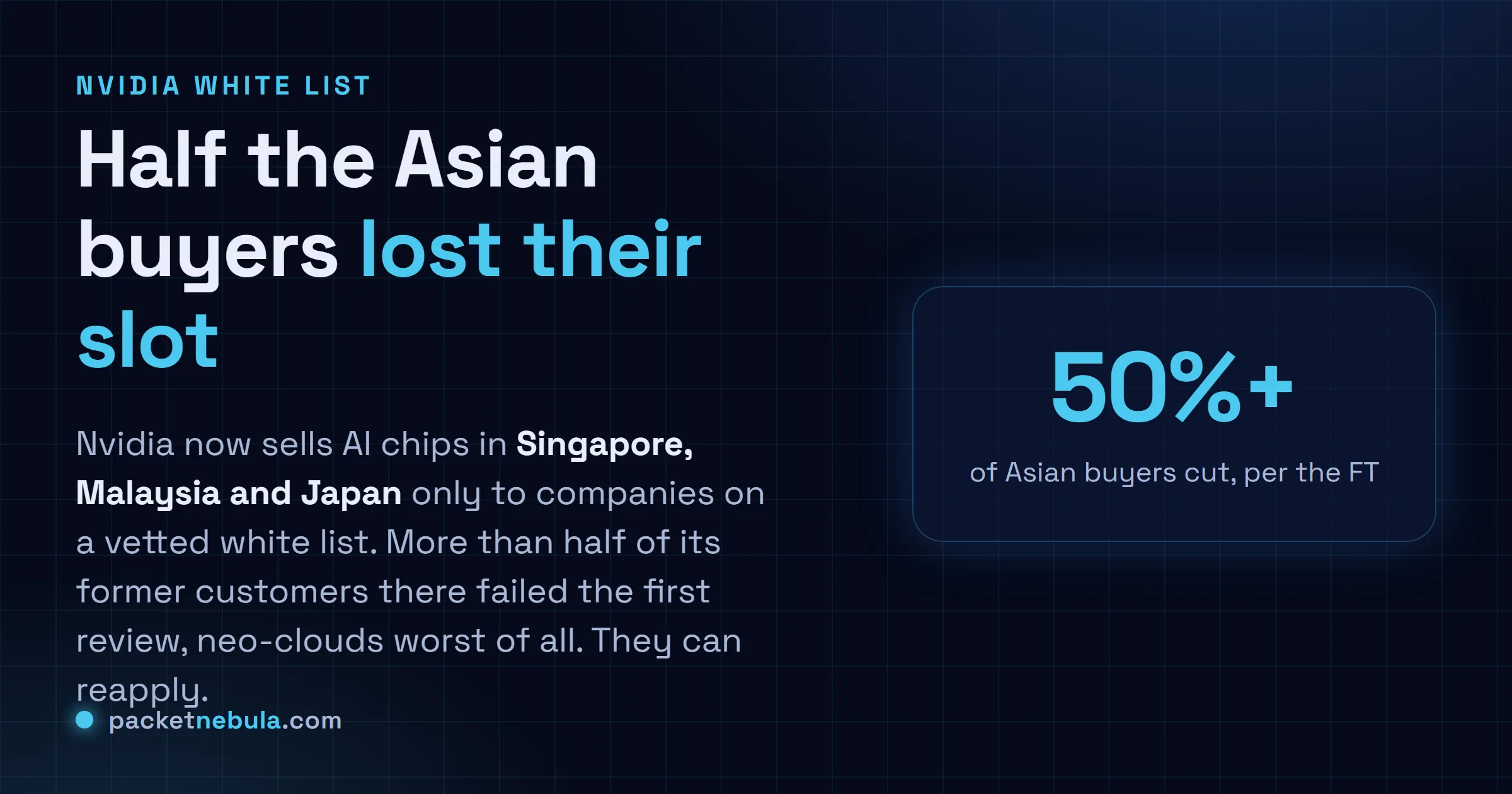
Nvidia now sells AI chips in Singapore, Malaysia and Japan only to companies that pass a compliance white list, and more than half its former customers there failed the first pass. Small GPU rental providers got hit hardest. They can reapply. If you rent from a major cloud, nothing here reaches you. If your capacity comes from a regional shop, go ask them where they stand.
What actually happened
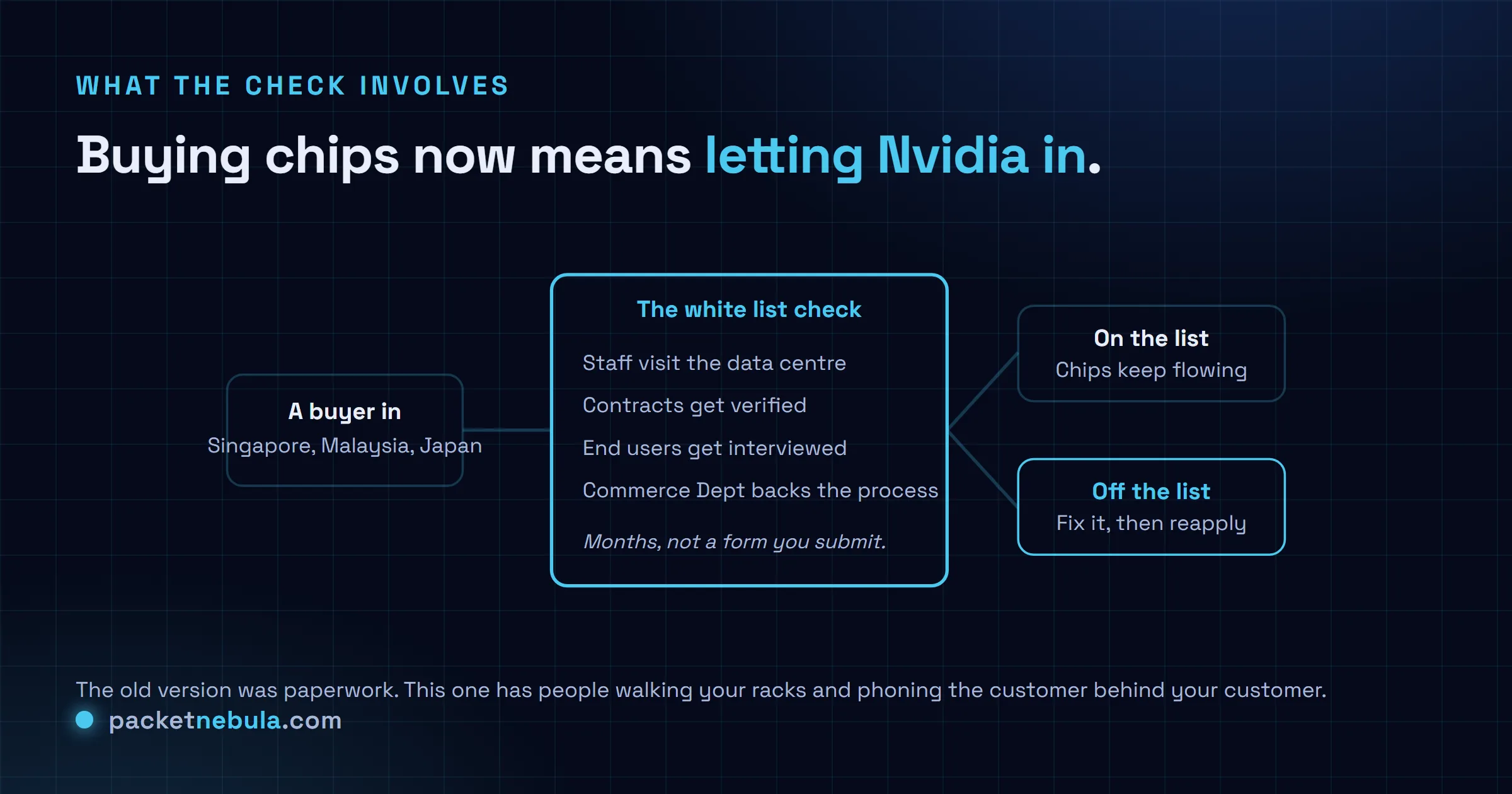
Nvidia built a list. If your company is on it, you can buy AI chips. If you’re not, you can’t, and you get to reapply once you’ve fixed whatever got you removed.
The FT reported it on Monday, July 13. Over the past few months Nvidia stepped up its due diligence across Singapore, Malaysia and Japan, and more than half of its former customers in those markets didn’t survive the first review. Neo-clouds took the worst of it. Those are the outfits that buy racks of accelerators and rent them back out by the hour, the ones whose pricing page you’ve probably had open at some point while wincing at a hyperscaler quote.
Nvidia hasn’t said anything publicly. Reuters picked the story up and noted it couldn’t verify the specifics on its own.
The check has people in it now
This is the part worth sitting with, because export compliance used to mean a form and an attestation.
Not anymore. Per the reporting, Nvidia staff visit customers’ data centres, verify contracts and interview end users. Somebody walks the room and counts what’s in it. Somebody phones the customer behind the customer to ask what the chips are actually for. The Commerce Department is involved too, providing oversight and political backing rather than running it directly.
Read the failure rate again with that in mind. More than half is not a story about crooks. A one-person neo-cloud with real customers and a filing cabinet instead of a compliance department fails a check like this on documentation alone, and it still fails, because passing means proving something rather than asserting it.
Why Nvidia is doing Washington’s job
Because the alternative is worse for Nvidia.
US export controls on AI chips to China go back years, and the Commerce Department issued guidance in May aimed at stopping advanced chips reaching overseas subsidiaries of Chinese companies. The concern behind it, per the reporting, is that Blackwell processors may have found their way to Chinese linked entities in places like Malaysia anyway. Southeast Asia is where the chips land first, and shell companies do the rest.
So Nvidia has a choice: police the channel itself, or let Washington decide the channel is unpoliceable and tighten the rules for everyone. Given that framing, cutting half your regional customers is the cheap option. It costs Nvidia very little. The buyers it dropped are not where the revenue is.
I might be wrong about the motive, and Nvidia hasn’t given one. But nobody sends staff to interview end users in three countries because they enjoy the travel.
Does any of this reach you
Mostly no. Let’s be honest about that before the take gets bigger than the facts.
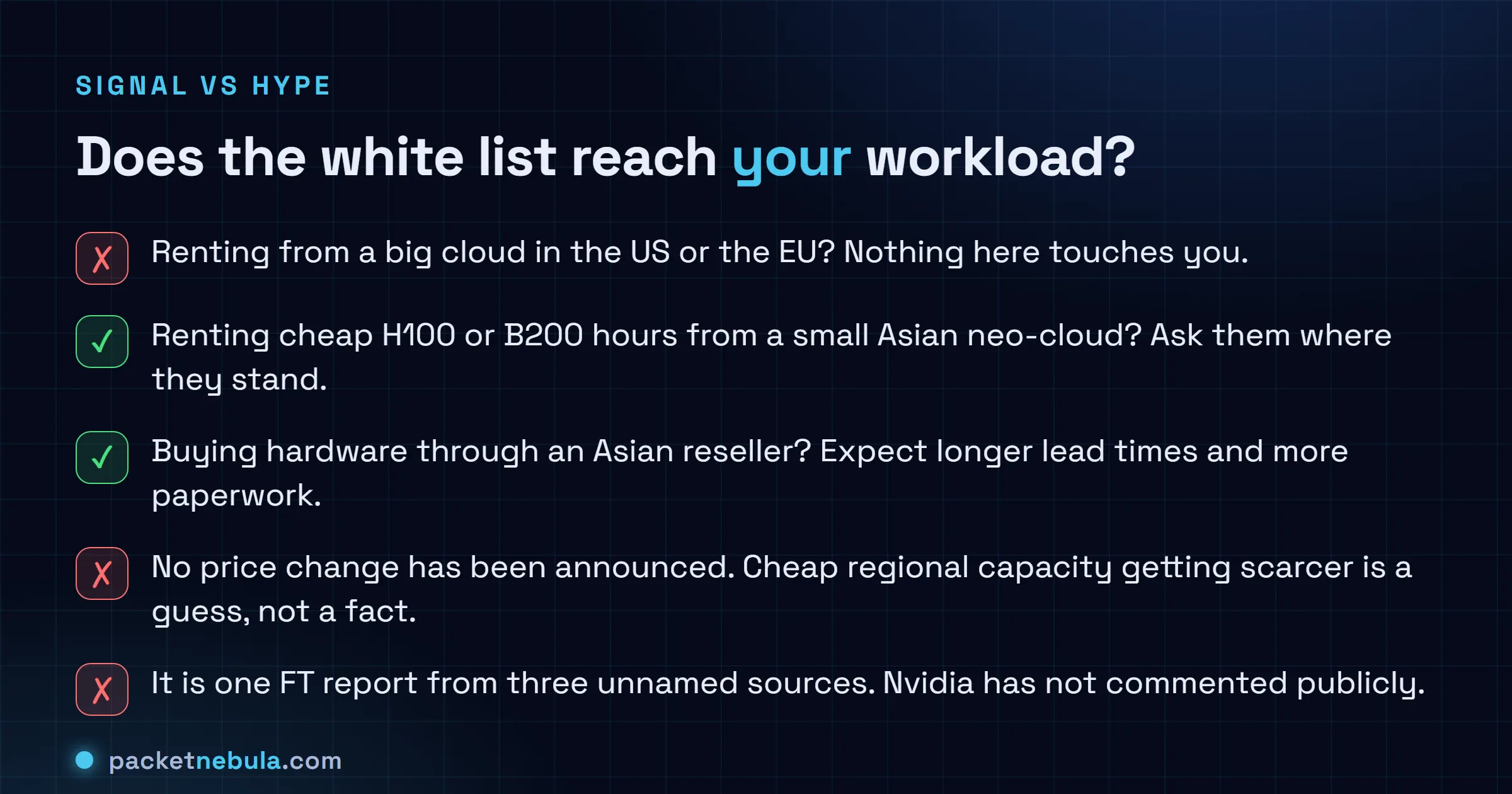
Rent from a big cloud in Virginia or Frankfurt and this changes nothing about your week. Your instances start, your bill is what it was, and your fine tuning run doesn’t care about a list in Santa Clara.
The narrow case is real, though. If you’ve been renting cheap hours from a regional provider in Singapore or Kuala Lumpur, ask them directly whether their supply is affected. It’s a fair question and a vague answer tells you something. Same if you buy hardware through an Asian reseller: budget for slower lead times and a lot more paperwork about who you are and what you’re doing with the cards.
What I’d resist is the tidy conclusion that GPU prices are about to move. Nobody announced that. Regional capacity getting thinner while demand doesn’t is the kind of thing that pushes prices up eventually, but that’s a guess dressed as analysis and you should treat it as one.
The thing underneath
Every big buyer is trying to get off this ride. Meta is building its own inference silicon, OpenAI has a chip with Broadcom, and now the company they’re all trying to route around gets to decide who’s allowed to be a customer at all, in whole countries, based on a site visit.
That’s not really a supply chain anymore. It’s a permission list.
For most of us the practical response is smaller than that sounds. Know where your compute physically comes from. If the answer is a provider you found because they were the cheapest per hour, that’s worth a five minute conversation this week, and if you’re running smaller models anyway, local inference on hardware you own keeps looking better every time a story like this lands.
Sources
Reported by the Financial Times on July 13, 2026, citing three people familiar with the matter, and carried by Reuters, which noted it could not independently verify the report and that Nvidia did not respond to a request for comment. Further detail via The Manila Times and Tech Startups. The Commerce Department’s May guidance and the concerns about Blackwell chips reaching Chinese linked entities are as described in that reporting. Nvidia has made no public statement.
Frequently asked questions
What is Nvidia's Asia white list?
It is an internal list of companies cleared to buy Nvidia AI chips after passing tougher compliance checks. The Financial Times reported on July 13, 2026 that Nvidia introduced it across Singapore, Malaysia and Japan, and that more than half of its previous customers in those markets failed the first review and came off the list. Nvidia has not commented publicly on the report.
Which customers were removed?
Per the FT, neo-cloud providers were hit hardest. Those are the smaller GPU rental companies that buy accelerators and resell compute by the hour, as opposed to the hyperscalers. Removal is not permanent: companies can reapply once they have made changes.
Does this change Nvidia GPU pricing or availability for me?
No price change has been announced, and nothing about this touches capacity you rent from a major cloud in the US or Europe. The plausible knock-on is narrower: if you buy through an Asian reseller or rent from a small regional provider, expect more paperwork and longer lead times. Anything beyond that is speculation.
Why is Nvidia policing its own customers?
US export rules bar advanced AI chips from reaching Chinese entities, and the Commerce Department issued guidance in May aimed at chips reaching overseas subsidiaries of Chinese companies. Reporting has raised concerns that Blackwell processors may have reached Chinese-linked entities in countries such as Malaysia despite those restrictions. Rather than wait to be blamed for diversion it did not catch, Nvidia is doing the verification itself, with Commerce providing oversight and political backing.
How solid is this reporting?
Treat it as credible but single-sourced. The story comes from the Financial Times citing three unnamed people familiar with the matter, and it was picked up widely from there. Reuters said it could not independently verify the details, and neither Nvidia nor the Commerce Department gave a statement.


_023.png)
