
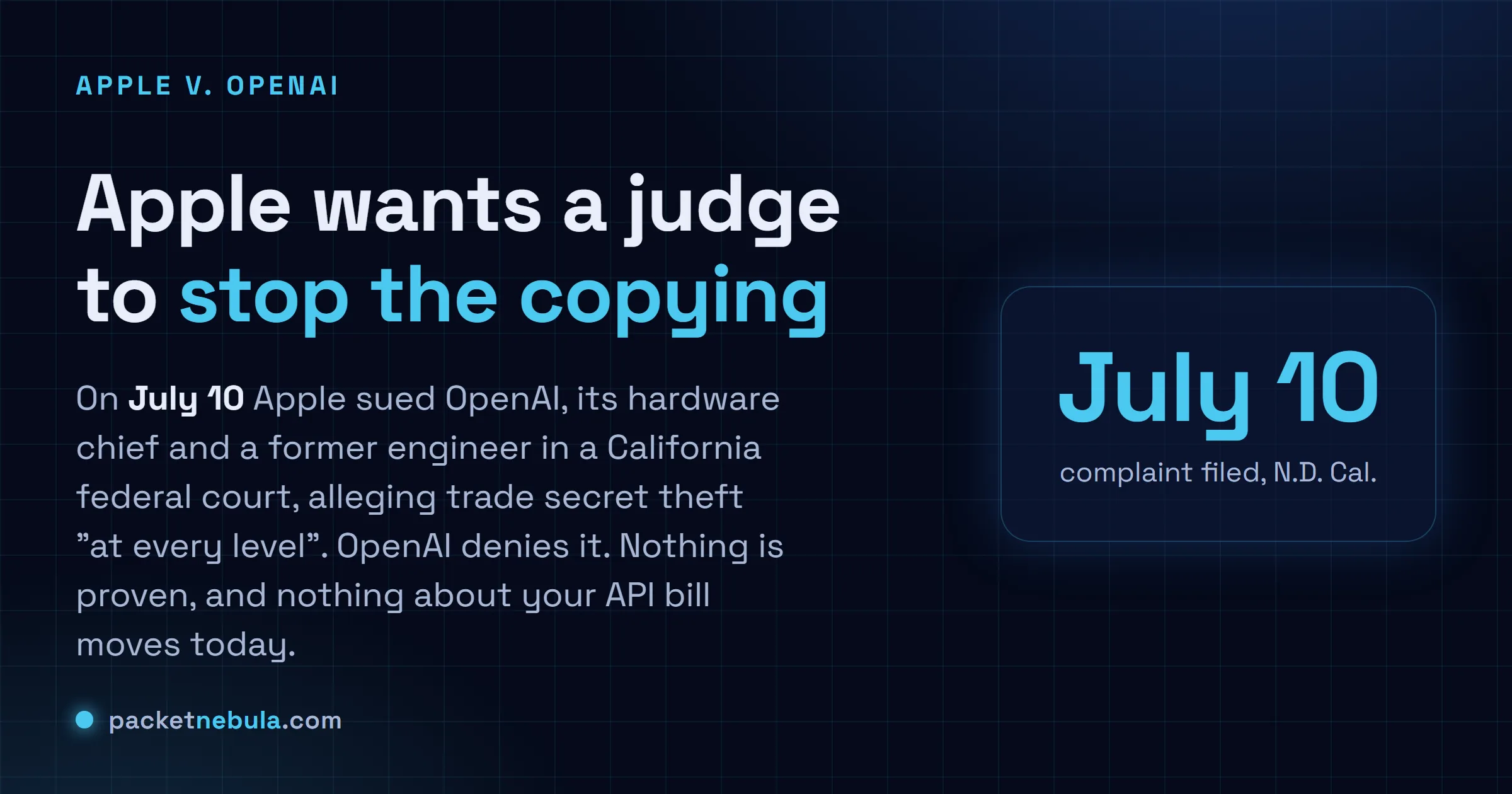
Two years ago Apple put ChatGPT inside the iPhone. On July 10 its lawyers filed a complaint against OpenAI in a federal court in California, accusing it of taking Apple's confidential work "at every level". That's the news. Apple names two former employees, hardware chief Tang Tan and engineer Chang Liu, and it wants a judge to make the copying stop. None of it is proven. OpenAI says it has no interest in other companies' trade secrets. So what does it change for you, today, if you ship software for a living? Close to nothing. No API moves, no price moves, no model goes away. The useful part isn't the courtroom drama. It's one mundane offboarding detail buried in the filing.
The short answer
Apple sued OpenAI, its hardware chief and a former engineer over alleged trade secret theft. It’s a hardware fight, not a model fight, so your ChatGPT access and your API pricing are untouched. Everything in the complaint is an allegation and OpenAI denies it. The one part worth stealing for your own shop is the offboarding hygiene.
What Apple actually filed
A complaint, on July 10, in the U.S. District Court for the Northern District of California. The defendants are OpenAI, io Products, Tang Tan and Chang Liu. Tan is OpenAI’s chief hardware officer and used to be Apple’s VP of product design for the iPhone and Apple Watch. Liu was a senior systems electrical engineer who spent about eight years there.
Apple’s framing is deliberately broad. It says that “at every level, from members of its Technical Staff to its Chief Hardware Officer”, OpenAI has been taking its confidential information. Apple wants four things: an order barring OpenAI from using or disclosing the material, the material handed back, evidence preserved, and damages.
OpenAI’s answer is one sentence long. It has no interest in other companies’ trade secrets, and it’s focused on building its own technology.
Hold onto this while you read the next section. It’s a complaint. Apple wrote every word of it, OpenAI disputes it, and no judge has weighed in.
The allegations, and which ones actually bite
The recruiting claims are the loud ones. Apple says Tan used internal project codenames in interviews to get candidates talking about work they shouldn’t have been discussing, and told candidates still on Apple’s payroll to bring “actual parts” to show-and-tell sessions. CAD files and prototypes too. One candidate apparently didn’t know you could carry that stuff out of the building. Apple also claims OpenAI coached departing staff on dodging the walkout procedure and told them not to sign exit paperwork without checking in first.
Then there’s the supply chain claim, which is the one that would sting a jury. Apple says io used its proprietary metal finishing technique, and that OpenAI told Apple’s own manufacturing partner it had permission it didn’t have.
And Liu. Apple says that after he left in January 2026, he found an authentication bug that still let him reach Apple’s network storage, and pulled down more than 1,000 pages of engineering documents. He didn’t report it. He texted a colleague still inside: “LOL, I found out I can access the [network storage], so funny.” Later, per the filing, “I still have another computer”. His laptop allegedly never came back either.
The weakest number in the whole thing is the headline one: 400+ former Apple employees now work at OpenAI. Apple leans on it. I might be wrong, but that’s atmosphere, not evidence. People move between big companies. Four hundred out of a workforce Apple’s size is a rounding error, and a headcount doesn’t prove anyone took a file.
Why this landed now
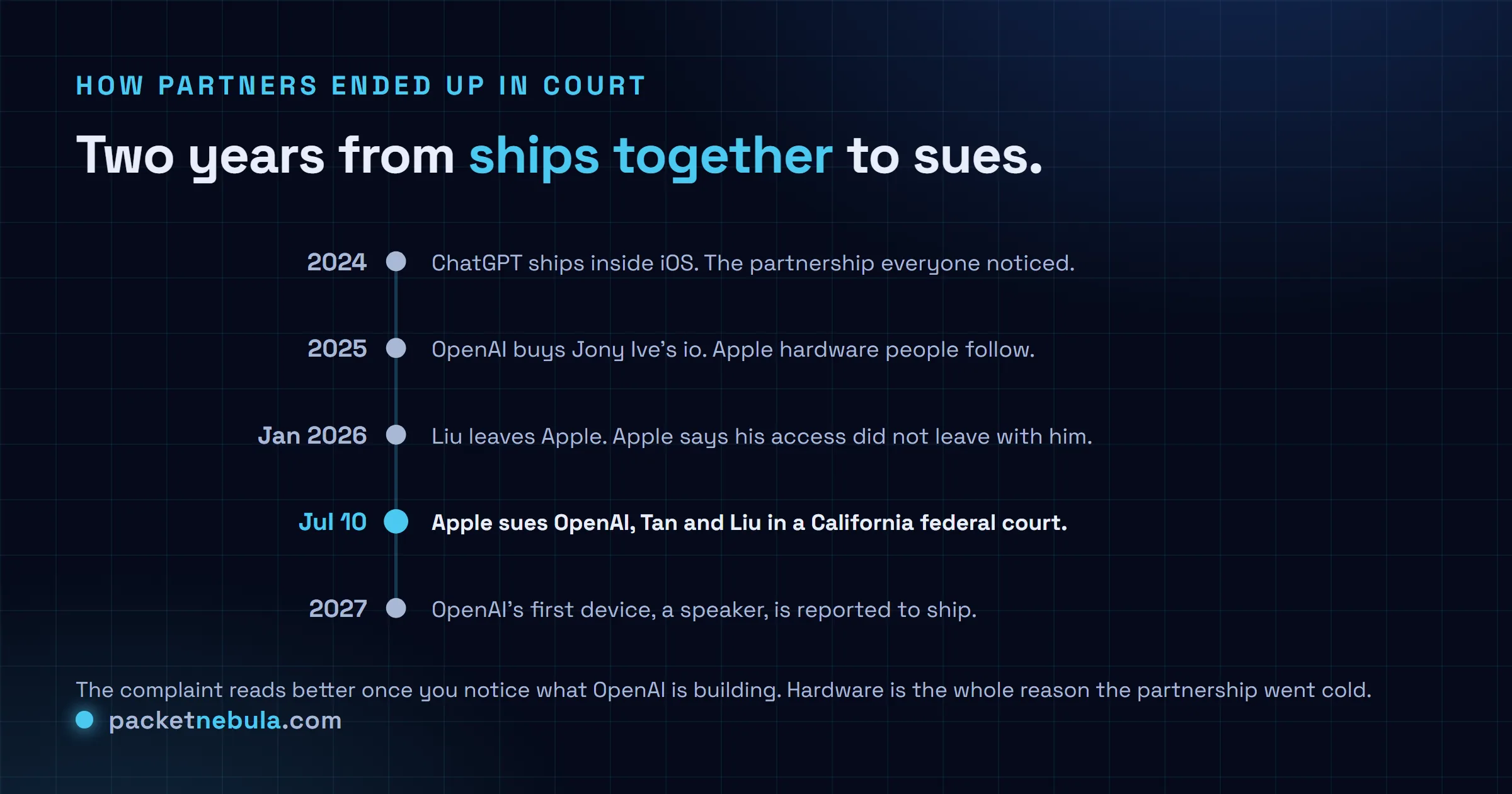
Because OpenAI builds hardware now. That’s the whole story.
The 2024 deal made the two companies partners. Then OpenAI bought Jony Ive’s design shop io in 2025, reported at roughly $6.4 billion to $6.5 billion depending on which outlet you read, and started hiring the people who designed Apple’s products. Bloomberg reported on July 14 that the first device is a portable, screenless speaker with a camera and sensors, meant to sit in your home as a companion, with an unveiling targeted for this year and a market launch in 2027. It’s one of about five products in the pipeline.
So a partner became a competitor in the one category Apple actually defends properly. Pair it with the custom inference chip OpenAI is building with Broadcom and the direction is obvious: OpenAI wants its own silicon and its own boxes. Nobody sues this hard over a hobby.
What it changes for you
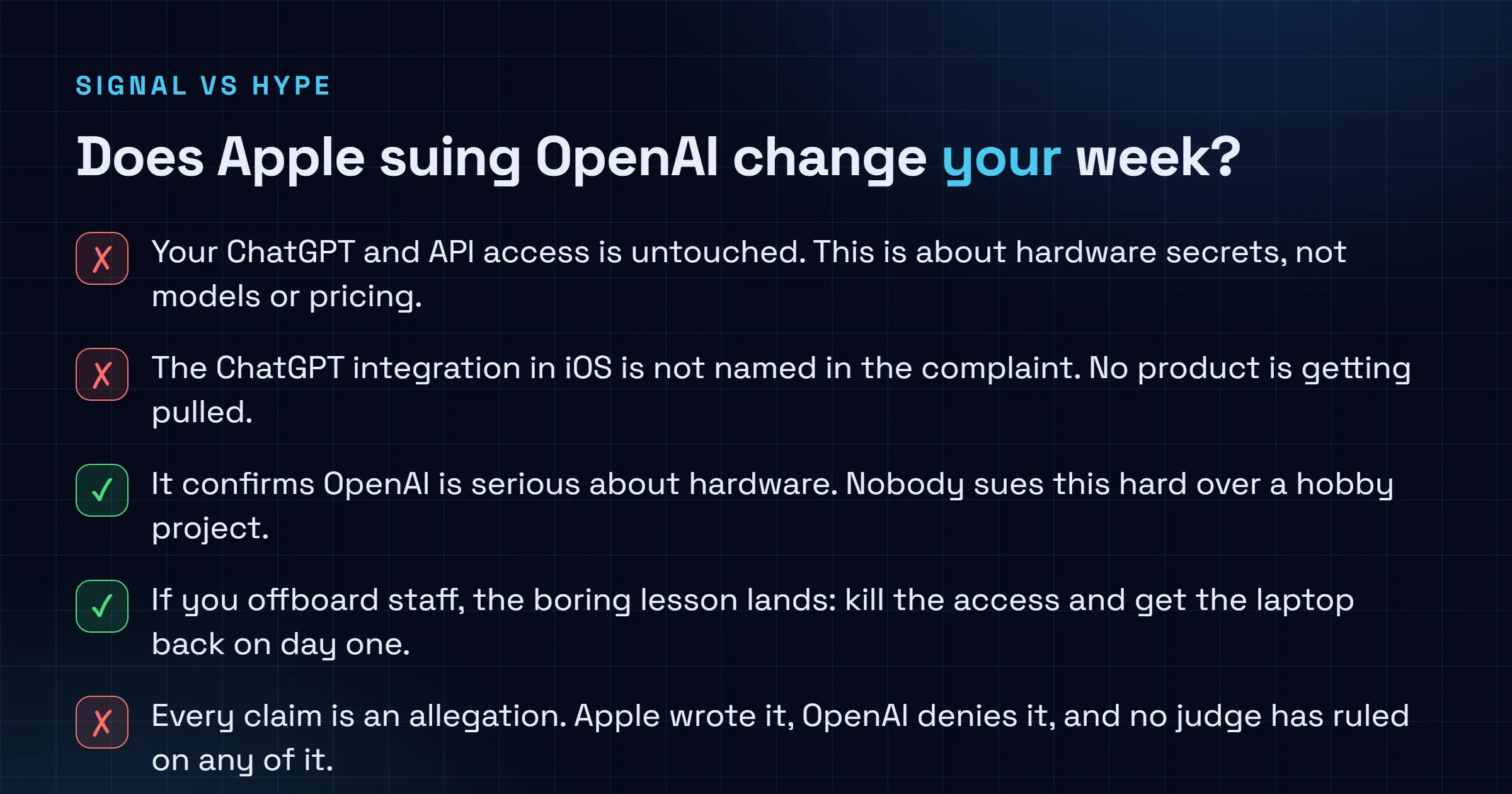
Nothing, this week. Your keys work. The GPT-5.6 tiers you’re budgeting cost what they cost. The ChatGPT integration inside iOS isn’t named in the complaint, and no one has asked a court to unwind it.
Trade secret suits like this one rarely kill a product. They extract a settlement, they slow down hiring for a while, and they make general counsel nervous about who you interview. If OpenAI’s speaker slips, it’ll be because hardware is hard, not because of a docket in San Jose.
The part that isn’t gossip
Strip out the codenames and the show-and-tell theatre and you’re left with something dull that applies to everyone reading this. An engineer left in January. Apple says his access to network storage worked anyway, for long enough to pull a thousand pages. His laptop never came back.
That’s not exotic tradecraft. That’s an offboarding checklist nobody ran.
We’ve seen the same shape in small shops plenty of times: the account gets disabled in the identity provider, and the storage box that authenticates separately just keeps saying yes. If a departure at your place doesn’t end with someone confirming the access is actually dead, not merely marked dead in a ticket, this whole story is a free rehearsal.
Sources
The complaint and its allegations as reported by TechCrunch, with further detail in its follow-up on the filing and 9to5Mac. OpenAI’s hardware plans reported by Bloomberg on July 14. Every allegation above is Apple’s claim, disputed by OpenAI and untested in court.
Frequently asked questions
What is Apple suing OpenAI over?
Apple filed a trade secrets and breach of contract complaint on July 10, 2026, in the U.S. District Court for the Northern District of California. It alleges OpenAI recruited Apple staff to extract confidential hardware information, and it names OpenAI, io Products, chief hardware officer Tang Tan and former engineer Chang Liu. Apple asks the court to bar OpenAI from using or disclosing the material, order it returned, and preserve evidence. It also seeks damages.
Does this affect the ChatGPT integration in iOS?
Not so far. The complaint is about hardware design information, not the 2024 deal that put ChatGPT into Apple's operating system. No filing asks to unwind that integration, and neither company has announced a change to it.
Does the lawsuit change the OpenAI API or its pricing?
No. Nothing in the complaint touches model availability, API endpoints or token prices. If you build on OpenAI, this suit gives you nothing to do this week.
Has OpenAI responded to the allegations?
Yes, briefly. OpenAI said it has no interest in other companies' trade secrets and that it remains focused on building its own technology. Every claim in Apple's complaint is an allegation that OpenAI disputes, and no court has ruled on any of it.
Why is Apple suing now, in 2026?
The likeliest reason is hardware. OpenAI bought Jony Ive's design company io in 2025 and is now building its own devices, which turns a partner into a competitor. Bloomberg reported on July 14 that OpenAI's first device is a portable screenless speaker with a camera and sensors, with a market launch planned for 2027.


